Forest Eve
December 13, 2019
Growing up, our house fronted a very large and treed city park in Rochester, New York, a city which has always received a great deal more of its share of snow than most due to what is known as lake-effect snow, when moist air over Lake Ontario contributes to great snowstorms, and, to our delight as children, ‘snowdays’ and their resulting school closures.
We’d head to Seneca Park with our Flexible Flyer sleds in tow for entire days of weaving down between the pines and firs, avoiding known rocks, stopping just before plunging down into Seneca Park pond.
The admonition from our mother was, ‘just head home when the snow turns blue’. Blue snow happened around 4 pm, and we’d make it just in time to change out of frozen snow suits and hit the dinner table, our cheeks bright red, our legs and fingers still tingling.
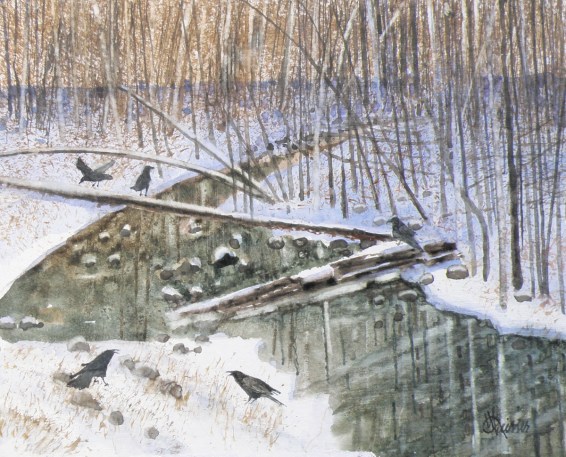
‘Silence Broken’
8″ x 10″, watercolour on art board by Lance Weisser
part of ‘The Small Works Show’, Kamloops Arts Centre, Kamloops, B. C., Canada
Three Pines
December 10, 2019
Ponderosa Pine is everywhere in British Columbia, and one of the predominant pine trees across western N. America, including parts of the Prairies and Plains. It was originally named by David Douglas in 1829 because the wood was so heavy, and thus ponderous. Around here, the very long needles which can be found lying shed at the base of these trees are gathered up, washed and used to make pine needle basketry, an art developed by Indigenous peoples all over our region, and wherever this tree flourishes.
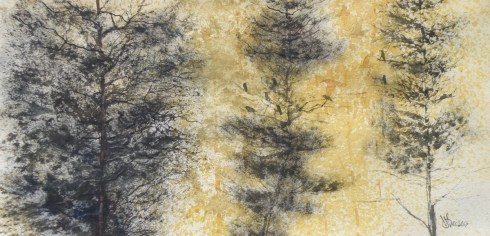
‘Three Pines’
watercolour on art board 8″ x 16″
by Lance Weisser
(for sale, framed and matted, contact weisserlance@gmail.com)
The Gathering
December 7, 2019
Ravens differ from Crows socially. Whereas Crows are given to form large groupings and congregate together socially–whether roosting for the night or for protection–Ravens are more solitary. Adult Ravens, once successfully mated, remain paired-up and together for life.
It is known that teenage Ravens, prior to mating, do in fact form in groups in order to be more effective in their newly-developed hunting skills. So when one teen Raven buddy discovers food, they all pile on, everyone benefiting from the find.
[source: ‘Ravens In Winter’ by Dr. Bernd Heinrich]
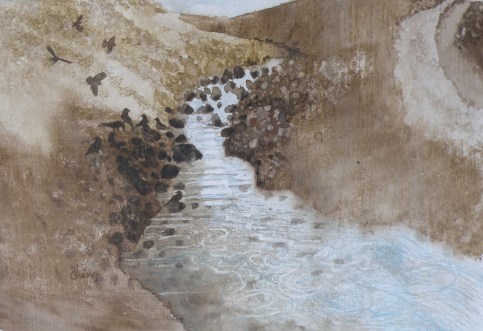
‘The Gathering’
watercolour by Lance Weisser, 8″ x 11″ on art board
for The Small Works Show, Kamloops Arts Council, November 24 to December 24
Old Courthouse, Kamloops, British Columbia
Our Kind of Winter
December 3, 2019
Having lived nearly 20 years in Vancouver and Victoria, B. C., Canada, where snow is a novelty and rain is the norm, it is a delight to then have restored the four definite, uniquely-blessed Seasons which we have here in Kamloops, B. C.
I’m a winter and cold month lover. Let me count the reasons: sweaters; hot spiced drinks; hearty stews and bread; cold room/many blankets; blue snow at dusk; birds at the feeders; bare-branched trees; lights under snowy pine boughs; woodpeckers at suet blocks; snowdrift patterns; long purple shadows; pre-dawn owl hoots; snow-muffled dog barks; pink-cheeked kids with sleds; fired-up logs; the music of the Season.
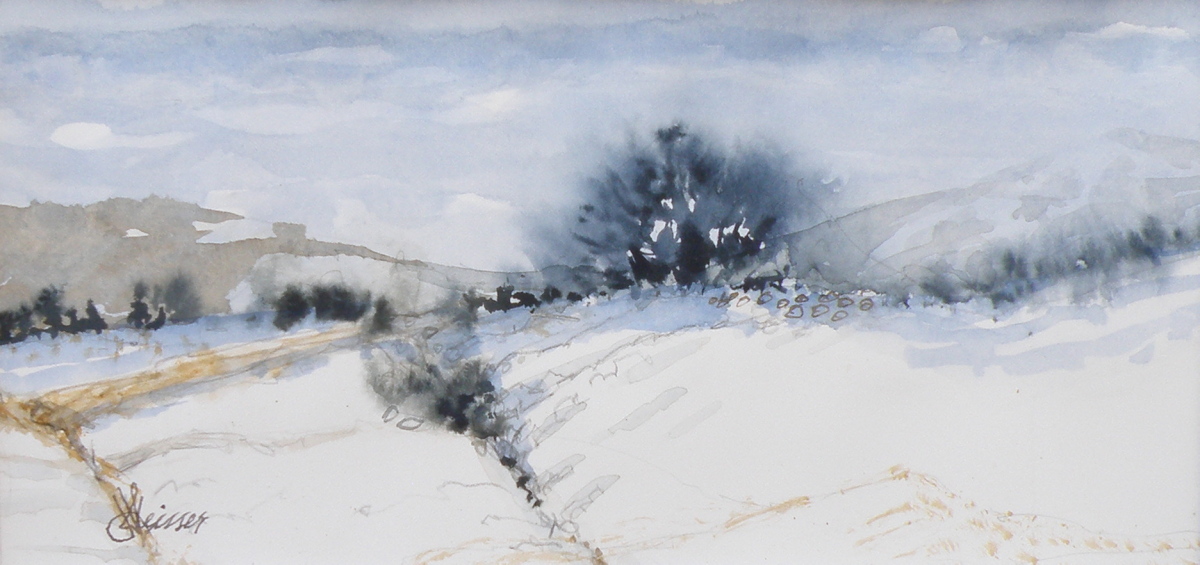
watercolour by Lance Weisser
Arches Hot Press 140# Paper; 5″ x 9″
November
November 26, 2019
November is my most favourite of months! In the Southern Interior of British Columbia where we live, November is one of those seasonal cusp months–like March–when no one quite knows what they’ll be waking up to in the morning; a month of mystery and change, full of windy days, foggy mornings, early evenings, and sometimes the schedule-disturbing onslaught of an unexpected blizzard.
This painting–now hanging in the Kamloops Arts Council ‘Small Works Show’–expresses and uses my painterly imagination to bring to the viewer all that I feel about my most favourite Season:

watercolour by Lance Weisser, 7″ x 10″, on art board
for Kamloops Arts Council ‘Small Works Show’
November 24 to December 24,
Old Courthouse, Kamloops, B. C.
Small Works
March 15, 2019
In my city of Kamloops, British Columbia, our Kamloops Arts Council hosts a number of different painterly events throughout the year. One of them was called ‘The Small Works Show’, an annual fundraiser whereby the artist gets half the proceeds and the Arts Council gets the other half.
Unlike most art shows, this one allows patrons to walk out the door with their purchase rather than wait till the event is over. No little red dots on title cards here!
Participating artists are allowed up to fifteen pieces, and if/when one piece is purchased, another is immediately put in its place. So I contributed twelve paintings, and was pleased to have sold seven of them.
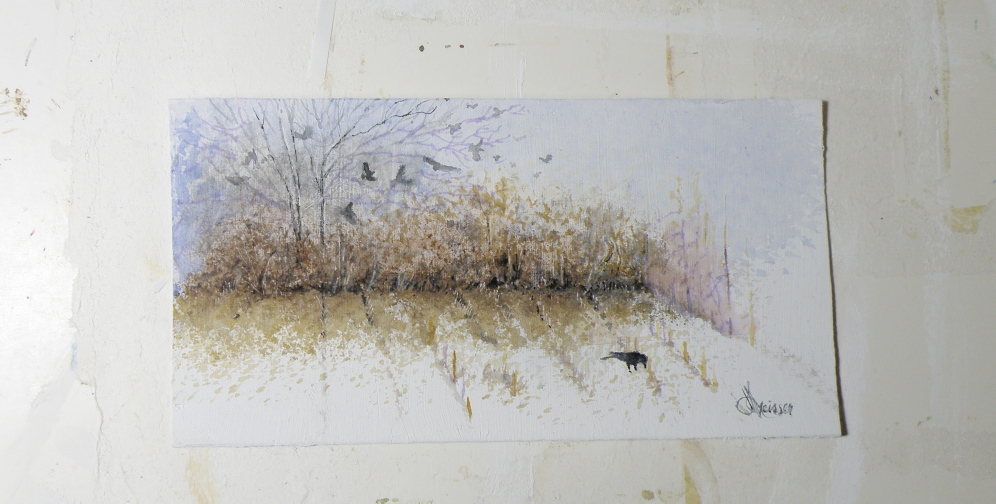
This little piece (rather crudely photographed before being matted and framed) was given a new home, and as time goes along, I’ll post others which were also purchased.
I am very grateful for the commitment and dedication of those heading up our local Kamloops Arts Council.
Life Partners
March 7, 2019
Ravens take around two to four years to mature and before finding their mate, hang around in teenage gangs according to some research, but once they do mate, they are monogamous and establish a territory for themselves.
I most often observe Ravens in our Interior British Columbia setting in pairs, unlike their crow cousins which gather in huge numbers.

by Lance Weisser
“The raven is symbolic of mind, thought and wisdom according to Norse legend, as their god Odin was accompanied by two ravens: Hugin who represented the power of thought and active search for information. The other raven, Mugin represented the mind, and its ability to intuit meaning rather than hunting for it. ” [https://www.whats-your-sign.com/raven-symbolism.html]
Here a ‘chuk’, there a ‘chuk’
March 2, 2019
Sometimes our guests awaken in the morning and come in the kitchen looking confused, ‘what is that strange sound coming from the back of the house? It sounds like a bunch of chickens being strangled.”
There are a number of birds named after their call–for example, the Whip-poor-will, Bobwhite, Killdeer and Chickadee. Now add to those the Chukar Partridge, which populates our back mountain ridge and does this: “Chu-Chu- Chuk-Chuk-Chuk-Chuk-ChukCHUKCHUKCHUK!!!!”
This is always the male progenitor of a brood (known as a covey) of some dozen or so chicks who often is announcing their collective descent down the ridge to wreak havoc in our vegetable garden. All one needs to do then is saunter down the back steps to suddenly frighten them to death as they go up in a giant, dreadful whir of feathers and squawking, after which the male will scold at me from atop the biggest rock, his ego bruised.
Native to Eurasia and Asia, including, Israel, Lebanon, Turkey, Iran, Afghanistan, Pakistan and India, along the inner ranges of the Western Himalayas to Nepal, Chukars were also introduced to Europe and N. America. [wikipedia]
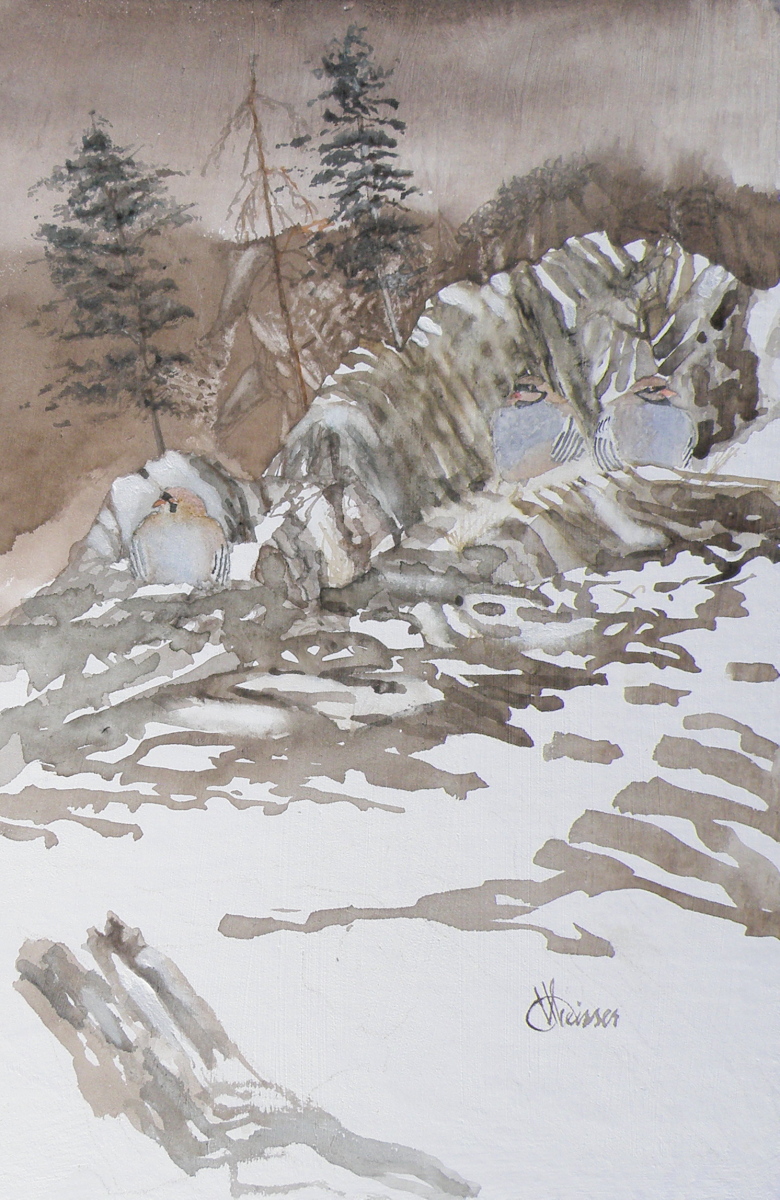
Lance Weisser
They are to me one of the strangest creatures I’ve ever come across.
They are either brazen as hell, or scared out of their freekin’ minds. Their markings are as odd as their call, their mannerisms are as odd as their habits (in our garden their choicest morsels are the tops of our onions–I mean, who eats the tops of onions?)
When you google them as a subject, you usually find sites generated by hunters in the ‘Lower 48’ who are on the prowl for ‘the illusive Chukar Partridge’ all decked out in camouflage. I’ve yet to hear of any hunters in our area on the prowl for them, but believe me, we’ve got Chukars and they ain’t illusive.
Here’s one in action, for your listening pleasure: https://www.youtube.com/watch?v=q09GNpev6sk
A Winter’s Eve
February 23, 2019
It snowed yesterday, the kind which floats down like sifted icing sugar, giving the impression that it can’t possibly amount to much, except it simply stayed that way for the entire afternoon and into the evening. And as I was cooking dinner, I glanced out and saw a van spinning its wheels, barely able to crest the top of the hill just below our house. That icing sugar now lay a significant number of inches deep, making the mule deer tracks under the bird feeders in our red maple appear as quilted dimples, leading off across the whited bedspread of the yard.
The mule deer–a party of three–come down from our backyard mountain ridge and go to town on the neighbourhood’s cedar hedges around four in the morning. Now, I’m not one to get all soft-hearted and nostalgic over having deer around, simply because they dine on just about anything except what mother nature provides in ample supply up beyond our neighbourhood: emerging tulips in the front–all manner of vegetables in the back–and everyone’s cedar. The other morning around five one of them confronted our little dog Elmo in the predawn pitch dark as we did our morning walk. Neither of them moved for a great while until the young buck got bored and sauntered off with its two pals to see what other landscape deconstruction they could manage before daybreak.
The Old Rookery
February 21, 2019
EVERY SO OFTEN I go truant and abandon my blog, but at least this time around it hasn’t (quite) been an entire year (!) I might be alone in this, but my temptation is to spend so much time daily exploring the interesting posts of fellow bloggers that I end up spending less and less time actually painting. My solution to this apparent addiction is to leave my own posts in limbo until enough progress has been made to once again continue.
In any case, thank you for your patience and understanding, and here is my latest painting entitled ‘The Old Rookery’, depicting a scene from my imagination, drawing on the spirit of book illustrators from the days of my youth:

Thank you for reconnecting with me and I hope your Winter is going well for you!
Rock and Sky
May 1, 2018
We live in a very rocky place. Our house is situated just below a mountain ridge that is home to native varieties of cactus, sagebrush, tumbleweed, and the domain of Chukar Partridges, mule deer, black bear, a variety of hawks and owls, and the occasional Cougar.
Painting rocky scenes is something particularly satisfying due to the artistically-geometric shapes which become something of a foil for the full-blown and free-flowing movement of cloud and sky.
This was simply an experiment–discovering where shapes and natural design and configuration would lead–a painting begun without knowing where it might end.

‘The Home Place’, watercolour by Lance Weisser, 14″ x 16″, Arches Hot Press Paper
Taste of Spring
April 17, 2018
A painting drawing on a style in keeping with children’s books illustration, this painting was done for my niece and great-niece and nephews. It was done more than ten years ago now, and is of a fictional place that now seems more like Middle Earth than anywhere else.
Taken by a low grade camera through glassed-in frame, I hesitated before posting this….
![Sept2009045[1]ab](https://weisserwatercolours.com/wp-content/uploads/2018/04/sept202009200451ab.jpg)
‘Fields of Home’, watercolour by Lance Weisser
Arches Hot Press 140 lb paper,
10″ x 16″
collection of R. Jones & Family
‘School’s Out’
April 9, 2018
Not far from our Kamloops, B. C., home is the village of Pritchard which used to have an original one room school occupying a corner of a farmer’s pasture–a school he himself reputedly attended as a boy–that no amount of seeking to have it lovingly restored bore any fruit with historical groups or municipalities.
Fearing its derelict floors and frame would be responsible for causing trespassing children accidental injury, he reluctantly tore it all down some five years or so ago. But fortunately I managed to capture its classic image with my camera while it was still part of this farmer’s horse paddock, and I’ve painted a series of watercolours using it as a focal point.
Since it no longer exists, I choose to place this old school in settings that depart rather dramatically from where it actually had been (on a rather non-descript flat field right beside Duck Range Rd).

‘School’s Out’, watercolour by Lance Weisser, 14″ x 16″
Arches Hot Press 140 lb. Paper, Sold
The ‘how’ of ACEOs
April 6, 2018
To gain more know-how about the way ACEOs are collected and acquired, just go to eBay and view the huge number of them being sold/auctioned: https://www.ebay.com/sch/i.html?_nkw=aceo+original+painting&_sacat=0&_from=R40
You’ll see the quality contrasts, the styles, the subject matter variety, the variety of mediums, too–as well as price, with some going for $40/ea to $1/ea.
Below are examples of how I personally approach doing ACEOs:
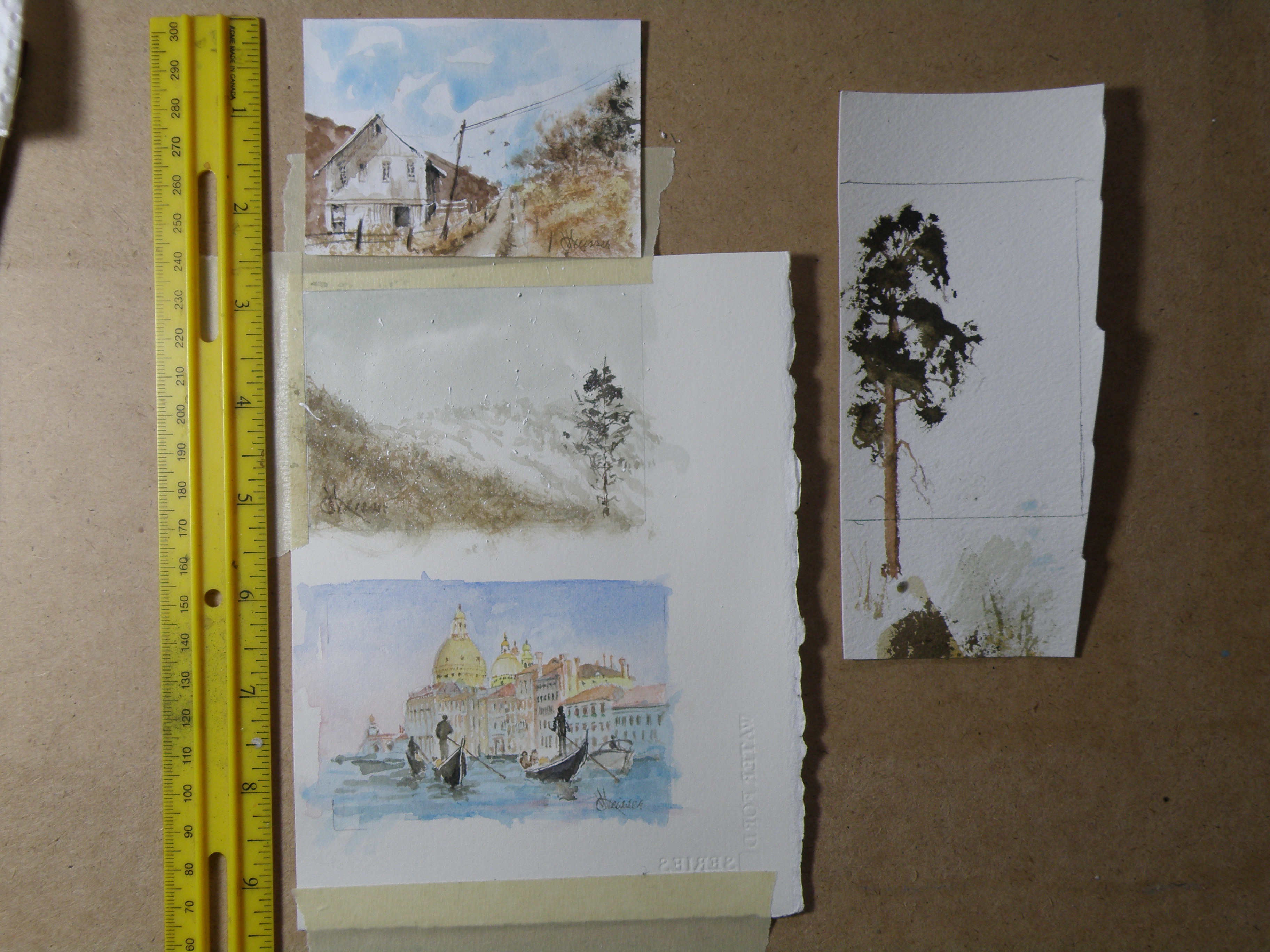
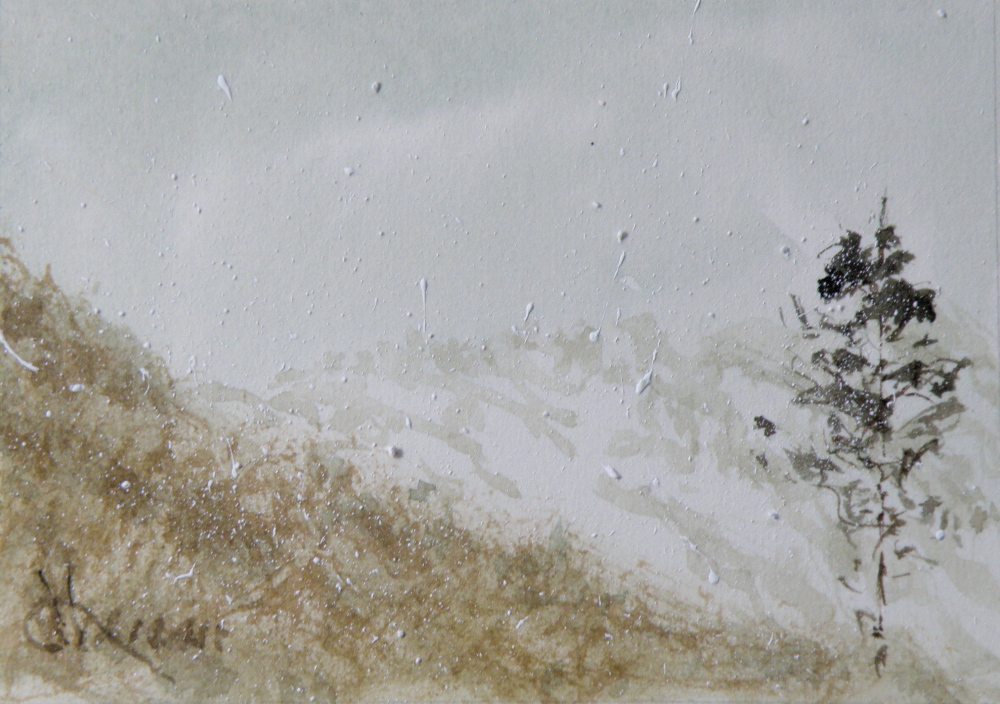
‘A Westsyde Winter’, ACEO by Lance Weisser, Arches Hot Press 140 lb Paper, sold.
Once one of mine is matted and framed, it is generally priced at $25 to $30US. Unframed, $20US. But I’m not beyond letting interested people barter for them because what is most pleasing to me is having a person get an original watercolour that is within his/her means. As painters, we really just want people to enjoy what we do, and know our work is being appreciated and displayed.
If interested, please just email me at weisserlance@gmail.com.
I can work from an emailed attached photo, or your personal subject matter ideas. It can be mailed to you wherever you may be — postal costs will be built into the final price 🙂
ACEO #2
April 4, 2018
Here’s another 2.5″ x 3″ art card–the same size as a baseball card. My experience with them is that watercolours simply have to have protection from the elements, so the only way I’ve ever sold ACEOs is matted and framed behind glass.
I find 3″ x 3.5″ metal frames and cut mats to fit, and sell them that way. The notion that they are to be traded and sold in the same way baseball cards are is to fail to take into account how a miniature original watercolour needs to be treated in order to be acceptable for the buyer. IOW, they may be the same size, but they aren’t baseball cards, lol.
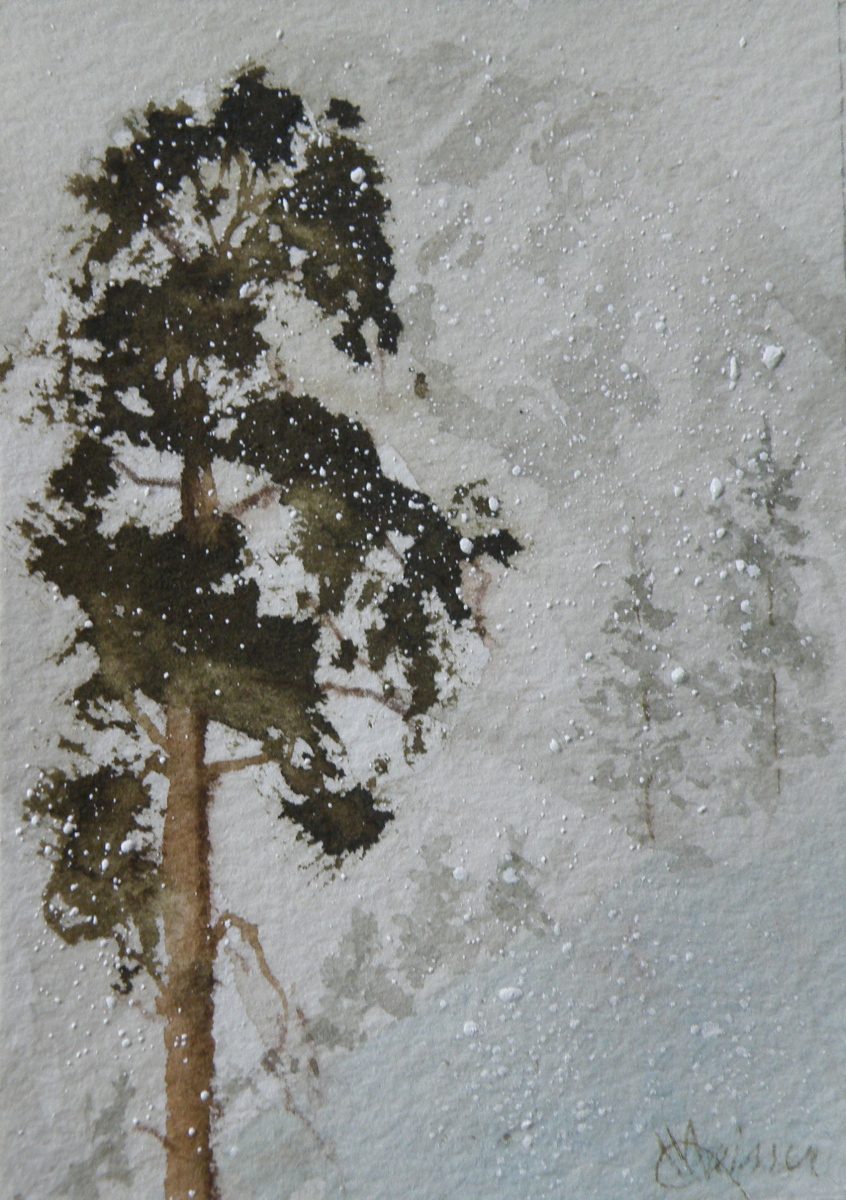
‘Lone Pine’, watercolour by Lance Weisser, 2.5″ x 3″, Arches Hot Press 140 lb Paper, Sold.
ACEOs (miniature art cards)
April 3, 2018
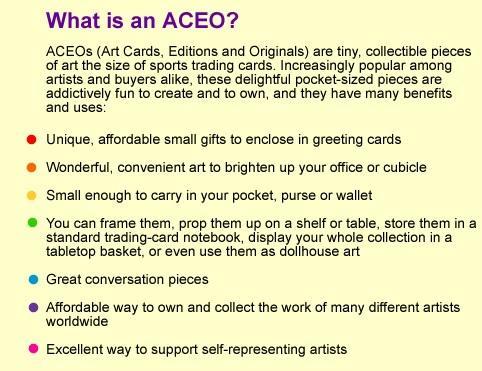
[source: https://creationsbygena.zibbet.com]
An ACEO is 2.5″ x 3″ — artwork the size of sports trading cards — otherwise known as a miniature. I personally love the challenge of painting something that small.

Old Barn, watercolour ACEO, 2.5″ x 3″, Arches Hot Press 140 lb paper. Sold.
Have you ever done them or bought one? I’d be interested to know!
Happy Easter
March 29, 2018
As children, we loved writing on eggs with crayon and then colouring them, the smell of vinegar used in setting the dyes filling the kitchen, and our fingers almost permanently stained purple and orange and green–yet we weren’t very keen on then having to eat cold hard-boiled eggs, pretty though they were. Our mother held a big church breakfast at our parsonage home, card tables decorated up, little ‘favour’ cups filled with mints and peanuts, lots of hot chocolate for people returning from sunrise service. And of course, lots of coloured, hard-boiled eggs.
I enjoy painting watercolour on eggs, which receive it quite well, the best eggs being duck eggs whose satin-smooth surface is perfect for watercolour. The eggs then have to be blown out and finally spray-lacquered to protect them.


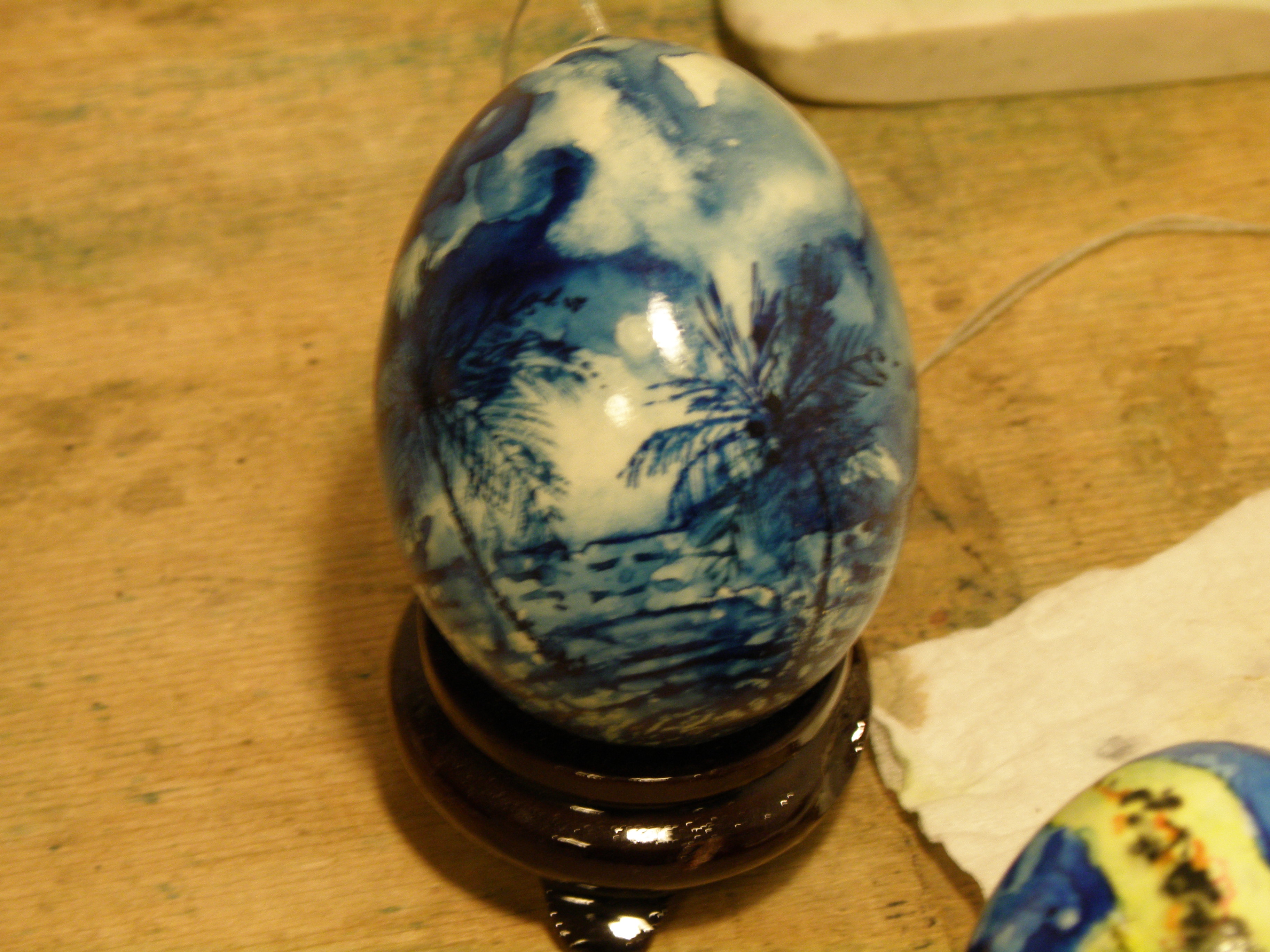

Christmas tree ornament egg done using the traditional Ukrainian beeswax and dye method.
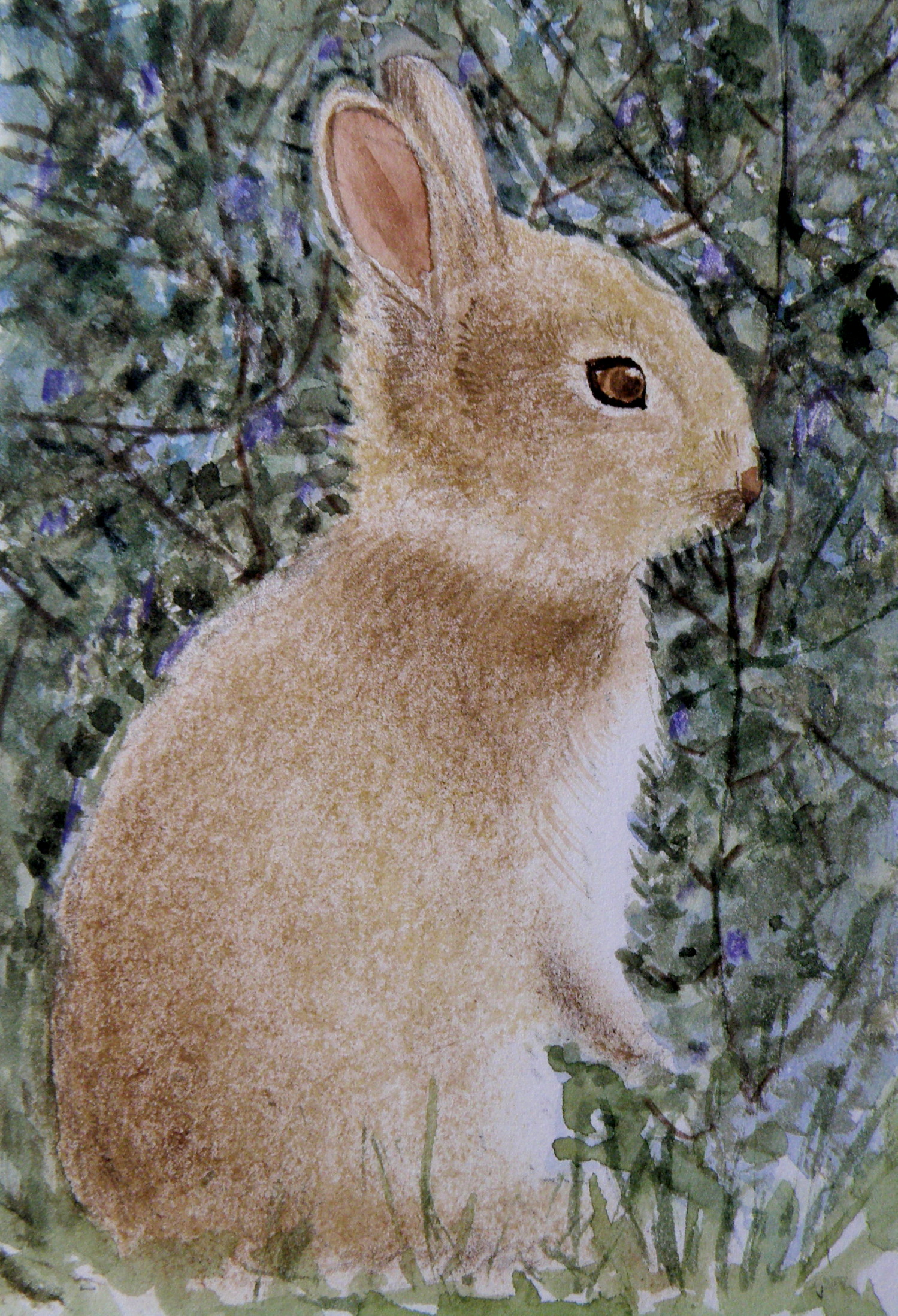
‘Little Bunny’, watercolour on Saunders Waterford Hot Press Paper, 4″x6″, sold.
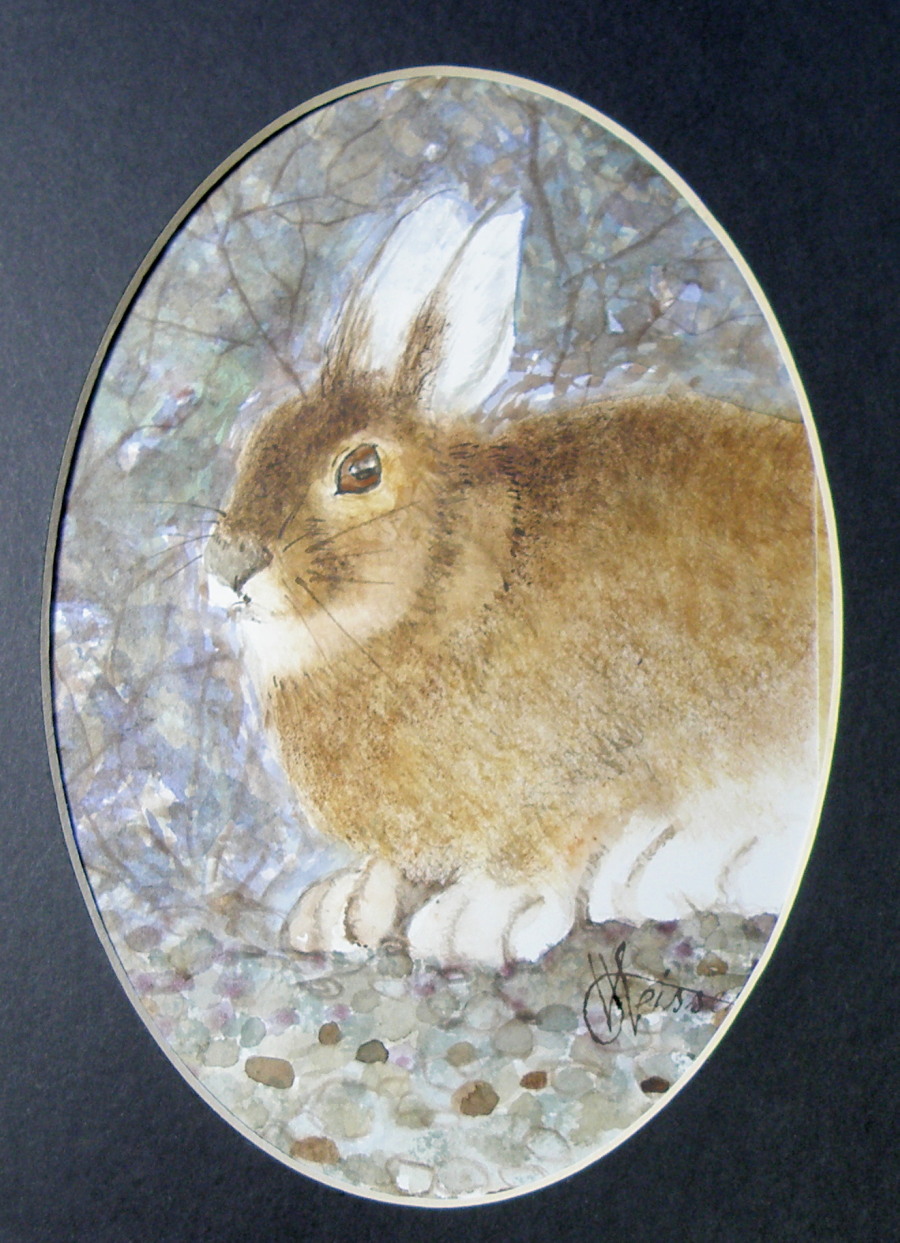
‘Arctic Hare’, watercolour, Arches Aquarelle Hot Press Paper, 4″x6″, sold.
A blessed and Happy Easter everyone!
Pinantan Country
March 5, 2018
Pinantan Lake is about twenty minutes from Kamloops, British Columbia, where we live. It is a small community spread around the little lake’s perimeter and prides itself on being independent, artistic, and avant garde.
Although this painting is not of an actual barn or photographed scene, it attempts to capture the spirit of what the area looks like under a snowy mantle when viewed from the road leading towards the lake. I’ve done it from my collective memory, rather than choosing to make use of photographs or while on location.

‘Pinantan Country’, watercolour on Saunders Waterford Hot Press Paper 90 lb., 9″ x 12″ Sold
Finished Painting: ‘Raven Winter’
February 16, 2018
It is snowing again, and is likely to continue through today and tonight and into tomorrow. As my friend Shiela says, snow today is water tomorrow, meaning we live in a characteristically arid part of British Columbia (our backyard mountain ridge has many cacti plants) and so every source of water is cherished. The snowmelt from the mountains is crucial to ensuring our lifeline, the Thompson River, is of normal size.
Around here, many people kind of roll their eyes and sigh when learning we’re getting another ‘dumping’, but I’ve always delighted in snow and can now sadly envision a day when there won’t be any. Our living situation is such that I can handle clearing the driveway without much effort, otherwise I might be joining one of the eye-rolling crowd.
Here is the painting ‘Raven Winter’ that is now framed and ready to be presented to my friend Patricia Kellogg as a possible choice in our painting exchange deal:

‘Raven Winter’, watercolour on treated art board, 9″ x 12″
Stage Two: ‘Raven Winter’
February 14, 2018
The painting for my friend Patricia Kellogg is taking shape. The treated surface of the mat board I’m using to paint on was/is achieved by applying a product by Daniel Smith called ‘watercolor ground’. It comes in a jar and is painted onto any surface one desires, instantly turning it–once allowed to thoroughly dry–into one which can be painted on using transparent watercolour. So, glass, metal, wood, masonite, anything of the kind can basically become a surface with the characteristics of watercolour paper.

Stage One: ‘Raven Winter’
February 13, 2018
My watercolourist friend Patricia Kellogg [https://www.facebook.com/Patricia-A-Kellogg-357357001050096/] and I are doing a painting exchange. I acquired one of hers of an artichoke plant in late autumn–that expressive form plants take when frost renders them lifeless, yet beautiful even so. And because she has a couple of mine with ravens in them, she wanted one more and so here’s the first stage of it.
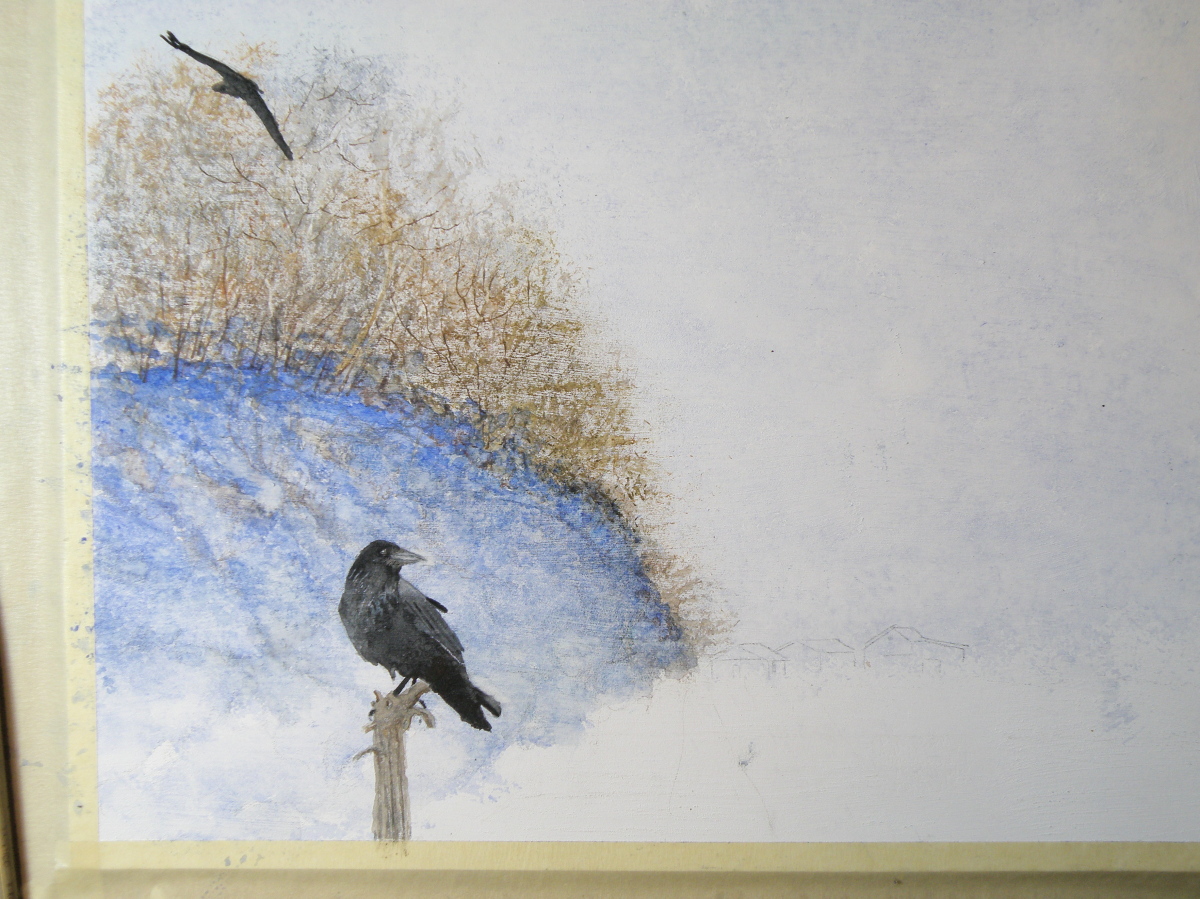
The surface for this painting is treated mat board and the medium is transparent watercolour. It is a 9″ x 12″ piece. Once it is finished I will enjoy taking it over to The Red Beard Cafe where we have our monthly coffee and seeing if she likes it. I’ll also bring a couple of others with me to provide a choice.
‘The Way Home’
January 24, 2018
In the spirit of watercolour experimentation, it was interesting to take ordinary white mat board and coat it with a thin layer of clear acrylic medium. The board then had to dry for a good 24 hours. The experience when painting is one of finding it acts as a kind of resist while providing a rather intriguing texturing quality.

It is a bit tricky because there’s no wet-in-wet opportunity, or much reworking/touching up or the acrylic medium will moisten and lift from the surface and become gummy. So getting one crack at it is pretty much all one gets, making every brushstroke really count.
….eggciting week ahead
March 20, 2016
Painting eggs is something of a little hobby which began almost 35 years ago when the process of the dyed Ukrainian eggs was intriguing from an artistic point of view–meaning, the way/how it was done, not the desire to become overwhelmed with making intricate geometric designs. So employing the method of using beeswax to wax over those parts of an egg one wanted kept white, then dropping the egg into coloured dye, again waxing over the area which would retain that dye’s colour, and dropping it into yet a different coloured dye and repeating the process until the entire egg was covered in wax.
At this point, the wax was removed by carefully holding it over a candle flame and wiping the melted wax free with a tissue. Once the wax was removed, the egg was blown of its contents and if being used as a Christmas tree ornament, a string was affixed to the top.
Here is an example…..
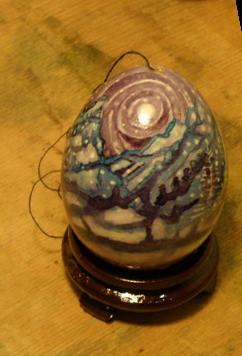
Quite a number of years later, the notion of doing away with the dye/wax method in favour of actually painting on the egg’s surface was experimented with. This was successful but a huge breakthrough occurred when moving from painting chicken eggs to painting duck eggs. A duck egg’s surface is not chalky like chicken eggs, but rather satiny smooth and extremely receptive to watercolour. This was discovered while staying in The Philippines, where duck eggs were easily come by.
Painting a duck egg would be done, then the egg would be spray-lacquered so as to protect and seal the watercolour-painted surface. Once completely dry, the insides would be blown out….
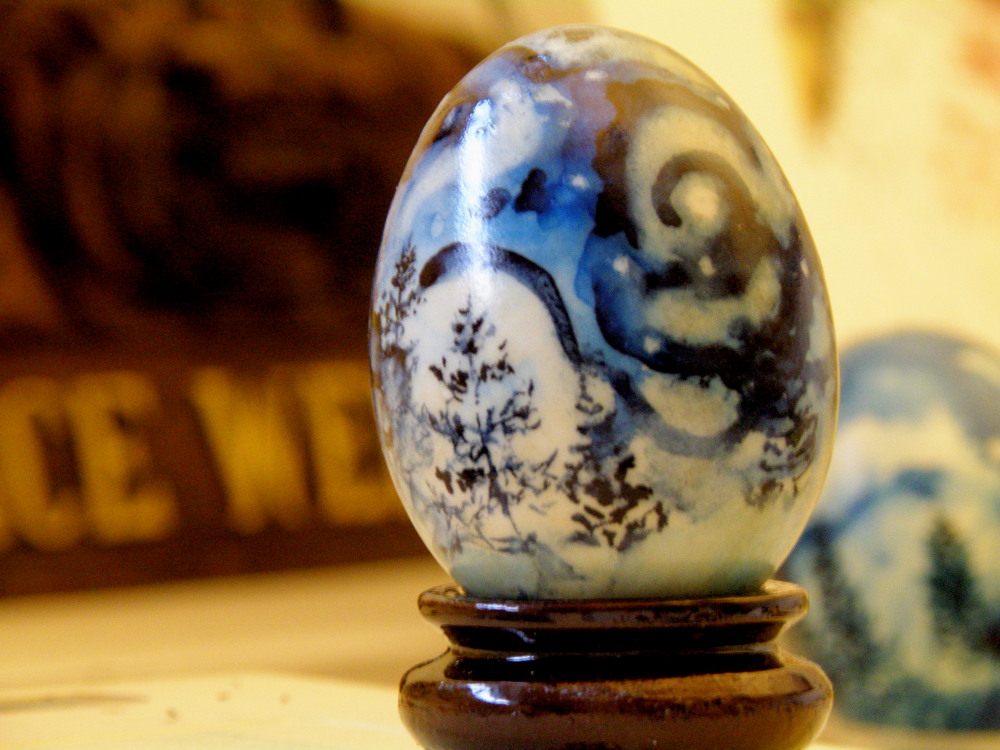
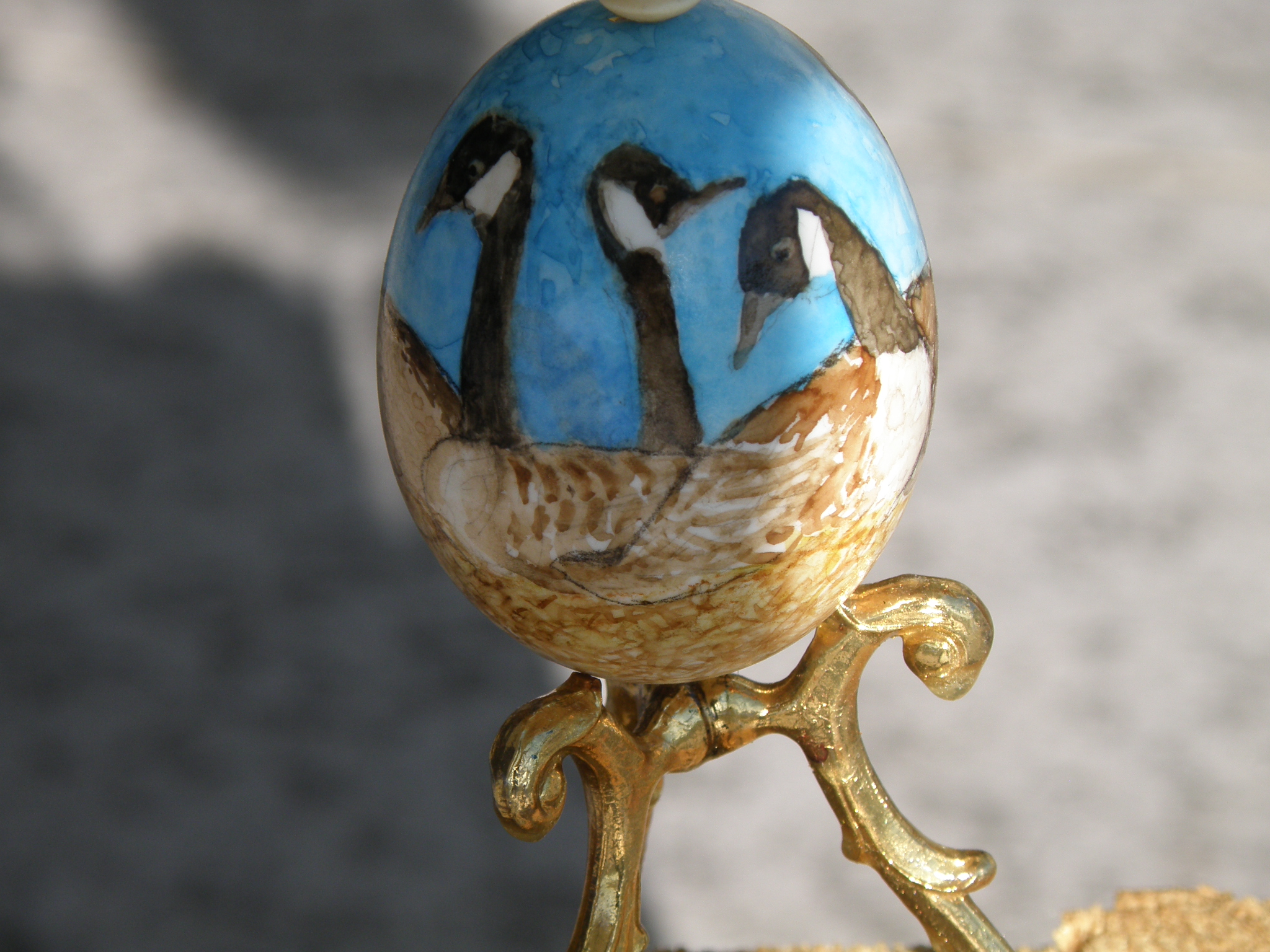
……and in honour of the 6th day of Christmas….
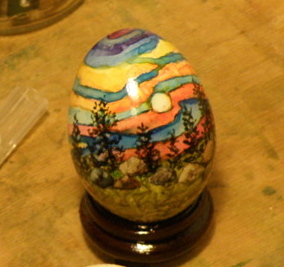
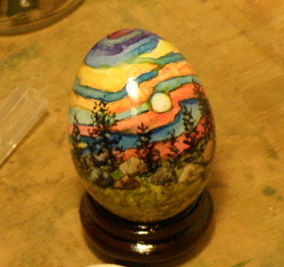
….which brings us to today and trying to replicate a moonlit rocky mountain scene on a duck egg purchased locally ($3.50/half doz) through craigslist and meeting the man carrying his trusty picnic cooler outside the supermarket:
A very Happy and Blessed Easter to all my blogging friends!
…. composition exercise conclusion
February 27, 2016
Results of ‘composition exercise 1’: dividing a landscape into thirds, placing visual interest at each intersectional point….
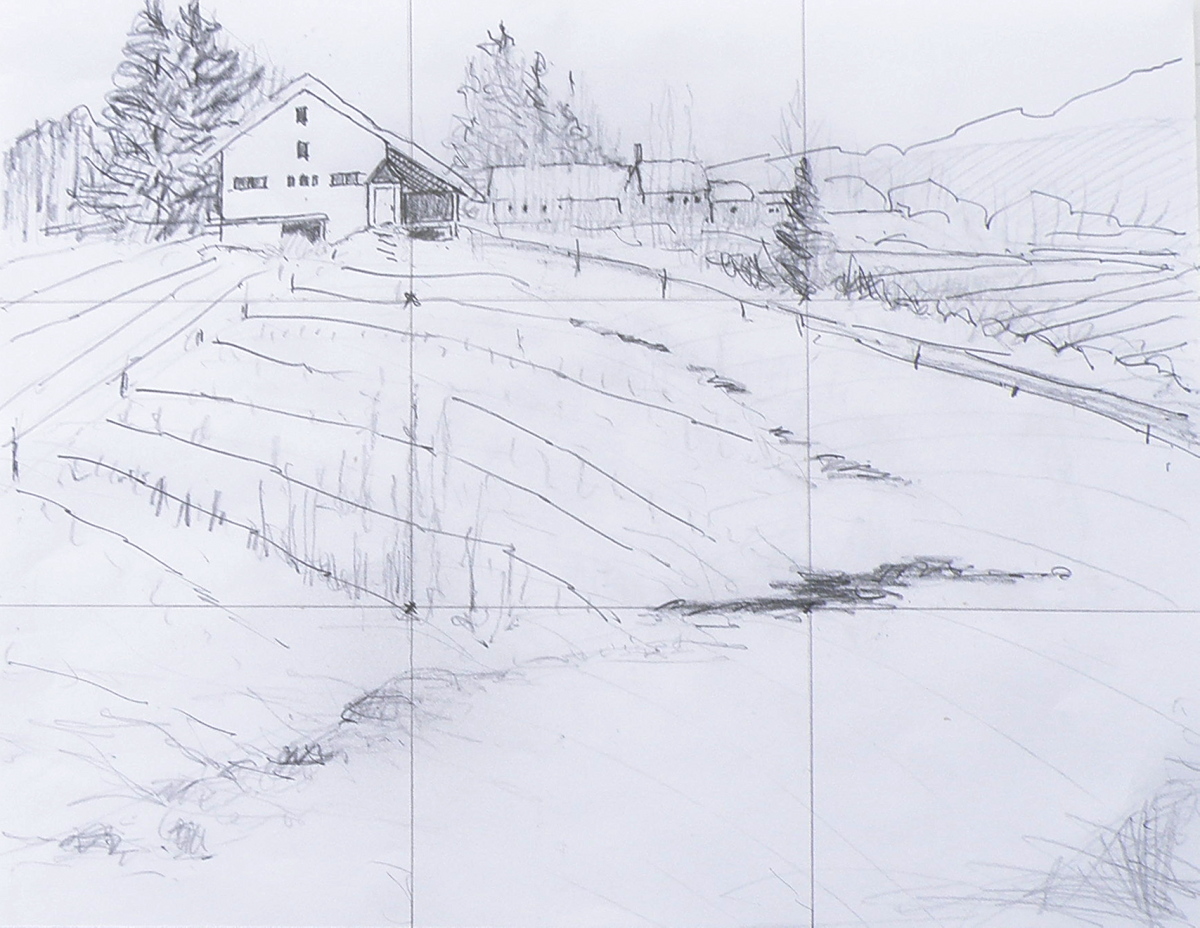
Results of ‘composition exercise 2’:
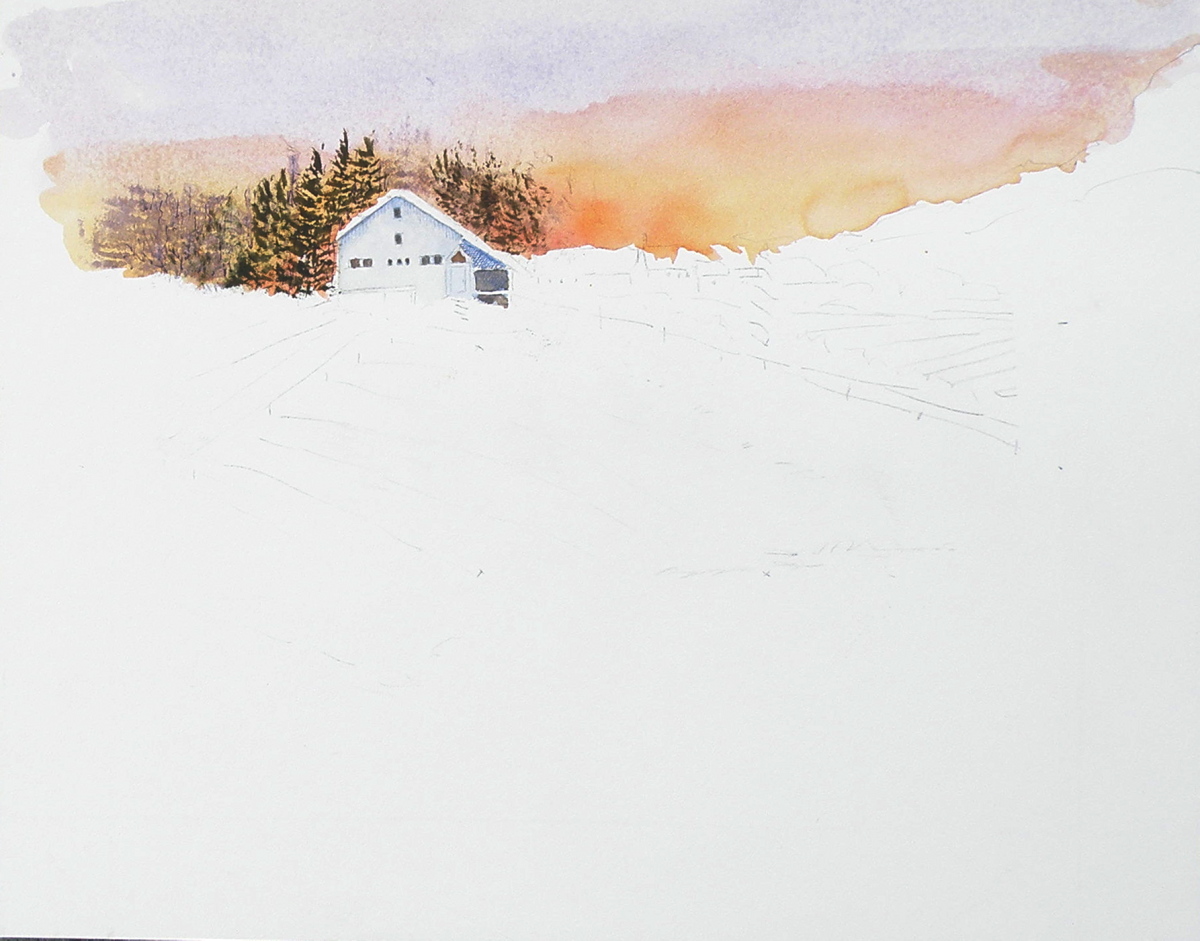
and 3:
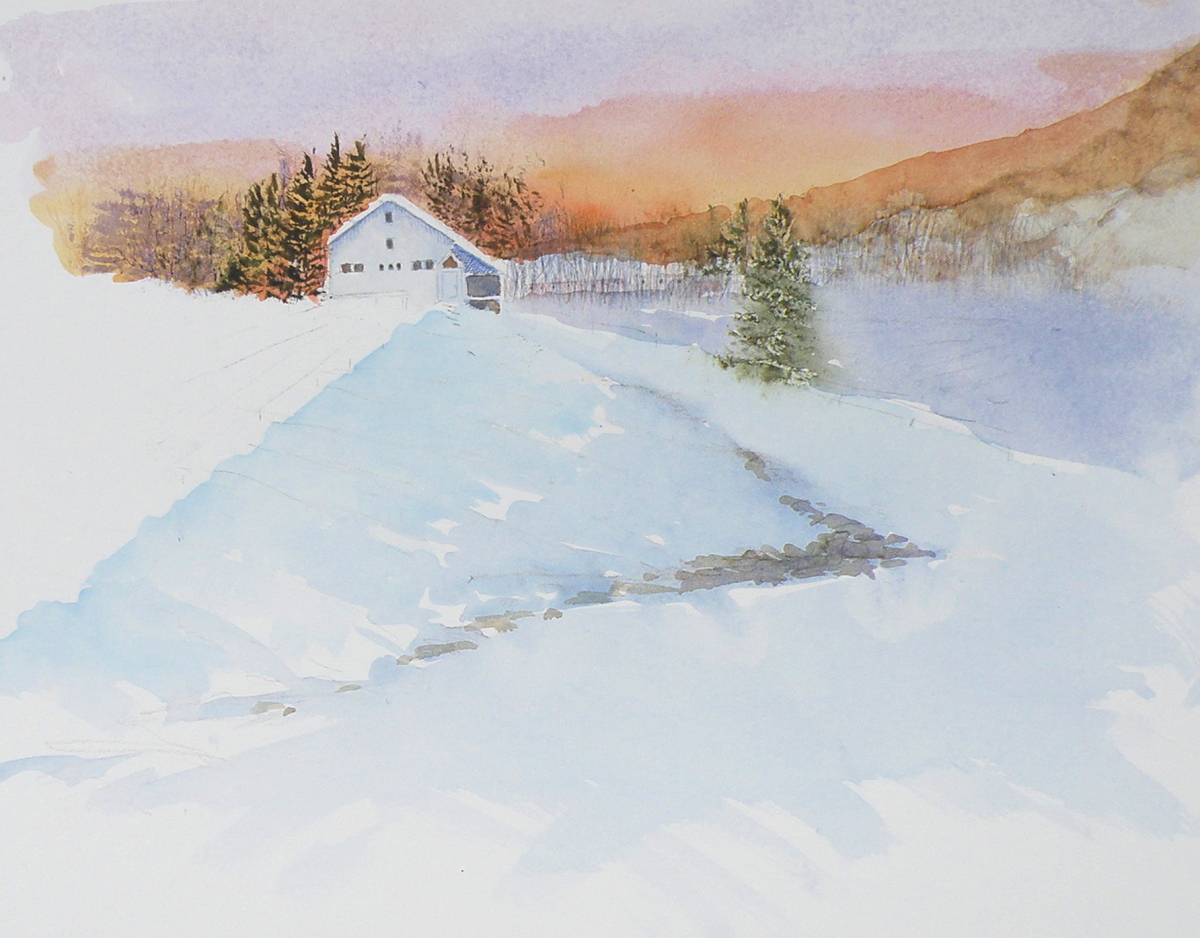
bringing us to 4:
It has taken a long spell of waffling over what to do about being less than pleased with the finished piece. The snowy fields seemed to extend themselves too far down, without enough visual interest to hold a viewer’s attention. And then I gave into the temptation/artistic trap I almost always seem to fall into, which is going one step too far by defining open field with regimented rows of corn which wind up being so monotonous, the fence posts going the opposite direction only add yet more visual predictability and kill whatever freshness the piece had going for it.
….so the only satisfactory outcome was to crop the painting and salvage what could be salvaged.
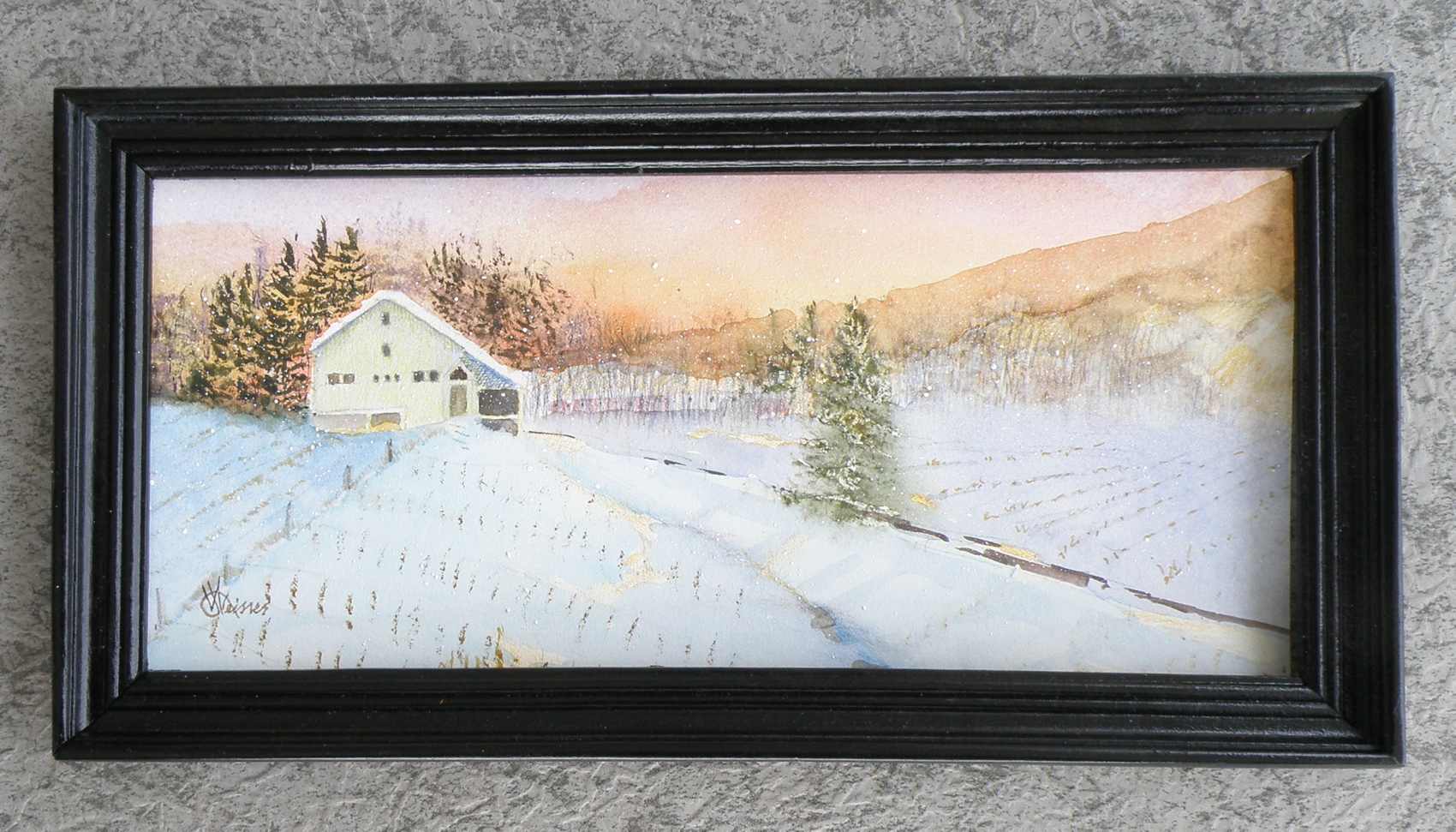
It is a very small painting, about 6″ x 12″, and has at least enough mood still going on to make it only just worth framing.
As an exercise, however, it was more than useful, and confirmed satisfactorily that placing interest at intersectional points within a composition divided into thirds works (sans rows of corn, that is), does hold one’s attention, and lends a feeling of balance.
…. Tranquille Creek Gorge
January 21, 2016
The watercolour video demonstrations of David Dunlop are challenging and yet simple. https://www.youtube.com/watch?v=Lgtg-Adql1Y&index=6&list=PLtEJwQmsB7SvVg8C4J2c4LDijerH7SSKF (I tried to embed the video itself in this post, but WordPress thought otherwise). But here is the blurb describing it….”Emmy Award winning David Dunlop takes you to his Connecticut studio to demonstrate a two minute watercolor, used as preparation for an oil sketch or to explore ideas“.
Mr. Dunlop is an artist/teacher from Connecticut, whose manner when teaching is inspiring and animated. He is a great follower of descriptive, energetic Masters like J.M.W. Turner and Winslow Homer, and seeks to employ their methods, while demonstrating their techniques.
The video cited above challenges painters to do two to three minute painting sketches, which convey the movement and mood and spirit of the subject, without stopping to think and rework. In an effort to ‘do’ and not think, the subject chosen here is a favourite–a place about 20 minutes from our house–called Tranquille Creek Gorge.
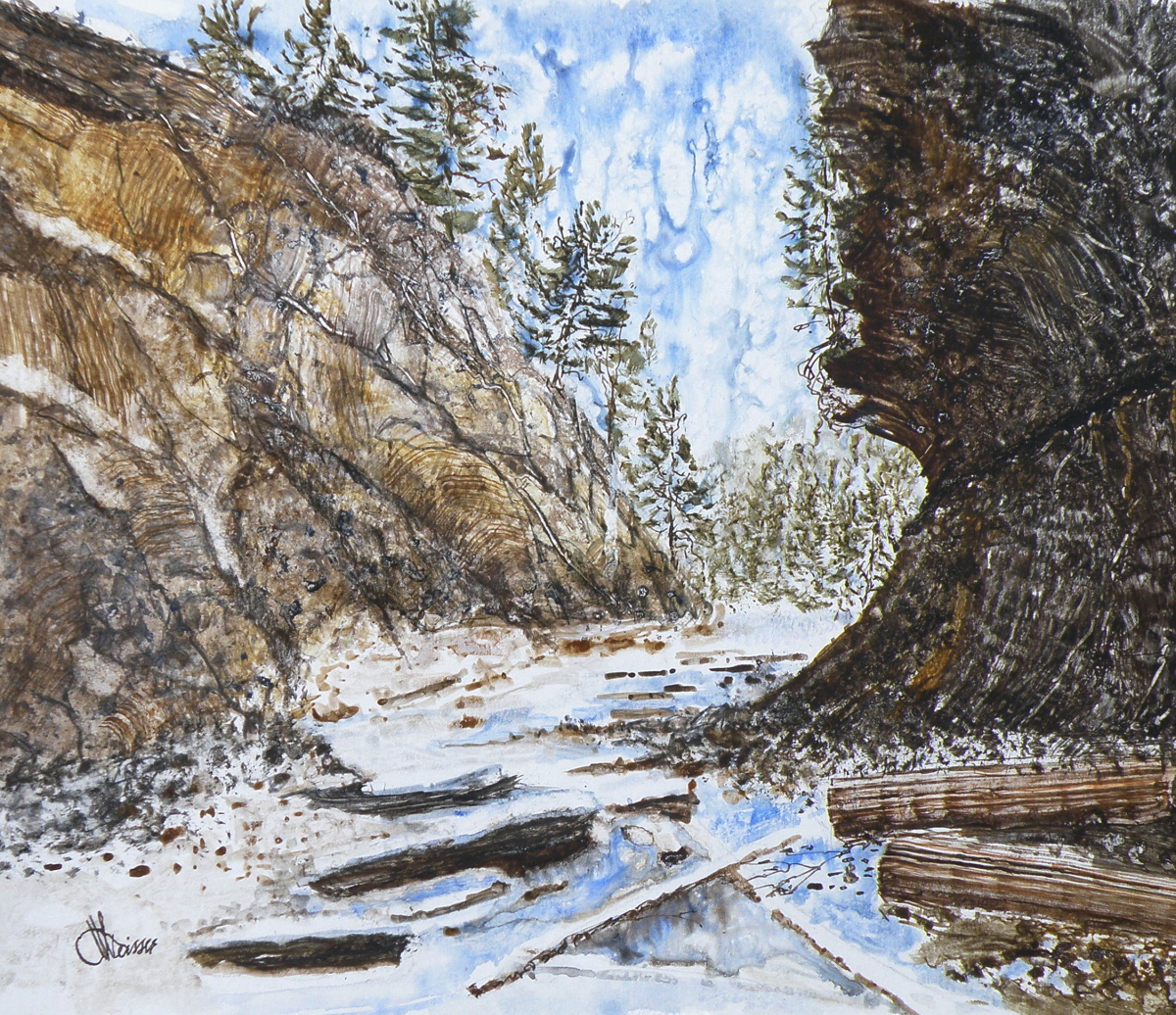
Mr. Dunlop’s videos are quite dynamic and aimed more at oil painters a bit more than watercolourists, but full of very encouraging lessons because of the force of his optimistic personality and sense of fun. They are well worth watching, for those who enjoy painting as a means of expression.
 weisserwatercolours