Sentinels
December 19, 2019
It is something a fascination how one species of bird spends its nights, in comparison with another. What they all have in common is a desire to feel protected and beyond the reach of nocturnal predators, like owls.
Ravens and crows go the safety in numbers route, heading in groupings to mutually accepted trees, with crows being particularly fond of the-more-the-merrier approach, with sometimes upwards of several thousand roosting at one time. Ravens are less inclined to roost in gigantic numbers, and confine themselves to congregate with family and ones they’ve bonded with.
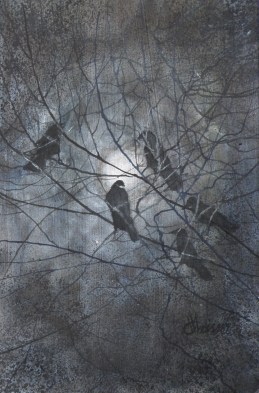
‘Nightwatch’
watercolour on art board by Lance Weisser
4.5″ x 7″ [sold]
Forest Eve
December 13, 2019
Growing up, our house fronted a very large and treed city park in Rochester, New York, a city which has always received a great deal more of its share of snow than most due to what is known as lake-effect snow, when moist air over Lake Ontario contributes to great snowstorms, and, to our delight as children, ‘snowdays’ and their resulting school closures.
We’d head to Seneca Park with our Flexible Flyer sleds in tow for entire days of weaving down between the pines and firs, avoiding known rocks, stopping just before plunging down into Seneca Park pond.
The admonition from our mother was, ‘just head home when the snow turns blue’. Blue snow happened around 4 pm, and we’d make it just in time to change out of frozen snow suits and hit the dinner table, our cheeks bright red, our legs and fingers still tingling.
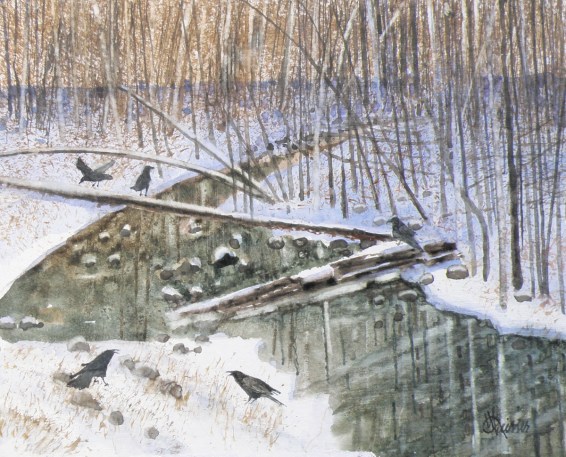
‘Silence Broken’
8″ x 10″, watercolour on art board by Lance Weisser
part of ‘The Small Works Show’, Kamloops Arts Centre, Kamloops, B. C., Canada
The Gathering
December 7, 2019
Ravens differ from Crows socially. Whereas Crows are given to form large groupings and congregate together socially–whether roosting for the night or for protection–Ravens are more solitary. Adult Ravens, once successfully mated, remain paired-up and together for life.
It is known that teenage Ravens, prior to mating, do in fact form in groups in order to be more effective in their newly-developed hunting skills. So when one teen Raven buddy discovers food, they all pile on, everyone benefiting from the find.
[source: ‘Ravens In Winter’ by Dr. Bernd Heinrich]
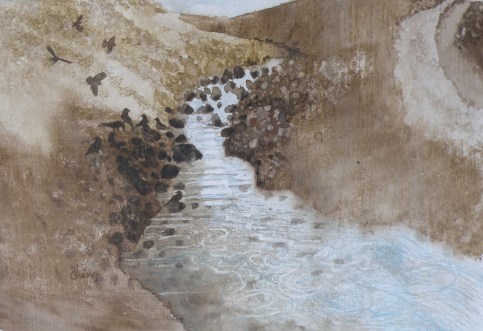
‘The Gathering’
watercolour by Lance Weisser, 8″ x 11″ on art board
for The Small Works Show, Kamloops Arts Council, November 24 to December 24
Old Courthouse, Kamloops, British Columbia
November
November 26, 2019
November is my most favourite of months! In the Southern Interior of British Columbia where we live, November is one of those seasonal cusp months–like March–when no one quite knows what they’ll be waking up to in the morning; a month of mystery and change, full of windy days, foggy mornings, early evenings, and sometimes the schedule-disturbing onslaught of an unexpected blizzard.
This painting–now hanging in the Kamloops Arts Council ‘Small Works Show’–expresses and uses my painterly imagination to bring to the viewer all that I feel about my most favourite Season:

watercolour by Lance Weisser, 7″ x 10″, on art board
for Kamloops Arts Council ‘Small Works Show’
November 24 to December 24,
Old Courthouse, Kamloops, B. C.
Small Works
March 15, 2019
In my city of Kamloops, British Columbia, our Kamloops Arts Council hosts a number of different painterly events throughout the year. One of them was called ‘The Small Works Show’, an annual fundraiser whereby the artist gets half the proceeds and the Arts Council gets the other half.
Unlike most art shows, this one allows patrons to walk out the door with their purchase rather than wait till the event is over. No little red dots on title cards here!
Participating artists are allowed up to fifteen pieces, and if/when one piece is purchased, another is immediately put in its place. So I contributed twelve paintings, and was pleased to have sold seven of them.
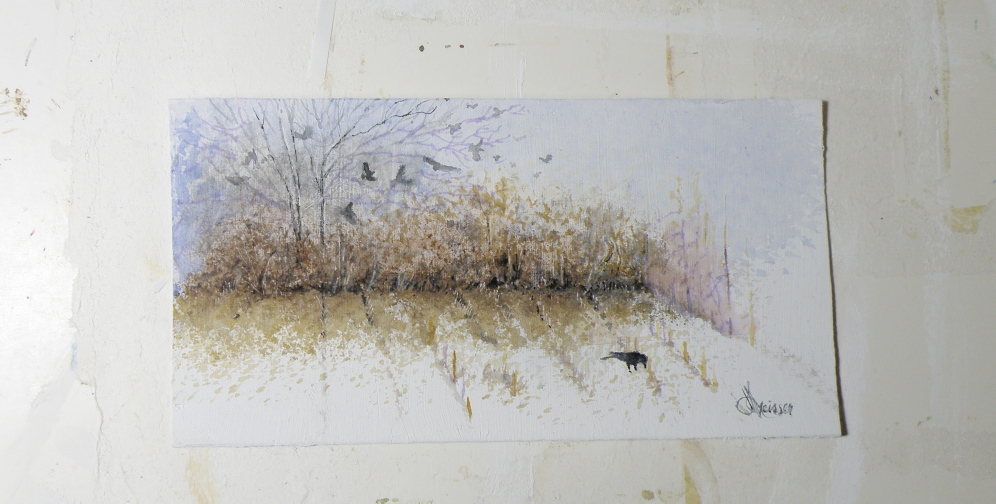
This little piece (rather crudely photographed before being matted and framed) was given a new home, and as time goes along, I’ll post others which were also purchased.
I am very grateful for the commitment and dedication of those heading up our local Kamloops Arts Council.
Life Partners
March 7, 2019
Ravens take around two to four years to mature and before finding their mate, hang around in teenage gangs according to some research, but once they do mate, they are monogamous and establish a territory for themselves.
I most often observe Ravens in our Interior British Columbia setting in pairs, unlike their crow cousins which gather in huge numbers.

by Lance Weisser
“The raven is symbolic of mind, thought and wisdom according to Norse legend, as their god Odin was accompanied by two ravens: Hugin who represented the power of thought and active search for information. The other raven, Mugin represented the mind, and its ability to intuit meaning rather than hunting for it. ” [https://www.whats-your-sign.com/raven-symbolism.html]
Here a ‘chuk’, there a ‘chuk’
March 2, 2019
Sometimes our guests awaken in the morning and come in the kitchen looking confused, ‘what is that strange sound coming from the back of the house? It sounds like a bunch of chickens being strangled.”
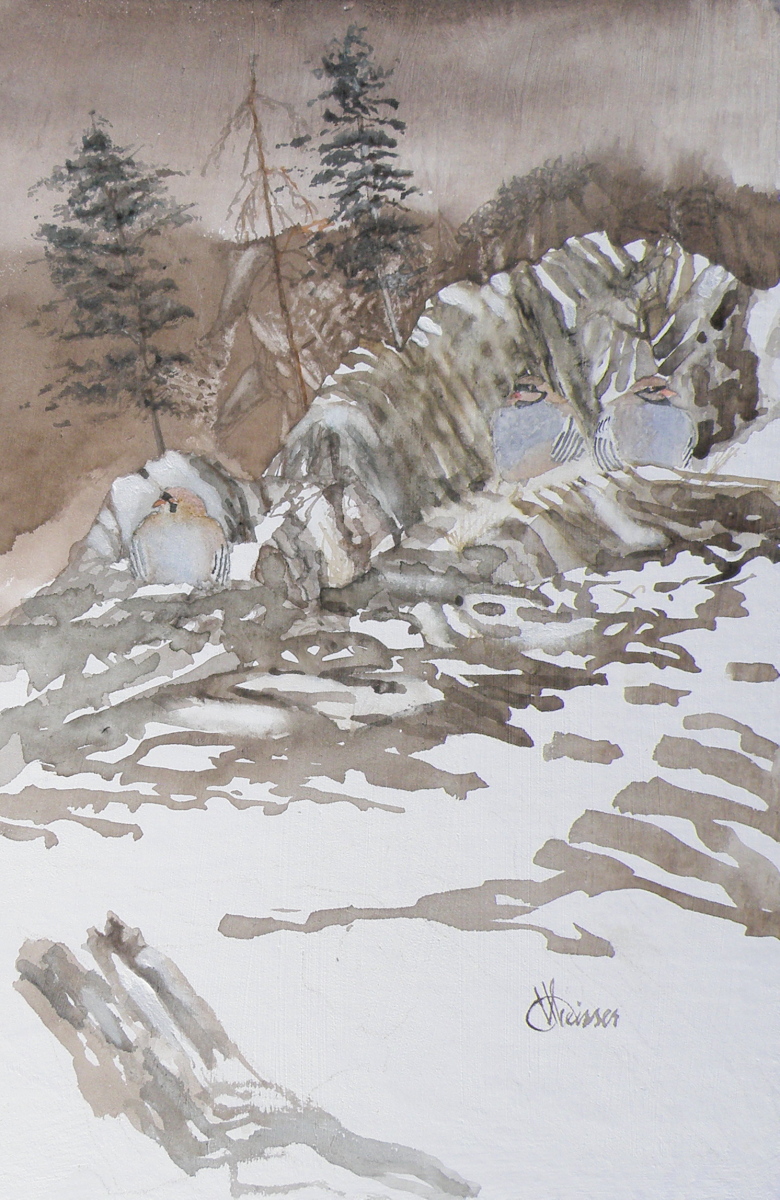
There are a number of birds named after their call–for example, the Whip-poor-will, Bobwhite, Killdeer and Chickadee. Now add to those the Chukar Partridge, which populates our back mountain ridge and does this: “Chu-Chu- Chuk-Chuk-Chuk-Chuk-ChukCHUKCHUKCHUK!!!!”
This is always the male progenitor of a brood (known as a covey) of some dozen or so chicks who often is announcing their collective descent down the ridge to wreak havoc in our vegetable garden. All one needs to do then is saunter down the back steps to suddenly frighten them to death as they go up in a giant, dreadful whir of feathers and squawking, after which the male will scold at me from atop the biggest rock, his ego bruised.
Native to Eurasia and Asia, including, Israel, Lebanon, Turkey, Iran, Afghanistan, Pakistan and India, along the inner ranges of the Western Himalayas to Nepal, Chukars were also introduced to Europe and N. America. [wikipedia]
Lance Weisser
They are to me one of the strangest creatures I’ve ever come across.
They are either brazen as hell, or scared out of their freekin’ minds. Their markings are as odd as their call, their mannerisms are as odd as their habits (in our garden their choicest morsels are the tops of our onions–I mean, who eats the tops of onions?)
When you google them as a subject, you usually find sites generated by hunters in the ‘Lower 48’ who are on the prowl for ‘the illusive Chukar Partridge’ all decked out in camouflage. I’ve yet to hear of any hunters in our area on the prowl for them, but believe me, we’ve got Chukars and they ain’t illusive.
Here’s one in action, for your listening pleasure: https://www.youtube.com/watch?v=q09GNpev6sk
Winter Corn
February 26, 2019
Yes, it is probably apparent by now that I have an ongoing fascination with Ravens. I’m not alone. There’s a woman in the historic house section of our city of Kamloops not-so-affectionately known by her neighbours as ‘the crow lady’, whom I depicted in an earlier post entitled ‘Where The Heart Is’:

She is known as ‘the crow lady’ because starting in late autumn and all through the ensuing winter, ‘crow lady’ fills a number of her vintage bird baths with cat kibble as corvid bird food. Her historic home then becomes wreathed in a continuous flight of ascending and descending crows, ravens, and starlings, and their distinctive din of calls and caws as they attack her bird baths.
I do believe there’s even a by-law ‘crow lady’ continuously violates, but it doesn’t seem to dint her enthusiasm for ensuring her lovely noisey visitors are kept fed and satisfied.
In tribute to my friend Joan (aka ‘crow lady’), I offer up today’s honouring of local ravens, these few trying their best to find themselves a few kernels of corn.
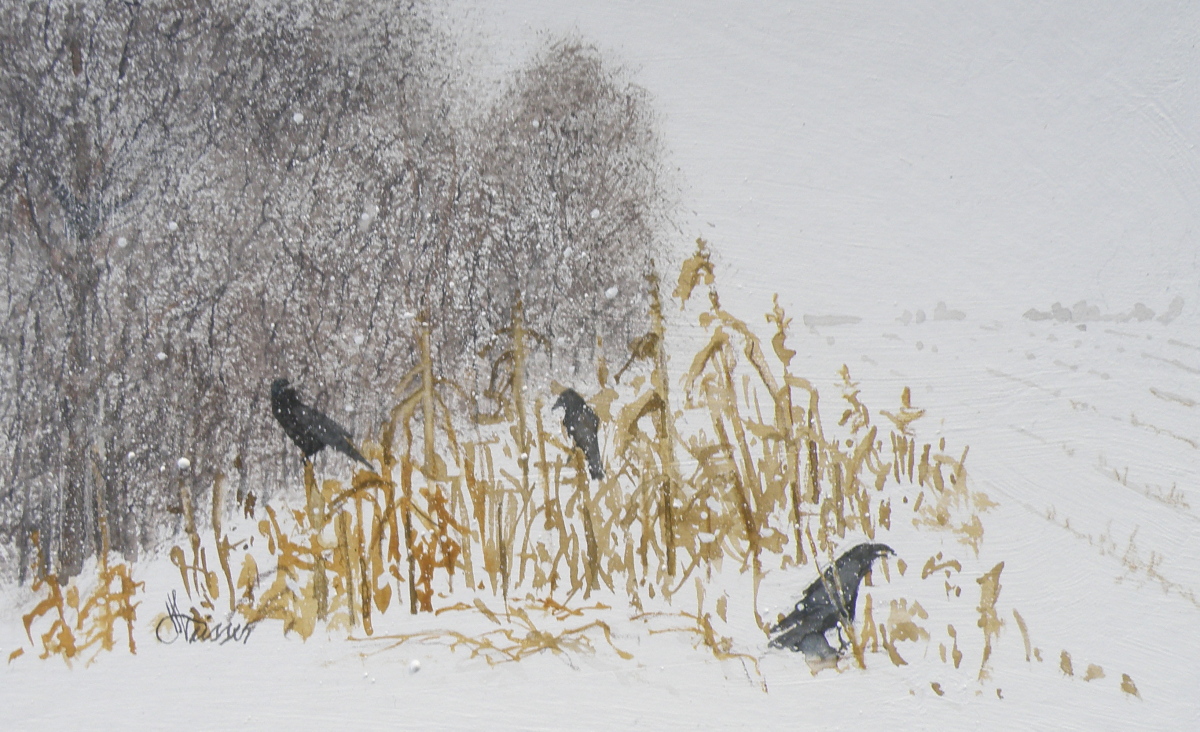
No doubt when they’re through scratching away here, they’ll give up and head over to Joan’s.
The Old Rookery
February 21, 2019
EVERY SO OFTEN I go truant and abandon my blog, but at least this time around it hasn’t (quite) been an entire year (!) I might be alone in this, but my temptation is to spend so much time daily exploring the interesting posts of fellow bloggers that I end up spending less and less time actually painting. My solution to this apparent addiction is to leave my own posts in limbo until enough progress has been made to once again continue.
In any case, thank you for your patience and understanding, and here is my latest painting entitled ‘The Old Rookery’, depicting a scene from my imagination, drawing on the spirit of book illustrators from the days of my youth:

Thank you for reconnecting with me and I hope your Winter is going well for you!
where the heart is
March 24, 2018
Our city, Kamloops, B. C., is a native word meaning ‘the joining of rivers’ (where the North and South Thompson meet), and was founded by the Hudson Bay Co. in 1812. As it grew and developed it became a railroad city (one of two cities in Canada where both CN and CP intersect). The most gentrified residences are found on St. Paul Street, where many bear historical plaques for passers-by to read and gain knowledge of.
Turn of the Century–c1904–homes are difficult to maintain and keep in tiptop condition, as many reading this can appreciate. Keeping up any house is expensive and challenging.
I befriended a woman who has outlived her spouse and is just able to keep the basics going while having to block off the upstairs from heat in the Winter. Budgeting simply to stay put and keep living in her beloved heritage house before facing the inevitable and dreaded ‘downsizing’, her joy is feeding Crows, Ravens and Starlings using cat kibble poured into oversized vintage bird baths. This certainly doesn’t make her the darling of her neighbours, but has earned her the moniker ‘the crow lady’.
She’s never seen this painting because I fear it may upset her, yet it was painted with affection and as a tribute to her intrepid spirit and unwillingness to let go of that which she dearly and completely loves:
‘Where the Heart Is’
watercolour on Arches 140 lb Hot Press Paper, 12″ x 16″, collection of J. Weisser
Three Amigos
March 19, 2018
Chickadees have a gift many would love to have, which is the ability to hide seeds and other items in a large variety of places and remember each of them without a problem. Some of us come across that well-placed but unfound Christmas present for Aunt Dorothy only when moving house or doing a major Spring cleaning.
They are also studied for their distinctive chick-a-dee dee call, with researchers noting that when it is a single ‘dee’ it indicates calm, but when there are multiple ‘dees’, it means the bird is stressed or senses danger. It seems whenever I am refilling the feeder, our resident Western Chickadee fires off a dozen or more, while insisting on grabbing yet one more seed even as I’m lowering it to the ground. Then it waits indignantly for the whole procedure to be completed while bombarding me with ‘dees’ as though from a miniature ray gun.
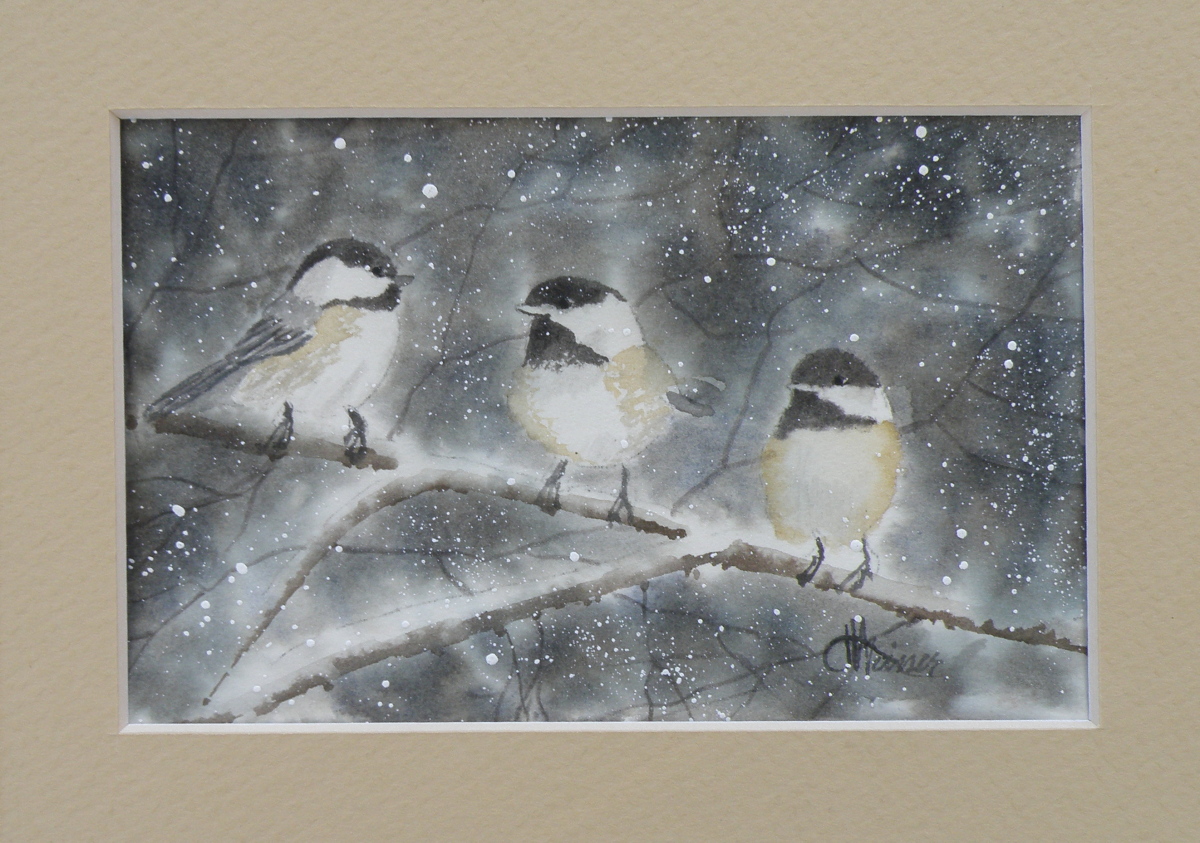
‘Three Amigos’, watercolour by Lance Weisser, 5″ x 7″, Saunders Waterford 90 lb Hot Press Paper, sold.
Raven Trio
March 10, 2018
Portraying moonlight is something of an intriguing interpretation for painters. Some, like the famous American painter Frederic Remington, chose a greenish hue for its earthly glow….
Others, like the American painter Maxfield Parrish, often used yellow as the predominant colour of moon glow….
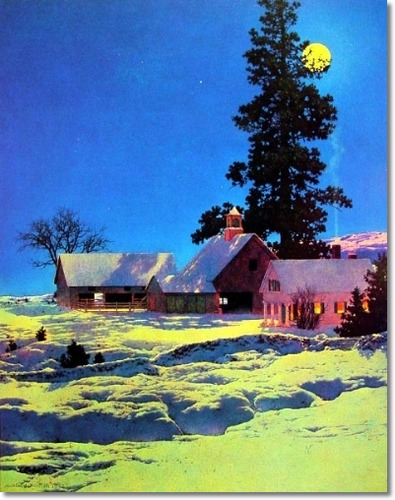
I’ve noticed other painters depicting the colour of moonlight in hues of blue. And in this little painting of Ravens, my choice is sepia and white….
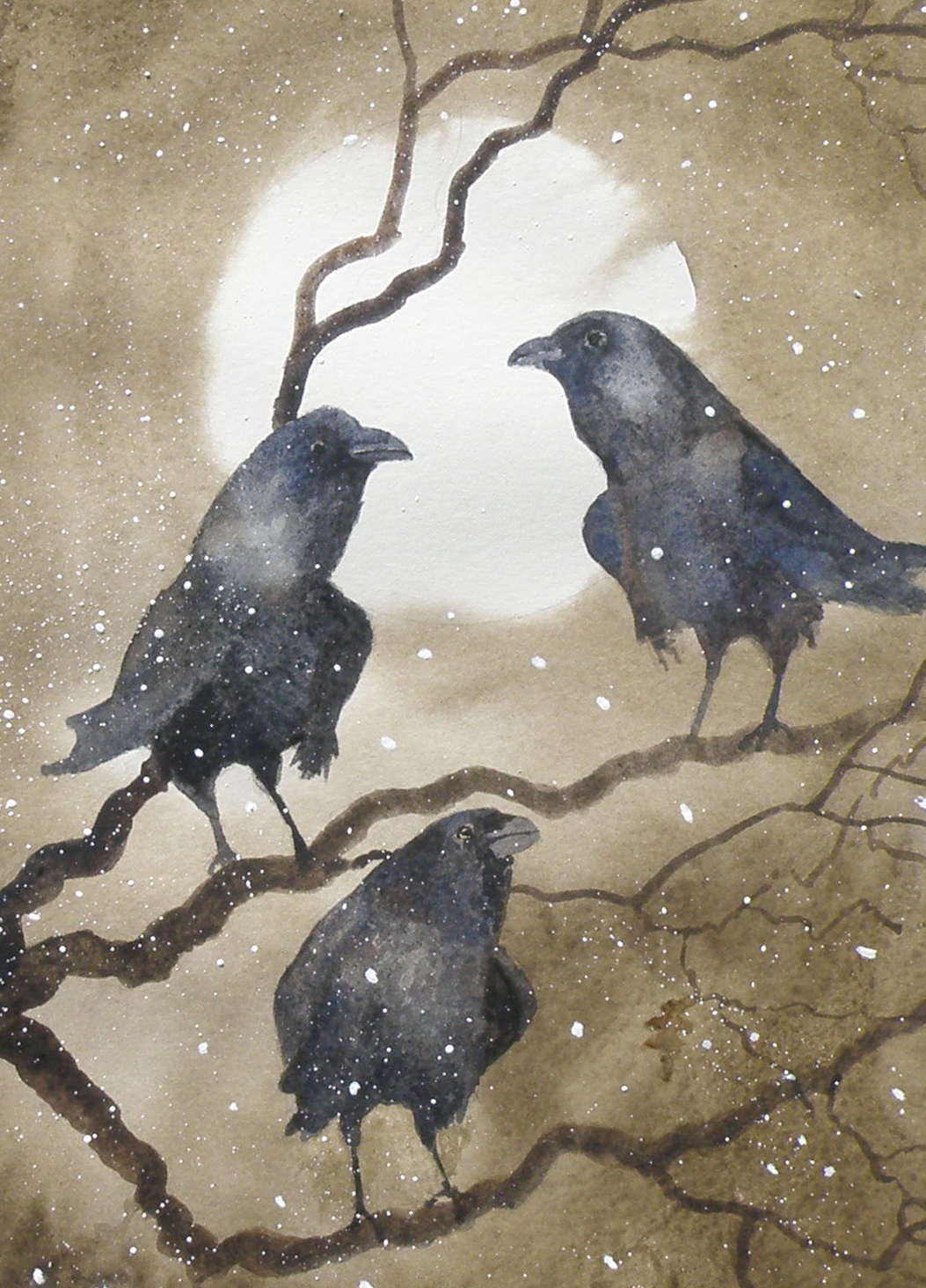
‘Three Ravens‘, 8″ x 10″, Arches Hot Press 140 lb Paper, Sold
By including my own, I’m certainly not attempting to put myself in the league of a Parrish or Remington–but merely drawing attention to how our eye finds mystery in the way the moon reflects and illuminates the landscape. When I go outside on a full moonlit night, I feel it is a blueish reflection on snow, and more earth-toned on our backyard mountain and rocks. And even though I never quite manage to see moonglow as green, I simply adore Remington’s moonlit scenes and illustrations. He convinces me it really is green!
What is it for you?
Pinantan Country
March 5, 2018
Pinantan Lake is about twenty minutes from Kamloops, British Columbia, where we live. It is a small community spread around the little lake’s perimeter and prides itself on being independent, artistic, and avant garde.
Although this painting is not of an actual barn or photographed scene, it attempts to capture the spirit of what the area looks like under a snowy mantle when viewed from the road leading towards the lake. I’ve done it from my collective memory, rather than choosing to make use of photographs or while on location.

‘Pinantan Country’, watercolour on Saunders Waterford Hot Press Paper 90 lb., 9″ x 12″ Sold
‘Raven Nights’
February 20, 2018
In keeping with my fascination over trying to capture night in watercolour, here’s another attempt at mood and texture:
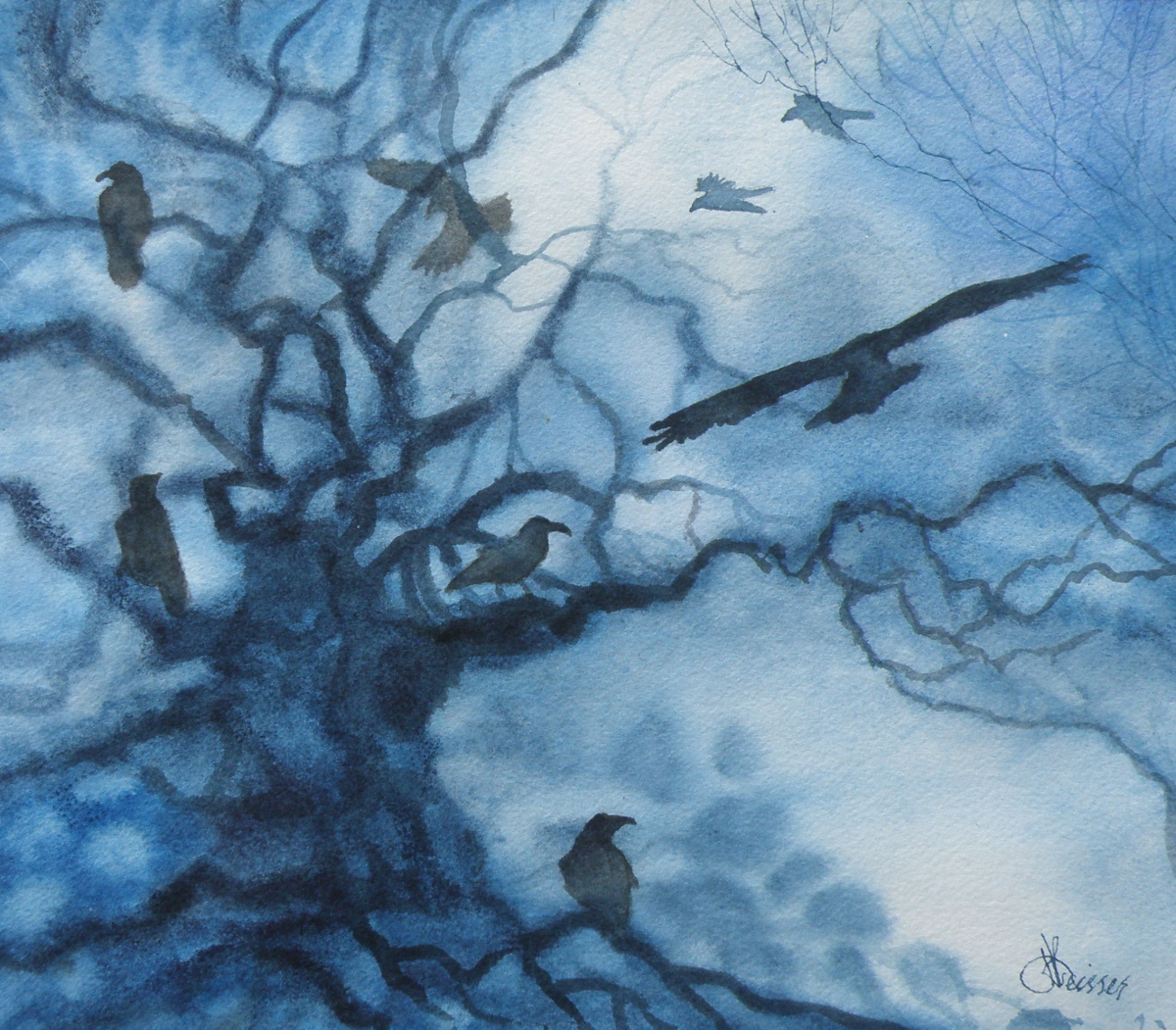
‘Raven Nights’, watercolour on Saunders Waterford Hot Press 90 lb. paper, 9″ x 10″, Sold
Finished Painting: ‘Raven Winter’
February 16, 2018
It is snowing again, and is likely to continue through today and tonight and into tomorrow. As my friend Shiela says, snow today is water tomorrow, meaning we live in a characteristically arid part of British Columbia (our backyard mountain ridge has many cacti plants) and so every source of water is cherished. The snowmelt from the mountains is crucial to ensuring our lifeline, the Thompson River, is of normal size.
Around here, many people kind of roll their eyes and sigh when learning we’re getting another ‘dumping’, but I’ve always delighted in snow and can now sadly envision a day when there won’t be any. Our living situation is such that I can handle clearing the driveway without much effort, otherwise I might be joining one of the eye-rolling crowd.
Here is the painting ‘Raven Winter’ that is now framed and ready to be presented to my friend Patricia Kellogg as a possible choice in our painting exchange deal:

‘Raven Winter’, watercolour on treated art board, 9″ x 12″
Stage Two: ‘Raven Winter’
February 14, 2018
The painting for my friend Patricia Kellogg is taking shape. The treated surface of the mat board I’m using to paint on was/is achieved by applying a product by Daniel Smith called ‘watercolor ground’. It comes in a jar and is painted onto any surface one desires, instantly turning it–once allowed to thoroughly dry–into one which can be painted on using transparent watercolour. So, glass, metal, wood, masonite, anything of the kind can basically become a surface with the characteristics of watercolour paper.

Stage One: ‘Raven Winter’
February 13, 2018
My watercolourist friend Patricia Kellogg [https://www.facebook.com/Patricia-A-Kellogg-357357001050096/] and I are doing a painting exchange. I acquired one of hers of an artichoke plant in late autumn–that expressive form plants take when frost renders them lifeless, yet beautiful even so. And because she has a couple of mine with ravens in them, she wanted one more and so here’s the first stage of it.
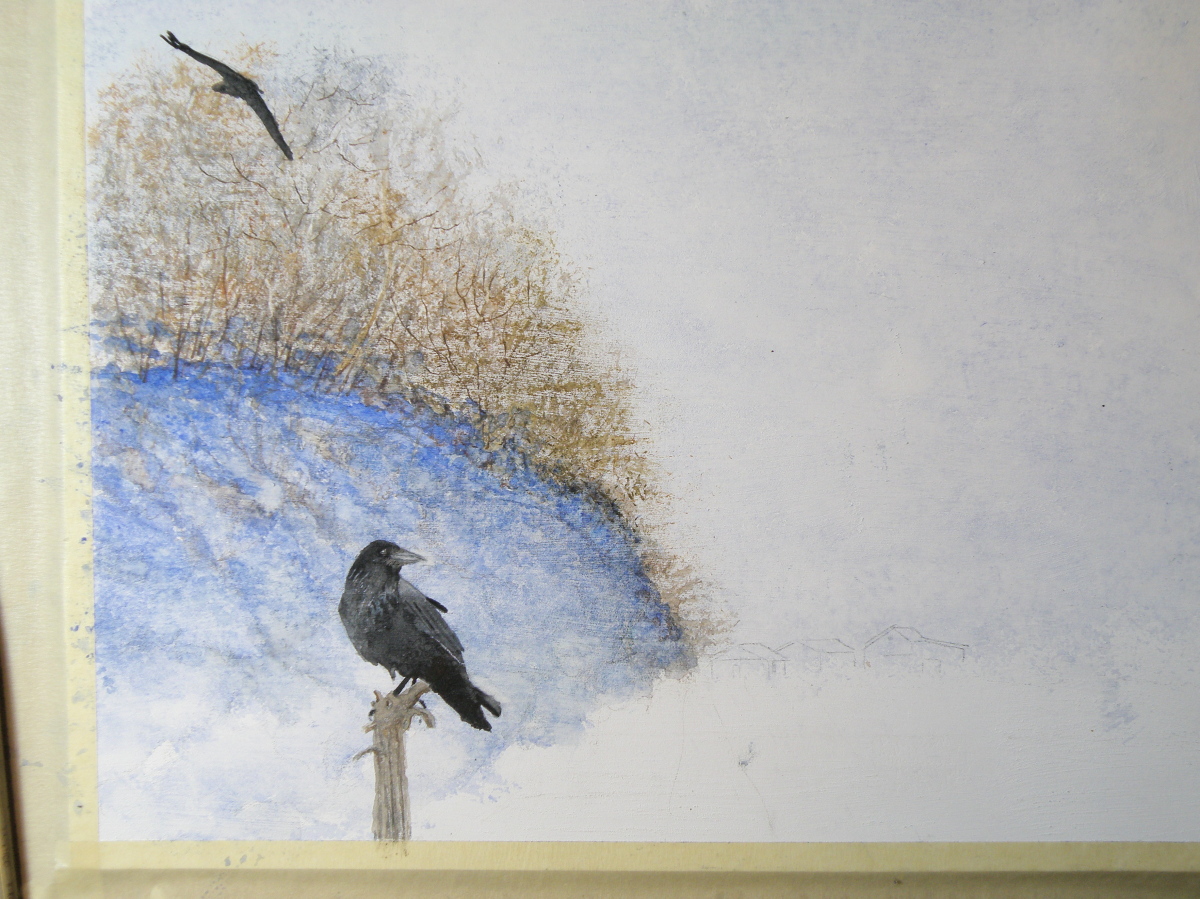
The surface for this painting is treated mat board and the medium is transparent watercolour. It is a 9″ x 12″ piece. Once it is finished I will enjoy taking it over to The Red Beard Cafe where we have our monthly coffee and seeing if she likes it. I’ll also bring a couple of others with me to provide a choice.
Stage Two: Waxwing Watercolour
February 5, 2018
1) They are named Waxing because they sport red wax-like accents on the tips of their secondary feathers;
2) Although they eat insects during Summer months, they thrive on berries the rest of the year and, in our part of British Columbia, go about in groups to feast on Mountain Ash berries;
3) If there is a cluster of berries hanging from the tip of a long branch that only a single bird can reach, sometimes the rest of the group will line up and pass berries beak-to-beak down the line allowing each bird the opportunity to feed.
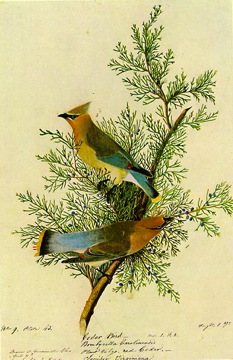
Audubon Print
Its fondness for the small cones of the eastern red cedar is why this particular Waxwing is called ‘Cedar’ Waxwing. (My first post is mistaken in assuming they are not found in Eastern N. America. They are–but I just wasn’t privileged to spot any when growing up in upper New York State.)
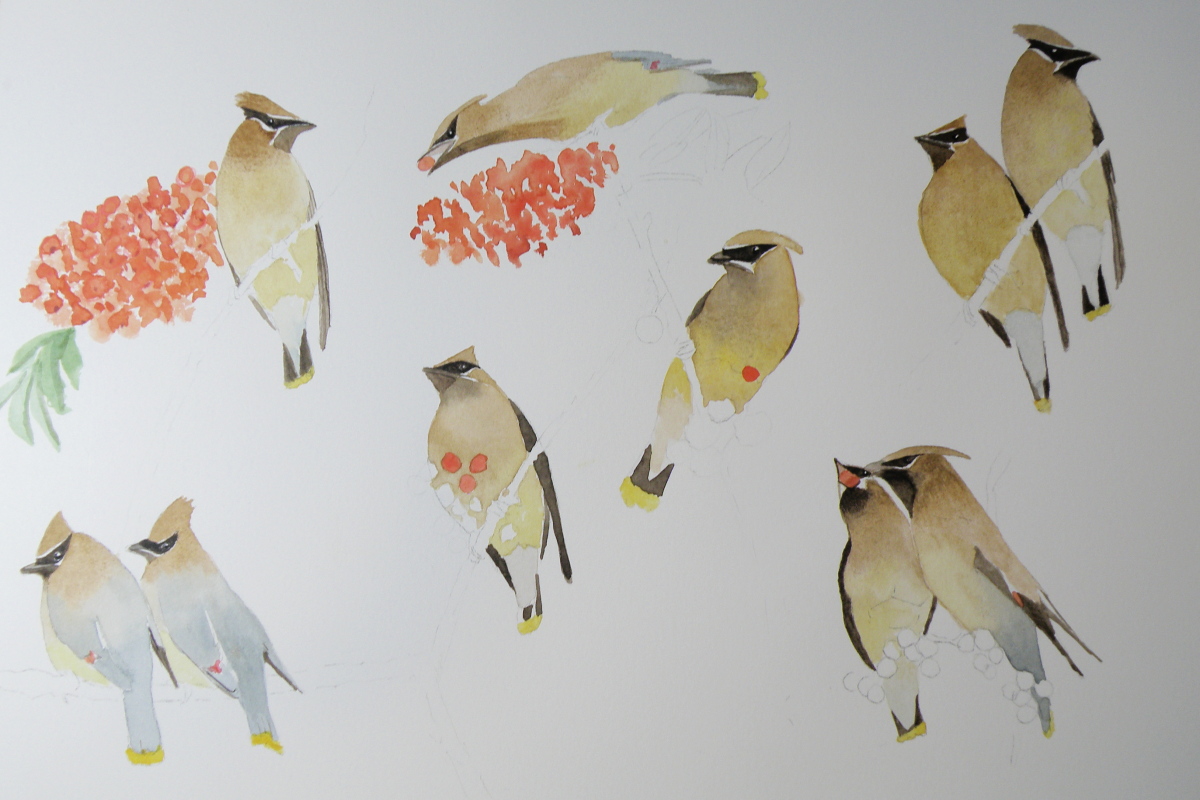
Cedar Waxwing watercolour-in-progress, Saunders Waterford Hot Press Paper 140 lb.
[above facts gathered from Cornel Ornithological and Wikipedia websites]
Work in progress: ‘An ear-full of Waxwings’
February 2, 2018
As a child there was probably no bird I wished more to see than a Waxwing. In on-location photographs they just looked so exotic and intriguing–their colouration and little tufted crowns–the whole package was and is so appealing.
In those days we lived in Eastern N. America where Waxwings aren’t found and so it took many decades–after I’d moved to British Columbia–for my chance to encounter these birds. And it happened as I stood at our front picture window looking out at the Red Maple just beyond the glass–a tree which had nestled within it a deserted Robin’s nest.
Suddenly there appeared a large group of birds I’d never before seen, Cedar Waxwings, darting about the nest, examining it animatedly and calling to one another. I watched in fascination as they systematically began dismantling this Robin’s nest, their little bandit’s masks seeming very appropriate to their deciding to make someone else’s home theirs for the taking.

‘An Ear-full of Waxwings’ — work in progress — Saunders Waterford Hot Press Paper, 140 lb.
A grouping of these birds is known as ‘an ear-full’ almost certainly because they go about in bunches and are constantly chattering in a distinctive, rather conversational voice that is more insistent than melodic or song-like, yet charming even so.
Robber Baron
January 20, 2018
From the Cornel Lab of Ornithology:
“. . . A large, dark jay of evergreen forests in the mountainous West. Steller’s Jays are common in forest wildernesses but are also fixtures of campgrounds, parklands, and backyards, where they are quick to spy bird feeders as well as unattended picnic items. . . ”
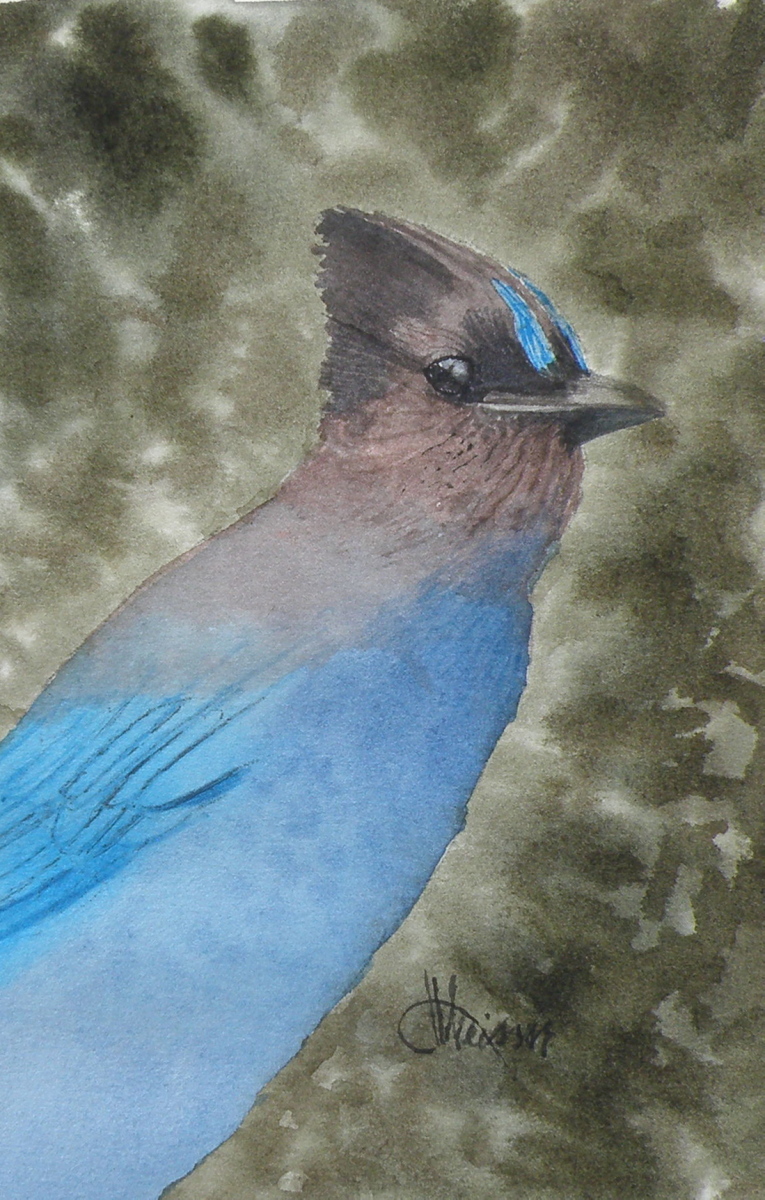
‘Steller’s Jay’, watercolour on Saunders Waterford Hot Press 90 lb., 4″ x 6″, Sold.
When we moved from Quebec to British Columbia and went camping, it was startling to hear this loud, rasping, strident taunting from high in the trees. Startling, because it was so like a Blue Jay, yet not–like a Blue Jay with the flu. And then this amazingly blue-black jay bounded down to the ground, looking up at us as though wondering why we were occupying its picnic table.
After returning from swimming, we found three of them pulling at the packaging of wrapped food and helping themselves to whatever they managed to expose. These are Blue Jays on steroids.
“. . . Steller’s Jays are habitual nest-robbers, like many other jay species. They’ve occasionally been seen attacking and killing small adult birds including a Pygmy Nuthatch and a Dark-eyed Junco. . . ” [Cornel Ornithology Lab]
But wow–how beautiful, how handsome, yes?
‘A Play of Jays’
January 13, 2018
We know the fun which comes from discovering how groups of birds are labelled and identified:
- a convocation of eagles
- a wake of buzzards
- a parliament of owls
- an exaltation of larks
- an ostentation of peacocks
Jays have two possibles–a ‘scold’, or a ‘play’–and given their feisty nature, both can be true at once. Here in Western Canada we have the Steller Jay, as well as the Whisky Jack or Grey Jay. Eastern Canada is home to the more familiar Blue Jay.
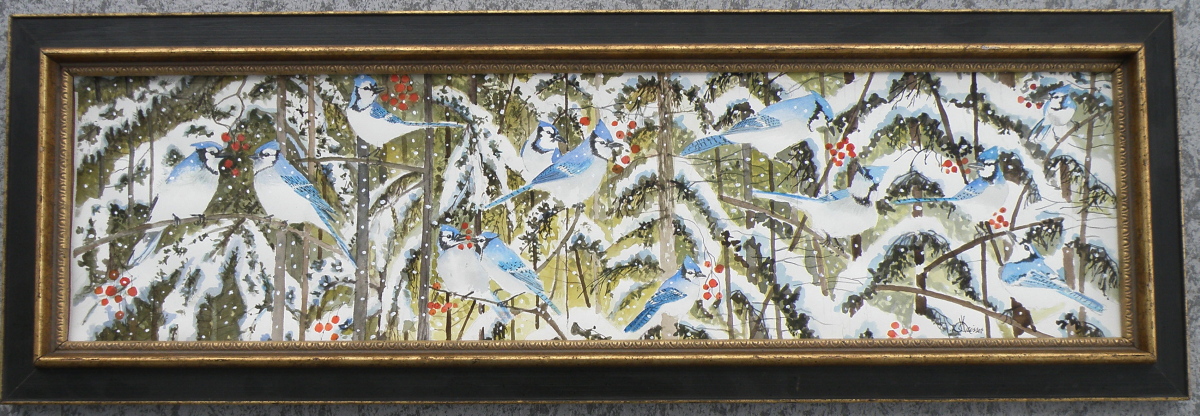
“A Play of Jays”, watercolour by Lance Weisser, 8″ x 30″, 140 lb. Saunders Waterford Hot Press Paper. Sold.
… a little Junco
May 3, 2016
My observations are that birds which winter over are more agreeable in disposition than birds which come here to breed. Case in point, Juncos, which winter over here and then head further North to breed. They are such a delightfully polite and agreeable little bird, not taken to fighting over the feeders, but rather preferring to peacefully forage below them.
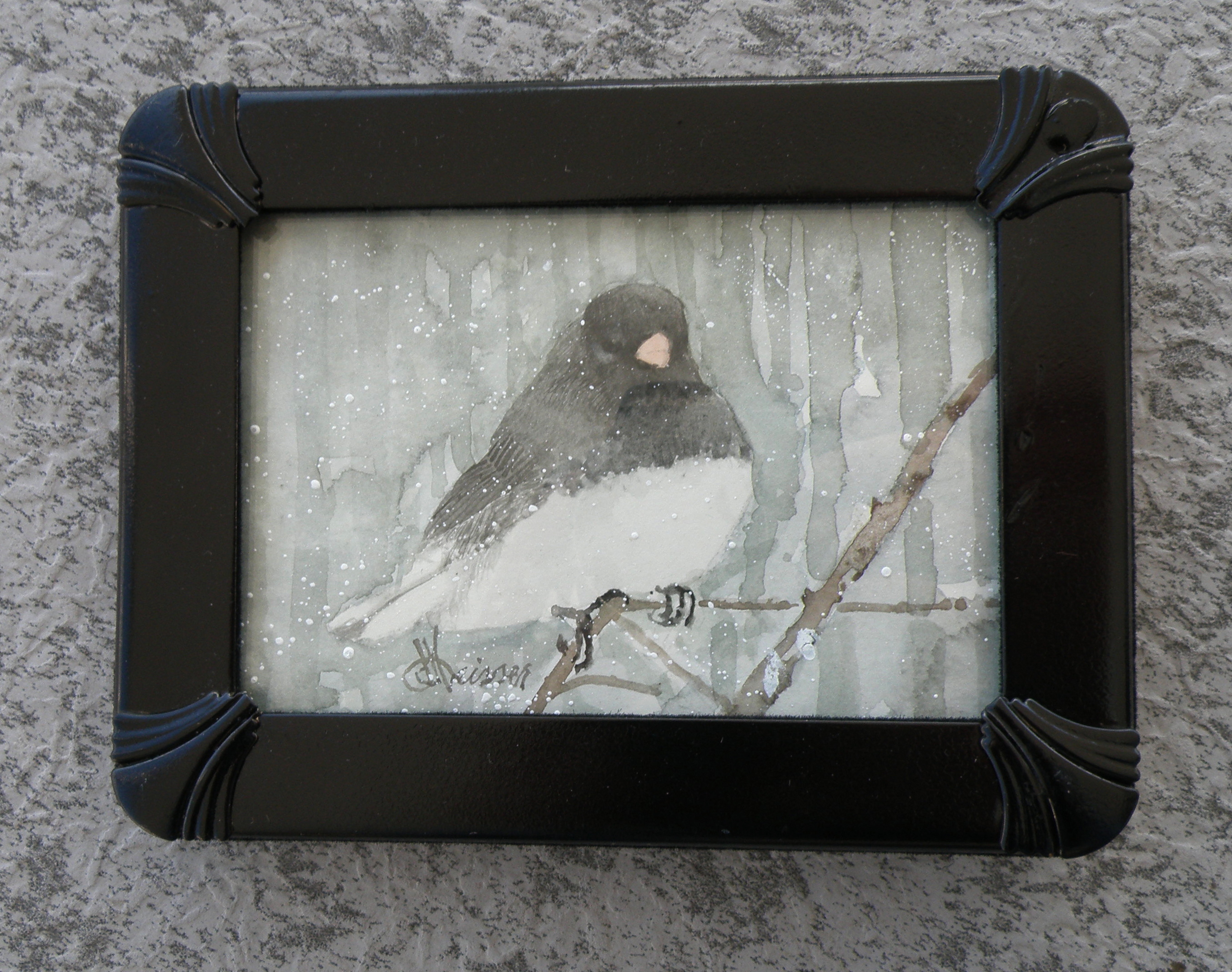
‘Dark-eyed Junco’
3″ x 5″, watercolour on Saunders Hot Press 140# Paper
On the other hand, birds which migrate here to breed, like the Common Grackle, dive-bomb me when I’m giving our dog Elmo his early morning walk, as though I am suddenly in my dotage going to start climbing trees to pull down their nests.
But blest be the birds which come here to winter over, like the so-lovely Common Redpoll and the Dark-eyed Junco. Although extremely territorial when nesting, we get to see Juncos when sex is the furthest thing from their bird-brained minds and finding seeds on the snow is all they care about.
Some birdie facts:
- Juncos are the “snowbirds” of the middle latitudes. Over most of the eastern United States, they appear as winter sets in and then retreat northward each spring. Some juncos in the Appalachian Mountains remain there all year round, breeding at the higher elevations. These residents have shorter wings than the migrants that join them each winter. Longer wings are better suited to flying long distances, a pattern commonly noted among other studies of migratory vs. resident species.
https://www.allaboutbirds.org/guide/dark-eyed_junco/lifehistory
….cedar waxwing
April 23, 2016
As a kid, having to enter the annual Science Fairs in Jr. High–the ones where invited experts walked around with clipboards trying to find possible prize winners–I had exhibits which were often concerned with birds–songbirds, usually–their migration patterns and predators, and fun facts.
I never won a prize. That usually went to kids who electrocuted themselves voluntarily in order to prove water and wires don’t mix–or the kids who cross fertilized seeds and created vegetative freaks.
The shortlist I had then in the 50s (living in upper New York State) was to see any kind of Bunting (they looked outrageously colourful), our State Bird the American Bluebird (which I never did see, and still haven’t), any kind of Tanager, and of course, any kind of Waxwing.
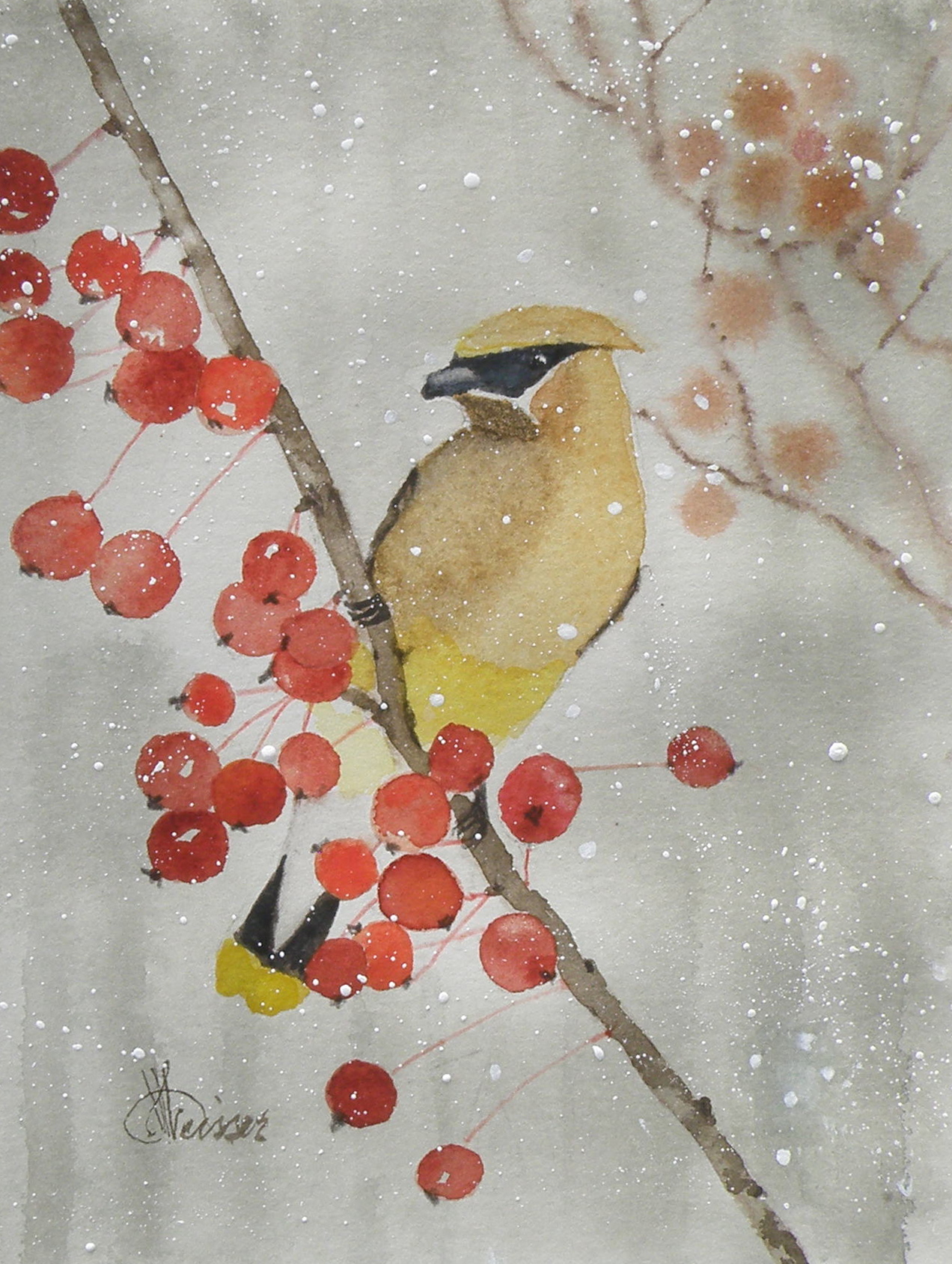
“Berry Picking”
Cedar Waxwing, 4″ x 6″, watercolour, Saunders Waterford Hot Press 140# Paper
Having lived now in seven different Canadian locations, from coast to coast, I’ve been able to photograph a Western Tanager in our front garden, a pair of Mountain Bluebirds (astonishingly blue), and a group of Cedar Waxwings which descended on our Red Maple branches and began dismantling a Robin’s nest, rather than having to bother scavenging their own material.
The Waxwings were much smaller than expected, and every bit as fascinating as I’d hoped. Their ‘bandit’s mask’ gives them an allure other birds lack, and their interesting ‘song’ and penchant for travelling about in flocks makes them worth having to wait 60 years to see them.
….Chickadee Miniature
April 21, 2016
This Winter along with the usual Mountain Chickadees at our feeders, we were pleased to have Black-Capped Chickadees as well. Coming from Eastern parts, they are the ones associated with childhood and so have a special place for me.
Right now we are experiencing amazingly warm temperatures–85F (30C)–and gardening is ramped up as a result. Dividing time between perennials and painting is a pleasure. As an Autumn and Winter person, I continue painting with that pallet of tones and colourations, and so ask you to cut some slack if/when I post snow scenes in April.
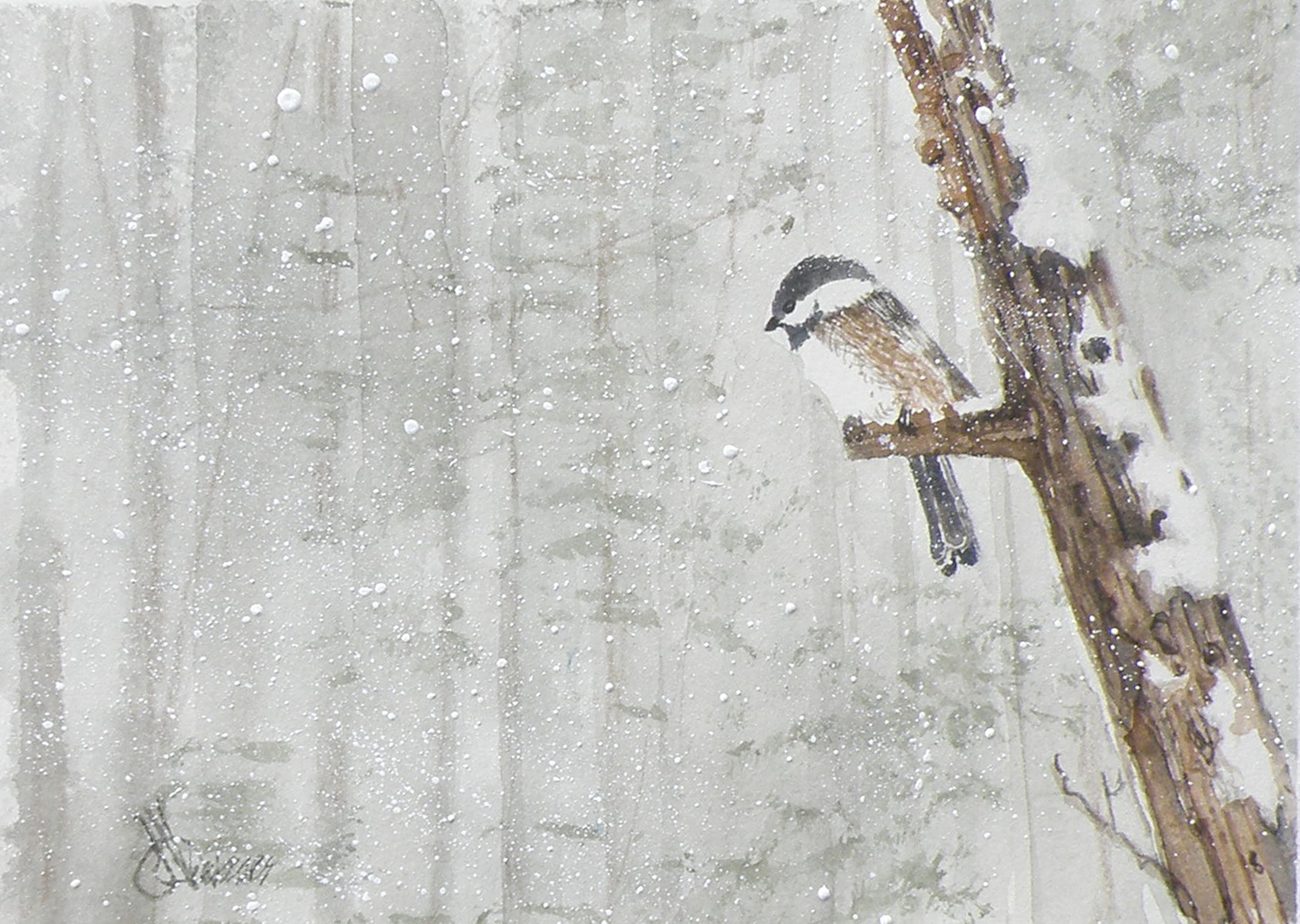
‘Pause That Refreshes’
5"x 7", Watercolour, Saunders Hot Press #140 paper
Cool Facts
- The Black-Capped Chickadee hides seeds and other food items to eat later. Each item is placed in a different spot and the chickadee can remember thousands of hiding places.
- Every autumn Black-capped Chickadees allow brain neurons containing old information to die, replacing them with new neurons so they can adapt to changes in their social flocks and environment even with their tiny brains.
- Chickadee calls are complex and language-like, communicating information on identity and recognition of other flocks as well as predator alarms and contact calls. The more dee notes in a chickadee-dee-deecall, the higher the threat level.
- Winter flocks with chickadees serving as the nucleus contain mated chickadee pairs and nonbreeders, but generally not the offspring of the adult pairs within that flock. Other species that associate with chickadee flocks include nuthatches, woodpeckers, kinglets, creepers, warblers and vireos.
- Most birds that associate with chickadee flocks respond to chickadee alarm calls, even when their own species doesn’t have a similar alarm call.
- There is a dominance hierarchy within flocks. Some birds are “winter floaters” that don’t belong to a single flock—these individuals may have a different rank within each flock they spend time in.
- Even when temperatures are far below zero, chickadees virtually always sleep in their own individual cavities. In rotten wood, they can excavate nesting and roosting holes entirely on their own.
- Because small songbirds migrating through an unfamiliar area often associate with chickadee flocks, watching and listening for chickadee flocks during spring and fall can often alert birders to the presence of interesting migrants.
- The oldest known wild Black-capped Chickadee was at least 11 years, 6 months old when it was recaptured and re-released during banding operations in Minnesota.
source: https://www.allaboutbirds.org/guide/Black-capped_Chickadee/lifehistory
….House Finch miniature
April 16, 2016
It is so heartening to have requests from bloggers and site visitors who have arranged to have original bird miniature paintings sent to them. The last posting of the Raven miniature, “Keeping Watch”, is currently winging its way to Hawaii, and the March 5th miniature entitled “Raven Moon” is sitting on Byron’s desk in Wisconsin. Another of a wintering Chickadee is with its new owner, Cynthia the poet, https://littleoldladywho.net/ in Maine.
Some bird species are seemingly germain to just about anywhere, the House Finch being one. When we moved from Eastern Canada to extreme Western Canada, there they were. And on fellow blogging sites like H. J. Ruiz’ Avian 101 (https://avian101.wordpress.com/), there they are in the Peach State of Georgia.
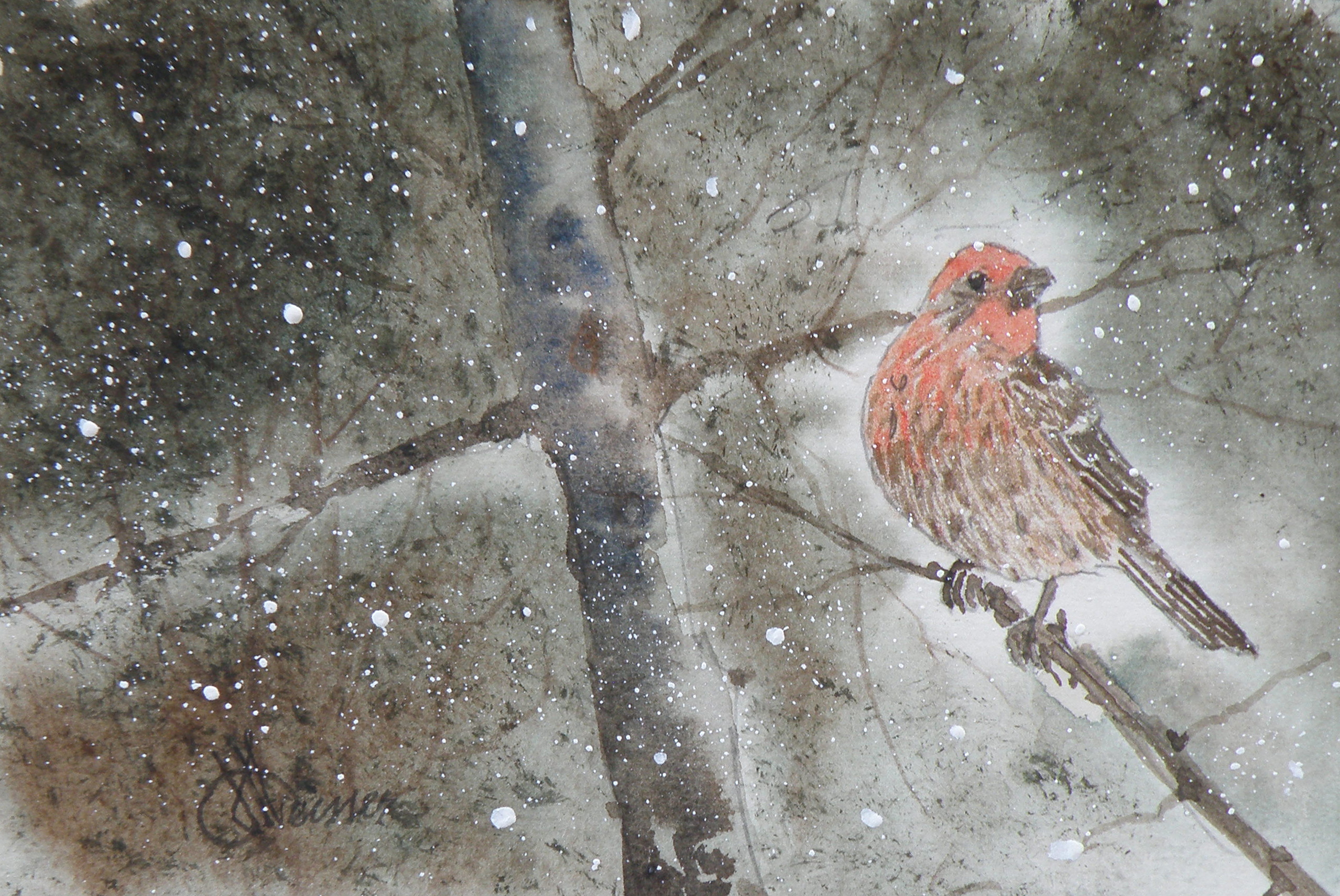
‘House Finch’ — watercolour on Saunders Waterford 140# Hot Press Paper, 2.5″ x 4″
They are, along with wintering Goldfinches, the most frequent visitor to our feeders, and have such a delightfully melodious song. Unlike the slightly larger Purple Finch which probably isn’t found in the West, they do not so much look like they’ve been dipped in raspberry concentrate, as they’ve stuck their heads in wild cherry cream soda. Their disposition is mild, insofar as they aren’t pushy or argumentative when at the feeders. If another species is bossy, they simply flit down to the snow and eat the remains below, along with the Juncos.
If you are ever interested in owning one of these posted bird miniatures, simply email me at: weisserlance@gmail.com and we’ll work out the arrangements. Thank you to all who are so very supportive in comments and visits!
 weisserwatercolours