….Raven rave
March 9, 2016
Having found a frame the perfect colour and size for a larger version of the Raven painting done a few days ago, this is turning out to be a Raven rave of sorts, this time a little more wintry.
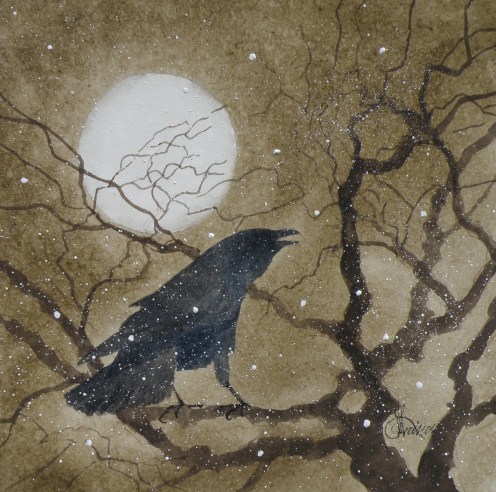
7″ x 7″ on Arches Hot Press #140 paper
….draw a bird day
March 8, 2016
Teresa Robeson reminded me of ‘bird day’ (https://wordpress.com/read/feeds/4736591/posts/949345080#comments) with her striking rendition of an exotic Araripe Manakin from Brazil.
Here is a far more humble (don’t tell it that!) species, but at least I’m doing my birdy duty this Tuesday morning…..
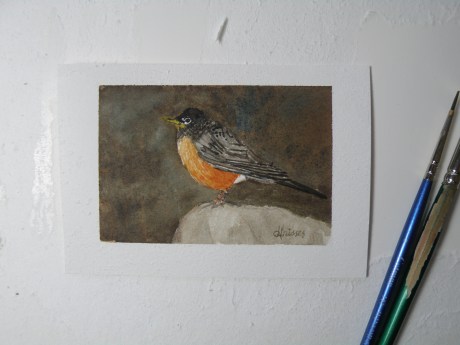
1.5″ x 2″ on Arches Hot Press 140# Paper
I saw my first one two weeks ago–around the third week of February–which is so early for this region, it is nuts. When they get here, they go for Mountain Ash berries and other withering, over-wintered types of fruit, until their usual fare of insects and worms become accessible. They are in breeding mode preoccupied with all their parental preparations.
….Raven Moon
March 5, 2016
Ravens sell very well in this neck of the woods, partially because they figure so prominently in our local Native legends–and partially because they are, as a species, so singular and distinctive. A customer pointed out to me that whereas Crows are very social (gathering together in great numbers), Ravens are solitary. Perhaps one of you can verify this comment–or add a correction?
This painting is 2.75″ x 1.75″ and, instead of putting it behind glass for protection, the decision was made to spray it with a durable fixative so the piece has more immediacy when viewed. I did include the glass in case the customer wishes to provide greater protection.
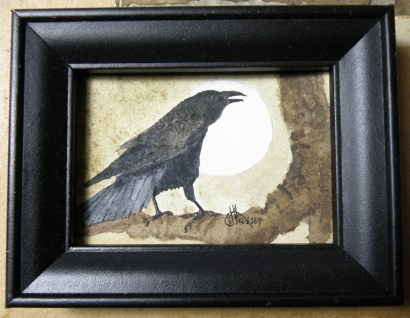
These bird miniatures can also be purchased from me through weisserlance@gmail.com for $30US (postage costs additional) unframed, $35US framed. Some buyers have chosen to select a suitable frame themselves locally and then email me the size the painting must be to fit their chosen frame. Then it is simply a matter of mailing off the painting in an envelope–easy-peasy. I have painted everything from someone’s favourite parrot (our late, great friend George Weaver’s prize pet) to exotic birds seen on a favourite trip and painted from a photograph supplied via attachment.
…. composition exercise conclusion
February 27, 2016
Results of ‘composition exercise 1’: dividing a landscape into thirds, placing visual interest at each intersectional point….
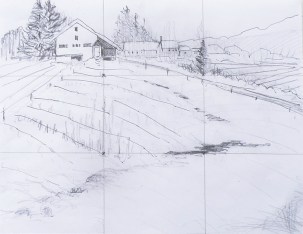
Results of ‘composition exercise 2’:
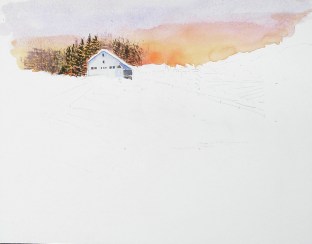
and 3:
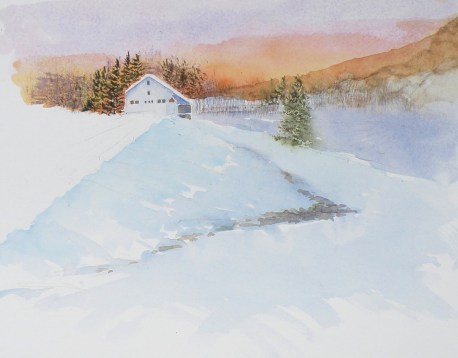
bringing us to 4:
It has taken a long spell of waffling over what to do about being less than pleased with the finished piece. The snowy fields seemed to extend themselves too far down, without enough visual interest to hold a viewer’s attention. And then I gave into the temptation/artistic trap I almost always seem to fall into, which is going one step too far by defining open field with regimented rows of corn which wind up being so monotonous, the fence posts going the opposite direction only add yet more visual predictability and kill whatever freshness the piece had going for it.
….so the only satisfactory outcome was to crop the painting and salvage what could be salvaged.
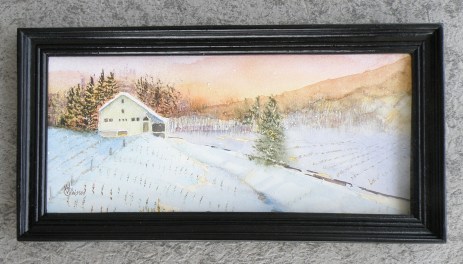
It is a very small painting, about 6″ x 12″, and has at least enough mood still going on to make it only just worth framing.
As an exercise, however, it was more than useful, and confirmed satisfactorily that placing interest at intersectional points within a composition divided into thirds works (sans rows of corn, that is), does hold one’s attention, and lends a feeling of balance.
…. Robin miniature 2
February 12, 2016
It has been an unsettlingly warm Winter here in interior British Columbia, with Spring bulbs actually starting to poke up through the ground. Unsettling, because being only mid-Winter, we might well suddenly get one of those Arctic inflows and see temps plunge to -20C, which would effectively ruin what shouldn’t have already begun sprouting, including fruit trees.
It wouldn’t be surprising at all to actually see Robins returning in February, when their normal return isn’t until mid-March. Being such avid worm-hunters, I have wondered at their early returns here, particularly as to what they find to eat. The answer is the Mountain Ash berry and other lingering berries. The danger, apparently, is eating ones which have fermented, thereby becoming naturally alcoholic and responsible for killing birds who eat too many.
This miniature is of the British/European Robin, which doesn’t reside in Canada. But English Robin miniatures are snapped up in our Gallery simply because they have established such a rich literary following, and also appeal to Canadian emigres.


The difficulty painting a bird the painter has never seen–and therefore isn’t familiar with–means it may not be true to how the bird actually looks. However, this particular bird has so frequently been depicted in book illustrations and greeting cards, that its persona lives beyond its ‘real life’ comings and goings. So here in Canada, getting the English Robin ‘right’ isn’t as stringent a matter as getting the Canadian Robin right–a bird everyone is familiar with, and therefore has to be flawlessly rendered.
They seem so very sweet.
…. belated draw a bird day
February 9, 2016
It has become ‘belated everything’ for me lately…so why not this as well.
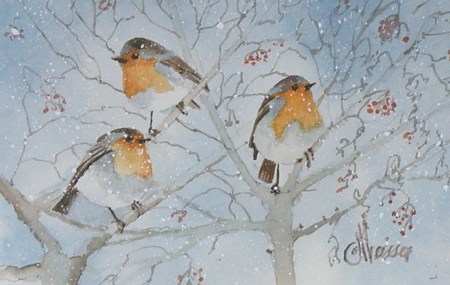
2.5″ x 3.75″ watercolour on Arches Hot Press 140#
We’ve come to know this as the English Robin (at least here in Canada), though I see it referred to elsewhere as the European Robin (which of course no Brit would ever go for).
Here are some (possibly) little-known tidbits about it: “. . . The distinctive orange breast of both sexes contributed to the European robin’s original name of redbreast (orange as the name of a colour was unknown in English until the sixteenth century, by which time the fruit of that name had been introduced). In the fifteenth century, when it became popular to give human names to familiar species, the bird came to be known as robin redbreast, which was eventually shortened to robin. As a given name, Robin was originally a diminutive of Robert . . . ” [ Lack, D. (1950). Robin Redbreast. Oxford: Oxford, Clarendon Press. p. 44]
Personally, I have never seen this bird except depicted and written about in stories like “The Secret Garden”. But whenever I paint a miniature of them, it is purchased very quickly, and usually by a homesick, transplanted member of a country ‘across the pond’. It would be a treat to see them in their natural setting.
…. mackerel sky
January 29, 2016
There is an Old English saying about weather which goes: “Mackerel scales and mare’s tails make tall ships carry low sails”. ‘Mackerel scales’ refers to Altocumulus clouds which (to some) resemble the markings on the sides of mackerel. ‘Mare’s tails’ refers to Cirrus uncinus clouds which–according to the saying–must, like mackerel scales, indicate strong winds, though the two types wouldn’t likely appear together in the same sky.

The subject is taken from a view of the British Columbia coast, beaten down by the effects of storm after storm. Having lived on Vancouver Island at one point, the weather forecast for the most northerly tip seemed to nearly always call for wind and rain which made me thankful we lived on the most southerly end. We received quite enough rain as it was. However, seldom was it ever a pelting, all-out soaking torrent–which made local people say to tourists complaining about the constant drizzle, “Yes, but it’s a dry rain.”
This was painted on treated illustration board.
…. Tranquille Creek Gorge
January 21, 2016
The watercolour video demonstrations of David Dunlop are challenging and yet simple. https://www.youtube.com/watch?v=Lgtg-Adql1Y&index=6&list=PLtEJwQmsB7SvVg8C4J2c4LDijerH7SSKF (I tried to embed the video itself in this post, but WordPress thought otherwise). But here is the blurb describing it….”Emmy Award winning David Dunlop takes you to his Connecticut studio to demonstrate a two minute watercolor, used as preparation for an oil sketch or to explore ideas“.
Mr. Dunlop is an artist/teacher from Connecticut, whose manner when teaching is inspiring and animated. He is a great follower of descriptive, energetic Masters like J.M.W. Turner and Winslow Homer, and seeks to employ their methods, while demonstrating their techniques.
The video cited above challenges painters to do two to three minute painting sketches, which convey the movement and mood and spirit of the subject, without stopping to think and rework. In an effort to ‘do’ and not think, the subject chosen here is a favourite–a place about 20 minutes from our house–called Tranquille Creek Gorge.
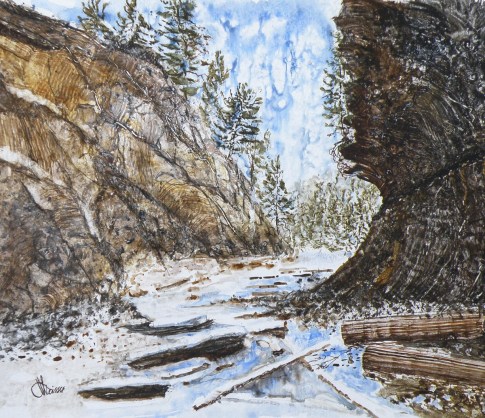
Mr. Dunlop’s videos are quite dynamic and aimed more at oil painters a bit more than watercolourists, but full of very encouraging lessons because of the force of his optimistic personality and sense of fun. They are well worth watching, for those who enjoy painting as a means of expression.
….composition exercise 2
January 17, 2016
Continuing on with an attempt to test out the compositional dictum known as ‘the rule of thirds’, which was conceived and named by John Thomas Smith in 1797 :
“. . . Analogous to this “Rule of thirds”, (if I may be allowed so to call it) I have presumed to think that, in connecting or in breaking the various lines of a picture, it would likewise be a good rule to do it, in general, by a similar scheme of proportion; for example, in a design of landscape, to determine the sky at about two-thirds ; or else at about one-third, so that the material objects might occupy the other two : Again, two thirds of one element, (as of water) to one third of another element (as of land); and then both together to make but one third of the picture, of which the two other thirds should go for the sky and aerial perspectives. . . “
To illustrate its basics…..

Once again, this is the drawing I did initially, to put this into practice….
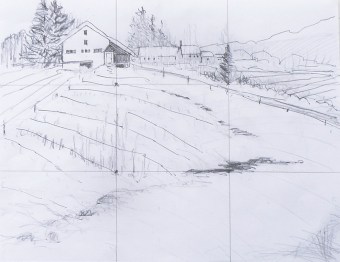
And this is the first go at painting the scene….

And now today, here is the progress so far, attempting to locate some visual interest at each of the four intersections within the piece, the barn being the first and the pine being the second and the creekbed being the third…..
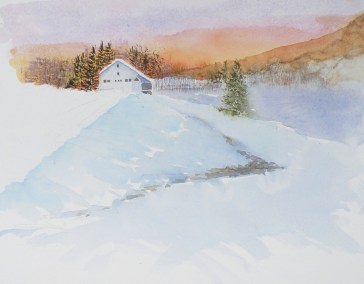
The darkest darks and greatest contrast will remain with the barn, for that is the intended focus for the picture, when completed.
The ‘rule of thirds’, as stated above, holds that generally two-thirds of a landscape be devoted to the sky, with one-third given to the land below (the sky being such a vast and dominant feature). In this case two-thirds is dedicated to the land and a very high horizon means that the one third is devoted to the sky area.
….the silt bluffs
November 22, 2015
An area east of Kamloops, B. C., follows the South Thompson River which flows between dramatic limestone cliffs originally formed (it is estimated) 270 million years ago.
Among those cliffs is a gully–a waterworn ravine known as ‘the silt bluffs’, featuring very distinctive rock formations which have the look and feel of something out of a Western movie.
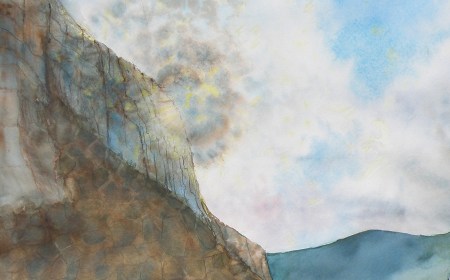
Massive geological formations such as these require some form of treatment by a painter in order to adequately convey their uniqueness and grandeur. This watercolour attempts to do that by purposely choosing to paint directly into the sun.
This part of our landscape gets quite literally baked by heat at midday, so when painting outdoors it is important to get it done quickly.
….a little nuts
November 20, 2015
Quite some months ago I asked Jackie of ‘Lost In Thought Photos’ (https://lostinthotphotos.wordpress.com/) for permission to do a miniature based on her wonderful photograph of a little tree squirrel.
Jackie very kindly agreed and emailed me back a very fine image of what –based on its colouration– appears to be a Fox Squirrel, which, even the most hardened rodent defamer would have to be a little nuts not to admit is cute.
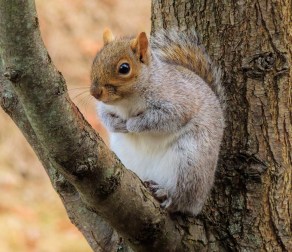
Here’s how they are described in Wikipedia: “. . . Fox squirrels are strictly diurnal, non-territorial, and spend more of their time on the ground than most other tree squirrels. They are still, however, agile climbers. They construct two types of homes called ‘dreys’, depending on the season. Summer dreys are often little more than platforms of sticks high in the branches of trees, while winter dens are usually hollowed out of tree trunks by a succession of occupants over as many as 30 years. Cohabitation of these dens is not uncommon, particularly among breeding pairs. . . ”
Besides their cuteness, it is charming that they are non-territorial, and have been known to share their homes. That is certainly not true for a great many squirrels, who seem to busy themselves hurling insults and chasing rivals all day long.
Hunting for frames is fun, losing myself in one or some of our ten or so 2nd hand stores, and recently resulted in this very nice (likely faux) leather 5″ x 7″ one for $.75. It allows this little painting to sell for $35.
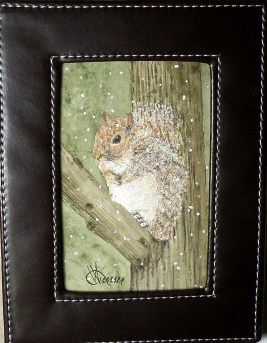
Our little Gallery keeps 20% commission. So many thanks to Jackie at https://lostinthotphotos.wordpress.com/ !
composition woes….
May 3, 2015
MY GREATEST CHALLENGE when painting anything is composition. For years I felt I was being a ‘purist’, insisting that I always paint on location, never in a studio setting. And once at the location, I convinced myself that if a tree was in that spot, then that was how it needed to be depicted.
IT WAS ALL DUE TO my tendency to early-on stop referring to the subject in front of me and become more and more involved in what was happening on paper, to the point where I may as well have not been on location at all. So in an effort at self-discipline, I decided that not only should I paint what things actually look like, I shouldn’t muck around with how and where ‘mother nature’ placed them.
THE SILLY THING WAS, I ended up choosing a composition by default because of course, I couldn’t paint everything my eyes saw in front of me. And more often than not, it was not a good composition. So now, not only do I go to some lengths to study the skill of creating an interesting arrangement, I realise it is the painter’s task to take what ‘mother nature’ provides and make art out of that. Fences do need to be repositioned, as do trees and hills and clouds.
SO NOW I MAKE thumbnail studies first on matt board before beginning anything . . .
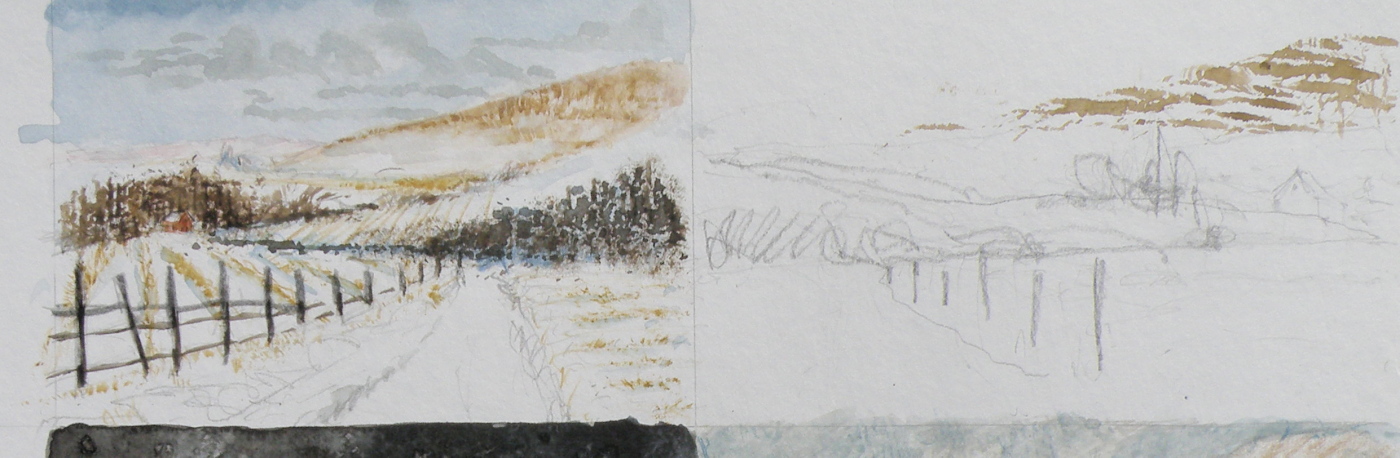
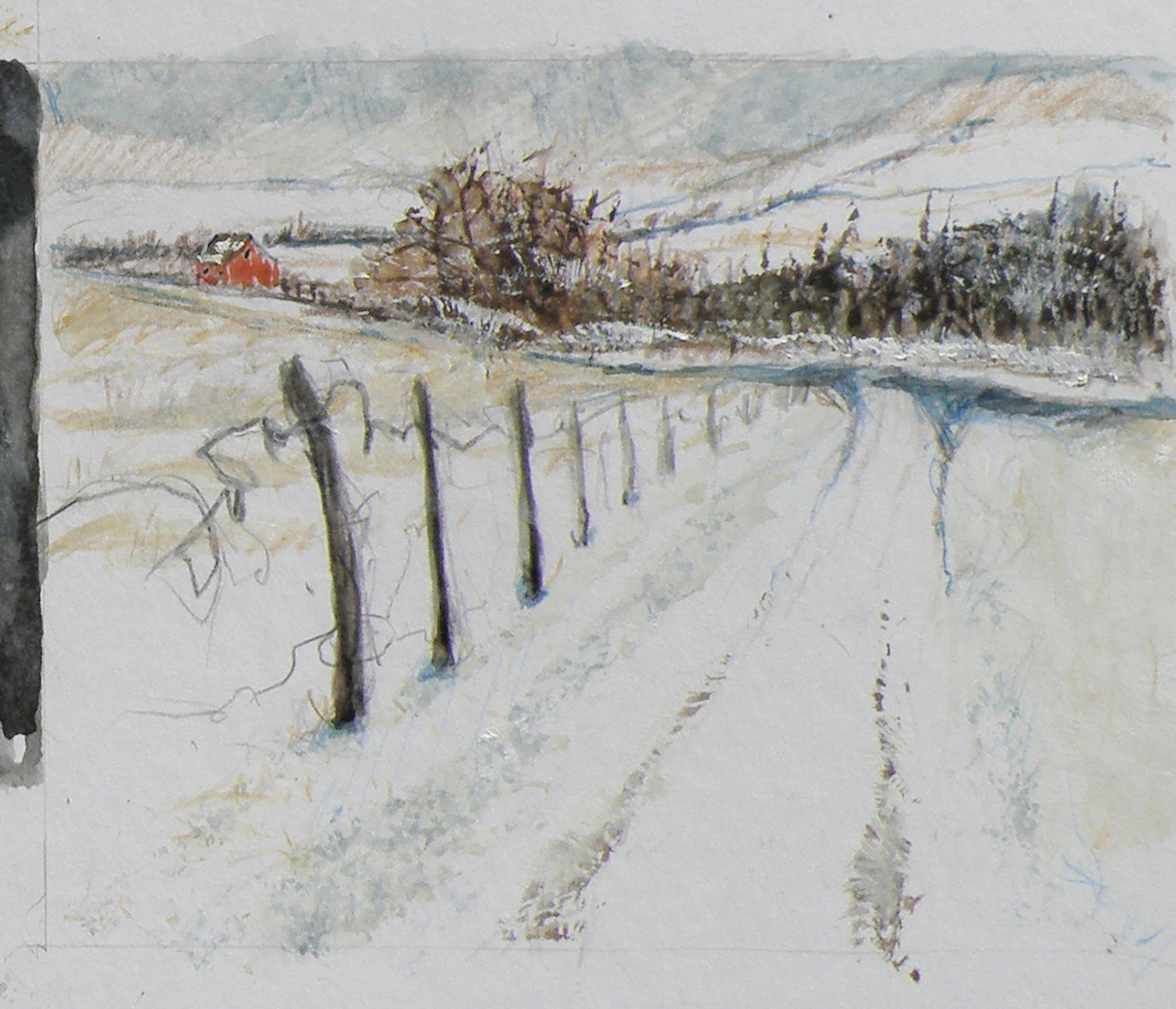
THE OBJECTIVE is to provide a focal point, a visual way in towards it, then additional visual interest so the eye has more to discover by wandering beyond the subject itself. These thumbnails are exploring the use of a compositional figure ‘Z’ shape to lead the eye of the viewer.
the stuff of watercolour
April 22, 2015
WATERCOLOUR is simply a mixture of pigment (ground-up minerals: organic and synthetic) held in a semi-solid form by a binder (usually gum arabic). In days of yore (not that long ago)–this was sold in little square cubes, called pans or cakes. The pans are ‘activated’ by adding a drop of water to them, causing the gum arabic to dissolve enough for the pigment to loosen and adhere to the brush tip.
TODAY IT IS DIFFICULT (for me) to find the pans, which have only pigment and a touch of gum arabic in them. Today everything is sold in tubes. This isn’t because tubes are so superior. No. It is because the painter gets stuff like water, glycerin, corn syrup, and who-knows-what-else, and only then, some pigment. . .

I HAVE PANS (winsor newton) which are 40 years old and just as good and useable as ever.

DO YOU THINK my pallets are messy? Have a gander at the pallet of one of the most renowned watercolourists, ever–Winslow Homer . . .

FROM THIS MESS he painted this . . .
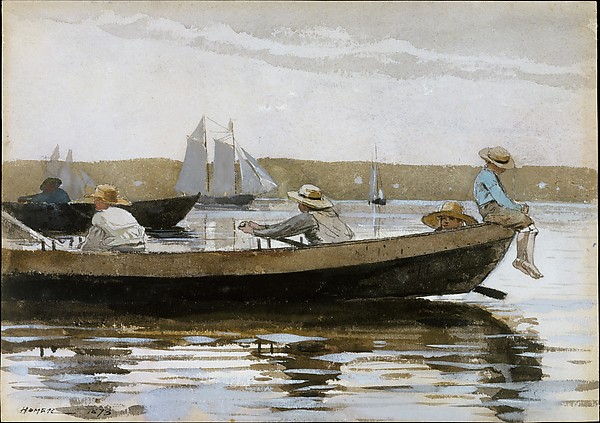
“Boys In A Dory”, Prouts Neck, Maine, Metropolitan Museum of Art, Winslow Homer, 1873, 25cm x 35cm, watercolour on paper
The only comparison which has any remote bearing is the messiness of our pallets. Other than that, watercolour painters of my calibre only stand in awe of his eternal greatness.
BEFORE YOU GO, do have a look at another of Winslow Homer’s delicious watercolours . . .
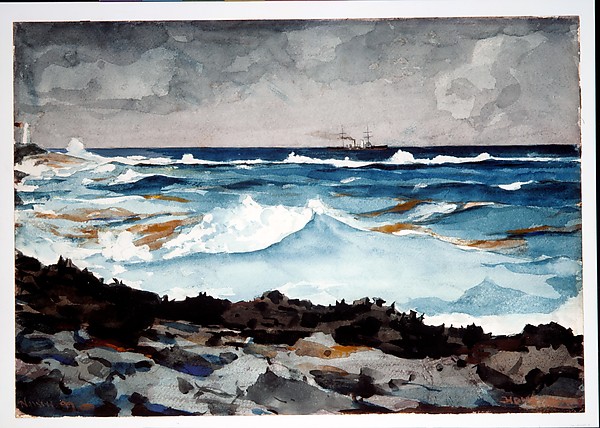
“Shore and Surf, Nassau”, Winslow Homer, 38cm x 54cm, 1899, Metropolitan Museum of Art
WOW. This man did not paint over top of washes (except to strengthen the intent of the line) allowing the whiteness of the paper to pass through, dazzling the eye. And adding even more punch, Winslow Homer did not shrink from placing great and deep darks right beside the lightest lights, thus heightening the power of the contrast. What a master. Wow.
The Common Raven (corvus corax)
April 21, 2015
THE COMMON RAVEN is amply represented in British Columbia and enjoys the distinction of co-existing with people for thousands of years, to the point where–in Haida Nation tradition–the Raven has god-like qualities. It was the Raven which released the Sun from its little box–made the stars and moon–and even brought people out of the earth in order to populate a party being thrown. But in traditional stories Raven doesn’t actually create (make things out of nothing), so much as steal, exchange, rearrange and redistribute and generally push things around into new combinations. If that isn’t humanlike, I don’t know what is, lol.

“Spring Thaw”
watercolour on art board, 20 cm x 28 cm (8″ x 11″), sold
In Kamloops it is against the law to feed them, as well as crows. A buyer of my work named Joan pours bags of cat kibble into her elaborate and large cement bird baths in the Winter and revels in their continuous, noisy presence. The neighbours? not so much. When they report her, she just pays the fine and keeps at it.
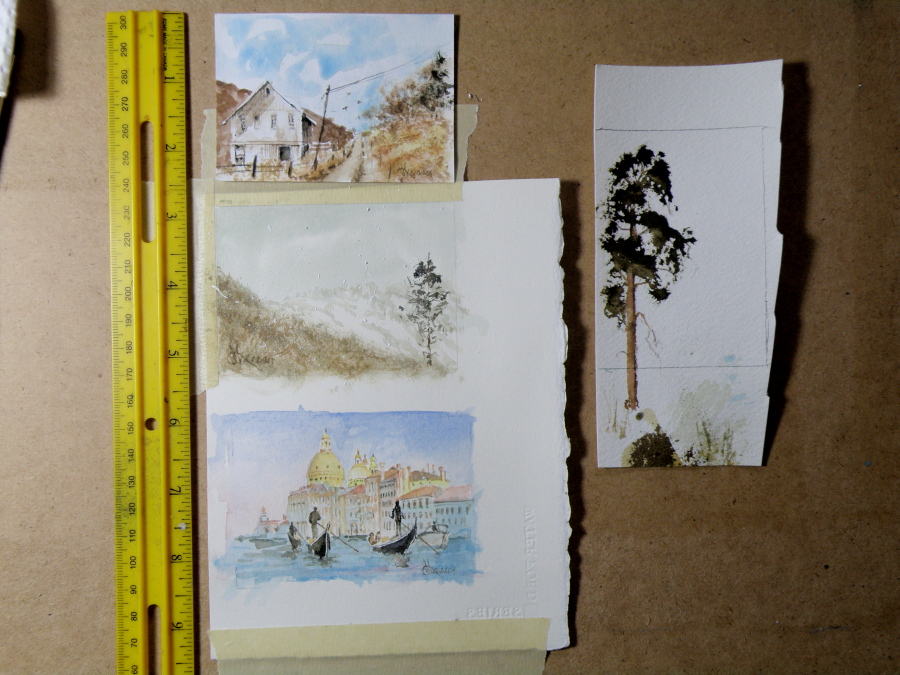
ACEOs (Art Card Editions and Originals)
April 20, 2015
ARTIST TRADING CARDS aka ART CARD EDITIONS AND ORIGINALS are popularly known as ACEOs. ACEOs are the size of baseball cards–65mm x 89mm (2.5″ x 3.5″) and are purchased and then traded and sold the way sports cards are. The ACEO movement originated in Switzerland in the 90s but grew in popularity through eBay, where art cards are now sold and bought on a 24hr basis.
They require precision and are very enjoyable to do. But then, who wouldn’t be fascinated by the challenge of painting tiny things (smile). The subject matter can be chosen by the purchaser, and the painting done accordingly.
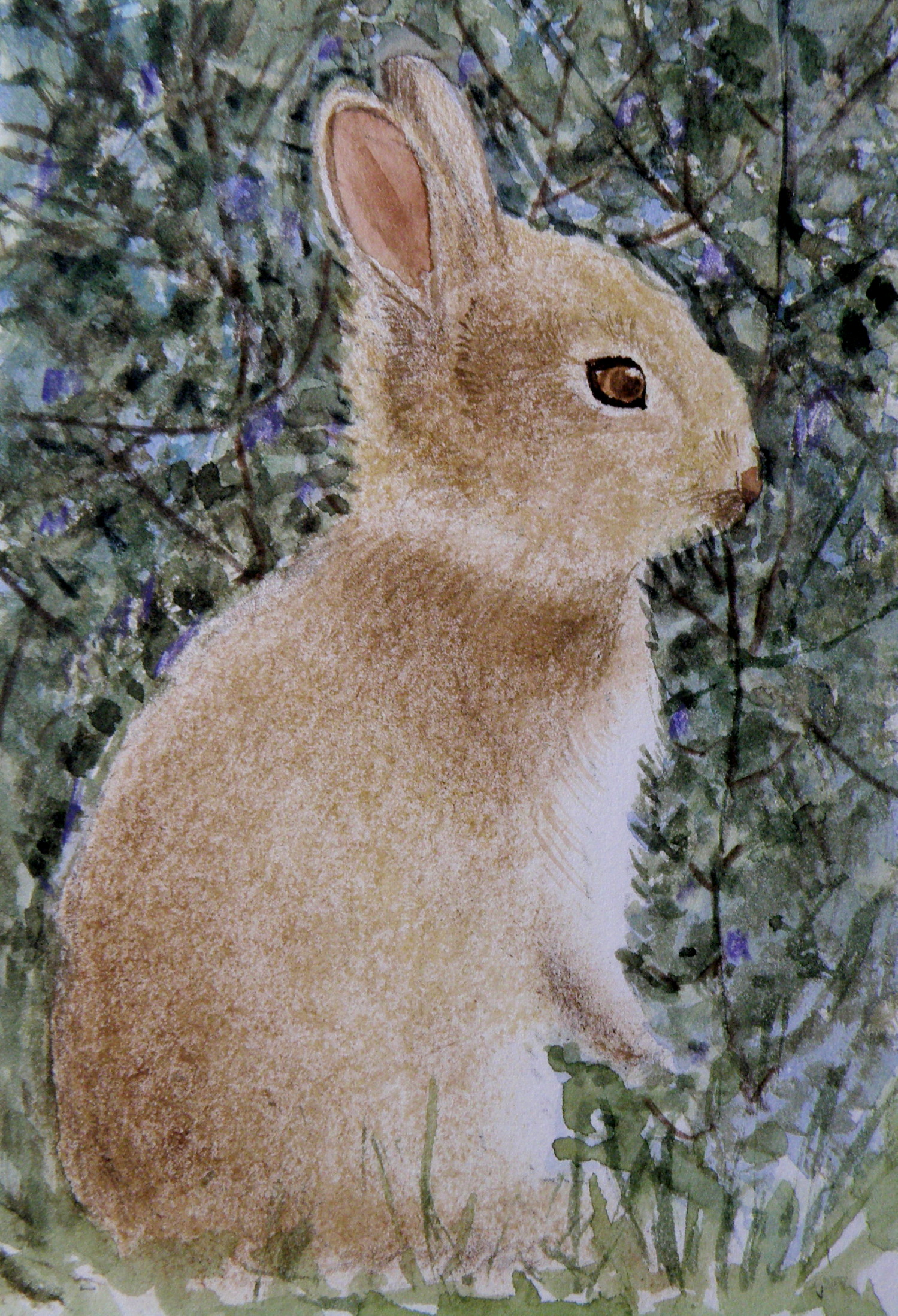
Spring means….bunnies
April 17, 2015
Finished work….”Logged-In”
April 16, 2015
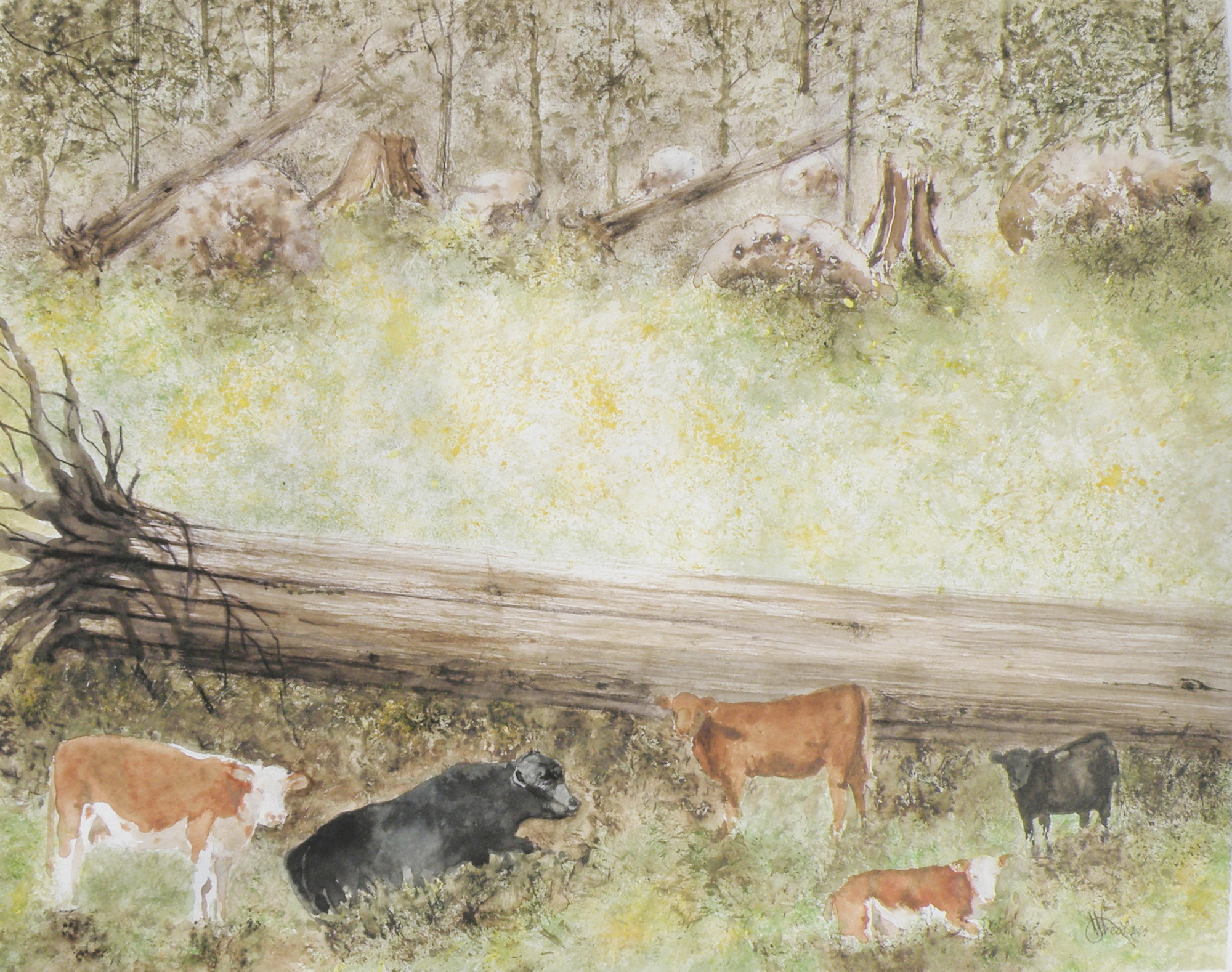
“Logged-In”, 25.5 cm x 35.5 cm (10″ x 14″), Watercolour on Arches 140 lb Hot Press paper, (donated to Kamloops Art Gallery Annual Art Auction)
painting progression 4 . . . “Cows”
April 15, 2015
THESE ARE BEEF COWS, Herefords, the breed most favoured by ranchers in our region. Their origins descend from small red cattle introduced by The Romans in ancient Britain, along with breeds from old Wales, their subsequent nurtured evolution taking place in Herefordshire where the Hereford is king. Today more than five million pedigree Hereford cattle exist in over 50 countries.

BECAUSE THE LARGE FALLEN CEDAR is indicated with only a minimum of brushwork it is necessary to help give it size, weight and substance through the simple use of shadow.
painting progression 3 . . . . “Cows”
April 14, 2015
THE SUBJECT MATTER comes from this photo, very quickly taken when we’d stopped the car on the dirt road running through The Dewdrop Valley (just outside the city limits of Kamloops) after I’d yelled, ‘Cows!’
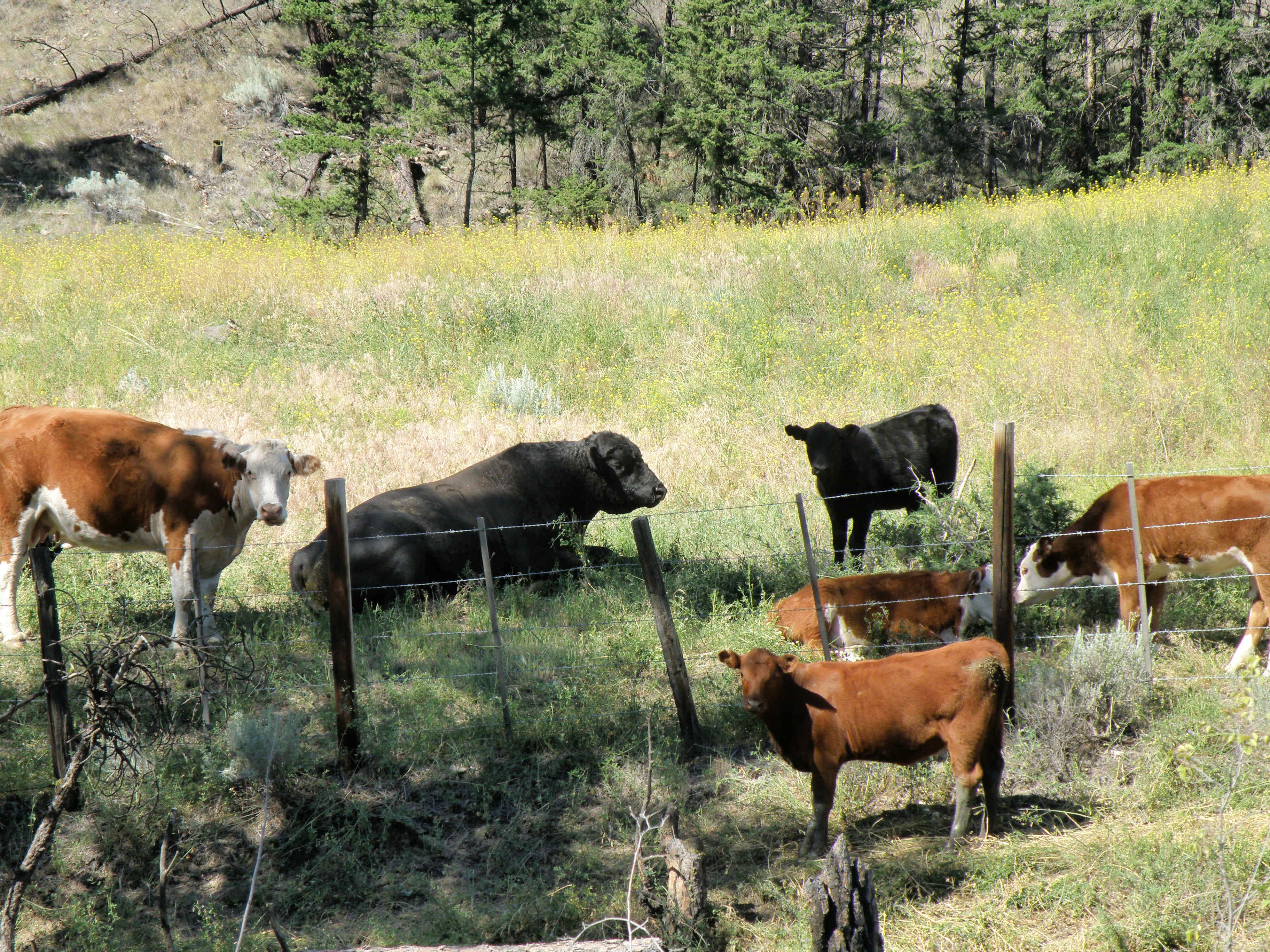
This grouping was described to me by my friend Max as a perfect example of a bull and his harem–and the ‘harem’ got nervous and didn’t remain in place very long once I began snapping pictures. The bull couldn’t have cared less what I was up to, and just lay there chewing.
The very prominent tree in the painting is placed to provide focus. Rather than leave in the barbed wire fence (in front of them), a natural enclosure is placed behind to sneak a storyline into the scene (the best grass lies out of reach)—that, and taking out the wire fence gives a more natural feel to the setting.
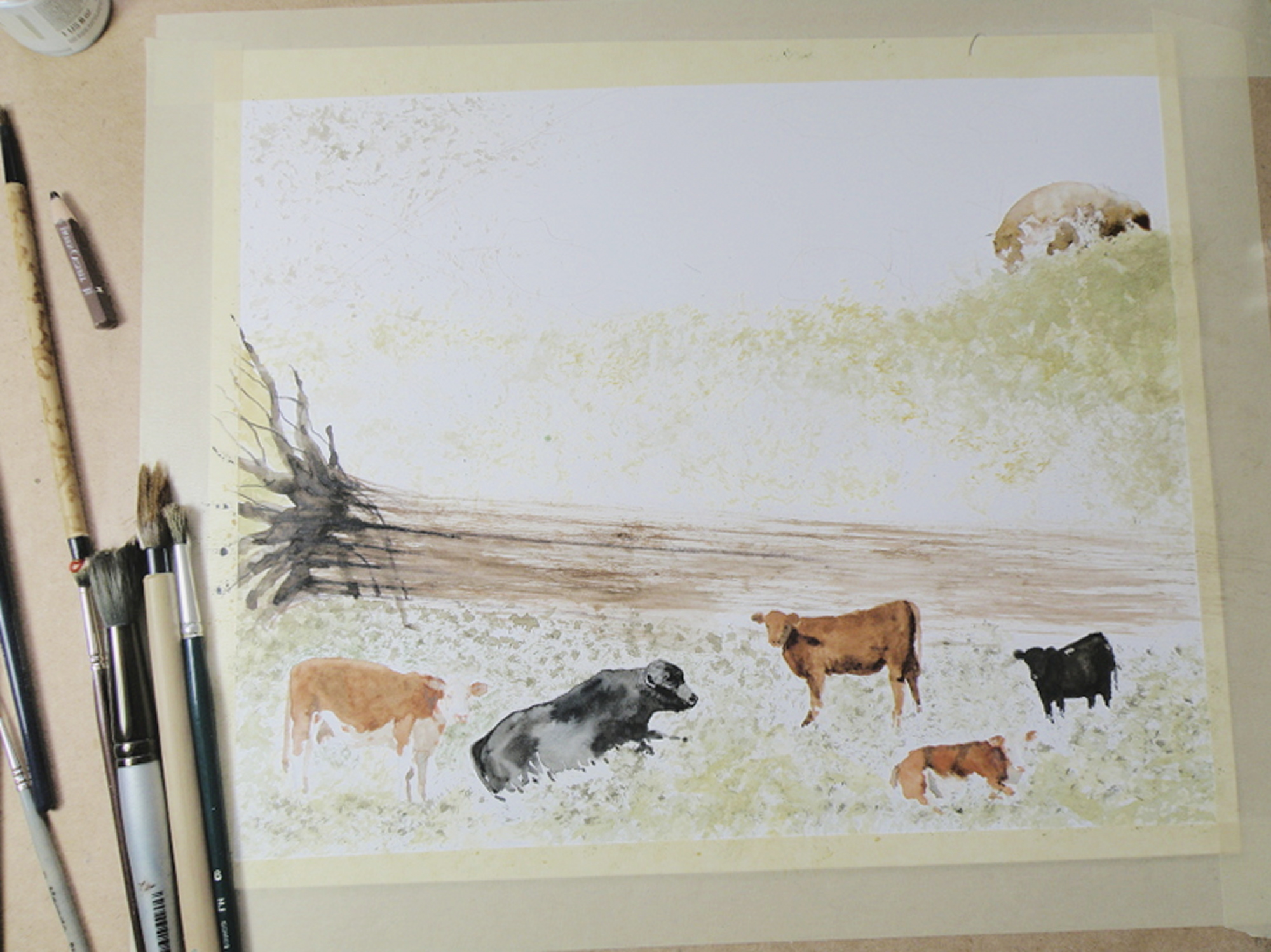
IN THIS GRASS RICH region, cattle roam all over boulder-strewn and mountainous terrain throughout the Spring and Summer. They are finally rounded up on horseback in classic cowboy style in the Autumn. Because of this, the beef from Kamloops is renowned for its organic, grass fed superior flavour and quality.
painting progression . . . 2 “Cows”
April 13, 2015
THE PAPER IN USE HERE is a very smooth-surfaced one called Hot Press (140 lb.) by the French Company, Arches (a very old watercolour paper maker). Hot Press paper has virtually no surface texture at all and is slightly cream-toned. When papers are this smooth, the paint initially floats on top before being absorbed. This floating quality creates effects a rough surfaced paper can’t deliver.

So Hot Press paper looks and feels pretty much like dollar store poster paper–smooth, shiny, and about the same thickness. And because it is not a heavy paper, and because it is so smooth, Hot Press watercolour paper cannot take a lot of scrubbing out if mistakes are made. The painter needs to be rather confident about the strength and amount of pigment to use before putting brush to paper. So because I am always a bit tentative when beginning to paint something as challenging as an animal, I gain confidence by always having a scrap piece of watercolour paper handy to try things out on first. Once I see how to do it on a scrap piece of paper, then I have confidence to do the same thing on the painting itself.
It needs to be stressed that Arches paper is superb and bears absolutely no comparison to poster paper when paint is applied to it. The weight (140 lb) is how thick the paper is. 300 lb. paper is very thick and therefore can take a lot more scrubbing and multiple washes, without losing luminosity. The downside is that 300 lb. watercolour paper is quite a bit more expensive. And when I work on very expensive paper, I am too aware of its cost. That makes me somewhat nervous about possibly ruining the painting. So I usually choose 140 lb. paper because if it gets ruined, I am not that concerned, and so therefore approach the painting with more boldness which gives a better result.
Painting progression 1. . . ‘Cows’
April 11, 2015
THE DEWDROP VALLEY is a local site and part of a much larger area near Tranquille River and the Tranquille River Gorge. In essence, the Dewdrop is really rocky, hilly, grass-and-tree- covered pasture for cows and cattle during the Spring and Summer months. The Kamloops Thompson Nicola Shuswap Region is no-nonsense cowboy rancher country, complete with serious Rodeos and horse and rider cattle round-ups in the Autumn.
This is the first of recording daily progress towards completing a watercolour depicting a typical scene in The Dewdrop Valley . . . .
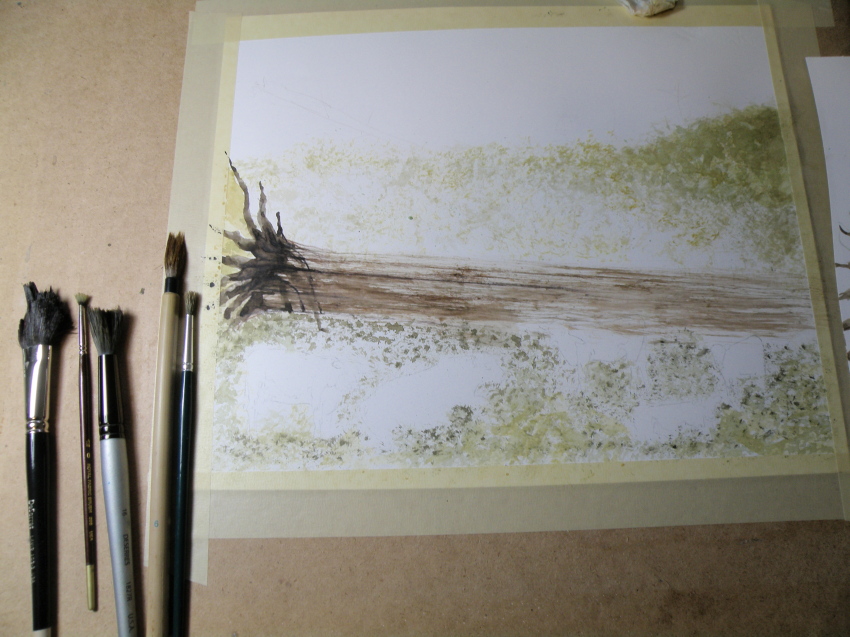
ON DISPLAY are a fine collection of tortured brushes. Some are from dollar stores or second hand bargain stores, and as soon as they get into the spare bedroom cum studio they’re cut up with scissors. None of them cost more than $2, and who knows what they’re made of–Moose? Sasquatch hair, perhaps. Each, however, is priceless.
Miniatures: Chipmunk
April 10, 2015
AS CHILDREN we always gravitated towards Chipmunks, squatting in total stillness with extended hands, hoping one would overcome its natural wariness and take the peanut being offered. The sprightly flicks of tail and peppy darts forward to snatch the gift–so quickly and deftly we didn’t see or feel it leave our palm–only added more charm to their compact, large-eyed, tiny bodied allure. On the other hand, the Grey Squirrel was just a nuisance. I guess size and colour made all the difference in our juvenile minds between one rodent’s mystique and another’s ho-hum plainness. We didn’t entice Squirrels. We threw sticks at them. Their raiding our bird feeders didn’t win them any points, either, I must say….
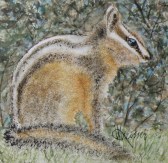
watercolour, 10cm x 10cm (4″ x 4″), art board
Local Mountains 2
April 9, 2015
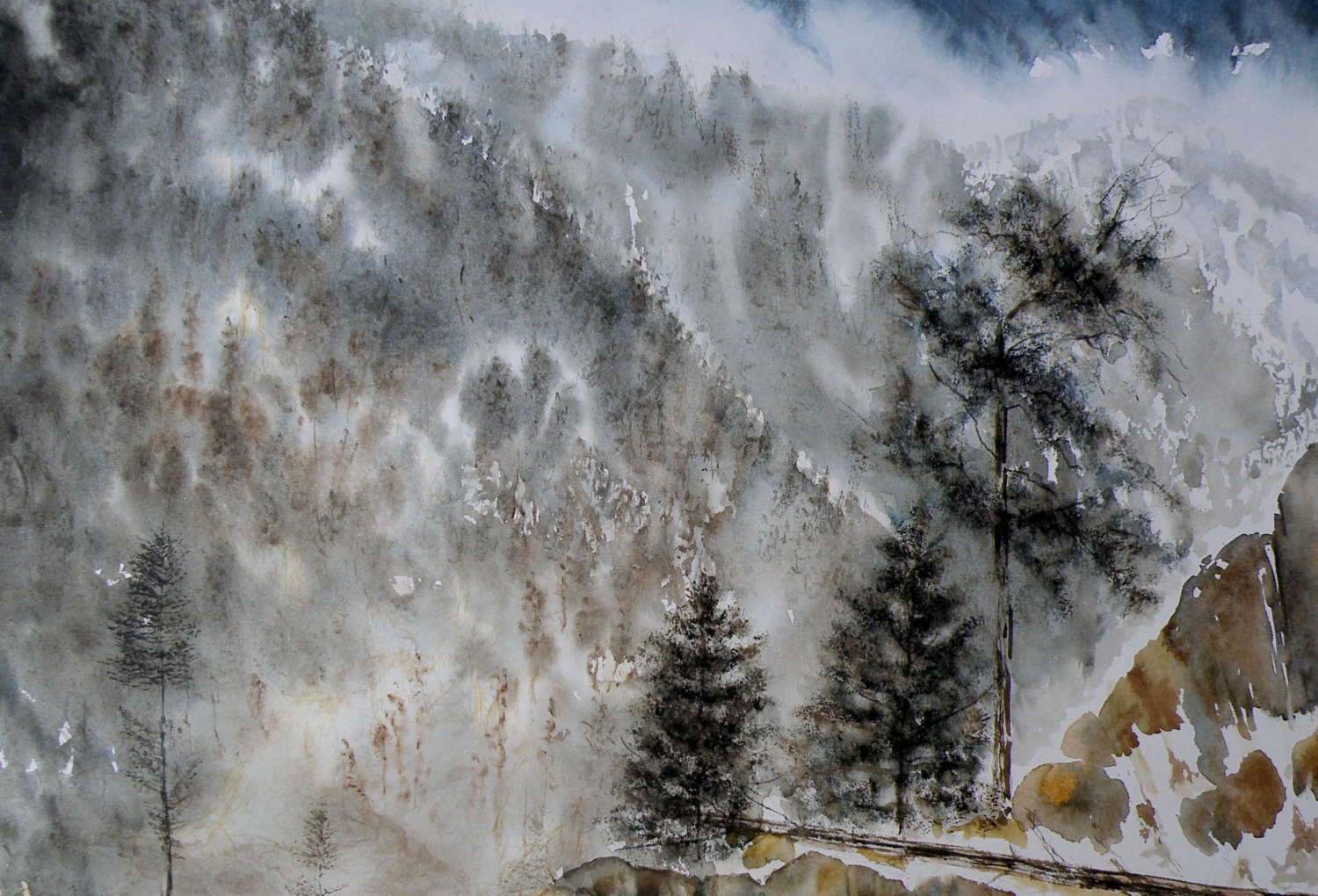
THIS COMPLETED PAINTING of the mountains in our Kamloops area was in need of cropping in order to strengthen the composition . . .
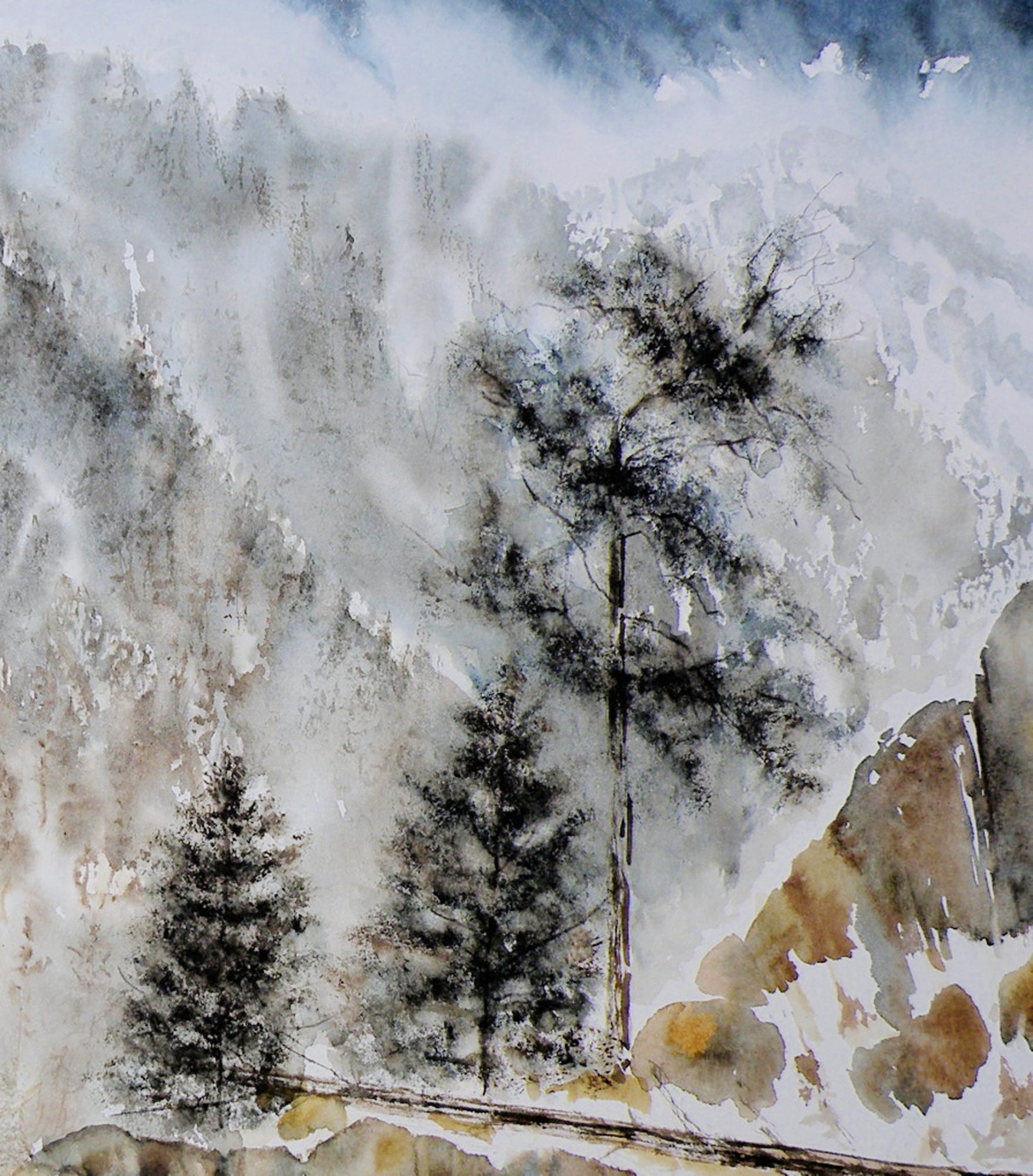
THE PAINTING WAS REDUCED IN SIZE down to this as the completed painting .. .
THE CHOPPED OFF parts of cropped work can successfully be made into bookmarks, I’ve found, and then be sold for around $2 ea in our little co-op Gallery (www.kamloopscourthousegallery.ca). Waste not, want not, lol!
Local Mountains
April 8, 2015
A decision has to be made as to whether this painting ‘holds up’, composition-wise. It succeeds in conveying the misty atmospheric conditions of winter in the mountains. But the composition is troubling me.
The Federation of Canadian Artists’ National Show
April 7, 2015
THE FEDERATION OF CANADIAN ARTISTS had its beginnings in 1941, and had as its goal the unified representation of all Provinces through one organization. Canada’s premier artists, The Group of Seven, were instrumental in organizing The FCA, with A. Y. Jackson as the Ontario head, and Lawren Harris in charge of the West Coast region.
TODAY THE FCA has become largely a Western Canadian organization with most of its activity within the Province of British Columbia. The hub is Vancouver [www.artists.ca] with regional Chapters throughout B. C. and Southern Alberta. The Thompson Nicola Shuswap Chapter (which I am a member of) has been hosting two Annual Art Shows for many years, with the 2015 National Show being mounted this coming Wednesday, April 8th.

THE NATIONAL SHOW is open to any qualifying FCA member, but submissions for jurying are limited to 3. Digital images of a member’s work are submitted to Vancouver and juried by three Signature Artists who use a point system to arrive at which pieces will be accepted and which will be declined. Of the 130+ digital entries, only 85 pieces are selected for inclusion into this National Show.
MY OWN SUBMISSIONS (two) have been juried, one being accepted–
‘Approaching Storm, Sechelt’, 25cm x 35.5cm (10.5″ x 14″), Watercolour on board
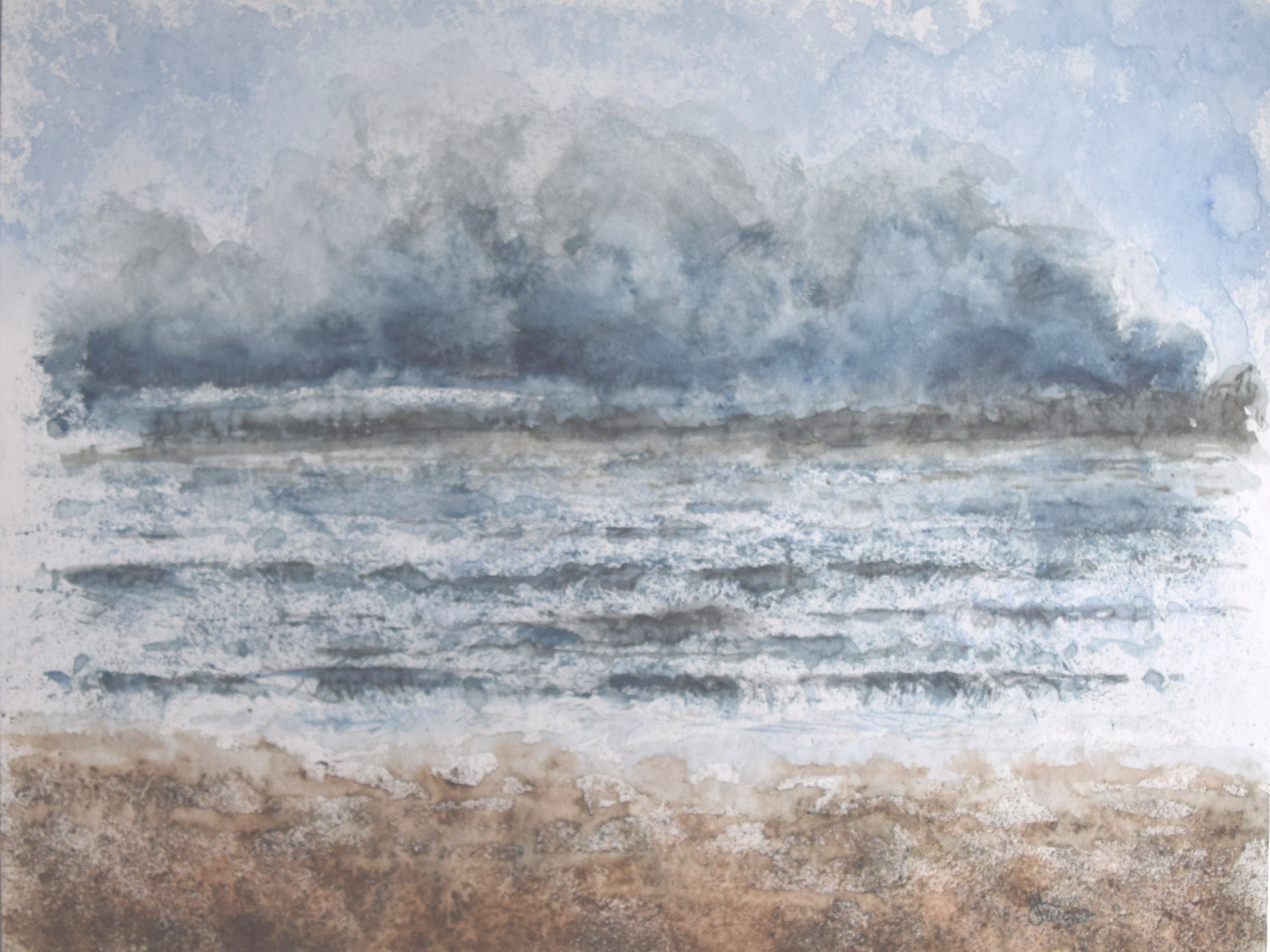
It is considered an achievement simply to get into this Art Show, while Opening Night, Friday the 10th, will be the occasion when $2800.00 in Prizes are awarded by another set of Jurors for those paintings which stand out as the best of The Best. Only once has a piece of mine ever been awarded a prize.
SENIOR MEMBERS OF THE FEDERATION have these paintings being considered for The SFCA Prize, with only one receiving top honours.
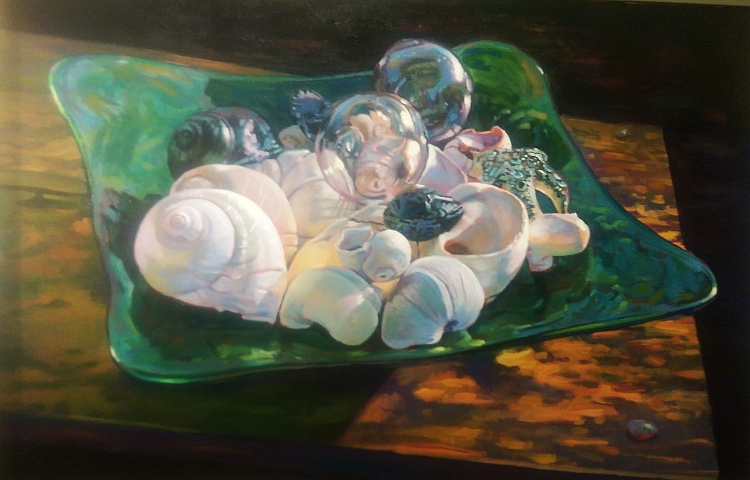
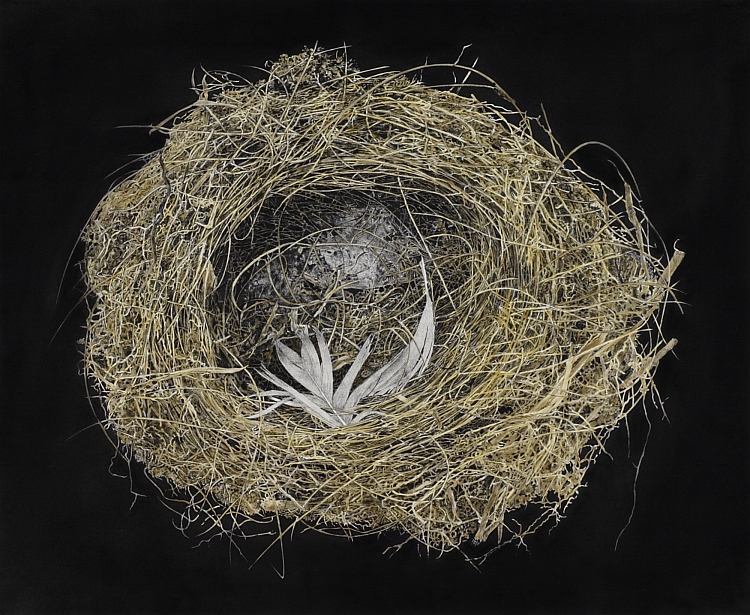
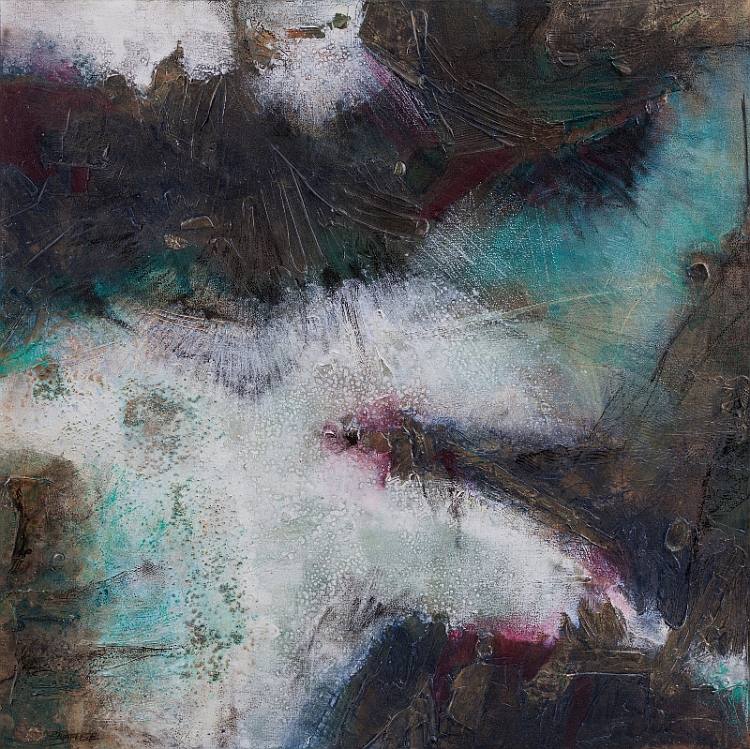
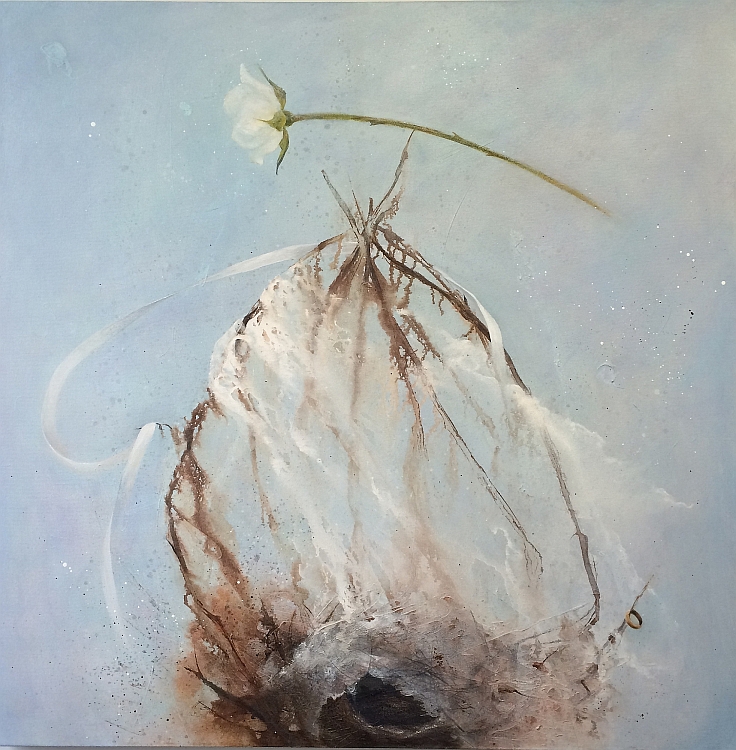

NEARLY ALL THE WORK submitted by artists for these Shows is rendered in acrylics or oils, with some pastel, and a few watercolours, and fewer still graphite drawings. Watercolour, generally, is not the preferred medium of most painters. It is considered difficult and problematic because of its demands and limtations.
 weisserwatercolours
