Seriously Shirley
April 23, 2020

watercolour 5″ x 7″ on Bockingford Paper
by Lance Weisser
SOLD
“Surely you can’t be serious.”
“I am serious — and don’t call me Shirley.” [movie: ‘Airplane’ with Leslie Nielsen]
Seriously, here’s where the Shirley Poppy gets its name:
“. . . Shirley Poppies are actually not a distinct species, but rather a strain, or even more correctly, multiple strains of the species P. rhoeas which have been selected for a colour break from the wild species. Rather than completely red, the first strains were carefully selected for their pastel colors so stylish in the late 1800’s. The name Shirley Poppies comes from where the first strain was developed, in the village of Shirley, in the United Kingdom where the vicar of a parish in the village made the very first selections, thus, isolating the first strains from wild poppies. Since then, all Shirley Poppy selections have originated from that first selection, and many are still grown today. . . ”
[source: http://www.growingwithplants.com/2012/07/shirley-poppies-step-by-step.html]
Peace
April 12, 2020
A bouquet of Peace roses on Easter Sunday, offering up peace of heart and mind during these uncertain times of isolation ….

watercolour, 7.5″ x 10″, Arches #140 Cold Press Paper
by Lance Weisser
SOLD
The Peace Rose was developed/cultivated from a seed the size of a pinhead in Lyon in 1935 by the French commercial rose-growing family, the Meilland’s, and introduced simply as ‘3-35-40’. Attracting much attention for its beauty at a rose convention in 1939, France was invaded by Hitler and the Meilland properties seized and used for food production.
In desperation, the Meilland’s smuggled ‘3-35-40’ out of France in a diplomatic satchel to The United States, where, in 1940, it was submitted to The All-America Rose Selections (AARS) for a three year testing. Based on the success of this testing, a launch date of April 29, 1945, was chosen to coincide with the Pacific Rose Society Annual Exhibition in Pasadena, California.
‘3-35-40’ still did not have a real name. Then, April 29th, 1945, its official launch date, coincided with the fall of Berlin and the declaration of a Europe-wide truce.
At The Pacific Rose Society Annual Exhibition, two doves were released and ‘3-35-40’ was christened by The AARS via this statement:
“We are persuaded that this greatest new rose of our time should be named for the world’s greatest desire: ‘PEACE’.“
The new rose ‘PEACE’ was officially awarded the AARS award on the day that the war in Japan ended, and on May 8, 1945, with the formal surrender of Germany, each of the 49 delegates to the newly created United Nations were presented with a bloom of “Peace”.
“As for the Meillands, whose rose farms and family assets were destroyed by World War II, the commercial success of “Peace” enable the family business to recover and subsequently continue to develop new, beautiful roses. In what might be a moral to a parable Francis Meilland, who died in 1958, wrote in his diary:
‘How strange to think that all these millions of rose bushes sprang from one tiny seed no bigger than the head of a pin, a seed which we might so easily have overlooked, or neglected in a moment of inattention’ . . . “
[source: http://www.b-srs.org/cgi-bin/popuptextA.cgi?t=../BSRS/BSRS-SSI/storyofpeace.txt&n=The%20Story%20of%20Peace]
visual metaphor
March 28, 2020
When I look through past work for one which visually sums up how things feel internally during these protectively distant and very strange strange days, this is the one….
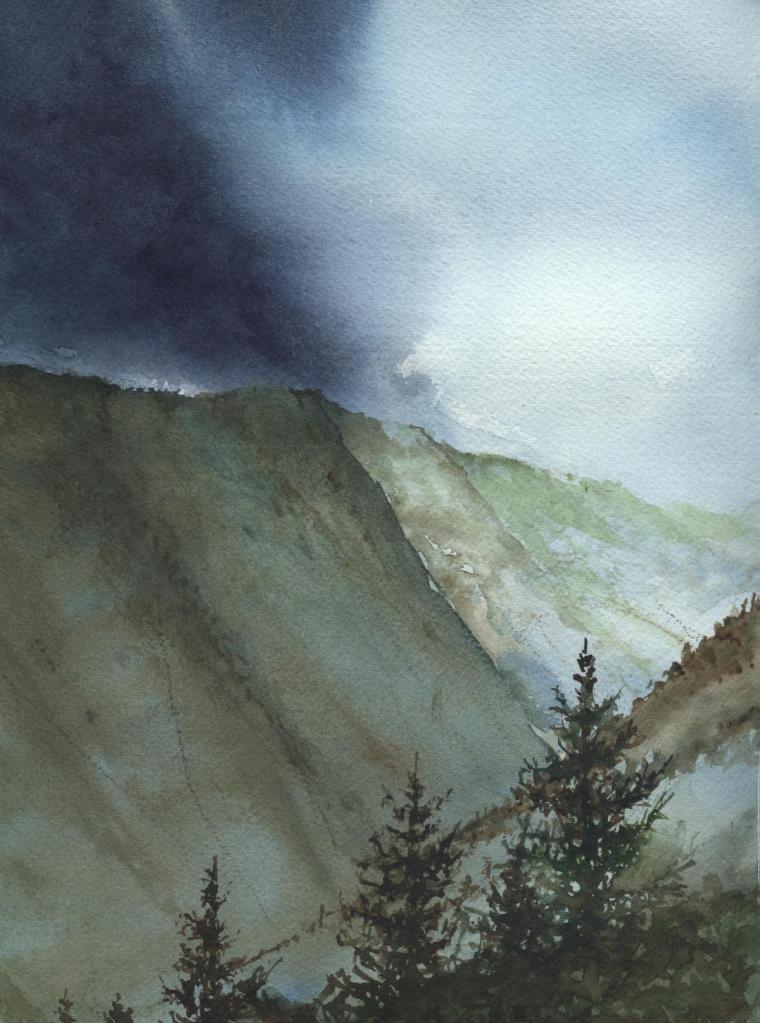
watercolour, arches #140 cold press paper, 14″ x 11″
by Lance Weisser
SOLD
Here in the Southern Interior of British Columbia, Canada, our Interior Health Authority’s policy is to refrain from revealing the precise location of any pandemic cases. This causes a certain incongruity in our city of 97,000, where there remain no official instances of anyone at all having contracted the virus.
Interior Health will only generalize by revealing ‘x’ number of cases in the whole of the Interior as new ones come to light. So citizens speculate as to which of our cities, towns, and rural situations are being most affected, or, possibly being affected at all. No one really knows.
This has created a two-meter-apart sharing of rumoured cases: ‘did you know ________ isn’t well?’; ‘they say __________ senior’s residence is under lockdown’. Yet when I stand looking out our front window, all I see are neighbours doing uncharacteristic, and very fastidious yard cleanup–and couples and dogs I never knew existed strolling in isolated threesomes, as though on holiday.
For all our apparent imperturbation, there’s a newly-felt internal jolt when hearing an ambulance making its way towards our nearby nursing home–something not unusual, something not out of the ordinary–but now, in these times, a jolt nonetheless; an unexpected, yet telling one.
Our dog groomer phoned to say she’ll still do our bichon, but to call first and then put him outside the door. I put $50 in a note of thanks, inside an envelope. Punching two holes and stringing yarn through and then around Elmo’s neck, I pushed him at her. She waved to me with surgical gloves through the screen–and it came to me how even if I put $50 in an envelope and tie it around my own neck, no one in our city is allowed to groom me.
I learned the art of denial in early childhood. While I labour away at mastering watercolour, when it comes to denial, I soar: that was mastered long ago. Slowly, the onion-skinned layers of pretending and pretension are exposing important vulnerabilities within: that social distancing demands creating innovative intimacies–reaching towards those who have no picture windows, impassionately observing couples walking dogs and neighbours trimming hedges–searching for ways to help others mitigate what is becoming a knot of fear over detecting a problem breathing; wondering if their lost job will be forever lost; literally unable to remain at all calm.
In other words, I either rise to the occasion or I don’t. And I don’t think I am. It’s made a little more difficult when, as citizens, we don’t even know what the occasion actually is. But at least I can donate online to the Food Bank. At least I can consciously stop myself from denying that this is a time to mobilize and discover where help is required and try to fill it.
The above painting is entitled ‘Distant Light’. It could just as easily be named ‘Present Darkness’.
The challenge is for me to help stop the one from becoming the other.
'Serenity now'
March 23, 2020
…..remember this? https://www.youtube.com/watch?v=Ow_9MglZrhs
So now we’ve all been plunged into Seinfeld rerunland.
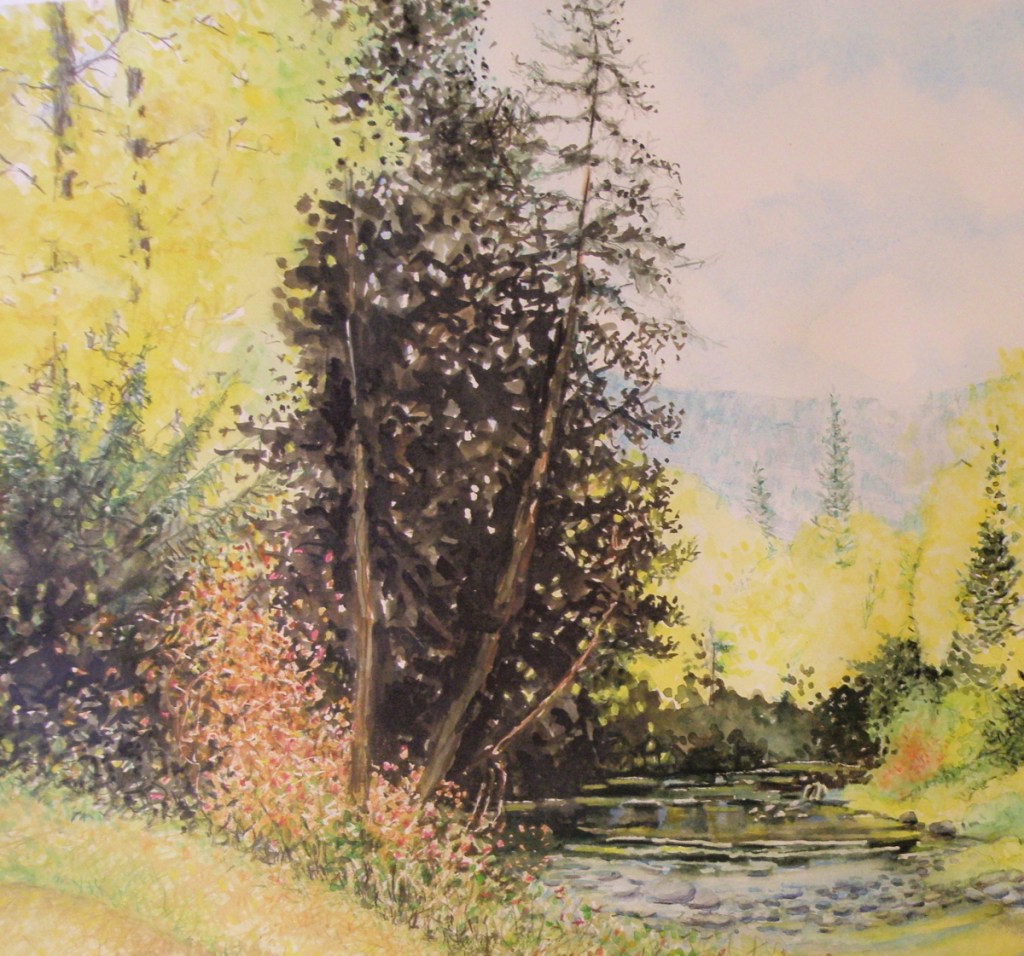
watercolour, Arches 140# Hot Press Paper, 16″ x 14″
by Lance Weisser
$150.00 (in 3″ mat)
$200.00 (matted and framed)
shipping not incl.
inquiries: weisserlance@gmail.com
Grass-fed and rather contented….
March 21, 2020
Although centrally located–and well within the city limits of Kamloops (pop: 97,000), British Columbia, Canada–we nonetheless hear cows bellowing distantly from the mountain range across the way from our house. This is cow country–beef cows–Herefords–grass-fed, and let out to pasture once Winter is past. Sitting out on our deck, I can just make out these tiny dots–Herefords most certainly–moving slowly across the great expanse of what is locally known as Strawberry Hill.
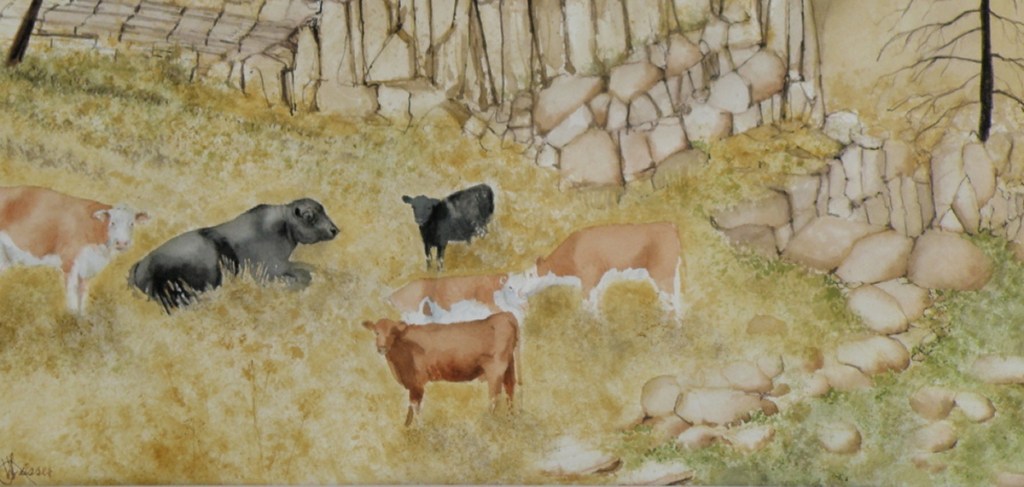
watercolour (detail of larger work), Arches Cold Press 140# Paper, 7.5″ x 14″
by Lance Weisser
During these unusual and routine-disrupted days, when everyone seems mildly ajar, pretending all is still fine, yet wondering what the heck to do with themselves, I find it reassuring to watch cows do nothing all day but search out grass on Strawberry Hill.
(And I’m sure many of you reading this have become even more thankful you have pursued painting or photography or writing as a mainstay in your life. These solitary-type endeavours are certainly now helping to anchor us amidst days of remarkable change and confinement.)
That lovely time of year…
March 20, 2020
A number of years ago I was commissioned to paint a bird watercolour by two sons for their mother for Christmas. Not that familiar with birds, nor familiar with what their mother preferred, they only said, ‘she really likes them’, and so left it to me to choose.
Even now I somewhat cringe inside for having chosen what I did. And I still can’t quite explain why I did–I just did–though I think it is because baby birds are so vulnerable and almost the epitome of innocence.
However, a baby N. American Robin….
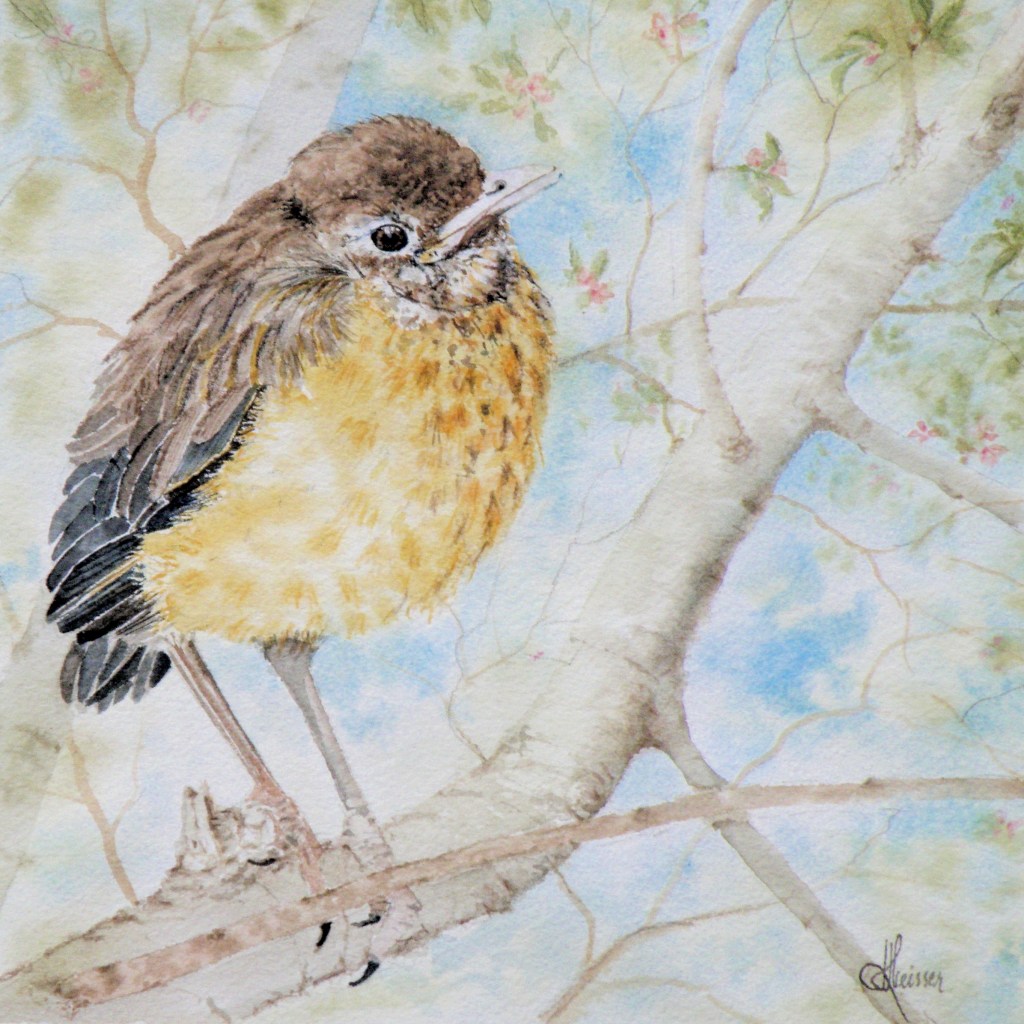
watercolour on Arches 140# Cold Press Paper, 7″ x 5″
by Lance Weisser
SOLD
……is one very ugly little bird, lol.
I never did hear back whether their mother liked it or not, which kind of spoke for itself. But, ugly or not, these little Robins don’t stay that way long as they go about discovering along with us, the joys of new life, renewed warmth, and gardens full of delightful tastes, smells, and colour.
It’s All In The Name
February 21, 2020
While some drivers get distracted by eating or talking–or what the latest fight in the backseat is all about–I, in my dotage, am beyond all that. Those distractions are way too sophisticated for me because I get distracted by street names. If they ever have to use the jaws of life on me it’ll be because I was mulling over the origins of ‘Puhallo Drive’ or ‘Sahali Terrace’.
The same goes for the names of birds. ‘Where does ‘Junco’ come from?’, I’ll ask out loud to an indifferent spouse. (It originally means ‘bush’ or ‘shrub’, which is where they hang out.) ‘And what’s with the name Grebe?’ (No one–much less my spouse–seems to know its name’s origins–just that it’s a diving waterbird.)
So it was with a bit of embarrassment that I discovered the reason Barn Swallows, Tree Swallows, Cave Swallows and Cliff Swallows are called ‘Swallows’
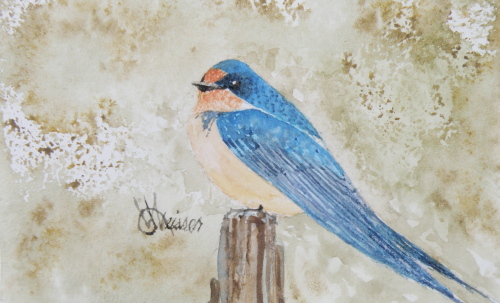
watercolour on Arches Hot Press 140# Paper
3.5″ x 5″
by Lance Weisser
SOLD
It’s because….
…..they ‘swallow’ alot of insects.
True Lovebirds
February 14, 2020
It is only the adolescent Ravens who gang together in raucous, food-finding frat parties. Once they find their true love, Ravens are almost always seen in pairs, and stay paired with their one-and-only for life.
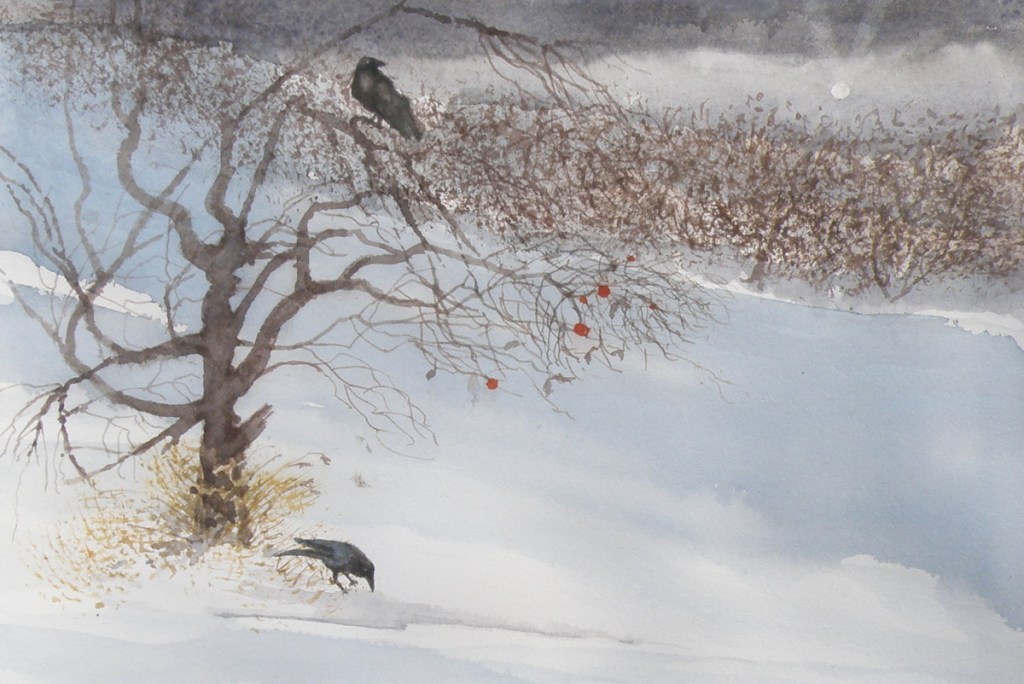
watercolour, 7″ x 10″, Arches 140# Hot Press Paper
by Lance Weisser
Maybe no box of chocolates for his soulmate, but one of those shrivelled crab apples would be at least a stab at making a Valentine’s Day gift.
Where Green Reigns Supreme
February 10, 2020
In watercolour-land much discussion takes place over how one goes about dealing with an abundance of greens in a given landscape. Summer landscapes abound with green, all of them different in hue and tone and degree. The old school adherents council the need to create greens from the various blues and yellows available on one’s pallet–that using those pre-mixed greens directly from tubes will only clash.
So if one is using Cobalt Blue for one’s sky, for example, using it with a Raw Sienna or New Gambodge for a foliage green will integrate it, anchor it and serve to unify the painting, as long as one then also uses the Raw Sienna and New Gambodge in other parts of the painting as well.
There are, however, such a huge variety of pre-mixed Greens being offered, it is almost too tempting not to use them, or at least borrow from them when mixing a blue and yellow, as was done in this little sketch of a Bulacan yard, Philippines. My spouse, Raul, is from there, and I stayed for a month each time over three years, a place so fresh and lush, it is a virtual and visual smorgasbord of every green there is.
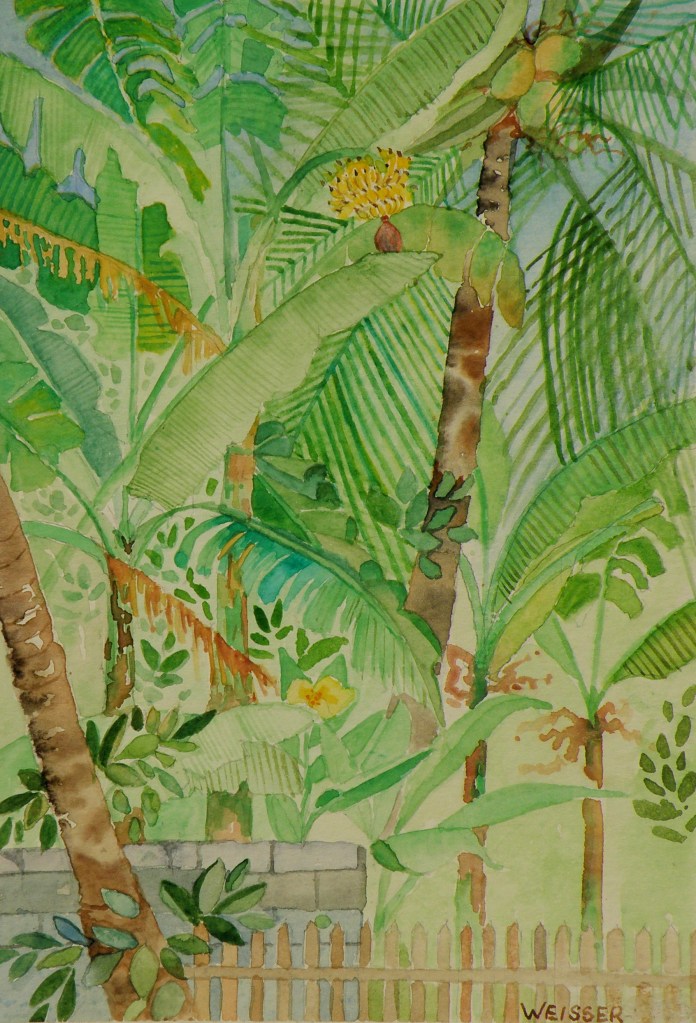
watercolour sketch, 5″ x 7″ on ordinary card
by Lance Weisser
Lovers of a Good Fire
February 6, 2020
Pinus contorta latifolia (Lodgepole Pines), are everywhere in British Columbia and Western N. America. They provide the forest industry with most of the logs used in sustainable logging operations. And their natural regeneration is brought about by periodic, seasonal fire.
“. . . some forest plants lay dormant under typical or ‘normal’ forest conditions; lying in wait to germinate or disperse after a fire provides an open canopy and abundant light. Seed banks stored in the soil (snowbrush) or forest canopy (lodgepole pine) provide ample seed for regeneration. . . ” [Dr. Dan Binkley, professor in Colorado State University’s Department of Ecosystem Science and Sustainability]
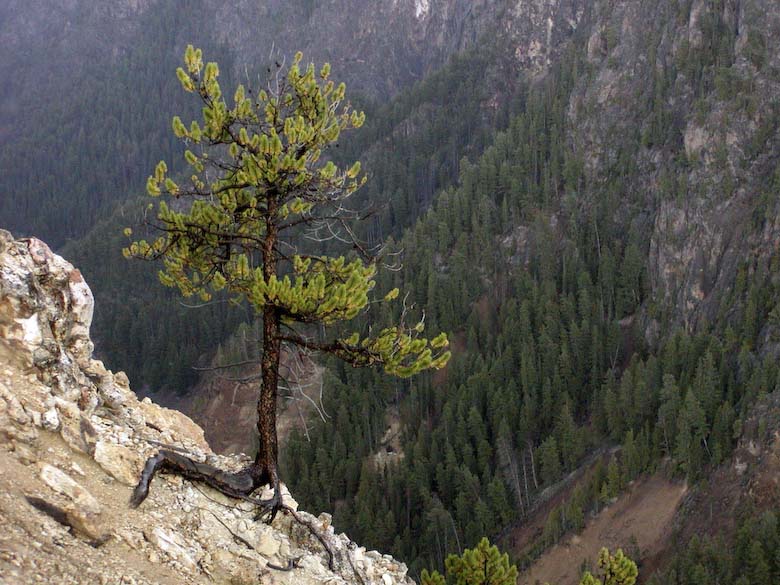
It’s all about the cones. Under normal conditions the Lodgepole Pine’s pine cones are sealed shut, but fire melts the natural sealant and opens the cones, releasing the seeds.
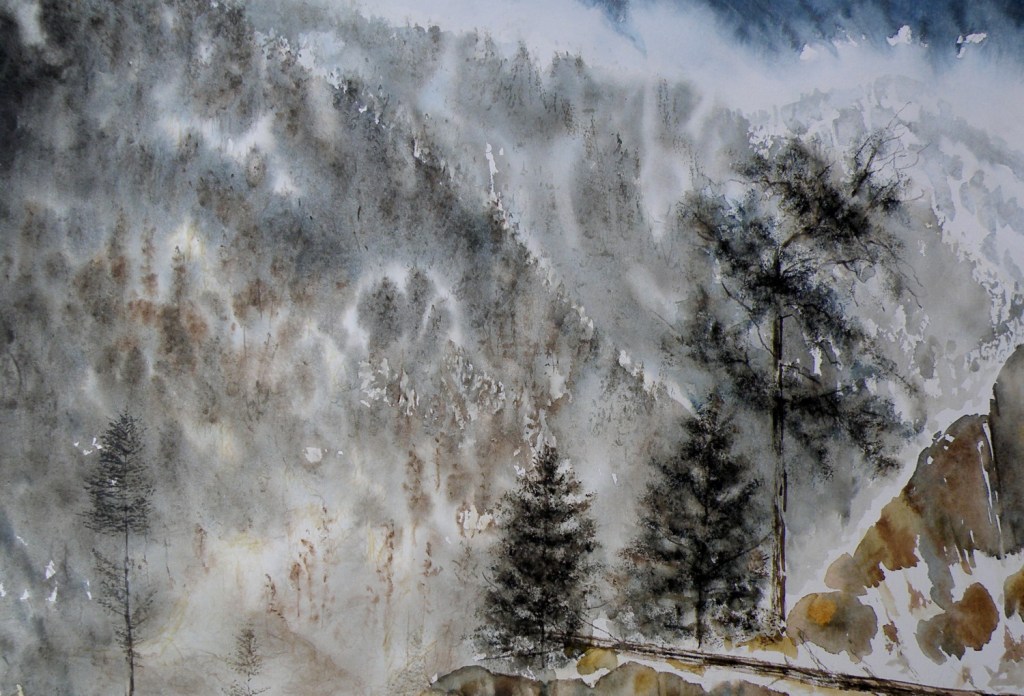
watercolour, 12″ x 14″, Arches Hot Press 140# Paper
by Lance Weisser
[sold]
Western Wall
January 31, 2020
I’m not much of a traveller. Outside of Canada and 45 U.S. States, I’ve visited Taiwan, The Philippines, and Israel. In 1990, the regional tensions were at an uneasy rest and we were able to go all through areas like The West Bank, Gaza, and the Golan Heights.
It is geographically and culturally stunning. Some places are visited for their beaches, their ability to bring an almost somnambulant quality, where rest and relaxation are a given. Israel offers endless contrasts, confrontation, challenge and comparison. I doubt anyone can go and have their presuppositions confirmed. I am quite sure everyone who leaves, leaves changed.
I have never been so moved by a place and a people as I was in Israel.
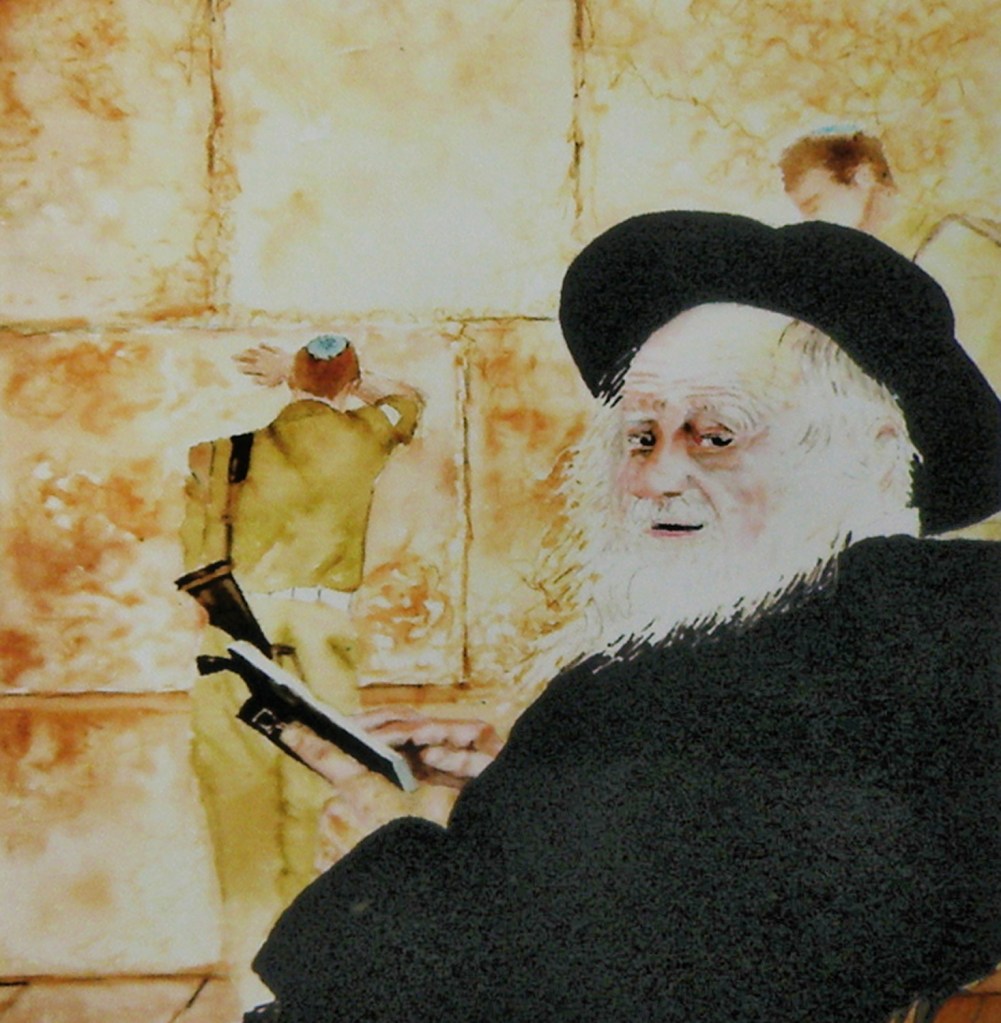
watercolour on Arches Cold Press 140# Paper
by Lance Weisser
12″ x 16″
SOLD
Bird-feeder royalty
January 23, 2020
Pushing and shoving, dive-bombing, squabbling, jockeying and butting-in, the bird-feeder etiquette of our variety of finches is the birdy equivalent of an episode of ‘Survivor’. There’s also gender bias going on. Early morning, when the very first flock gingerly descends from the upper branches, nervously eyeing the freshly-filled feeders, the males timid over whether it’s safe to go for it or not, hold back. Waking up as finches, the males suddenly decide they’d rather be chicken. So, it’s up to their female partners to make the first attempt. Only then, do the males feel emboldened.
And then, there’s the the Dark-eyed Junco: royalty of bird-feeder land. Shy, yet able to hold their own, Juncos forego the unseemly behaviour going on above, and instead head for the ground underneath. Gathering in polite groups, they snatch up the morsels the more greedy finch riff-raff above them can’t quite manage to gorge fast enough.
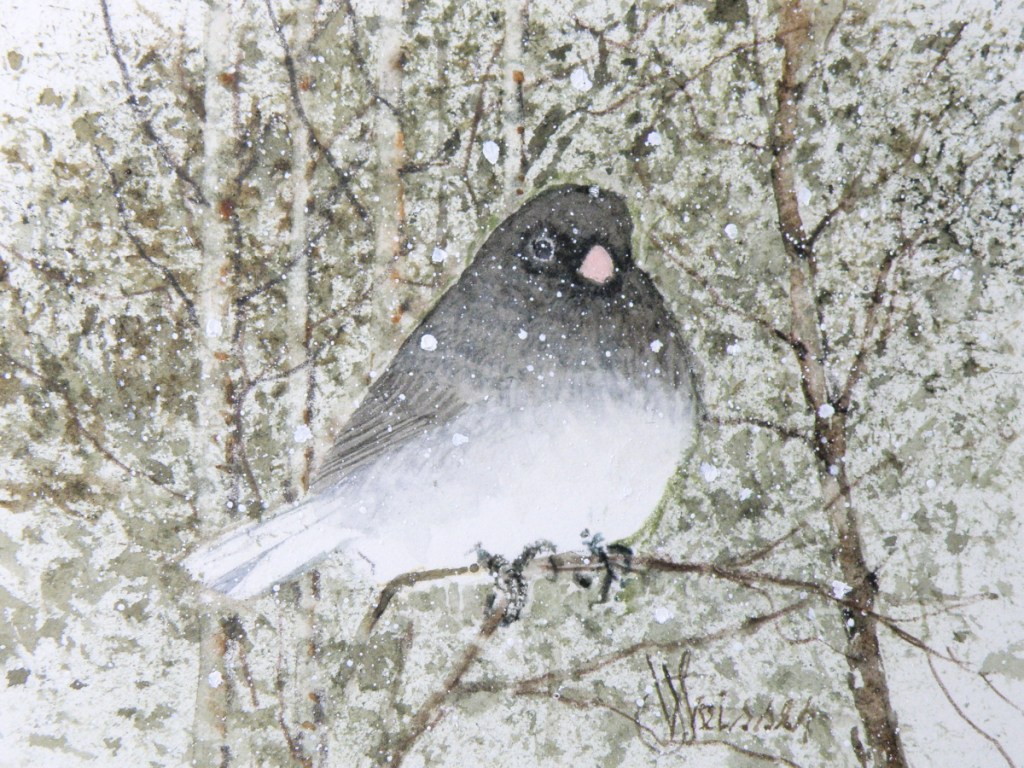
watercolour, 3″ x 5″, Arches Hot Press #140 Paper
by Lance Weisser
The Long Wait
January 17, 2020
Two days ago I left the house at 9am. Between then and returning at noon, our pipes had frozen. It was -23C (-9.5F). On the coldest day so far in 2020–with pipes freezing all across Kamloops, B. C.–the search for an available plumber was on. Four tries later, I snagged one just finishing up in our neighbourhood, and an hour-and-a-half –and $165– later, we heard that lovely sound of water bursting out of multiple taps.

“The Long Wait”, 10″ x 8″, watercolour on art board
by Lance Weisser
Seeing our rescuing plumber to the door, I saw we’d gotten some mail. It was our first-of-many, colourful Spring Seed Catalogs.
Small Works Show 2019
January 10, 2020
Our Kamloops Arts Centre in Kamloops, B. C., does our city of 100,000 proud by hosting and promoting many art events throughout the year. The 2019 Small Works Show is a fundraising event whereby half of all art purchases go to the KAC, and the remaining half goes to the artists.
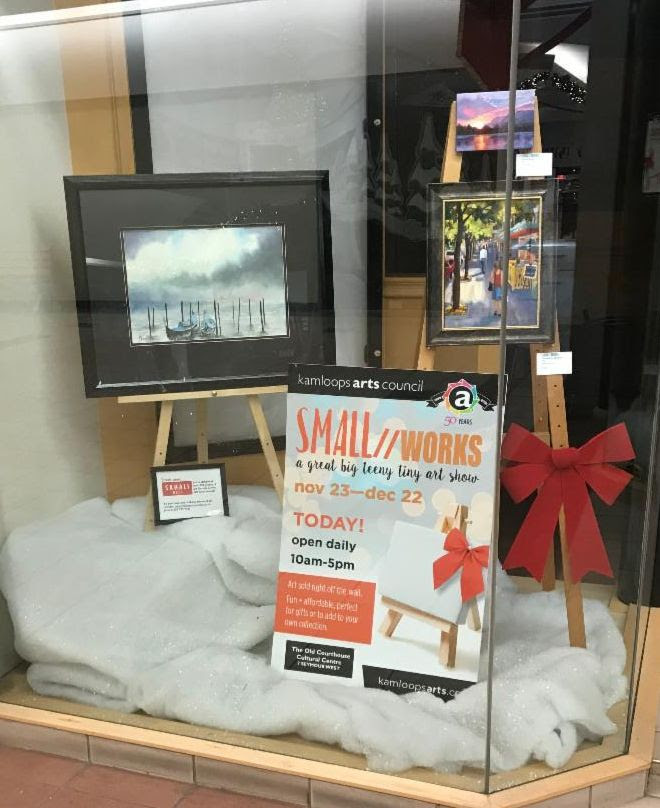
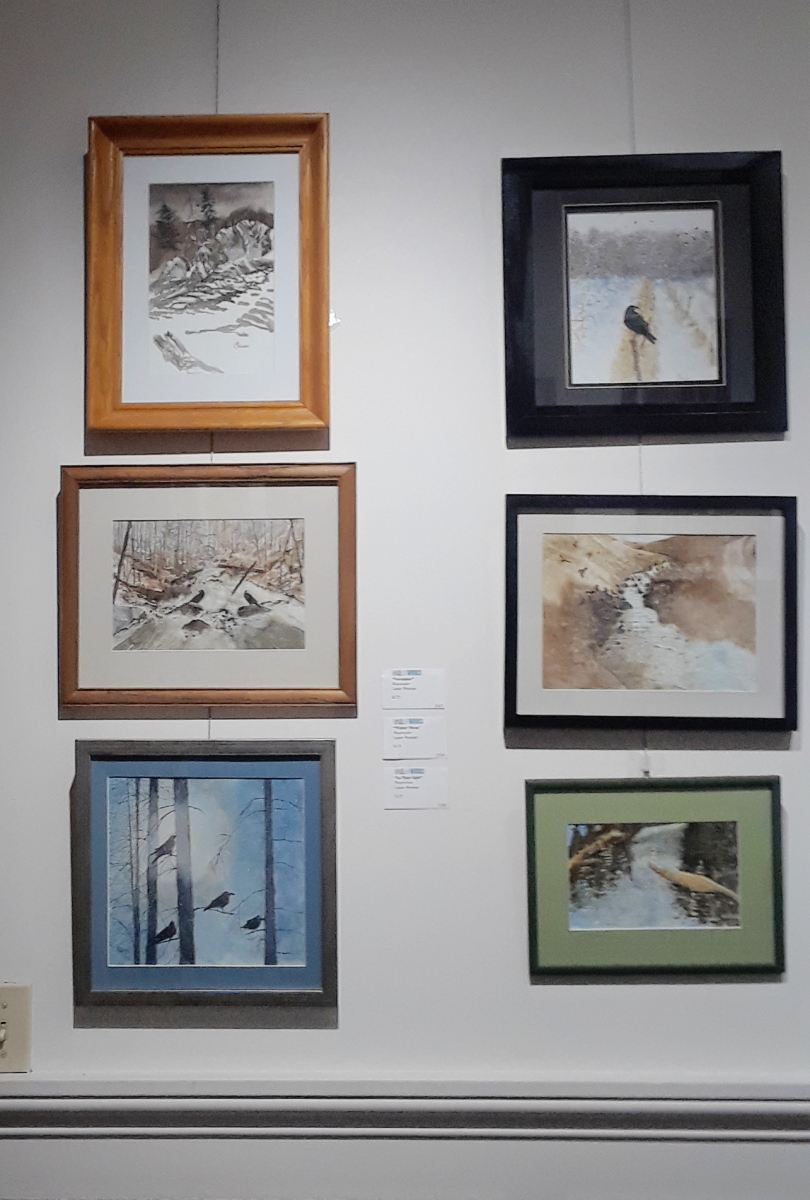
“Venetian Memories” is one of my entries featured in a local store window. Below, the rest of my contribution is on a wall in the hallway of The Old Courthouse.
Murtle Lake November
December 30, 2019
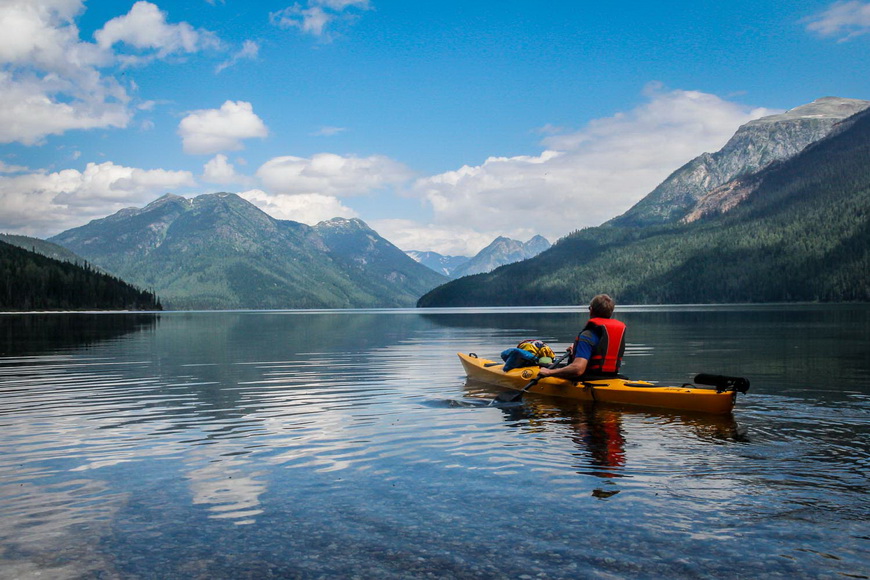
Murtle Lake–housed within the gorgeous Wells Grey Provincial Park–about an hour’s drive from our home in Kamloops, B. C.–“is world-famous as the largest canoe-only lake in North America. Set in a pristine mountain valley, the north and west arms are approximately 20 km long, and the lake averages three kilometres wide. . . ” [http://www.env.gov.bc.ca/bcparks/explore/parkpgs/wg_murt/]
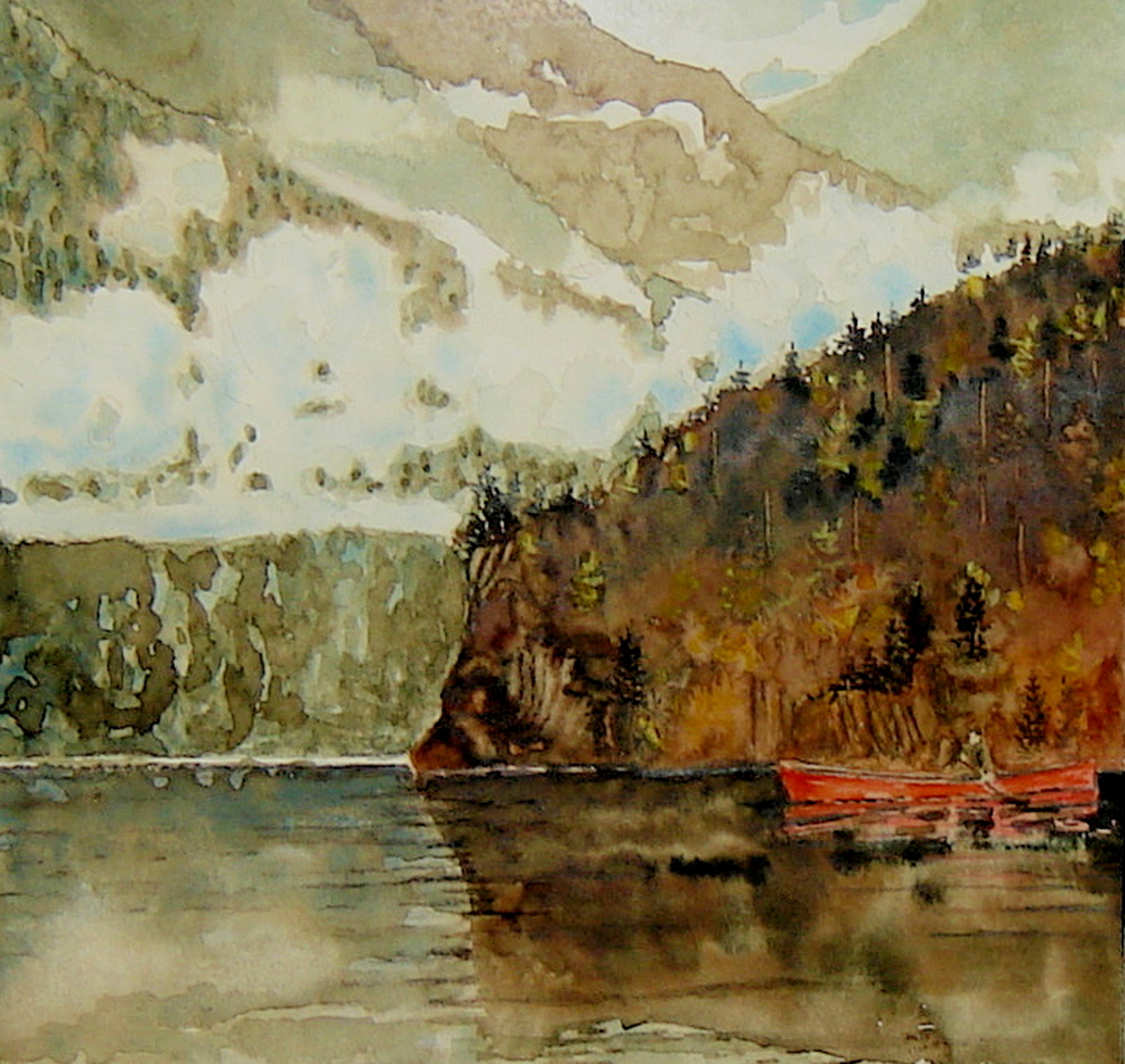
watercolour by Lance Weisser
140# Arches Cold Press Paper [sold]
On the Wells Grey Provincial Park website comes this advice to those who wish to access Murtle Lake for overnight canoe/kayaking trips:
“The outlet of Murtle Lake is the swift-flowing and dangerous Murtle River, noted for its many waterfalls. Visitors wishing to hike to McDougall Falls must use caution in Diamond Lagoon.”
“Murtle Lake is a large lake and subject to gusts of strong wind. The lake often becomes choppy in the afternoon. If moving camp it is best to do so in the forenoon. Never try to out-run a storm; beach at the first available opportunity and wait out bad weather. The Park Operator has emergency communication and a satellite phone link located in the Ranger Cabin on the south shore of Murtle Lake.”
Midnight snack
December 21, 2019
My first real encounter with an owl took place in the middle of Toronto in the 1970s. It was a normal mid-summer night and I was at an inner city, tree-lined neighbourhood intersection, when suddenly I heard this unworldly screech above my head, a tremendous rush of sound–like wind in a leafy tree–as though something unknown above me had collided with another object. Then, right in front of me fell from the sky and onto the road a rolling, jumbled ball of feathers, violently jumping and heaving about, me not knowing what on earth was happening, nor able to visually make out anything other than this great confusion of feathers and screeching.
And then I saw an owl’s head very swiftly rise up from the feathery pile, stare at me for a split second before shifting its body and letting me see how it had a struggling pigeon in its grasping talons. A few more jabs with its beak and the owl lifted off the pavement, its wings widespread and powerful, the pigeon weighing it down, as it climbed upward and out into the urban night to search for a place to finish its meal of squab.
The whole business only lasted but a minute, if that. So violent and sudden was it, that I’ve always understood since that day why songbirds and doves always appear wary when at our feeders, and rarely do anything if not in a protective grouping. Woodpeckers seem unaffected by much of anything going on around them, so I presume owls don’t consider woodpecker a delicacy.
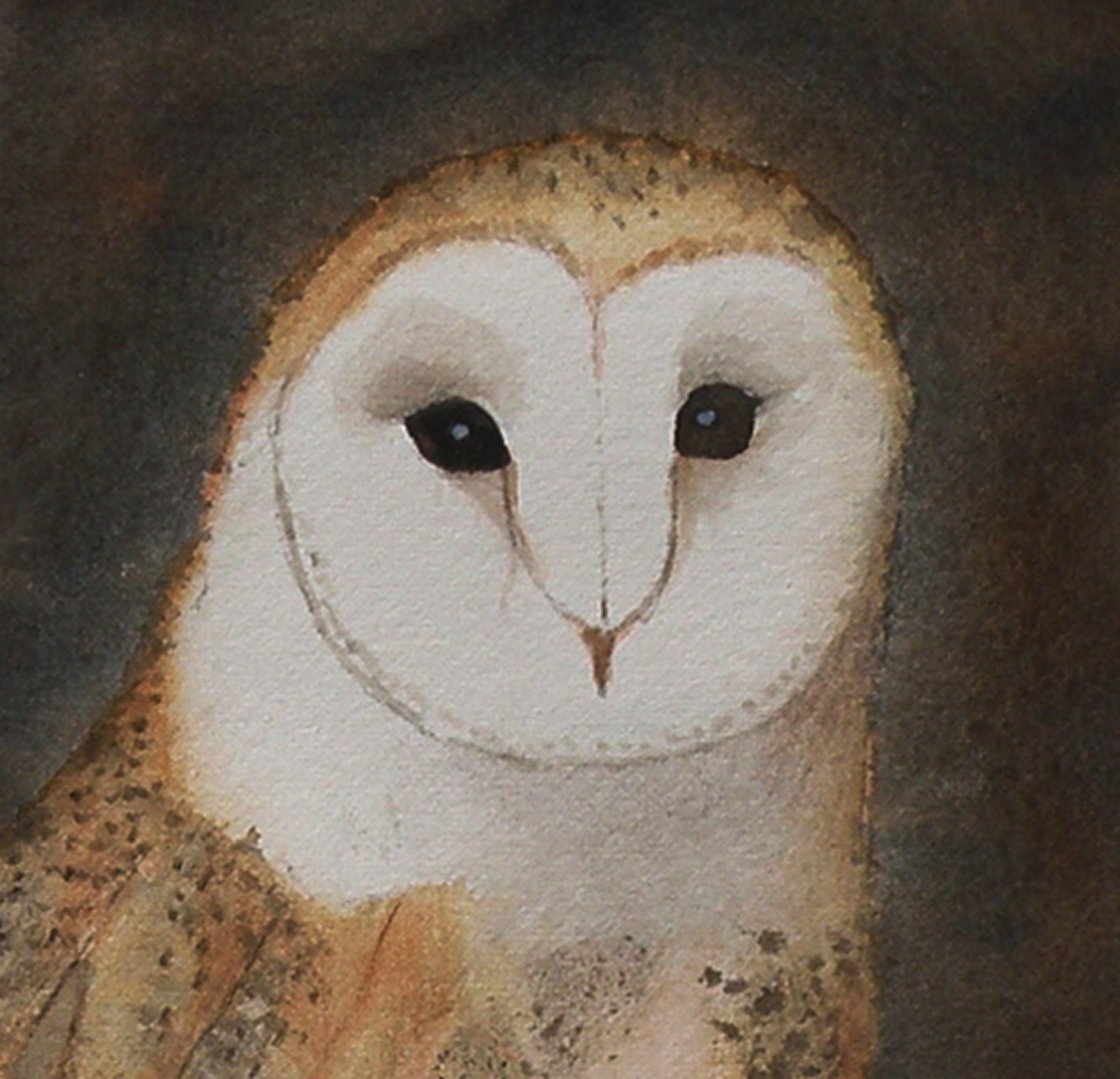
‘Barnie’
watercolour on Arches 140# hot press paper
Sentinels
December 19, 2019
It is something a fascination how one species of bird spends its nights, in comparison with another. What they all have in common is a desire to feel protected and beyond the reach of nocturnal predators, like owls.
Ravens and crows go the safety in numbers route, heading in groupings to mutually accepted trees, with crows being particularly fond of the-more-the-merrier approach, with sometimes upwards of several thousand roosting at one time. Ravens are less inclined to roost in gigantic numbers, and confine themselves to congregate with family and ones they’ve bonded with.
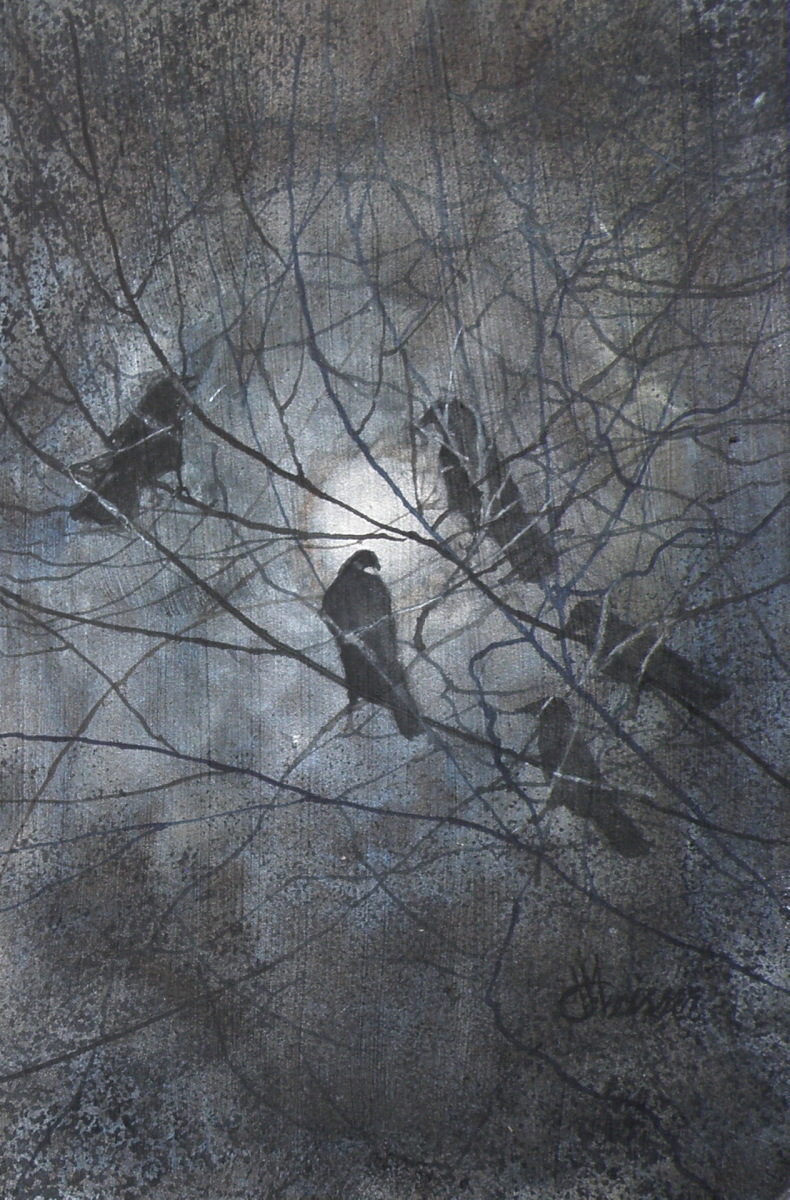
‘Nightwatch’
watercolour on art board by Lance Weisser
4.5″ x 7″ [sold]
Forest Eve
December 13, 2019
Growing up, our house fronted a very large and treed city park in Rochester, New York, a city which has always received a great deal more of its share of snow than most due to what is known as lake-effect snow, when moist air over Lake Ontario contributes to great snowstorms, and, to our delight as children, ‘snowdays’ and their resulting school closures.
We’d head to Seneca Park with our Flexible Flyer sleds in tow for entire days of weaving down between the pines and firs, avoiding known rocks, stopping just before plunging down into Seneca Park pond.
The admonition from our mother was, ‘just head home when the snow turns blue’. Blue snow happened around 4 pm, and we’d make it just in time to change out of frozen snow suits and hit the dinner table, our cheeks bright red, our legs and fingers still tingling.
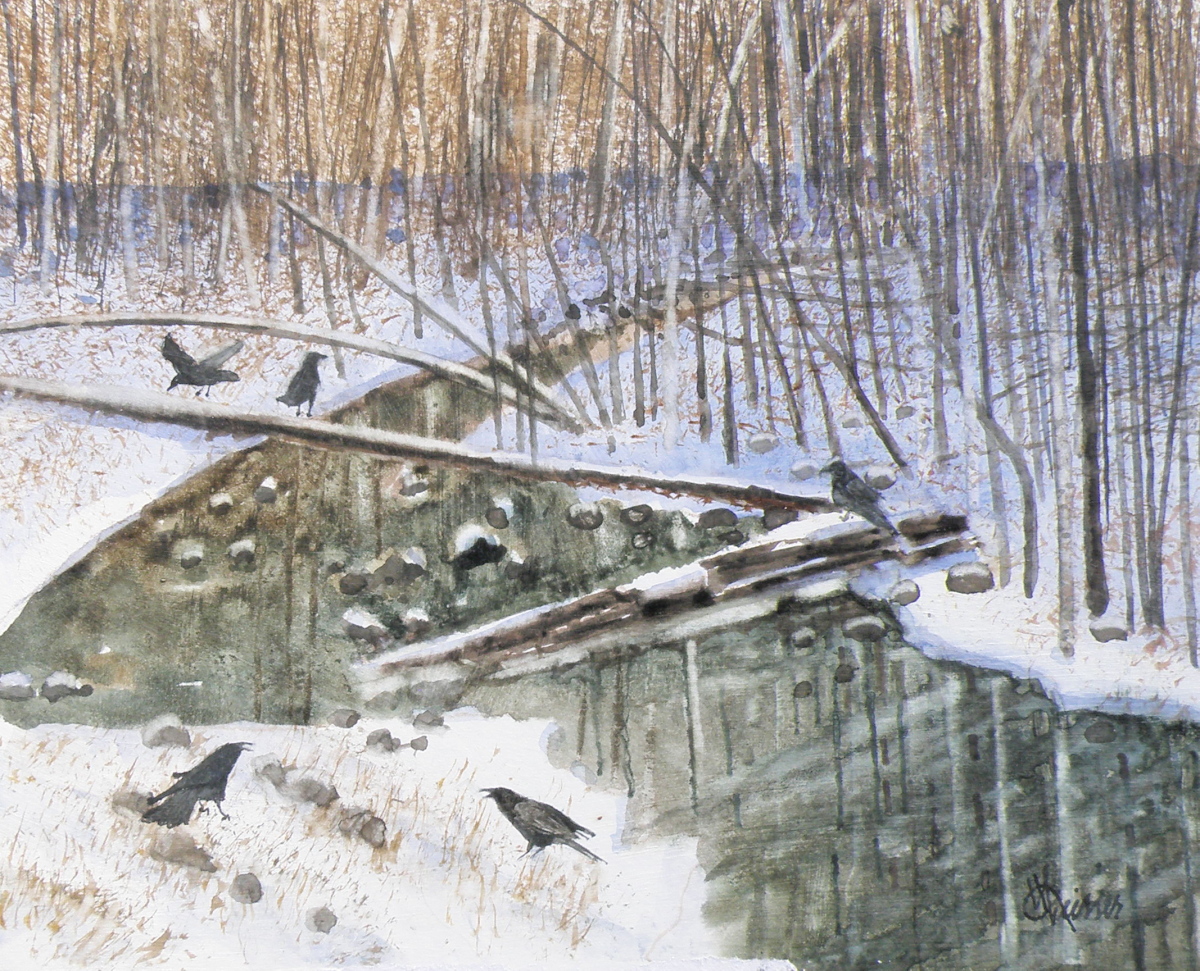
‘Silence Broken’
8″ x 10″, watercolour on art board by Lance Weisser
part of ‘The Small Works Show’, Kamloops Arts Centre, Kamloops, B. C., Canada
Three Pines
December 10, 2019
Ponderosa Pine is everywhere in British Columbia, and one of the predominant pine trees across western N. America, including parts of the Prairies and Plains. It was originally named by David Douglas in 1829 because the wood was so heavy, and thus ponderous. Around here, the very long needles which can be found lying shed at the base of these trees are gathered up, washed and used to make pine needle basketry, an art developed by Indigenous peoples all over our region, and wherever this tree flourishes.
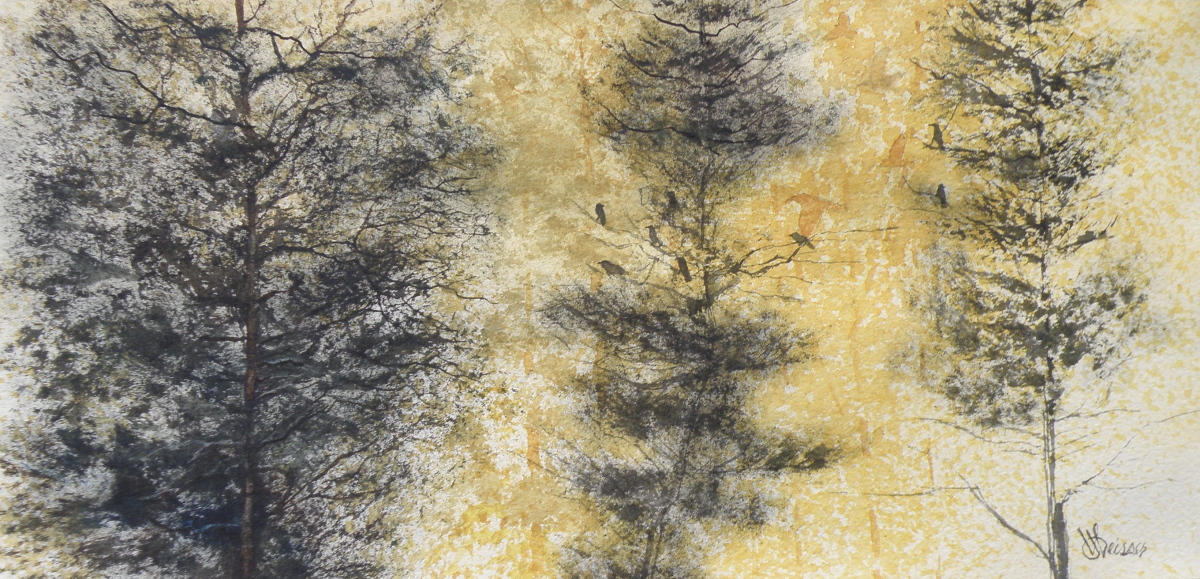
‘Three Pines’
watercolour on art board 8″ x 16″
by Lance Weisser
(for sale, framed and matted, contact weisserlance@gmail.com)
The Gathering
December 7, 2019
Ravens differ from Crows socially. Whereas Crows are given to form large groupings and congregate together socially–whether roosting for the night or for protection–Ravens are more solitary. Adult Ravens, once successfully mated, remain paired-up and together for life.
It is known that teenage Ravens, prior to mating, do in fact form in groups in order to be more effective in their newly-developed hunting skills. So when one teen Raven buddy discovers food, they all pile on, everyone benefiting from the find.
[source: ‘Ravens In Winter’ by Dr. Bernd Heinrich]
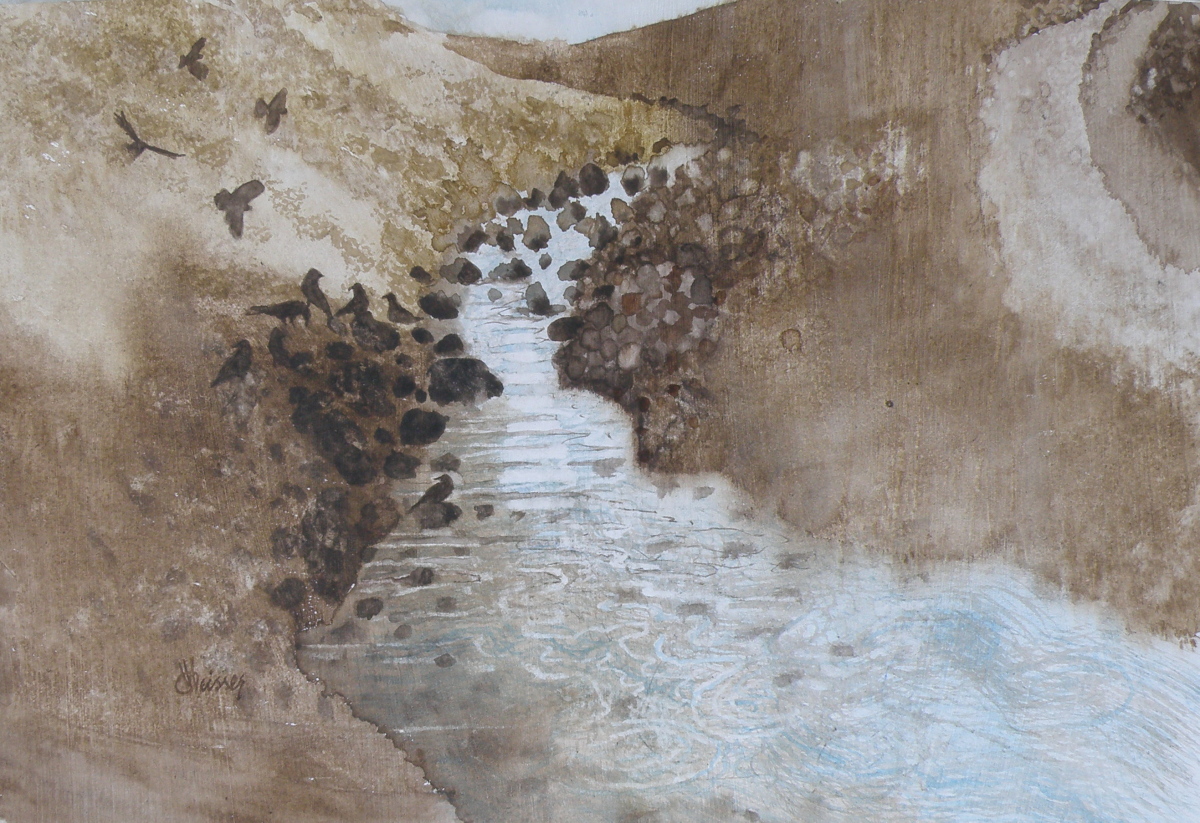
‘The Gathering’
watercolour by Lance Weisser, 8″ x 11″ on art board
for The Small Works Show, Kamloops Arts Council, November 24 to December 24
Old Courthouse, Kamloops, British Columbia
Our Kind of Winter
December 3, 2019
Having lived nearly 20 years in Vancouver and Victoria, B. C., Canada, where snow is a novelty and rain is the norm, it is a delight to then have restored the four definite, uniquely-blessed Seasons which we have here in Kamloops, B. C.
I’m a winter and cold month lover. Let me count the reasons: sweaters; hot spiced drinks; hearty stews and bread; cold room/many blankets; blue snow at dusk; birds at the feeders; bare-branched trees; lights under snowy pine boughs; woodpeckers at suet blocks; snowdrift patterns; long purple shadows; pre-dawn owl hoots; snow-muffled dog barks; pink-cheeked kids with sleds; fired-up logs; the music of the Season.
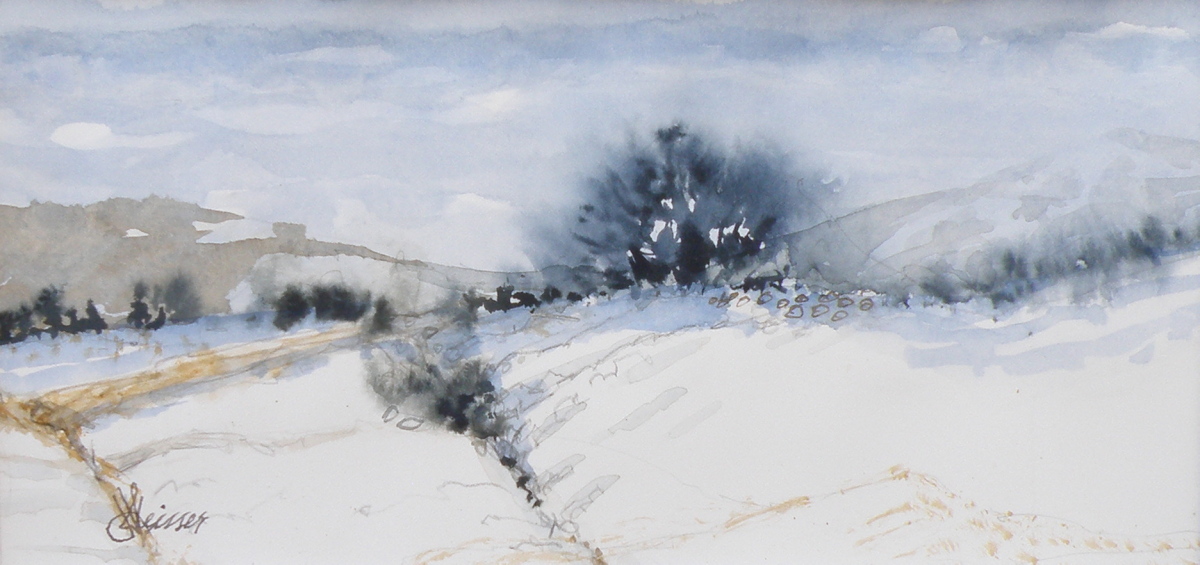
watercolour by Lance Weisser
Arches Hot Press 140# Paper; 5″ x 9″
November
November 26, 2019
November is my most favourite of months! In the Southern Interior of British Columbia where we live, November is one of those seasonal cusp months–like March–when no one quite knows what they’ll be waking up to in the morning; a month of mystery and change, full of windy days, foggy mornings, early evenings, and sometimes the schedule-disturbing onslaught of an unexpected blizzard.
This painting–now hanging in the Kamloops Arts Council ‘Small Works Show’–expresses and uses my painterly imagination to bring to the viewer all that I feel about my most favourite Season:

watercolour by Lance Weisser, 7″ x 10″, on art board
for Kamloops Arts Council ‘Small Works Show’
November 24 to December 24,
Old Courthouse, Kamloops, B. C.
Small Works
March 15, 2019
In my city of Kamloops, British Columbia, our Kamloops Arts Council hosts a number of different painterly events throughout the year. One of them was called ‘The Small Works Show’, an annual fundraiser whereby the artist gets half the proceeds and the Arts Council gets the other half.
Unlike most art shows, this one allows patrons to walk out the door with their purchase rather than wait till the event is over. No little red dots on title cards here!
Participating artists are allowed up to fifteen pieces, and if/when one piece is purchased, another is immediately put in its place. So I contributed twelve paintings, and was pleased to have sold seven of them.
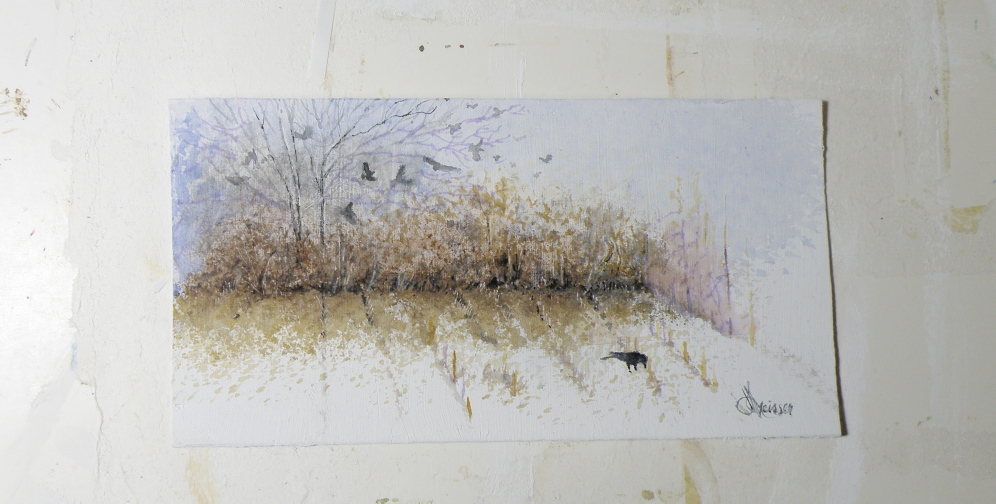
This little piece (rather crudely photographed before being matted and framed) was given a new home, and as time goes along, I’ll post others which were also purchased.
I am very grateful for the commitment and dedication of those heading up our local Kamloops Arts Council.
Life Partners
March 7, 2019
Ravens take around two to four years to mature and before finding their mate, hang around in teenage gangs according to some research, but once they do mate, they are monogamous and establish a territory for themselves.
I most often observe Ravens in our Interior British Columbia setting in pairs, unlike their crow cousins which gather in huge numbers.

by Lance Weisser
“The raven is symbolic of mind, thought and wisdom according to Norse legend, as their god Odin was accompanied by two ravens: Hugin who represented the power of thought and active search for information. The other raven, Mugin represented the mind, and its ability to intuit meaning rather than hunting for it. ” [https://www.whats-your-sign.com/raven-symbolism.html]
Here a ‘chuk’, there a ‘chuk’
March 2, 2019
Sometimes our guests awaken in the morning and come in the kitchen looking confused, ‘what is that strange sound coming from the back of the house? It sounds like a bunch of chickens being strangled.”
There are a number of birds named after their call–for example, the Whip-poor-will, Bobwhite, Killdeer and Chickadee. Now add to those the Chukar Partridge, which populates our back mountain ridge and does this: “Chu-Chu- Chuk-Chuk-Chuk-Chuk-ChukCHUKCHUKCHUK!!!!”
This is always the male progenitor of a brood (known as a covey) of some dozen or so chicks who often is announcing their collective descent down the ridge to wreak havoc in our vegetable garden. All one needs to do then is saunter down the back steps to suddenly frighten them to death as they go up in a giant, dreadful whir of feathers and squawking, after which the male will scold at me from atop the biggest rock, his ego bruised.
Native to Eurasia and Asia, including, Israel, Lebanon, Turkey, Iran, Afghanistan, Pakistan and India, along the inner ranges of the Western Himalayas to Nepal, Chukars were also introduced to Europe and N. America. [wikipedia]
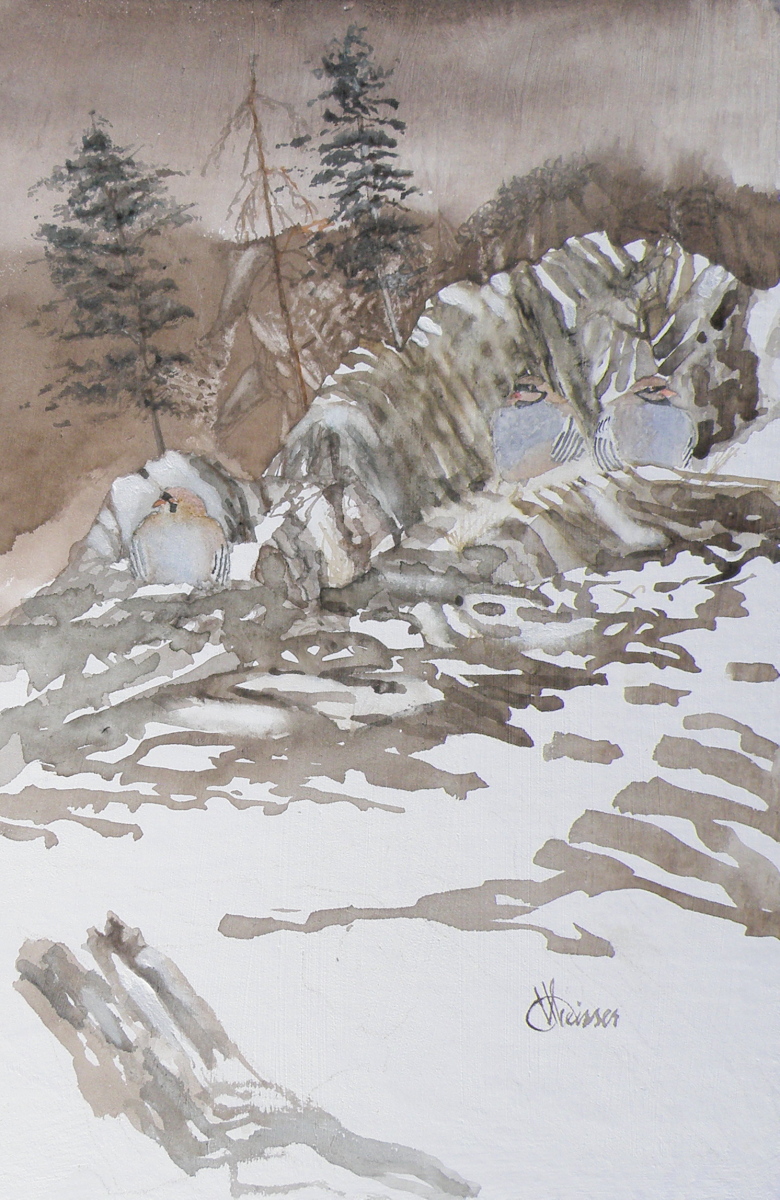
Lance Weisser
They are to me one of the strangest creatures I’ve ever come across.
They are either brazen as hell, or scared out of their freekin’ minds. Their markings are as odd as their call, their mannerisms are as odd as their habits (in our garden their choicest morsels are the tops of our onions–I mean, who eats the tops of onions?)
When you google them as a subject, you usually find sites generated by hunters in the ‘Lower 48’ who are on the prowl for ‘the illusive Chukar Partridge’ all decked out in camouflage. I’ve yet to hear of any hunters in our area on the prowl for them, but believe me, we’ve got Chukars and they ain’t illusive.
Here’s one in action, for your listening pleasure: https://www.youtube.com/watch?v=q09GNpev6sk
 weisserwatercolours