venice challenge 1
August 9, 2015
Our local Kamloops Photo Arts Club is doing a joint arts project with our Kamloops Courthouse Gallery, involving the pairing of chosen art photographs with various art media interpretations based on the photo.
At one of our meetings we sat around large tables with a great many photographs strewn about, and at a given moment were invited to select ones which struck us as exciting to base our own work on. Jan, who is a weaver, selected photos which spoke to her about textures and colours. Others went with shapes, values, composition.
As a student of representational painting technique, almost all of the photographs were appealing due to their rich tones and lively views. One in particular was very striking because it involved architecture and rain and water, and an exemplary scene from that painter’s perennial eye-trap, Venice–a place so overly painted, yet so eternally attractive.

“Blue Umbrella”, 11.5cm x 16.5cm (4.5″ x 6.5″), Frank Dwyer KPAC, 2014
Choices had to be made immediately about size, complexity (whether to simplify while not messing with the integrity of the scene), wetness/dryness (very rainy? or as is), attention to detail (loose interpretation, or ala the photo itself), type of paper, and selection of pallet (minimal number of colours, or full compliment), overall tonal value (to keep it dark or go for something less so).
There is a website where its blogger goes to great and tremendously helpful lengths to demonstrate the qualities of particular watercolour colours when mixed together. Her name is Jane Blundell http://janeblundellart.blogspot.com.au/. When wanting to know what might work well as a pallet, she never fails but to provide great choices. So it was through her that the combination of Ultramarine Blue and Burnt Sienna was selected as the backbone for this challenging photo/watercolour project.
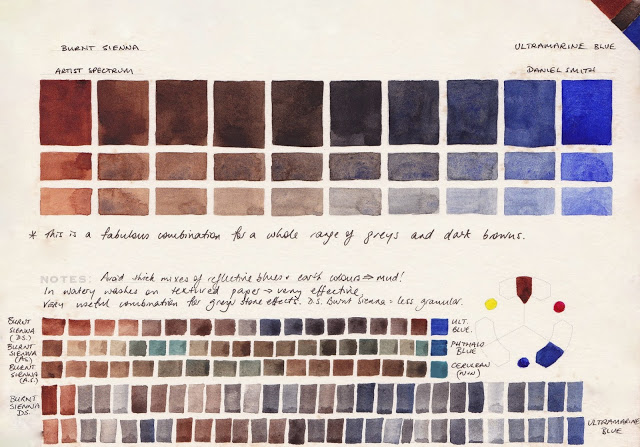
combination of visual effects possible when combining burnt sienna and ultramarine blue, Jane Blundell: Watercolour Comparisons 4 – burnt sienna
This visual and written saga will continue as progress is (slowly) made on this. If all is well, the painting and the photograph will be displayed side-by-side in The Main Gallery of The Old Courthouse, Kamloops, B. C. for the month of November. (www.kamloopscourthousegallery.ca)
Stan Miller, AWS — painter and teacher
July 25, 2015
 In his own words…
|
“I remember, when I must have been quite young, watching my older brother Greg draw. He was good. In the third grade our teacher taught us perspective, how to make a road go back and disappear into the mountains. I never forgot how to do that. When I was seven or eight years old, our family took a trip to Wisconsin to visit a friend of my Dads. He was a professional watercolorist. I remember the drive through the woods, walking up to his front door, through the entry, looking up at the walls as soon as I entered the house. I wanted to see his paintings. Randy Penner. I’ll never forget that name or that trip and the influence it had on me. “In Junior High I took some art, mechanical drawing and enjoyed it. I wrote a career paper on becoming an artist but never really thought that it was possible. In college I decided to major in physical education since I considered an art major unrealistic. The second year I switched to a commercial art major since the community college had a good graphics program. It was during the three years of training to become a commercial artist that I took watercolor. My first watercolor class I got a “C”. The worst grade I had ever received in any art class. I was required to take it again the following year and it went much better. Not only did I get an “A”, but I fell in love with it. I started selling my paintings before I graduated for as little as $2. In the fall of 1973 I had made a decision to try to make a living as a full time, professional watercolorist and have managed to do that now for more than thirty years.” Stan Miller
|
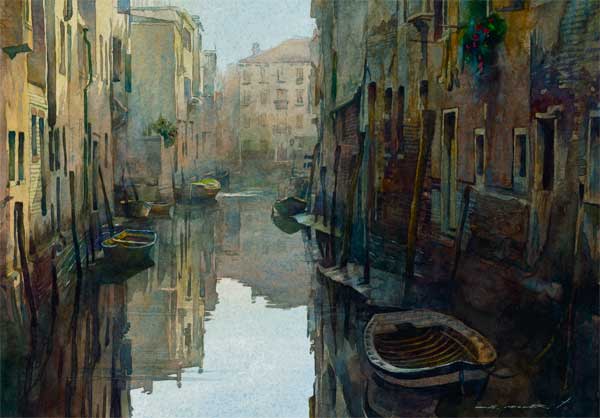
“Venice Calm”, watercolour, Stan Miller, AWS (sold)
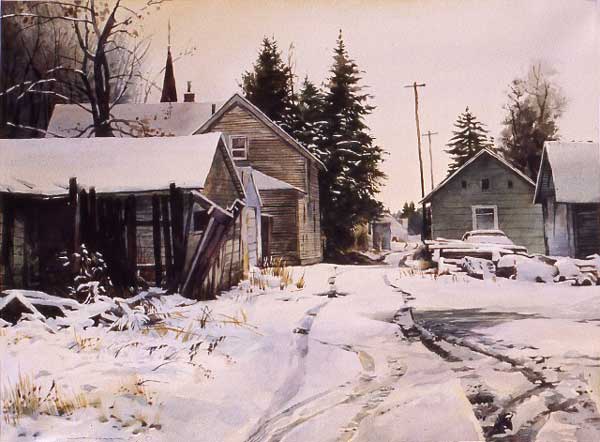
“Sunday Morning Snow” , Stan Miller
watercolour 18″ x 24″ (sold)
I have learned some important fundamentals by watching Stan Miller’s presentations on YouTube. There are a cartload of painters offering ‘tips’ and ‘tricks’ on how to ‘do’ watercolours on YouTube, and while I do not always wish to pursue instruction beyond what the medium itself teaches me through trial and error, there are areas where I absolutely require help.
Searching for help regarding composition can be frustrating and fruitless. That is because not every painter’s views on the subject resonate. Gut feeling is something I have come to trust when it comes to watercolour, and many instructional videos on YouTube don’t ring true to my own personal approach. That is not to say these videos won’t ring true to someone else’s taste and fulfil their ‘gut feeling’.
Stan Miller is plain spoken, down to earth and sensible about how he goes about painting. There’s very little ‘artiness’ about the man. Yet, what he accomplishes on paper is, to my eyes, lovely and true and a delight to the senses.
Here is his helpful short video on how to logically and sensibly approach the difficult area of composition–something I forever struggle with–which you might find helpful also.
breakers
July 22, 2015
The depicting of waves in watercolour is particularly challenging when one has decided on being a ‘purist’ by refraining from both opaque white and masking fluid. Personally speaking, masking fluid has become so offensive in terms of smell (its natural thinner, in case anyone wonders, is ammonia, which is why it smells so awful–but a little ammonia will indeed thin thickened masking fluid, if stirred in slowly), and damaging brushes (even when dipping them in soapy water first), and causing the hardest of edges when removed, that it’s rarely a choice for me. It does make for quite lovely snow squalls when flicked from a stiff toothbrush, I must say–and great fun, too.

‘Third Beach, Vancouver’, watercolour, painted on location, 35.5cm x 23cm (14″ x 9″), Arches Hot Press 140lb. Paper
Breaking waves challenge any student of watercolour (and every single person working in this medium will forever be a student) because of having to leave paper white for crest foam, swash, and the receding backwash effects. This, coupled with understanding which part of the wave receives more or less pigment, not to mention the change of pigmentation if backwash is curling up and drawing in sand at the same time, comes the added realisation that sky is being reflected off top surfaces the further from shore one looks.
There truly is nothing for it but to get right into the actual physics of spilling, surging, plunging, and collapsing breakers, each of which exhibits its own characteristic properties–ones our eyes are very accustomed to and therefore recognize in a flash when viewing surf–properties a viewer expects to be reproduced in paintings (if the painting is trying to conform to the challenges of representational art, that is).
https://en.wikipedia.org/wiki/Breaking_wave Drawing each of these examples over and over again makes wave action less of a mystery and eventually becomes familiar and far less challenging. However, a single line of waves is always backed by more, multiplying the visual dynamics, adding to the confusion of having to depict row upon row of breakers. Where does foam end and the gathering wave behind it start? For this, it is very instructive to carefully observe photographs and again draw over and over how this actually does look.(https://en.wikipedia.org/wiki/Breaking_wave) Only then, personally speaking, do I find painting on location not as daunting, for stopped action is easier to analyze than sitting in front of actual pounding surf.
Painting water is a dedicated pursuit all of its own. There is a painting friend of mine who includes water in every single piece he does because he is dedicated to the depiction of water, whether in the form of rain, surf, river, lake, stream, waterfall, because in each case there is a lifetime’s worth of challenge.
first tries
July 20, 2015
At age thirteen, in 1960, there was a book at the public library on ‘how to paint’ in watercolour. In those years we lived in Rochester, New York (the home of Eastman Kodak and famous for its Lilac Festival), and ‘art class’ had been a favourite because of Miss Wright.
Miss Wright (Cecile) had a long wooden table covered in Mason jars filled with tempera paint of what seemed to be every colour known to humankind. There were those wooden medical tongue depressors in each jar for stirring, and the rank smell of that paint probably still resides somewhere on our persons. In the back room she had dozens of file folders filled with magazine clippings of any subject we wished to study in order to do our work–trees, flowers, mountains, old people, young people, dogs, cats, chipmunks, birds and on and on and on.
There was no real structure to that 45 min. period, insofar as we simply went to the back room and retrieved whichever folder was of interest that day and put on our smocks (my father’s old shirt), dribbled our paint selections onto an old plate and went to town. Miss Wright was strict and had her long greying hair wound round tightly atop her nobly-held head, through which she always thrust her pencil. She was strict about a few things, including making sure that if a street lamp or person or fence post were in front of a tree branch, we had to be sure to make the rest of the branch extend beyond the object (“otherwise it looks like the lamp post chopped it off!”, she’d say, grabbing our brush and doing it herself. “See??”).
To this day I have always followed this advice. No lamp posts ever chop off branches.
In the ‘how to paint’ book were step-by-step instructions of how to do a finished painting, complete with step-by-step illustrations. All I had available were those paints in round pans housed in a black metal rectangle of a box, which every child in America at some point found thrust into a Christmas stocking (not what the book recommended).
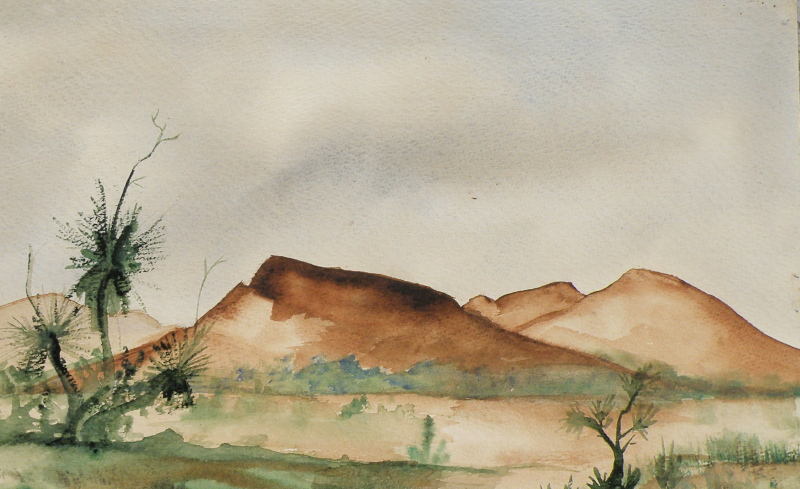
watercolour study, some kind of spiral-pad watercolour paper, 18cm x 28cm (7″ x 11″)
Beginning with the drawing (not as difficult a subject as the others available), the first task was the sky. It was an absolute fascination discovering how a wetted area would feather into sort-of ‘instant’ clouds. That alone had me sold. Learning from the author that more distant objects required less paint and more water was very helpful. And so was adding more detail as the paper dried, saving the finest detail for when it had dried completely.
And the most helpful thing was learning that a single Kleenex solved a lot of problems. What it didn’t teach me was when it was a good time to stop fussing and ‘perfecting’ (another word for ‘ruining’), which I’ve still not quite managed to learn.
rufous hummingbird miniatures
July 18, 2015
The rufous hummingbird (Selasphorus rufus) is a small hummingbird, about 8 cm (3.1 in) long with a long, straight and very slender bill. These birds are known for their incredible flight skills. Some are known to fly 2,000 mi (3,200 km) during their migratory transits.
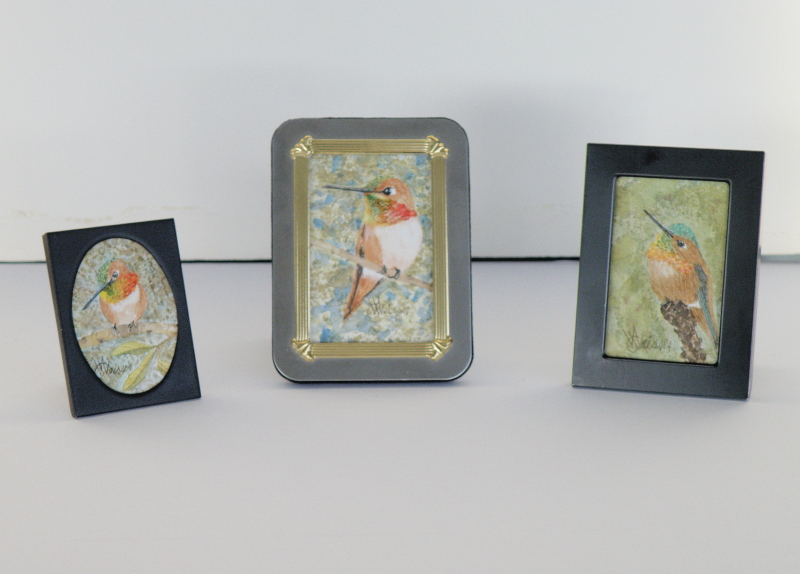
Rufus & Allen’s Hummingbird miniatures, approx. 3.8cm x 5cm (1.5″ x 2″), Arches Hot Press 140 lb. paper
The adult male has a white breast, rufous face, upper-parts, flanks and tail and an iridescent orange-red throat patch or gorget. Some males have some green on back and/or crown. The female has green upper-parts with some white, some iridescent orange feathers in the center of the throat, and a dark tail with white tips and rufous base. Their breeding habitat is open areas and forest edges in western North America from southern Alaska to California. This bird nests further north than any other hummingbird.
The female is slightly larger than the male. Females and the rare green-backed males are extremely difficult to differentiate from Allen’s hummingbird. (source: https://en.wikipedia.org/wiki/Rufous_hummingbird)
[In the photo above, the pre-dawn light produced a less-than-sharp picture. Photography is an artform unto itself. This is a digital image produced by a Kodak Brownie-type picture taker.]
atlantic puffin
July 13, 2015
The Atlantic Puffin is the only puffin native to the Atlantic Ocean and breeds in Iceland, Norway, Greenland,Newfoundland and many North Atlantic islands, and as far south as Maine in the west and the British Isles in the east. The Atlantic puffin has a large population and a wide range. It is not considered to be endangered although there may be local declines in numbers. On land, it has the typical upright stance of an Auk. . .

The Little Auk (Alle alle), is a tiny seabird, around the size of a starling
At sea, Atlantic Puffins swim on the surface and feed mainly on small fish, which they catch by diving underwater, using their wings for propulsion.
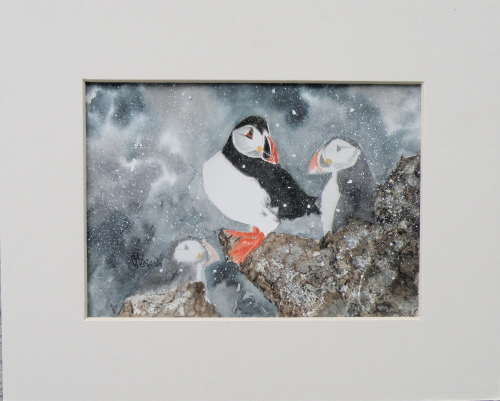
‘Atlantic Puffin’, watercolour miniature, 12.5cm x 17cm, (5″ x 6.5″), Arches Hot Press 140 lb. Paper
The Atlantic puffin spends the autumn and winter in the open ocean of the cold northern seas and returns to coastal areas at the start of the breeding season in late spring. It nests in clifftop colonies, digging a burrow in which a single white egg is laid. The chick mostly feeds on whole fish and grows rapidly. After about six weeks it is fully fledged and makes its way at night to the sea. It swims away from the shore and does not return to land for several years. (source: https://en.wikipedia.org/wiki/Atlantic_puffin)
(reference photo for painting from: Rolf Stange…www.spitzbergen-svalbard.com)
…..carabao
July 11, 2015
MY PARTNER RAUL is from The Philippines, and we’ve been together now 12 years, married (with my sister officiating) in 2008. We met online in 2003, and a month later I flew to Manila where he met me at Aquino International Airport. My sponsorship of him as my ‘conjugal partner’ brought him here in 2007, and Raul is now an LPN, whose specialty area is Geriatrics.
The small Barangay of San Jose, Plaridel, Bulacan, features rice fields whose rhythms set the tone for the annual life cycle of villagers and livestock, including the stolid and dependable beast of burden, the Carabao.
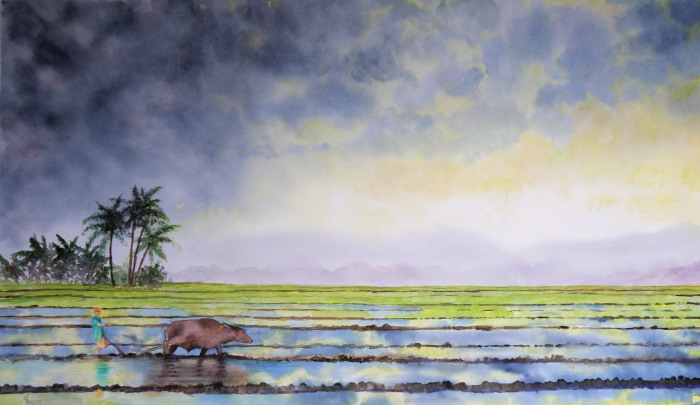
“Bulacan Dawn”, watercolour, 43cm x 74cm (17″ x 29″), Arches Cold Press Paper 140 lb
Water buffaloes are well adapted to a hot and humid climate. Water availability is of high importance in hot climates since they need wallows, rivers or splashing water in order to reduce the heat load and thermal stress. They thrive on many aquatic plants and in time of flood will graze submerged, raising their heads above the water and carrying quantities of edible plants. They eat reeds, giant reeds, bulrush, sedges, water hyacinth and marsh grasses. (source: https://en.wikipedia.org/wiki/Carabao)
There is something so completely humbling about how humans are graced with the educational presence of massively-strong animals whose disposition is nonetheless docile, coupled with a willingness to be put to work with little being asked in return. My three stays in The Philippines of some 6 weeks each, allowed me to learn from the perfect symbiosis of rice worker and carabao, whose calm partnership in the tending of the greenest of green fields was both reassuring and a powerful living metaphor.
…..draw a bird day
July 8, 2015
Kwakiutl First Nation is a First Nations government based on northern Vancouver Island in British Columbia, Canada, focused on the community of Port Hardy, British Columbia in the Queen Charlotte Strait region.
A Kwakiutl Native legend has it that the eagle once had very poor eyesight. Because it could fly to the highest treetops, however, a Chief asked the eagle to watch for invading canoes. Anxious to assist, the eagle convinced the slug, which in those days had excellent vision, to trade eyes temporarily.
The slug agreed, but when the eagle’s sentinel duties were finished, the eagle refused to trade back eyes. Thus, goes the legend, not only is the eagle’s sharp vision accounted for, but also the slowness of the slug.
source: [http://www.baldeagleinfo.com/eagle/eagle-myths.html]
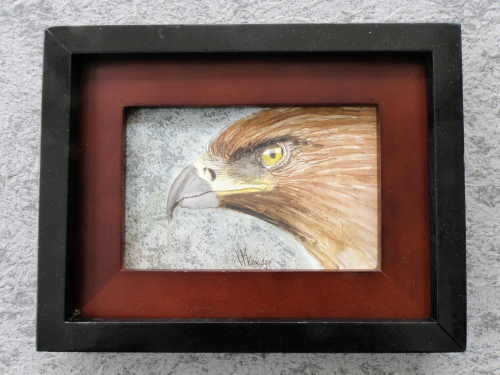
‘Golden Eagle’, watercolour, 9cm x 14cm (3.5″ x 5.5″), Arches 140 lb. Hot Press Paper
Laura, over at www.createarteveryday.com announced a challenge to draw birds today. And ‘Monday,Tuesday,Wednesday’ ‘s contribution was The Nevada State Bird, the magnificent Mountain Bluebird. Kirk’s contribution is The Baltimore Oriole, another gorgeous bird.
inspiration galore!
July 6, 2015
THERE ARE TODAY few watercolourists with the mastery, control, spontaneity and lyrical grace of Joseph Zbukvic, an Australian painter who emigrated from Zagreb in 1970, and took up watercolour in his adopted country.
He is among a handful of true masters of classical watercolour technique, due to an ability to transform veritably any subject into visual poetic language.
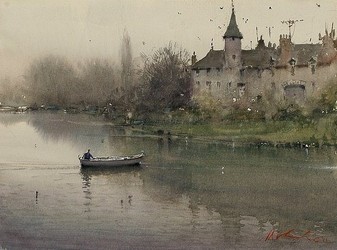
Adroit and seemingly effortless whether out on location or in the studio, Joseph Zbukvic’s handling and style builds on a foundation of an accurate, yet freely-rendered underdrawing, the suggestion of detail, a flawless sense of both composition and values, sparing yet daring choices, brought off with efficiency and dashed-off finishing touches of highlighting contrast.
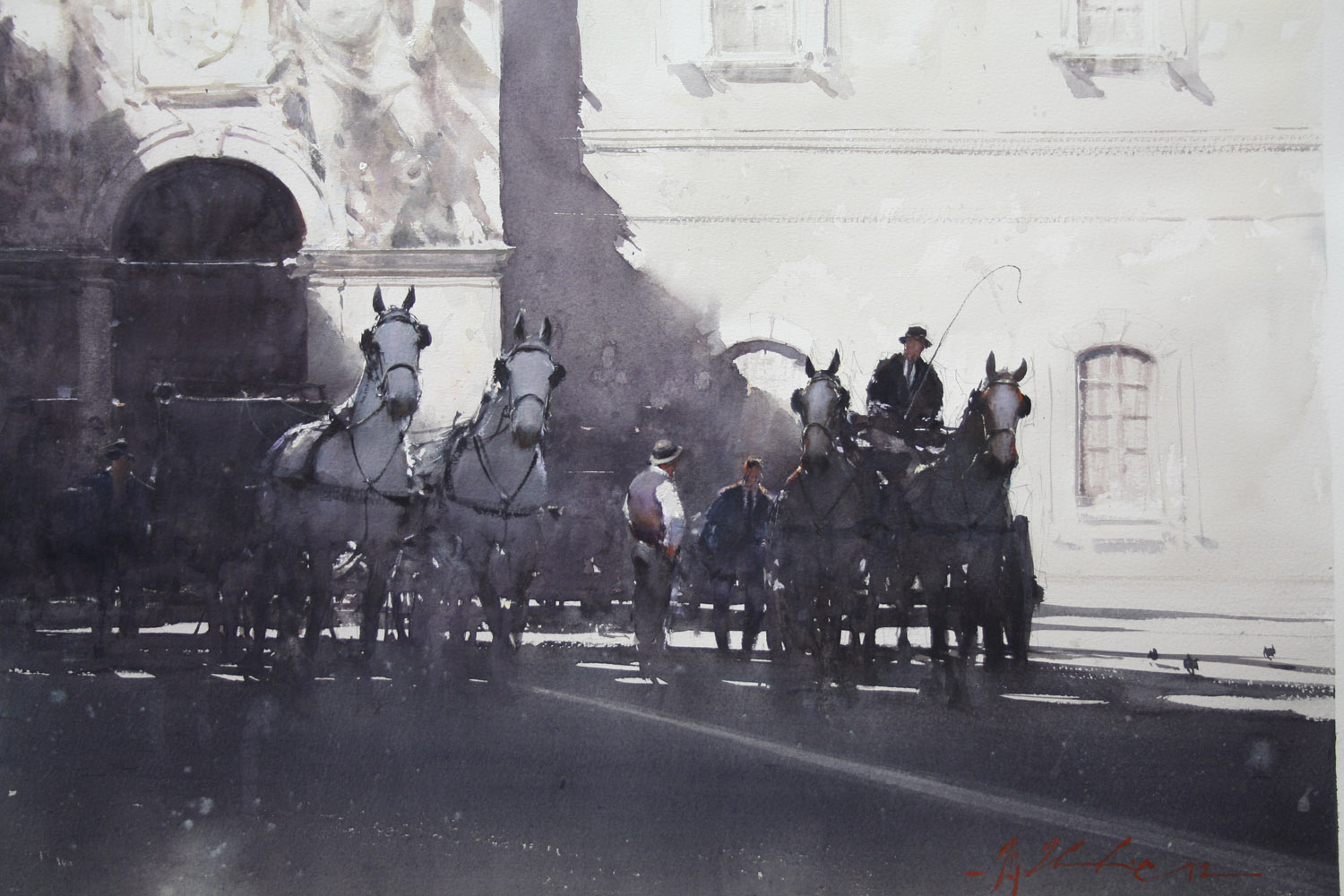
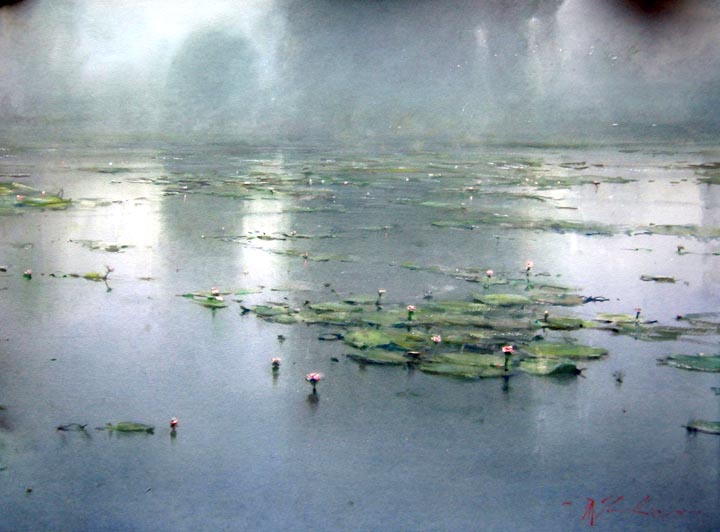

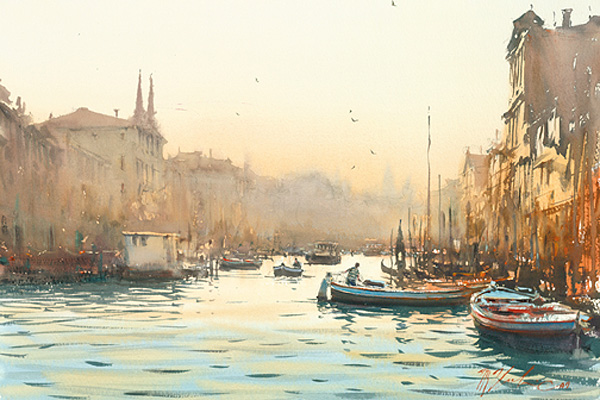

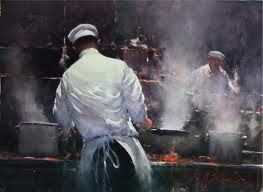
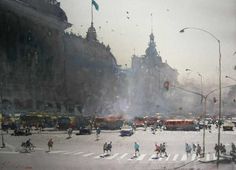
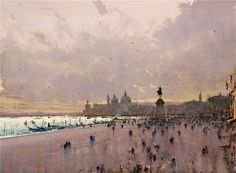
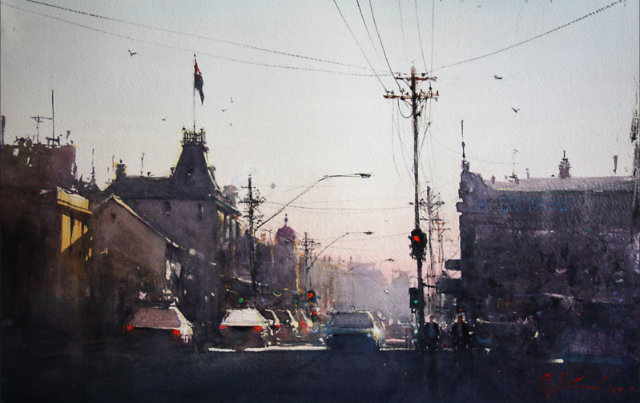

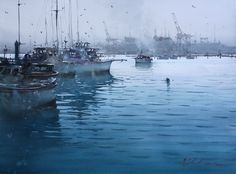

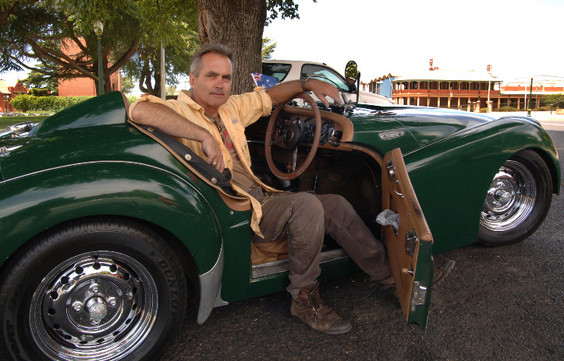
This calibre of painting keeps any student of the medium of watercolour inspired and wanting to stretch and keep striving. It is a wonderful thing to see how high the watercolour bar can be set!
blue moon
July 4, 2015
Because watercolour basically amounts to taking white paper and staining it with various colours by way of a brush and water-activated pigments, the possibility of texture using a buildup of paint, gesso, gel medium and other ‘helps’ available to painters in acrylic and oil just isn’t there. IOW, in classic watercolour technique the word ‘impasto’ doesn’t exist.
Some painters get around this disadvantage by way of collage, and apply watercolour to glued on tissue and similar textural material…..
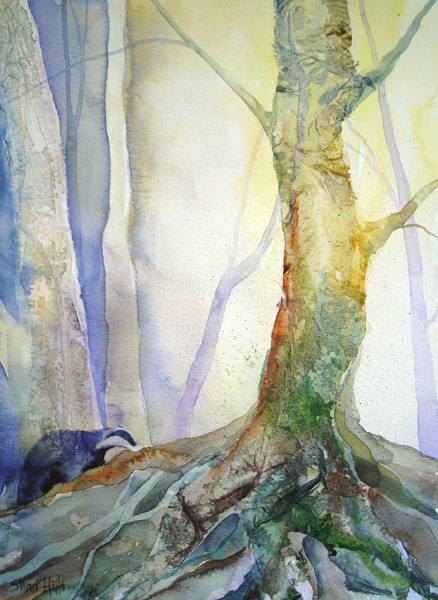 “Forest Forager”, watercolour and collage by Shari Hills, source: httpwww.drawntothevalley.co.ukartistsdetailshari-hills
Here, the painter, Sheri (Colours by Sheri), used ‘delicate papers’ as a glued foundation to provide textures which then received watercolour paint to complete the effect. On her site she describes how she also has used organic leaf material at times.
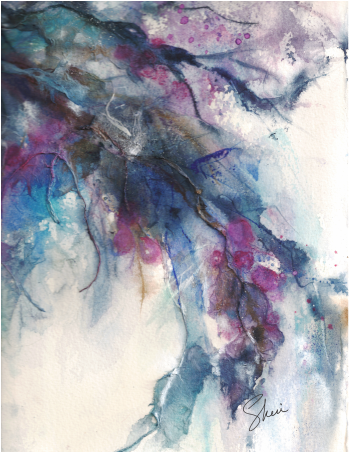
“Winter’s Chill”, watercolour collage, Colours by Sheri, source: httpwww.coloursbysheri.comcurrent-series.html#sthash.aUBXtd8f.dpuf
If this method is used, painters are required to identify their medium as ‘collage’, or ‘watercolour collage’ if entering the piece in an exhibition or juried show. Such work falls outside the accepted boundaries of what constitutes a ‘watercolour’.
In order to remain within the rather strict boundaries painters cannot have more than one third be of another medium or it then becomes a ‘mixed media’ work or ‘collage’ or ‘gauche’. Gauche is watercolour which uses white tempera paint, and thus is opaque, not transparent. Of course, that is perfectly well and good. Every painter does as (s)he is led to do.

‘Moonrise’, watercolour on art board, 19cm x 24cm, (7.5″ x 9.5″)
Personally, like writers who enjoy the challenge of staying within the bounds of iambic pentameter and composing 14 line sonnets, being ‘confined’ to the rather strict parameters of traditional watercolour is rewarding. These protocols include reserving paper to serve as white in a painting (such as the moon in the above example) — and the white of the paper is what brings life to the pigments laid over it. And it means having to discover ways of creating texture which, in the end, remains just an illusion.
conclusion to ….. DIY bookmarks
July 2, 2015
IT IS HEARTENING to read the comments lavished on me for this little project, and to see no one asking me ‘why bookmarks when we have Kindle Readers?’
heh heh….I do own one. And I do have a Google Reader app loaded onto my cell phone. And yes, I do occasionally (like at the dentist’s) have need to continue reading the free download of the 19th C. contemporary of Charles Dickens, Wilkie Collins’ “The Guilty River” (a mystery).
And, because I didn’t want to undergo surgery for a crushed rib cage attempting to read the kazillion-page ‘War and Peace’ in bed, I did read that on my Kindle.
HOWEVER, reading ‘War and Peace’ on a Kindle, though less cumbersome, brings no satisfaction whatsoever when, many grey hairs later, one finishes it. Why? Because those kazillion pages simply vanish into thin air. You don’t get the ego satisfaction of hefting the giant tome onto a bookshelf and nodding at it whenever going by, thinking, “I read that — the whole damn thing — every damn page of it.”
LIKEWISE, young misses into the third week of dating a diehard Kindle devotee–invited to the apartment for coffee, waiting for it to be served–don’t get to peruse the bookshelves to get a good glimpse as to what this person is REALLY like.
THE CLINCHER FOR ME was when Kindle and Google started charging as much for their so-called cloud download of electronic nothingness, as a bookstore does for an actual, substantial, lap-filling, real-and-in-your-hands, BOOK. Uh-uh. If I’m gonna pay $20 for a book? I WANT A BOOK.
THUS, the bookmark DIY project. Because there are still alot of I-want-something-for-my-money book readers like me, who see Kindle as the garment of the Emperor. So if a kindred spirit is going to have to pay $20+ regardless, not only do they want a real book, they’d enjoy receiving a bookmark gift to go with it.
So let’s finish it up…..
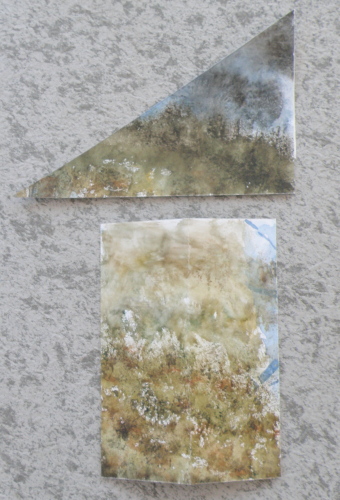
….the remains of the painting reject get chopped into pieces, the largest one measuring wider than 2 widths of the bookmark, because it is going to serve as a sleeve holder…..the smaller piece will become the gift giver’s “To:/From:” tag
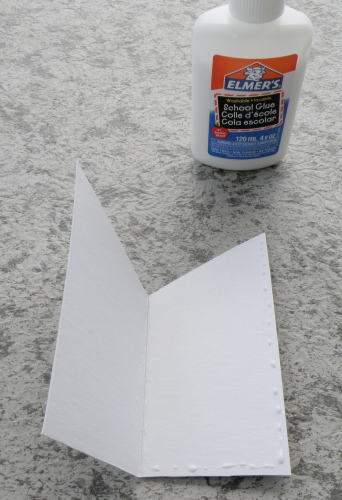
….the larger piece gets chopped down further, with the top part cut on the bias, and glue applied to the side and bottom edges. This is then folded shut, and placed under a flat, heavy weight (I recommend ‘War and Peace’, snigger)….
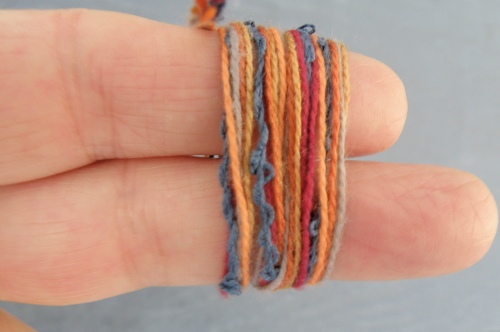
….meanwhile, start your tassel by winding your choice of yarn(s) around the width of two fingers, thereby choosing how big or small you want the finished tassel to be….
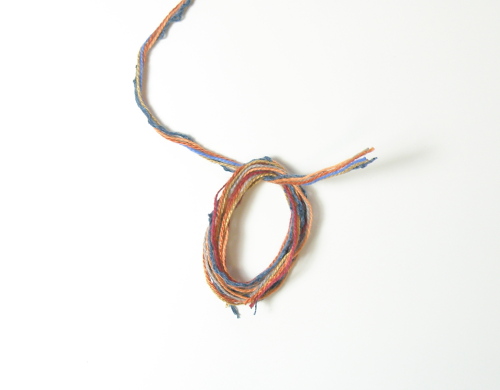
…..thread the tassel loop through with a length of remaining yarn…..
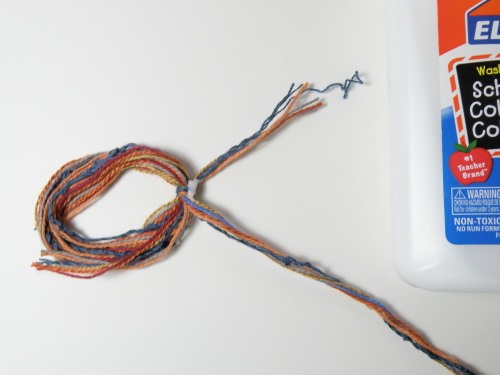
….there are a few ways to handle the rest of this, and I prefer tying a simple knot and then adding a touch of glue to keep from having to knot it twice, thus making it too bulky-looking….
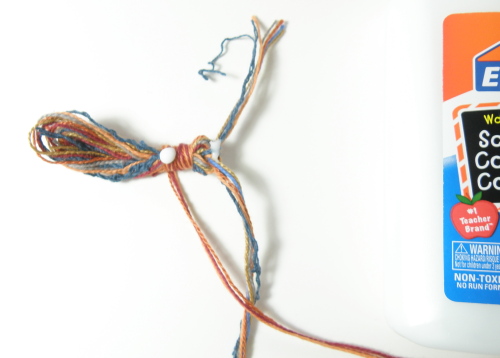
…..wrap a length of yarn below the knotted top to serve as the tassel’s ‘noose’, and secure that with another dab of glue, setting it all aside till the glue has soaked in and dried clear….
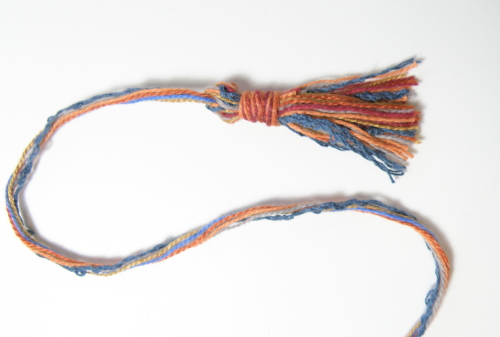
….the frayed ends are trimmed from the knot and the noosed yarn, then the looped bottom is sliced completely across to create the tassel…..
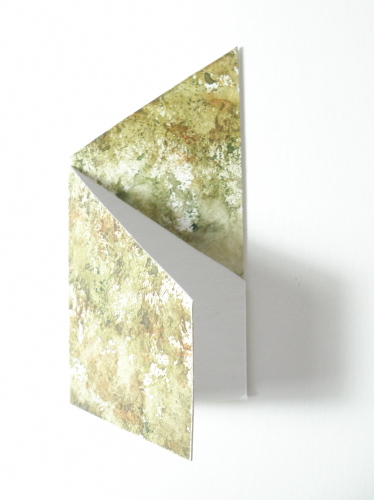
…..the gift sleeve is removed when dry and a complimentary-sized gift card/tag is glued to the front of it…..
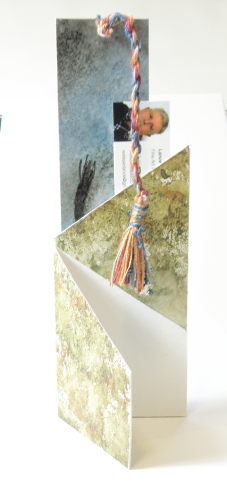
….the completed bookmark, with tassel is inserted into the gift sleeve, accompanied (in this case) with a business card, ready for display and selling…
DIY bookmarks
June 30, 2015
When I was 17, my mother bought me art lessons at The Manchester Art Center, Manchester, Vermont the Summer between high school and college, 1965. Those classes proved to be very memorable. My teacher was a watercolourist I deemed to be old, who was probably a good several years younger than I am now…heh heh.
He advised me to choose my medium carefully and stick with it my whole life, saying, “You’re unlikely to master even one medium, much less a few.” When I told him I wanted to paint in watercolour (because I so enjoyed his), he said, “Ok, good….but now always adhere to the 20 to 1 principle…..for every watercolour you keep, throw out 19.” (IOW, don’t frame often, and if so, make sure it’s worth framing. I think now you know why they were memorable, lol.)
Thus, we come to what to do with the 19. And I cut ’em up and make bookmarks. They sell from between $3 to $5 — $3 for the bookmark alone; $5 for a gift card-type sleeve with gift tag.
Here we go…..
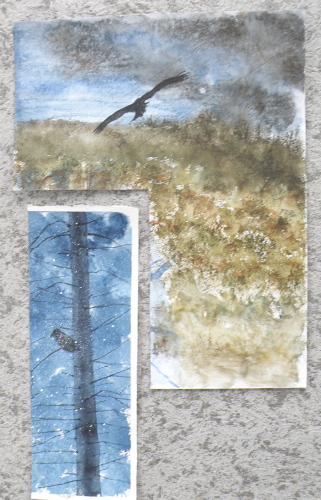
Discarded/cropped portions of paintings…
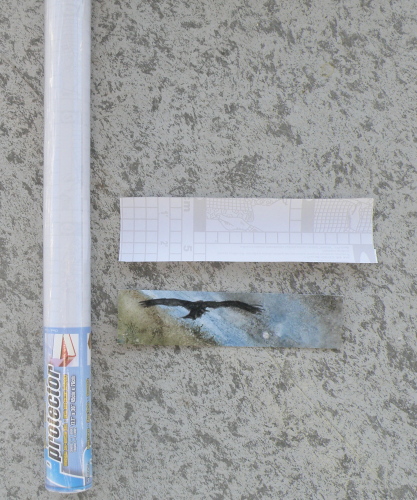
Bookmark part of rejected painting is cut out and also artist signed on front; 2 pieces of protective lamination paper from the dollar store are then cut a bit larger than the bookmark…
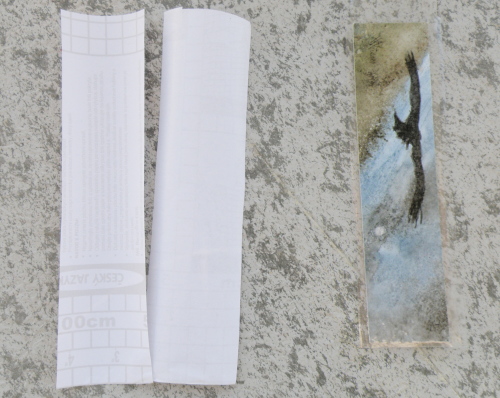
the bookmark is laminated on both sides ….
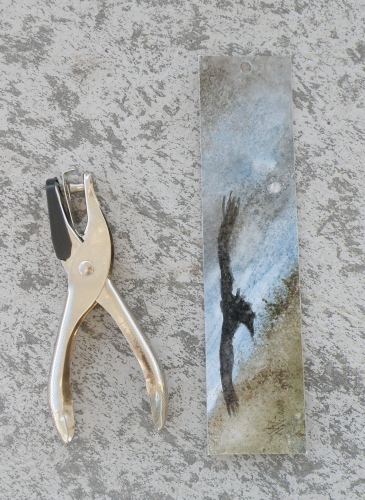
once the laminated edges are trimmed, a paper punch is used to make a hole…..
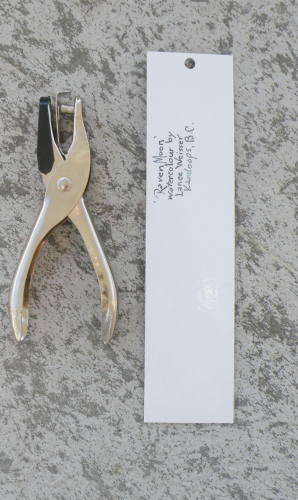
a title (in this case ‘Raven Moon’) and artist info can be written on the reverse before laminating….and the hole is punched at the top
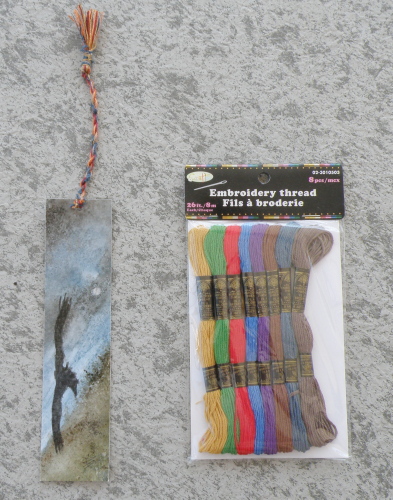
dollar stores also sell embroidery yarn which is then used to make a tassel…
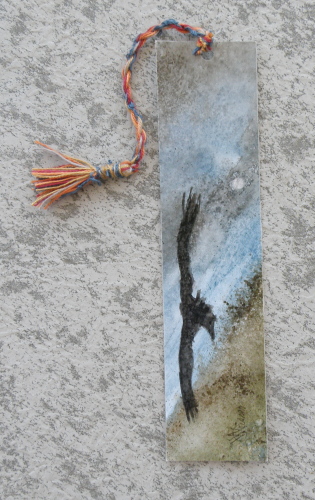
voila
The materials come to practically nothing, cost wise. It’s your time requiring compensation, but I do these watching Netflix, so hey….
Next time I will demo how to make and attach the tassel and also how to make the gift card-type sleeve and gift tag.
tiny robin
June 28, 2015
There is a woman named Robin who comes to the Gallery looking for namesake treasures. It is my personal pleasure to keep her mission accomplished.
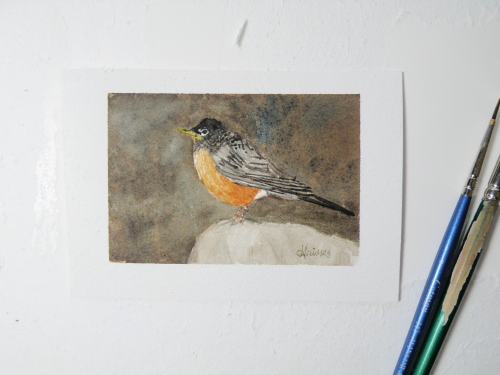
‘N. American Robin‘, 4cm x 6cm, (1.5″ x 2.5″), watercolour miniature, sold
I have a niece named Robin. What’s cool about her is that she is married to Peregrin. And the relieving detail is that they chose not to name any of their three children after birds.
I went to school with a girl named Candi Barr. When I was a kid, our next door neighbour’s maiden name was Olivia Greene. Fortunately, none of my (known) relatives ever named their son Bud.
Please provide some examples of your own known ‘unfortunate’ names. We could all do with a smile.
twilight time
June 26, 2015
DUSK HAS ALWAYS BEEN a magical time for photographers and painters alike. Exemplifying this is John Singer Sargents’ famous work, ‘Carnation, Lily, Lily Rose’ . . .

He would work on the piece by running outside every evening at that magical time to take in the effects the setting sun created in his garden, and add more detail to this wonderful painting–and did this over an entire year, between 1885 and 1886.
It borders on fatuous to have a Singer Sargent and something of mine on the same page, so please refrain from making a comparison. Rather, note along with me that regardless of who is photographing, painting in oils, watercolour, or pastel, trying to gain an understanding of the effects of the setting sun continues to be a worthy and challenging pursuit, no matter which century we happen to find ourselves living in.
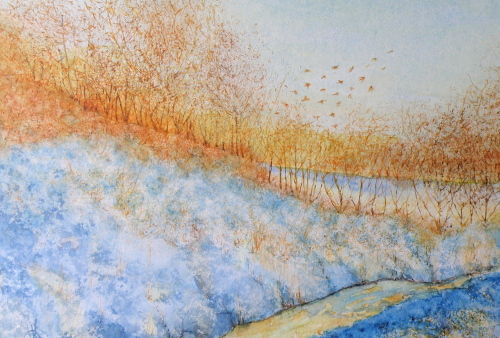
“Winter Sun”, watercolour, 20cm x 30.5cm (8″ x 10″), art board, unsold
heatwave relief
June 24, 2015
IT IS BARELY PAST the first day of Summer and temperatures here in Southern British Columbia, Canada, are scheduled to climb to 40C (104F) and stay there. It is feared the heat and drought affecting California is heading North, Along with such heat, thunderstorm probabilities rise, and they become fire starters. By August there’ll be what weather reports term ‘local smoke’–a haze hanging over everything–accompanied by the sound of helicopters and planes working to douse flames in affected regions close by.
My favourite month is November. It is both an exciting and contemplative month–exciting because any day, any moment I might step out to feel those fortifying winds suddenly becoming the first snow squall. Contemplative, because the fog rising from the closeby Thompson River mixes with wood stove breathings and the last of the leathery oak leaves falling to join the others, invites thoughts on things ethereal and eternal.

“Logging along Jamieson Creek Road”, watercolour, 20cm x 25cm, (8″ x 10″) Arches Hot Press 140 lb Paper, unsold
As a child, there was nothing more beautiful than what I called ‘purple snow’–that snow which signalled to us that we’d best take only one more turn sledding down Dead Man’s Hill (many years prior, legend had it, a man went down its twists and turns standing on his sled and smacked into a maple–back in the old days, when men apparently went sledding). Purple snow meant dinner. Purple snow meant finally discovering just how cold our digits actually were– thawing under a running cold faucet–pins and needles hot pink cold.
And even now, there is nothing to me more beautiful than purple snow. On this 40C second day of Summer, all I can say is, Lord get us through to November.
on display
June 22, 2015
THE OLD COURTHOUSE GALLERY CO-OP and Gift Shop got its start in 2007. The Courthouse itself is a Kamloops, B. C., landmark, built in 1909.
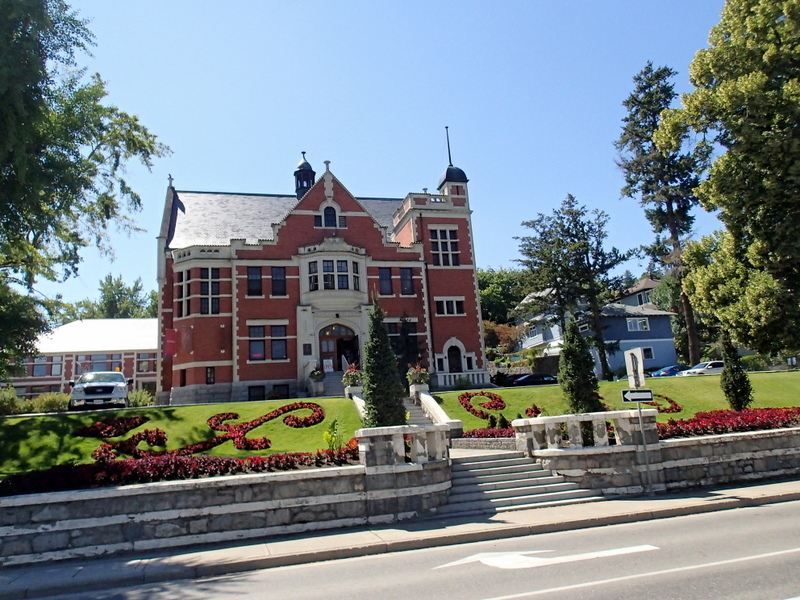
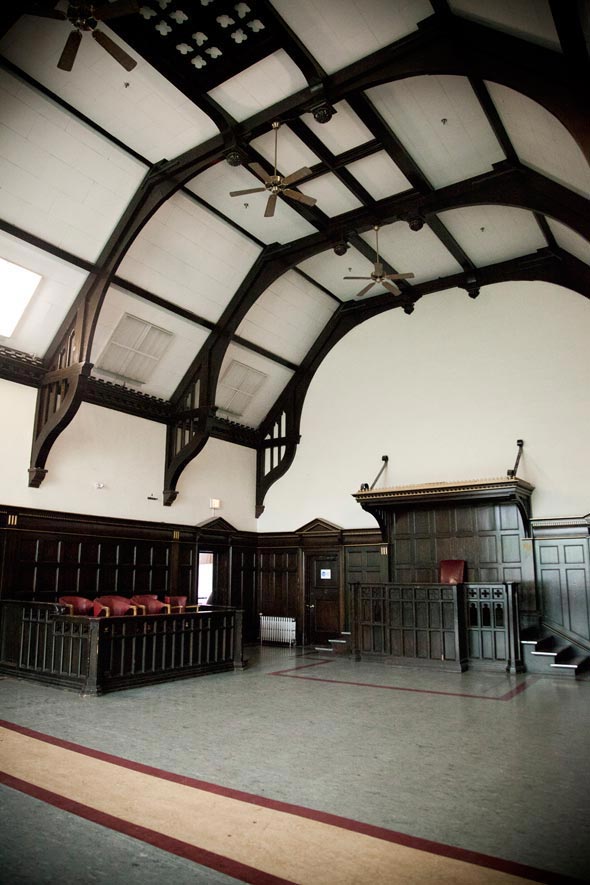
photo: Okanagan Art Review.com
A superb and intact example of the Edwardian Baroque style, its interior demonstrates an Arts and Crafts sensibility.
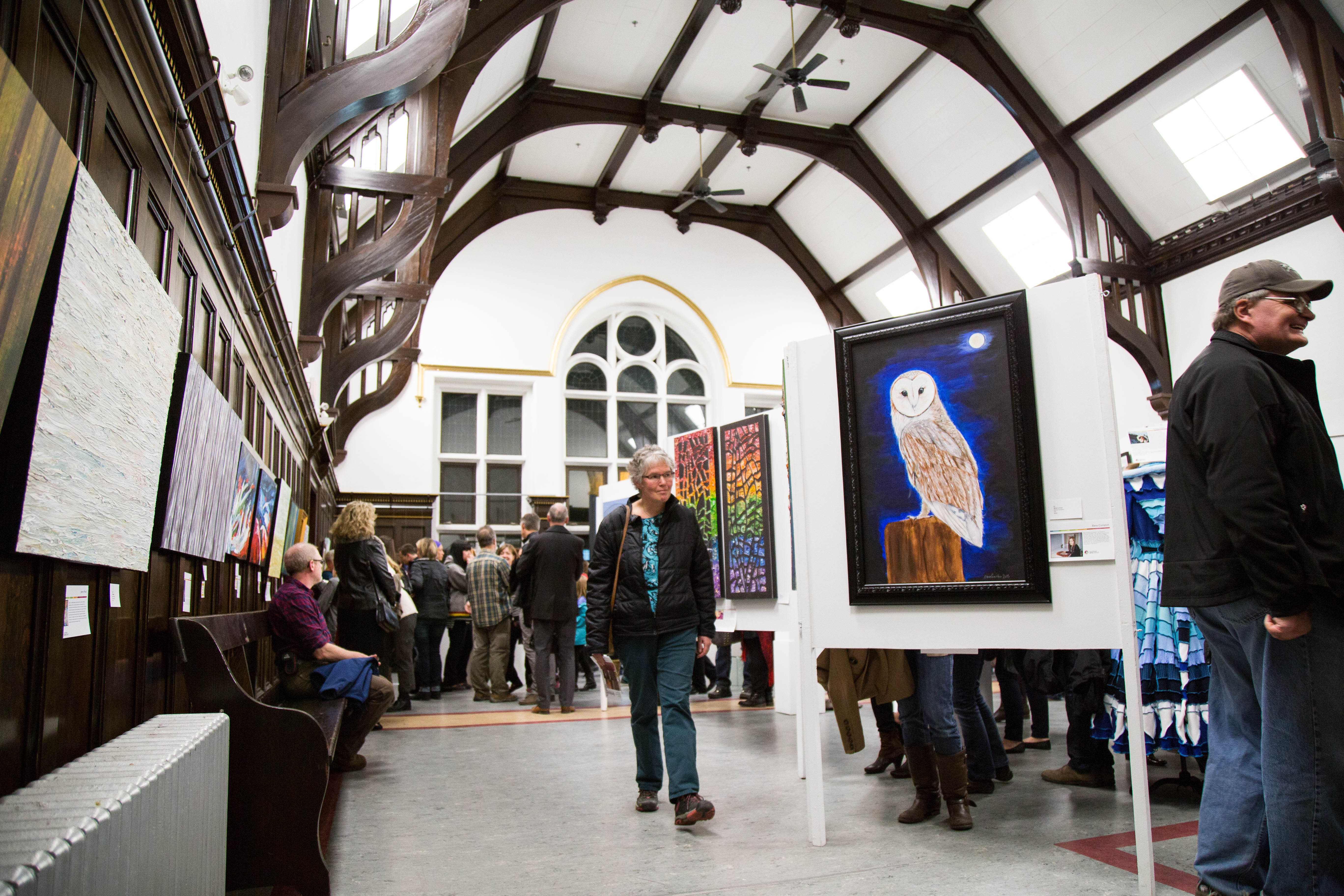
Mainly symmetrical, the building features an elaborate central entry, prominent parapet gables and a corner square-domed tower. It was constructed primarily of local brick, British Columbia stone such as granite, limestone and slate, and wood from local lumber mills. The choice of materials symbolized a commitment to the use of quality British Columbia products, a source of pride in this provincial building. An exceptional level of design and craftsmanship is evident throughout the building. It is one of the most accomplished designs of prominent architects Dalton & Eveleigh, and the stained glass came from the studio of Charles Bloomfield. (source: http://www.historicplaces.ca/en/rep-reg/place-lieu.aspx?id=12791)
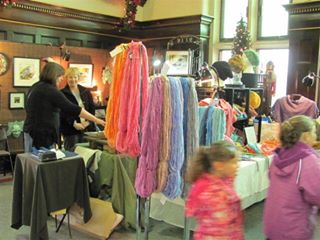
Our Artists’ Co-op now consists of sixteen local artists, whose work is on display within one of the rooms of the original Courthouse. We are a group made up of several potters, glassmakers, jewelry makers, painters, two photographers, one dollmaker, and one weaver. I am currently the President.

Every month we schedule one or two of us to be the Featured Artists who occupy a special area just inside the entrance.
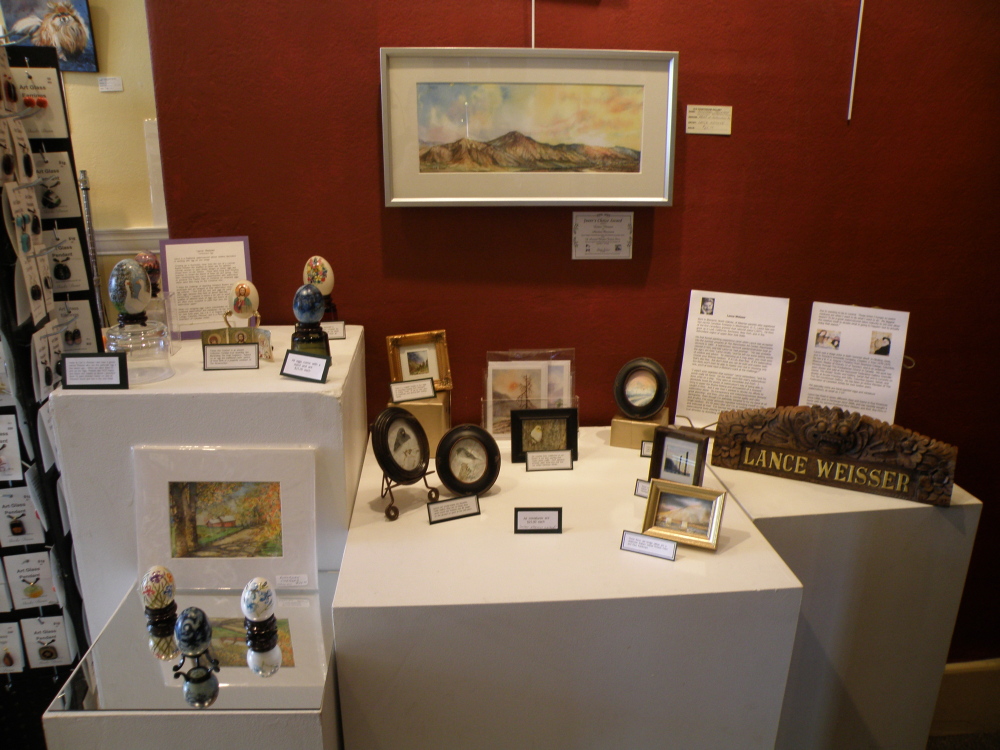
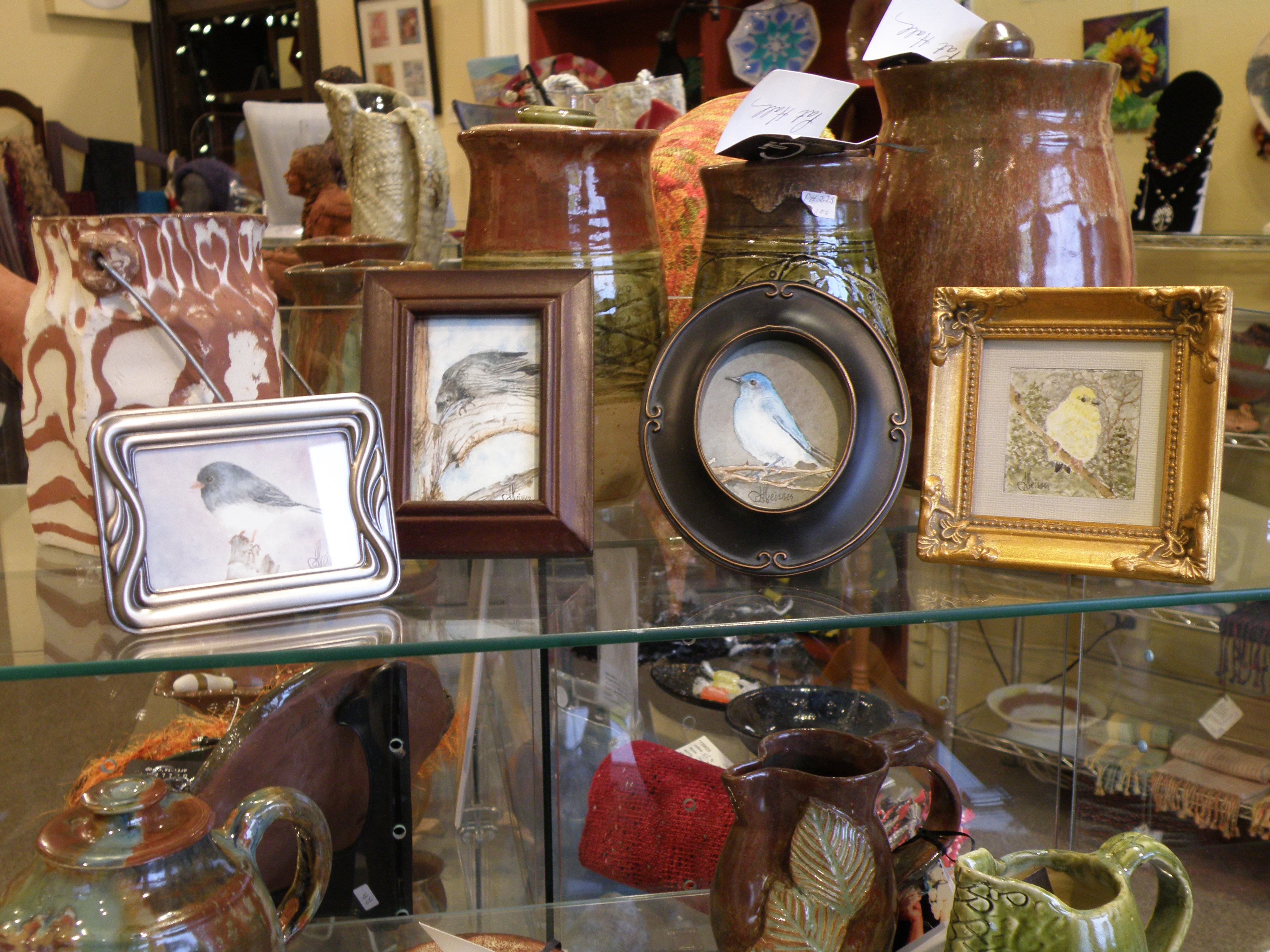
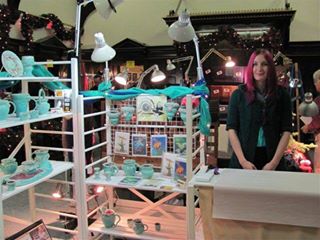
We are open five days a week, all year round, and our biggest event is called Christmas At The Courthouse where we invite and jury in arts and fine crafts vendors to sell their wares throughout the entire building . . .

mountain pine
June 20, 2015
In January 2011, a Pacific ponderosa pine in the Rogue River–Siskiyou National Forest in Oregon was measured with a laser to be 268.35 ft (81.79 m) high. This is now the tallest known pine. The previous tallest known pine was a sugar pine.
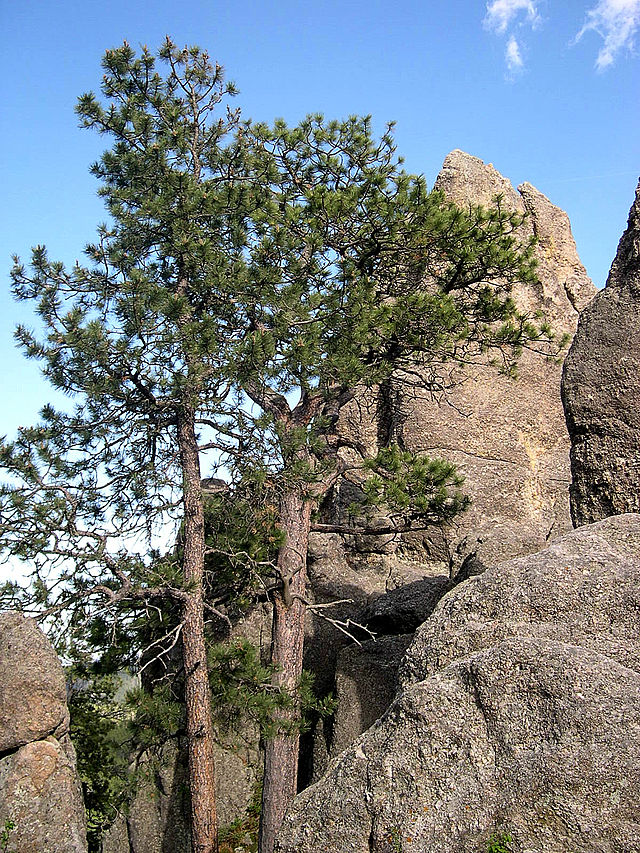
Ponderosa Pine photo by Jason Sturner
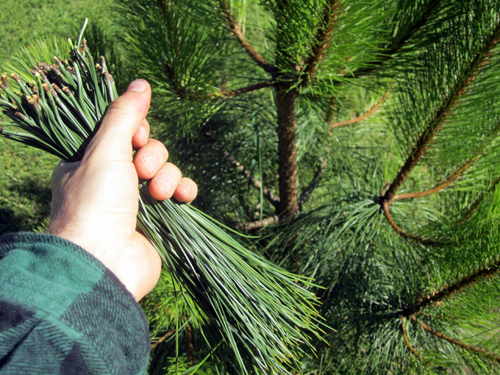
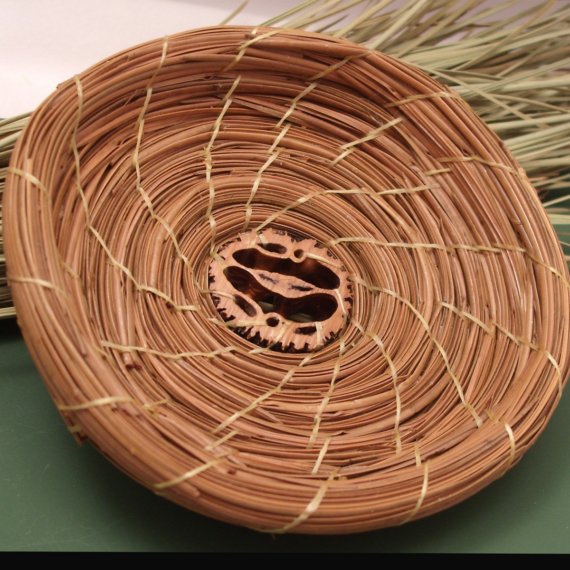
The needles are harvested by First Nations and other local artisans, then washed and woven into Ponderosa Pine needle baskets . . .

(photos: PineGardenBaskets, Etsy)
The mountain pine beetle is just over six millimetres long (about the size of a grain of rice). But the tiny forest insect has infested huge areas of mature pine around the interior of British Columbia, causing colossal amounts of damage on B.C. forests.
The beetle likes mature pine and mild weather. Because B.C. has more old pine than ever before, and has had several consecutive mild winters, mountain pine beetle populations have exploded to epidemic levels. (source + photo: Government of British Columbia)
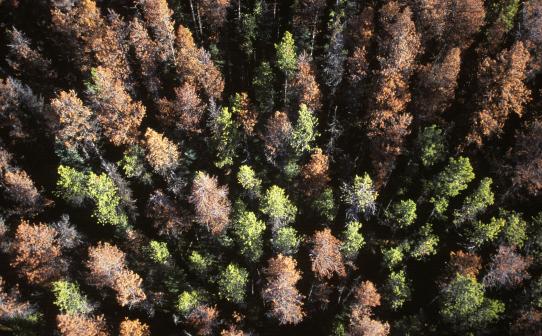
Here in Kamloops, B. C., even pines growing in people’s yards get ravaged–as much as in our great forests. It is a helpless feeling, yet more and more innovative products are being developed from pine beetle timber.
Below is the Richmond, B. C., Olympic Skating Oval, totally made from pine beetle-killed timber. The wood has retained all the pine beetle bores and markings, and has been acclaimed as a ‘truly majestic work of art and design’.
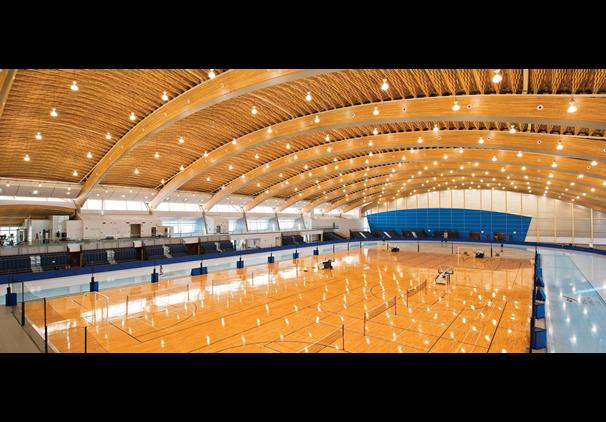
photo: Architectural Review
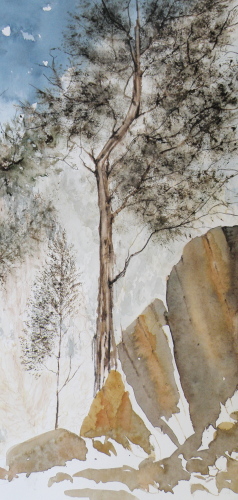
‘Mountain Pine’, (study), watercolour, 15cm x 36cm, 6″ x 14″, Arches Hot Press 140 lb. Paper, unsold
butterfly morning
June 18, 2015
Many butterflies have developed interesting ways of defending themselves from predators. One method is disguise, or “cryptic coloration”, where the butterfly has the ability to look like a leaf or blend into the bark of a tree to hide from predators. Another method is chemical defense, where the butterfly has evolved to have toxic chemicals in its body. These species of butterfly are often brightly colored, and predators have learned over time to associate their bright color with the bad taste of the chemicals. (source:http://www.defenders.org/butterflies/basic-facts)

As children, we chased them with homemade cheesecloth and coathanger nets, paying frequent visits to our neighbour’s butterfly bush which truly was just that. Of course, today they are no longer so abundant and butterflies are–I grew to know–best viewed while alive and gracing the perennials in the front yard.


chestnut chickadee miniature
June 16, 2015
The Chestnut-backed Chickadee uses lots of fur in making its nest, with fur or hair accounting for up to half the material in the hole.
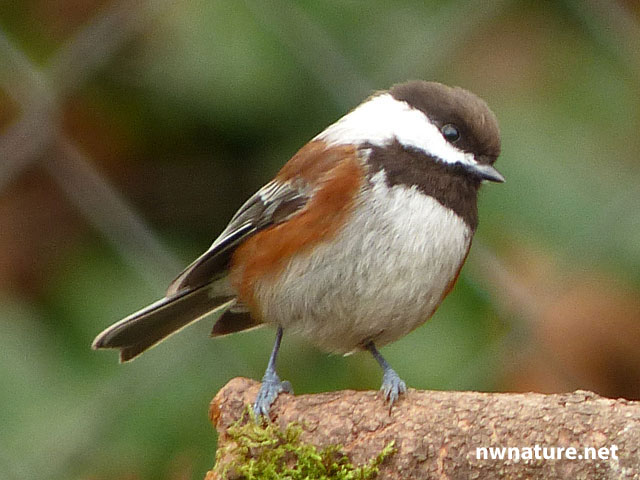
nwnature.net
Rabbit, coyote, and deer hair are most common, but hair from skunks, cats, horses, or cows appears in nests as well. The adults make a layer of fur about a half-inch thick that they use to cover the eggs when they leave the nest. (source: allaboutbirds.org)
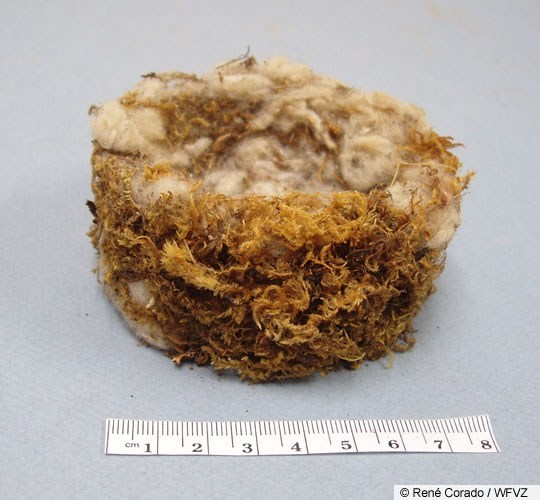 © René Corado / WFVZ
What’s not to like about these chittery, agile, and nimble bits of joy–so accommodating, they’re willing to eat out of an uplifted palm. At feeders, they flit in, impetuously seize a seed, cock their heads and in a mercurial moment are pounding the life out of their shell-encased prize, hammering against a solid branch.
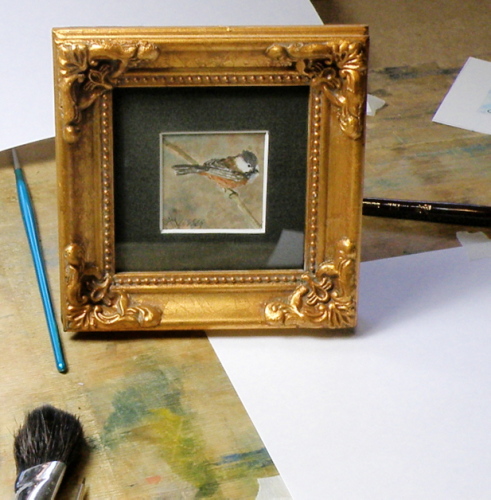
“Chestnut Chickadee”, 2.54cm x 2.54cm (1″ x 1″), watercolour on Arches Hot Press Paper, sold
When annoyed, they chee-chee-chee-chee at any feeder chaos, curtly muscle back in, and sprightly dart back up to pummel their sunflower seed in privacy.
shirley poppies
June 14, 2015
The Shirley poppy was ‘created’ circa 1880 by the Reverend William Wilks, vicar of the parish of Shirley in England. Rector Wilks found in a corner of his garden where it adjoined arable fields, a variant of the field poppy that had a narrow white border around the petals.

By careful selection and hybridization over many years The Rev. Wilks obtained a strain of poppies ranging in colour from white and pale lilac to pink and red, and unlike the wild poppies these had no dark blotches at the base of the petals. (source: https://en.wikipedia.org/wiki/Shirley_Poppy, photo credit: http://pantip.com/topic/30827995)
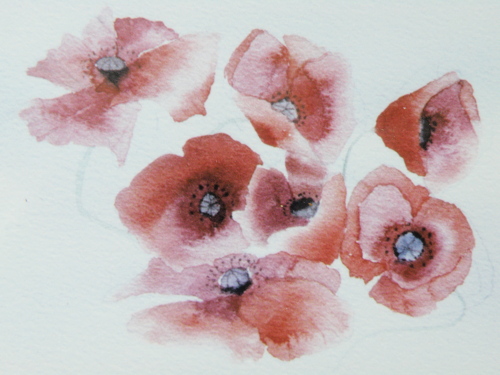
‘Shirley Poppies’, watercolour, Bockingford Cold Press 140# Paper, 15cm x 20cm (6″ x 8″), sold
THEY HAVE BECOME SYNONYMOUS with the Remembrance Day poppy, worn in lapels all over Canada and the U. K. in the early days of November onwards through to the 11th, post-memorial cenotaph services, where, in Canada’s capital, people place their poppy on The Tomb of the Unknown Soldier before departing.
Northern Mockingbird
June 12, 2015
TODAY MY BLOGGING COMRADE, H.J. Ruiz of ‘Avian101’ ( https://avian101.wordpress.com/2015/06/12/law-and-order-2/) features his stories and photographs of The Northern Mockingbird, a bird I was asked to do a miniature of, but not a bird which we (to my knowledge) have populating the Interior of British Columbia (it is probably just too cold here).
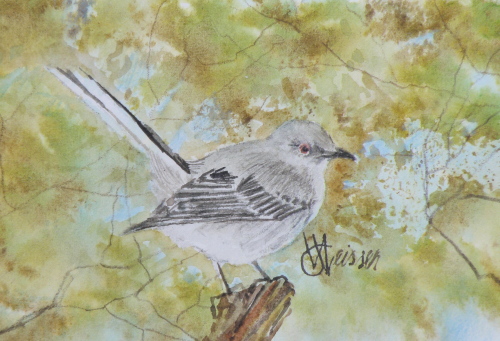
The Northern Mockingbird, 2″ x 3″, watercolour, L. Rice-Sosne Collection
I HAD TO RELY ON REFERENCE PHOTOS and see from H. J.s photos that its feet are quite a distinctive size relative to the body. And it seems from photos to be a very sharp-eyed, inquisitive, decisive–almost wary–garden ‘defender’, as H.J. declares the Mockingbird to be. I’d perhaps have made its wings a degree darker had I had his photos before me, but I’m okay with the results.
OF COURSE, BOOMERS LIKE ME grew up hearing Patti Page singing ‘Mockingbird Hill’, as well as Inez and Charlie Foxx’s ‘Mockingbird’ (https://www.youtube.com/watch?v=g47_NI1CWNQ — which my parents hated and I loved ). It was, to me anyhow, later perfected by James Taylor and Carly Simon — watch here: https://www.youtube.com/watch?v=KmnTcBdpbHI . So all I really knew was the lore, rather than the bird.
AND I HAVE OVER THE YEARS, come to associate The Northern Mockingbird with The Old South, whether warranted or not, I just don’t really know.
barn swallow
June 9, 2015
A FEW INTRIGUING FACTS about Barn Swallows:
(source: allaboutbirds.org)
- Although the killing of egrets is often cited for inspiring the U.S. conservation movement, it was the millinery (hat-making) trade’s impact on Barn Swallows that prompted naturalist George Bird Grinnell’s 1886 Forest & Stream editorial decrying the waste of bird life. His essay led to the founding of the first Audubon Society.
- According to legend, the Barn Swallow got its forked tail because it stole fire from the gods to bring to people. An angry deity hurled a firebrand at the swallow, singeing away its middle tail feathers.
- The oldest known Barn Swallow in North America was 8 years, 1 month old.

‘Male Barn Swallow‘, watercolour, 7.5cm x 12.5cm, 3″ x 5″, Arches Hot Press 140# Paper, L. Rice-Sosne Collection
Barn Swallows don’t come to seed or suet feeders, but they may take ground-up eggshells or oyster shells placed on an open platform feeder. If you have a suitable outbuilding, leaving a door or window open can encourage Barn Swallows to build a nest inside. Providing a source of mud will also help with nest building. Barn Swallows may use artificial nest cups attached to an appropriate surface.
Barn Swallows also drink and even bathe on the wing, dipping down to take a mouthful of water or touch their belly to the surface for a quick rinse. Males defend a small territory around the nest site and aggressively chase away other males, even grabbing them with their feet and tumbling to the ground. Individuals or groups of Barn Swallows mob predators such as hawks, gulls, or grackles that approach nests.
joan’s place
June 7, 2015
THIS FORMAL AND RATHER LOVELY Heritage Home in our small city (90,000) of Kamloops, B.C., (canada) is known as the Dr. M.S.Wade House. Dr. Mark Wade was an eye, ear, and throat specialist who arrived in Kamloops in 1895. A decade later, in 1905 he built his home. It has become a great favourite painting subject of mine . . .

Dr. M.S. Wade House
THE BASIC SHAPE OF THE HOUSE is undecorated and angular, but Wade added rich Victorian millwork and slender, turned verandah columns. Bay windows, stained glass and a wraparound verandah are lovely features to this home.
IT IS SUCH AN APPEALING SUBJECT. The reasons for this are my enjoyment of Victorian architecture, how the many nuances of this design capture the imagination, (especially when situating the house in the midst of ‘moody’ seasonal weather), and how its present owner adds her own personal touches. The watercolour below has been posted here, but some years ago now. . . .
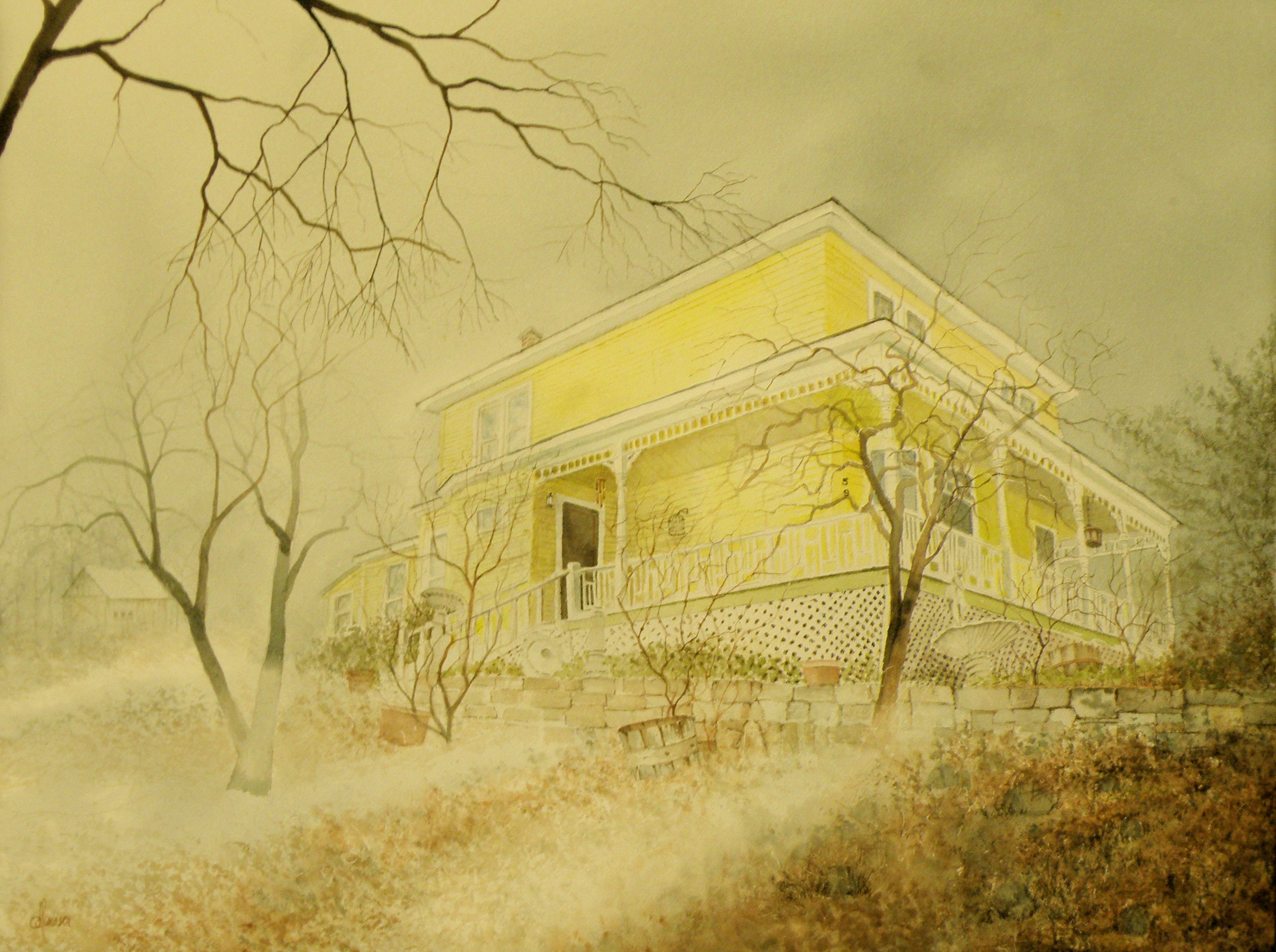
‘Foggy Dew’, November, Dr. Wade Home’, watercolour, Arches 140# Cold Press Paper, 36cm 50cm (14″ x 20″), J. Potter Collection
BUT A MORE SUMMERY ONE is of a portion of the house at the very back which can be faintly seen at the far left in the painting above . . .

“Joan’s Place”, watercolour on matt board, 23cm x 31cm (9″ x 13″)
THIS WAS AN EXPERIMENTATION in depicting grasses on the almost glassy smoothness of plain old white matt board. As a finished painting, it is so-so. The composition suffers from there being just a bit too much grass, and how the lawn ornaments unintentionally became the subject. Without an interesting focal point, in the end it was a helpful study in summer grasses and pines–and an instruction in what to avoid in seeking good composition (i.e. not everything in a photograph needs to be included).
more night
June 5, 2015
I KNOW, I KNOW, it’s June. I’m incurably attracted to Autumn and Winter, most likely because they are for me what I’d describe as cozy seasons, where a sweater serves perfectly.
ADMITTING to age preferences is slightly embarrassing, but only slightly. Heat is no longer an attraction to me, weather-wise, and here it is June 5 and in two days it will be going to 92F (33C). Now please, do NOT misinterpret this as whining. I’m not (right now), but rather simply stating a preference in order to justify posting this painting….
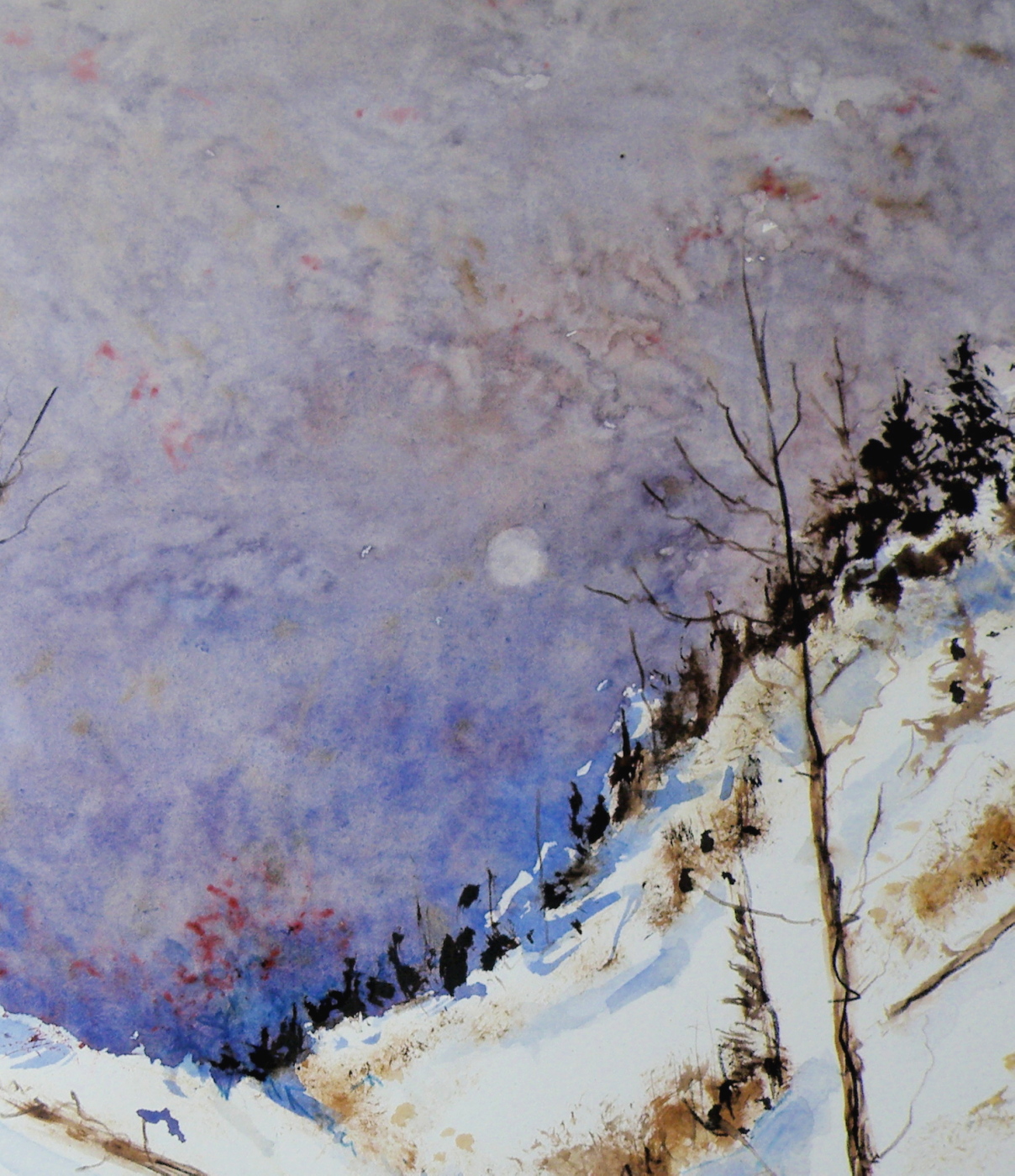
‘Pale Moon’, Watercolour on Arches Hot Press 140 lb Paper, 13cm x 18cm (5″ x 7″)
WHEN PAINTING, I admit to finding it more satisfying to express feeling through stark scenes with diminished-light. For one thing, the above place is not one many people would find themselves visiting at that hour in that weather. It therefore brings us in as though inviting a search for Snowy Owls on the prowl, or a pack of Grey Wolves threading a path back to the lair.
tranquille creek gorge
June 3, 2015
ANCIENT FLOWS OF LAVA have left our regional landscape (Kamloops, B. C.) with dramatic canyons, a single lane dirt road skirting the edges.

‘Tranquille Creek Gorge’, watercolour 23cm x 41cm (9″x16″) Arches Hot Press 140 lb. Paper, sold
MY PAINTING FRIEND MAX drove me through this arid landscape, only 10 minutes outside a city of nearly 100,000. Every so often she’d tell me of cars which had not been successful at executing a snowy, icy, tricky piece of road only to careen down the sides. At one place, the car was still there, making me both dizzy and almost nauseous, leaning over to see its rusting bulk caught between broken pines and rock.
‘MY GOD, WHERE WERE THEY HEADED?’ I’d asked. ‘Home, of course’, Max pointed ahead. And there was a small grouping of houses not far from the road, some fencing in horses or livestock–one had alpacas–and looking semi-deserted, though that was far from the case. Dogs barked at Max’s pickup as we threaded through and headed into yet more wilderness. ‘They take this road to Kamloops and back?’ — it seemed to my chicken, urban-minded guardedness a scary place to build one’s home. ‘Only for shopping, or a night on the town’, Max said. ‘Which is why someone sometimes doesn’t make it home–especially in the Winter.’
 weisserwatercolours