

….Raven Moon

March 5, 2016

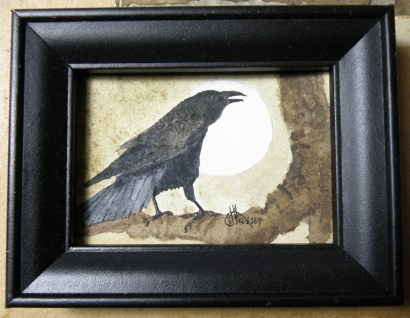
Ravens sell very well in this neck of the woods, partially because they figure so prominently in our local Native legends–and partially because they are, as a species, so singular and distinctive.  A customer pointed out to me that whereas Crows are very social (gathering together in great numbers), Ravens are solitary.  Perhaps one of you can verify this comment–or add a correction?

This painting is 2.75″ x 1.75″ and, instead of putting it behind glass for protection, the decision was made to spray it with a durable fixative so the piece has more immediacy when viewed.  I did include the glass in case the customer wishes to provide greater protection.


OLYMPUS DIGITAL CAMERA


These bird miniatures can also be purchased from me through weisserlance@gmail.com for $30US (postage costs additional) unframed, $35US framed.  Some buyers have chosen to select a suitable frame themselves locally and then email me the size the painting must be to fit their chosen frame.  Then it is simply a matter of mailing off the painting in an envelope–easy-peasy.  I have painted everything from someone’s favourite parrot (our late, great friend George Weaver’s prize pet) to exotic birds seen on a favourite trip and painted from a photograph supplied via attachment.


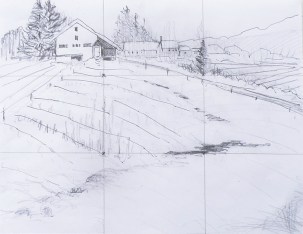
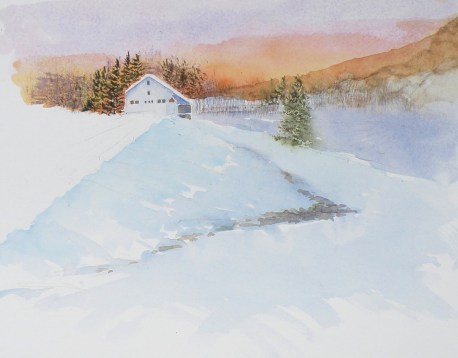
Results of ‘composition exercise 1’: dividing a landscape into thirds, placing visual interest at each intersectional  point….

OLYMPUS DIGITAL CAMERA

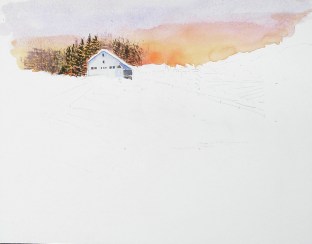
Results of ‘composition exercise 2’:

OLYMPUS DIGITAL CAMERA

and 3:

OLYMPUS DIGITAL CAMERA

bringing us to 4:

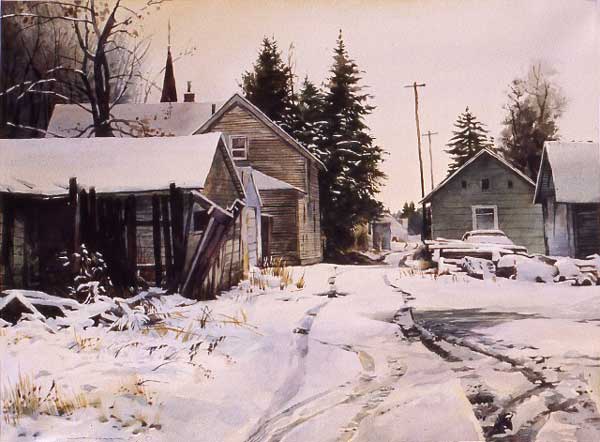
It has taken a long spell of waffling over what to do about being less than pleased with the finished piece.  The snowy fields seemed to extend themselves too far down, without enough visual interest to hold a viewer’s attention.  And then I gave into the temptation/artistic trap I almost always seem to fall into, which is going one step too far by defining open field with regimented rows of corn which wind up being so monotonous, the fence posts going the opposite direction only add yet more visual predictability  and kill whatever freshness the piece had going for it.

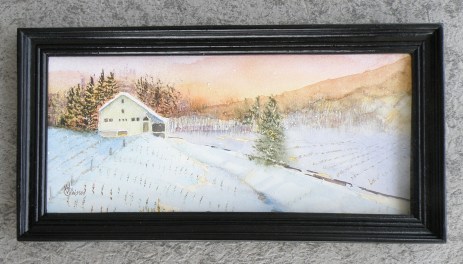
….so the only satisfactory outcome was to crop the painting and salvage what could be salvaged.

OLYMPUS DIGITAL CAMERA

It is a very small painting, about 6″ x 12″, and has at least enough mood still going on to make it only just worth framing.

As an exercise, however, it was more than useful, and confirmed satisfactorily that placing interest at intersectional points within a composition divided into thirds works (sans rows of corn, that is), does hold one’s attention, and lends a feeling of balance.


…. Robin miniature 2

February 12, 2016

It has been an unsettlingly warm Winter here in interior British Columbia, with Spring bulbs actually starting to poke up through the ground.  Unsettling, because being only mid-Winter, we might well suddenly get one of those Arctic inflows and see temps plunge to -20C, which would effectively ruin what shouldn’t have already begun sprouting, including fruit trees.

It wouldn’t be surprising at all to actually see Robins returning in February, when their normal return isn’t until mid-March.  Being such avid worm-hunters, I have wondered at their early returns here, particularly as to what they find to eat.  The answer is the Mountain Ash berry and other lingering berries.  The danger, apparently, is eating ones which have fermented, thereby becoming naturally alcoholic and responsible for killing birds who eat too many.

This miniature is of the British/European Robin, which doesn’t reside in Canada.  But English Robin miniatures are snapped up in our Gallery simply because they have established such a rich literary following, and also appeal to Canadian emigres.

The difficulty painting a bird the painter has never seen–and therefore isn’t familiar with–means it may not be true to how the bird actually looks.  However, this particular bird has so frequently been depicted in book illustrations and greeting cards, that its persona lives beyond its ‘real life’ comings and goings.  So here in Canada, getting the English Robin ‘right’ isn’t as stringent a matter as getting the Canadian Robin right–a bird everyone is familiar with, and therefore has to be flawlessly rendered.

They seem so very sweet.


It has become ‘belated everything’ for me lately…so why not this as well.

OLYMPUS DIGITAL CAMERA

2.5″ x 3.75″ watercolour on Arches Hot Press 140#

We’ve come to know this as the English Robin (at least here in Canada), though I see it referred to elsewhere as the European Robin (which of course no Brit would ever go for).

Here are some (possibly) little-known tidbits about it: “. . . The distinctive orange breast of both sexes contributed to the European robin’s original name of redbreast (orange as the name of a colour was unknown in English until the sixteenth century, by which time the fruit of that name had been introduced). In the fifteenth century, when it became popular to give human names to familiar species, the bird came to be known as robin redbreast, which was eventually shortened to robin. As a given name, Robin was originally a diminutive of Robert . . . ”  [ Lack, D. (1950). Robin Redbreast. Oxford: Oxford, Clarendon Press. p. 44]

Personally, I have never seen this bird except depicted and written about in stories like “The Secret Garden”.  But whenever I paint a miniature of them, it is purchased very quickly, and usually by a homesick, transplanted member of a country ‘across the pond’.  It would be a treat to see them in their natural setting.

…. mackerel sky

January 29, 2016

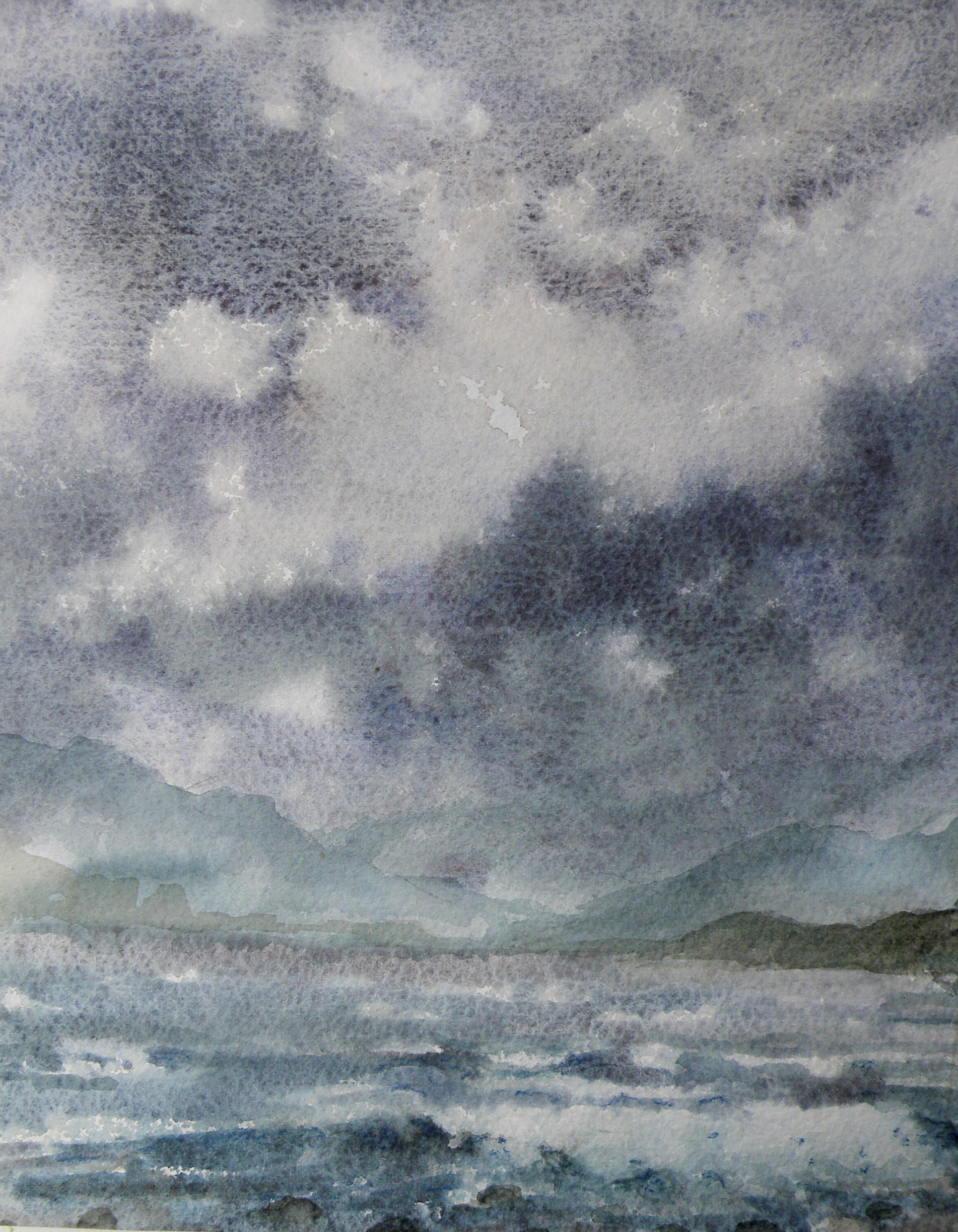
There is an Old English saying about weather which goes:  “Mackerel scales and mare’s tails make tall ships carry low sails”.  ‘Mackerel scales’ refers to Altocumulus clouds which (to some) resemble the markings on the sides of mackerel.  ‘Mare’s tails’ refers to Cirrus uncinus clouds which–according to the saying–must, like mackerel scales, indicate strong winds, though the two types wouldn’t likely appear together in the same sky.


OLYMPUS DIGITAL CAMERA

The subject is taken from a view of the British Columbia coast, beaten down by the effects of storm after storm.  Having lived on Vancouver Island at one point, the weather forecast for the most northerly tip seemed to nearly always call for wind and rain which made me thankful we lived on the most southerly end.  We received quite enough rain as it was.  However, seldom was it ever a pelting, all-out soaking torrent–which made local people say to tourists complaining about the constant drizzle, “Yes, but it’s a dry rain.”

This was painted on treated illustration board.


…. Tranquille Creek Gorge

January 21, 2016

The watercolour video demonstrations of David Dunlop are challenging and yet simple.  https://www.youtube.com/watch?v=Lgtg-Adql1Y&index=6&list=PLtEJwQmsB7SvVg8C4J2c4LDijerH7SSKF (I tried to embed the video itself in this post, but WordPress thought otherwise).  But here is the blurb describing it….”Emmy Award winning David Dunlop takes you to his Connecticut studio to demonstrate a two minute watercolor, used as preparation for an oil sketch or to explore ideas“.

Mr. Dunlop is an artist/teacher from Connecticut, whose manner when teaching is inspiring and animated.  He is a great follower of descriptive, energetic Masters like J.M.W. Turner and Winslow Homer, and seeks to employ their methods, while demonstrating their techniques.

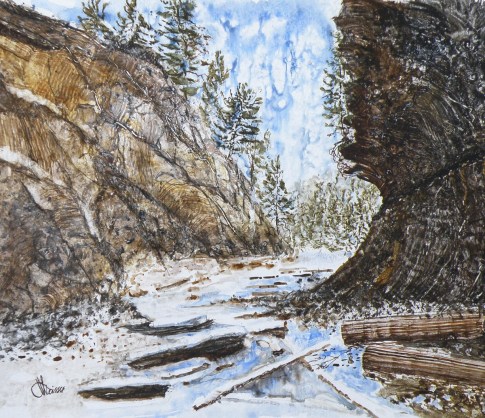
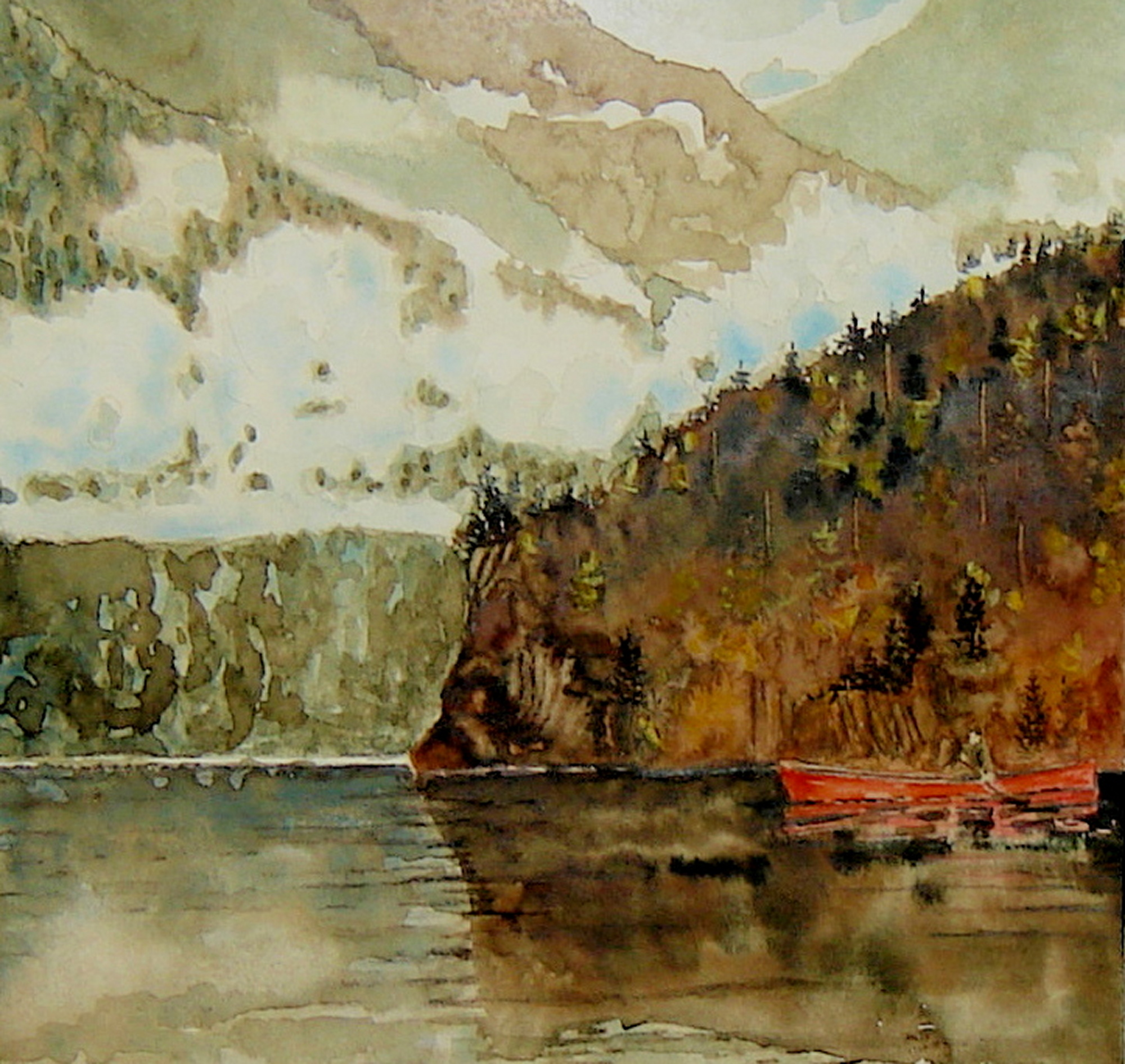
The video cited above challenges painters to do two to three minute painting sketches, which convey the movement and mood and spirit of the subject, without stopping to think and rework.  In an effort to ‘do’ and not think, the subject chosen here is a favourite–a place about 20 minutes from our house–called Tranquille Creek Gorge.


OLYMPUS DIGITAL CAMERA

Mr. Dunlop’s videos are quite dynamic and aimed more at oil painters a bit more than watercolourists, but full of very encouraging lessons because of the force of his optimistic personality and sense of fun.  They are well worth watching, for those who enjoy painting as a means of expression.


….composition exercise 2

January 17, 2016

Continuing on with an attempt to test out the compositional dictum known as ‘the rule of thirds’, which was conceived and named by John Thomas Smith in 1797 :

“. . .  Analogous to this “Rule of thirds”, (if I may be allowed so to call it) I have presumed to think that, in connecting or in breaking the various lines of a picture, it would likewise be a good rule to do it, in general, by a similar scheme of proportion; for example, in a design of landscape, to determine the sky at about two-thirds ; or else at about one-third, so that the material objects might occupy the other two : Again, two thirds of one element, (as of water) to one third of another element (as of land); and then both together to make but one third of the picture, of which the two other thirds should go for the sky and aerial perspectives. . . “

To illustrate its basics…..

ruke of thirds

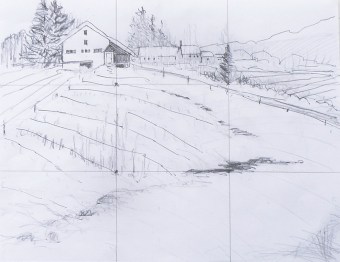
Once again, this is the drawing I did initially, to put this into practice….

OLYMPUS DIGITAL CAMERA

And this is the first go at painting the scene….

OLYMPUS DIGITAL CAMERA

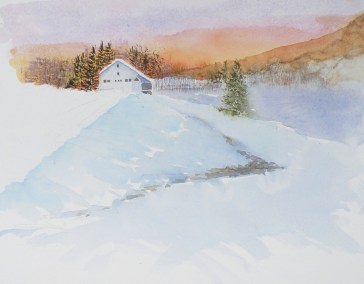
And now today, here is the progress so far, attempting to locate some visual interest at each of the four intersections within the piece, the barn being the first and the pine being the second and the creekbed being the third…..

OLYMPUS DIGITAL CAMERA

The darkest darks and greatest contrast will remain with the barn, for that is the intended focus for the picture, when completed.

The ‘rule of thirds’, as stated above, holds that generally two-thirds of a landscape be devoted to the sky, with one-third given to the land below (the sky being such a vast and dominant feature).  In this case two-thirds is dedicated to the land and a very high horizon means that the one third is devoted to the sky area.


….snow

November 25, 2015

We received about 12cm overnight and now everything’s white, with temperatures starting to drop to around -10C (16F) under strong winds.

The birds are in the branches of the large Red Maple just beyond our big front window–at the four hanging feeders and suet cakes.  We get mostly goldfinches and house finches, chickadees, juncos, nuthatches, flickers, clark’s nutcrackers, pine siskins, ring-necked doves, occasional pileated and downy woodpeckers, grosbeaks, stellar’s jays, magpies, ravens, white-crowned sparrows, and when it gets really cold the sweetly-blushing redpolls come down from the Arctic (but not likely until January or so).

Occasionally we see a Northern Pygmy Owl which swoops in on the dining lot, lighting on a branch like a handful of fluff with alarming eyes and causes the rest to take off like an explosion. They are one of a few daylight-hunting owls, and for two or three days following, the feeders remain untouched, the memory of that fist-sized, feathered-danger keeping everyone away.

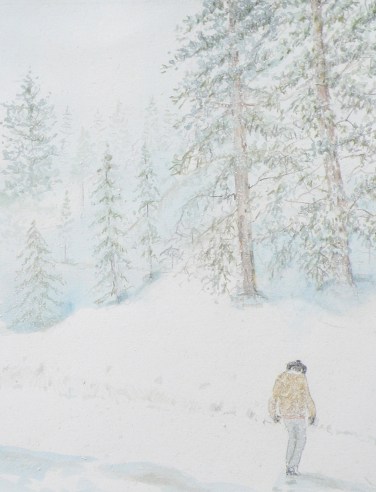
In honour of the occasion — the advent of real Winter — a wintry watercolour, not unlike what the countryside looks like presently.  The subject no doubt wishes the wind were less than it is….

OLYMPUS DIGITAL CAMERA

….but imagine the pleasures of fireplace and toddies once he gets back.

It’s an old painting–6 years–and approximately 8″ x 10″ on my favoured Arches Aquarelle Hot Press 140# paper.  It took approximately 30 years to finally discover the right paper, having gone through all the choices of surface, weight, paper-maker (brand), and so on.  Were it to be done again, the figure would be altered some, as there’s something anatomically odd about it.

….the silt bluffs

November 22, 2015

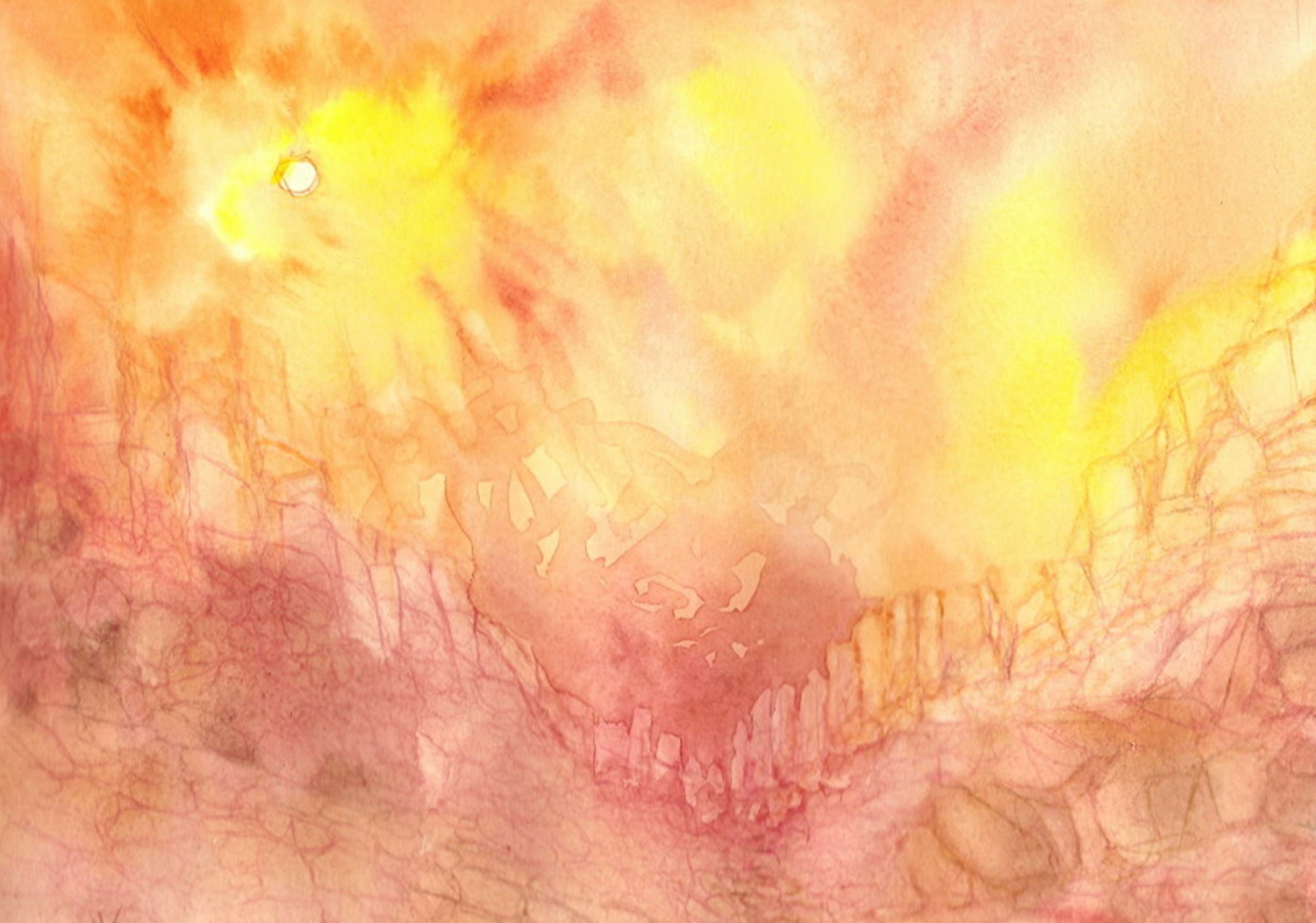
An area east of Kamloops, B. C., follows the South Thompson River which flows between dramatic limestone cliffs originally formed (it is estimated) 270 million years ago.

Among those cliffs is a gully–a waterworn ravine known as ‘the silt bluffs’, featuring very distinctive rock formations which have the look and feel of something out of a Western movie.

OLYMPUS DIGITAL CAMERA

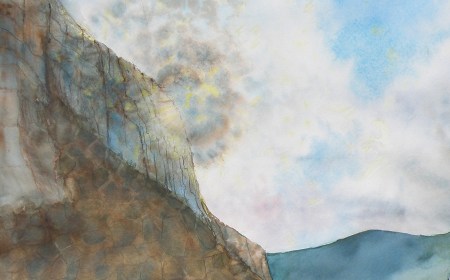
Massive geological formations such as these require some form of treatment by a painter in order to adequately convey their uniqueness and grandeur.  This watercolour attempts to do that by purposely choosing to paint directly into the sun.

This part of our landscape gets quite literally baked by heat at midday, so when painting outdoors it is important to get it done quickly.


….a little nuts

November 20, 2015

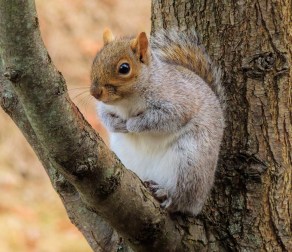
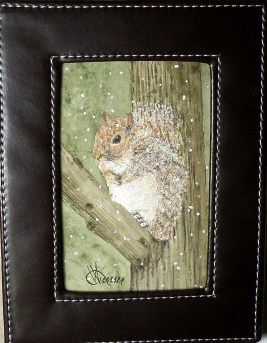
Quite some months ago I asked Jackie of ‘Lost In Thought Photos’ (https://lostinthotphotos.wordpress.com/) for permission to do a miniature based on her wonderful photograph of a little tree squirrel.

Jackie very kindly agreed and emailed me back a very fine image of what –based on its colouration– appears to be a Fox Squirrel, which, even the most hardened rodent defamer would have to be a little nuts not to admit is cute.

treesquirrel-2 (1000x864)

Here’s how they are described in Wikipedia:  “. . . Fox squirrels are strictly diurnal, non-territorial, and spend more of their time on the ground than most other tree squirrels. They are still, however, agile climbers. They construct two types of homes called ‘dreys’, depending on the season. Summer dreys are often little more than platforms of sticks high in the branches of trees, while winter dens are usually hollowed out of tree trunks by a succession of occupants over as many as 30 years. Cohabitation of these dens is not uncommon, particularly among breeding pairs. . . ”

Besides their cuteness, it is charming that they are non-territorial, and have been known to share their homes.  That is certainly not true for a great many squirrels, who seem to busy themselves hurling insults and chasing rivals all day long.

Hunting for frames is fun, losing myself in one or some of our ten or so 2nd hand stores, and recently resulted in this very nice (likely faux) leather 5″ x 7″ one for $.75.  It allows this little painting to sell for $35.

OLYMPUS DIGITAL CAMERA

Our little Gallery keeps 20% commission. So many thanks to Jackie at https://lostinthotphotos.wordpress.com/ !


….November

November 14, 2015

It is the most blessed of months heralding the muted pallet–the toned-down greens, beefed-up greys, complex browns, accents of burnt orange, titian–trees simply/complexly themselves, displaying their line, frost-kissed leaves flashing their last colour, refusing dismissal.

Wonderous November--leaf-whipping, mini-cyclones, clouds suddenly letting forth face-lashing first flakes on towards frost-spongy earth–days framed by late mornings and early evenings, one’s home truly one’s castle, warming against the elements.

wells gray November a

Showboats gone, one paddles purposefully, keeping warm, the lapping sounds musical, deep-throated rooks ricocheting their call round rocky bends echoing, bouncing off glassy surfaces, wood-smoky mists rising.

Banished is the garish, overly-festooned–any and all too-muchness falling away to let be what simply is…..

November

Winter’s cusp

Summer’s compliment

Spring’s concealer

…..downtown, phase 2

November 9, 2015

The Plaza Hotel (completed in 1928) is a five story Spanish Colonial Revival building in downtown Kamloops BC, Canada. It is listed as a cultural heritage site in the Canadian Register of Historic Places.

ThePlaza

As is so often the case when seeking out subjects for painting, the postcard view isn’t usually very interesting.

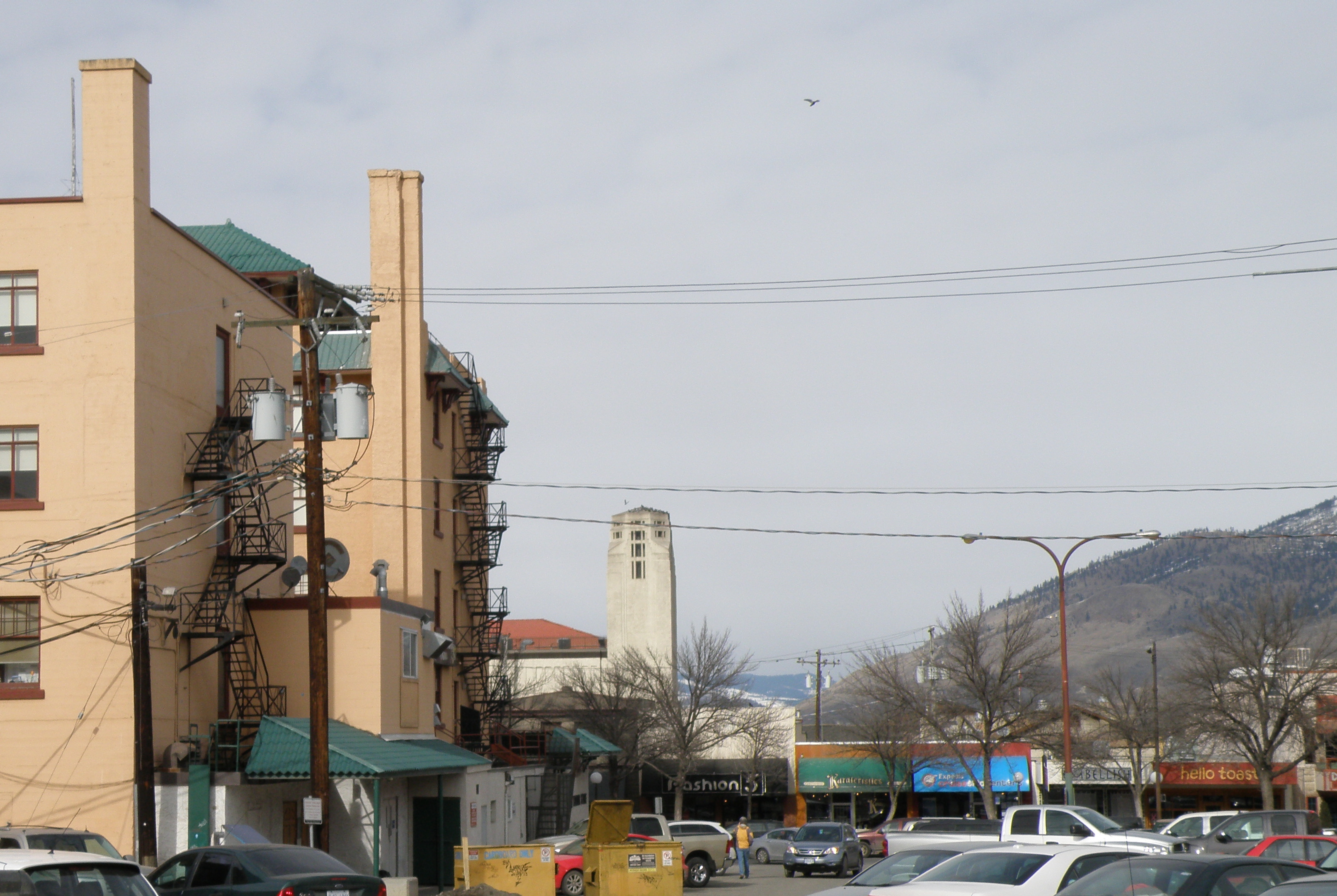
The photo used for reference for this watercolour was taken from the rear alley of The Plaza.

OLYMPUS DIGITAL CAMERA

In view is the old Fire Hall tower, with belfry, 73 ft, built in 1935 at a cost of $24,500, when Kamloops had a population of approximately 6,000 (population today is about 100,000).  It remains a distinctive landmark.

OLYMPUS DIGITAL CAMERA

The decision to cast the subject in Winter has to do with wanting to bring some drama to the scene due to there being an overly abundant amount of sky.  Pigeons have also been added to give more visual interest.

OLYMPUS DIGITAL CAMERA

Because the hotel is a very light orange, (which gives off a bit of a pink cast in late afternoon), the sky is a wash of quin red, quin yellow and ultramarine blue in order to help incorporate the tones of the building into the rest of the painting.  So quin red and quin yellow will be used as the shade of the hotel as the painting progresses.

…..downtown

October 31, 2015

Growing up in the 50s, we lived in a treed suburb of Rochester, New York (home of Eastman Kodak, Bausch and Lomb), but my father was a Pastor of a poor, post-WWII German refugee, inner city Church next to the Greyhound bus depot.  My fascination with the grittier side of Rochester’s downtown must have come from how much more interesting it was compared with the staid predictability of houses and lawns and more houses and more lawns where we lived.

Sneaking away during the sermon, I’d scout out the alleyways of crumbling late 19th century brick tenements with their fascinating tangle of iron fire escapes doubling as fasteners for clotheslines, festooned with gingham tablecloths and sheets and jeans.  Labyrinths of back-doored kitchens, cooks smoking, observing me in my too-small Sunday navy suit, an out-of-place kid trying to look nonchalant and part of the scene.

Luckily for me, Kamloops has that kind of feel.  It is a railroad hub, cow ranchers beyond that–a labourer’s city–begun in 1812 as an outpost of the Hudson’s Bay Company, and has enough Western wear and roughness that some citizens feel our downtown still lacks class.  By ‘class’ they mean there aren’t enough designer boutiques and specialty shops.

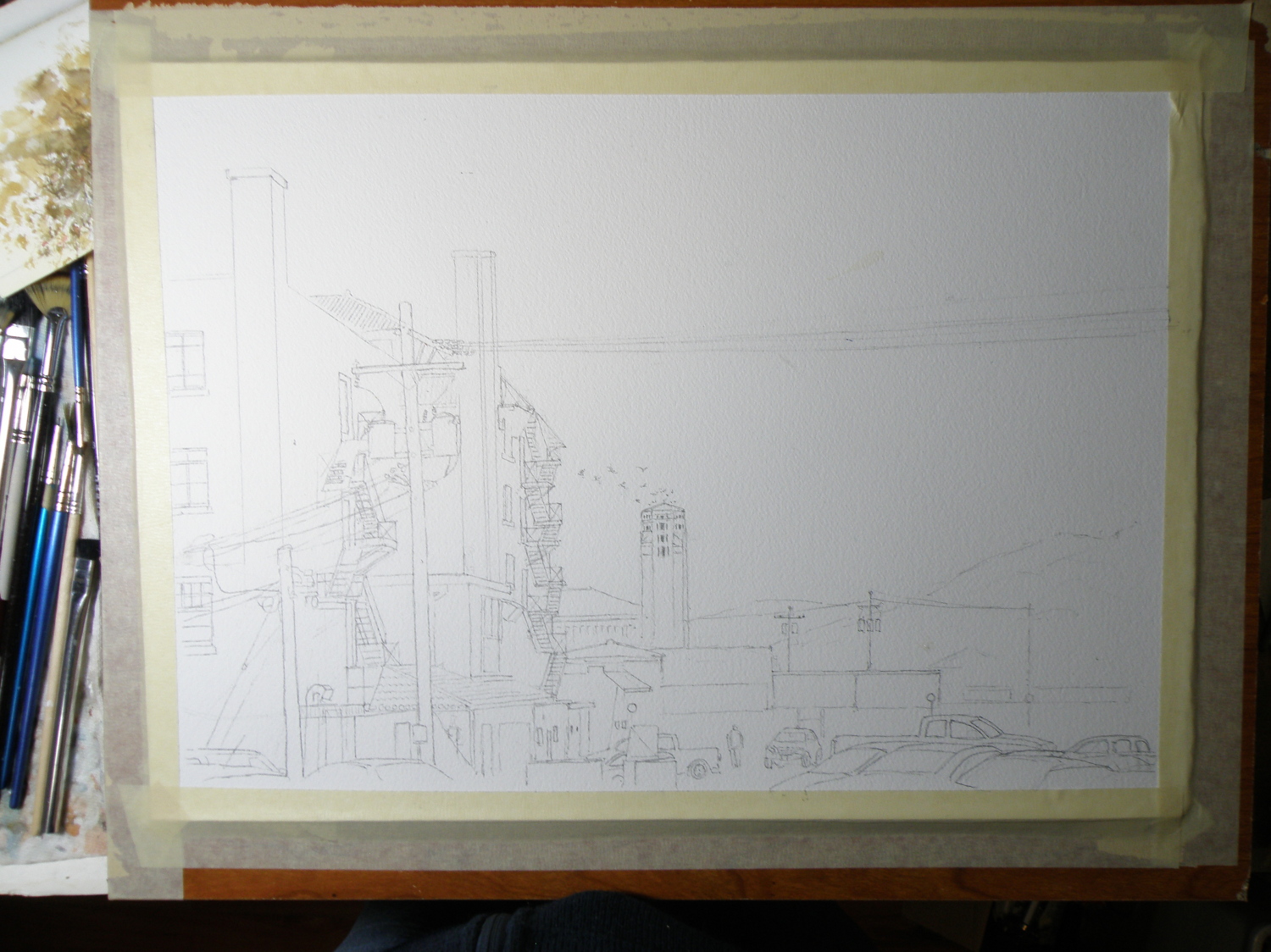
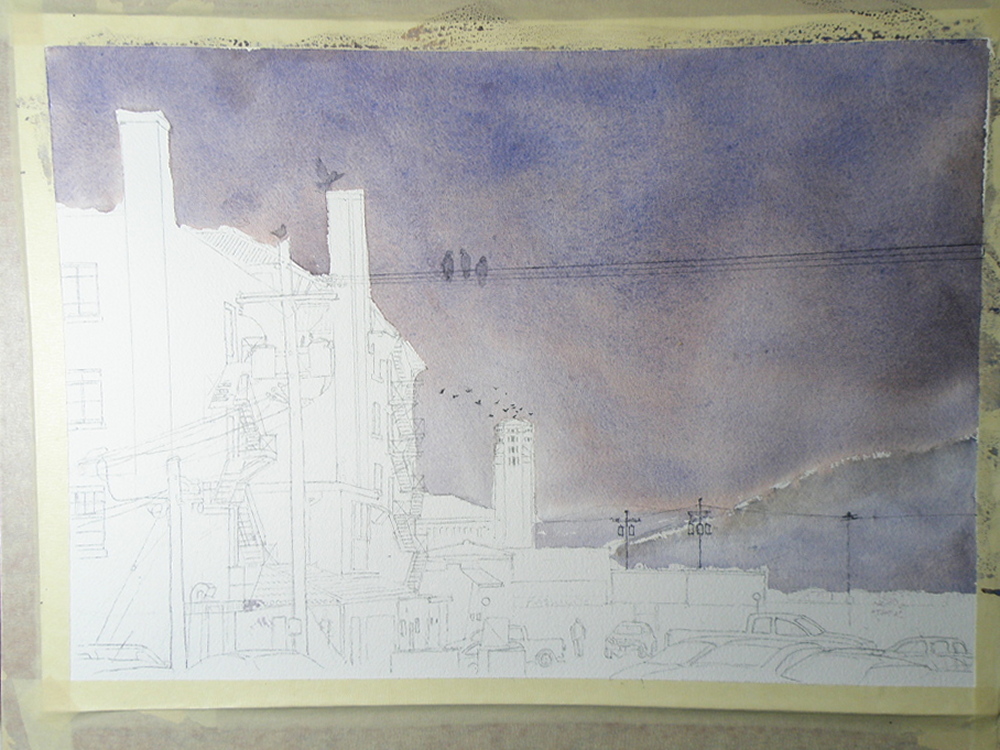
This is the start of a painting of downtown from behind one of the old hotels. . . .

OLYMPUS DIGITAL CAMERA

Downtown Kamloops, B. C. Canada

The intention here is to make this a Christmasy, snowy subject, and its progress will be followed as the days go by.

“. . . The Harry Potter series borrowed ancient Celtic views towards the European Mountain Ash also called the Rowan Tree. The Celts and other people of early British Isles thought the tree had magical properties. Its powers were to protect you from witchcraft, one of two reasons why it is also called Witchwood. The other reason is a pucker at the end of the fruit reminds some of a pentagram which is associated with witchery.”

“As one might think, animals also know the mountain ashes as food. It is a favored browse of moose and white-tailed deer. Bears, fishers and martens like it as well as snowshoe hares, squirrels, small woodland rodents, the ruffed grouse, ptarmigans, sharp-tailed grouse, blue grouse, American robins, thrushes, waxwings, and jays. . . ”  http://www.eattheweeds.com/mountain-ash-rowan/

OLYMPUS DIGITAL CAMERA

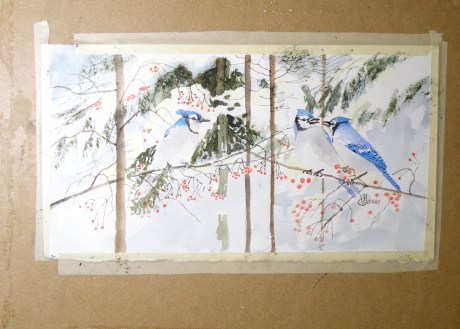
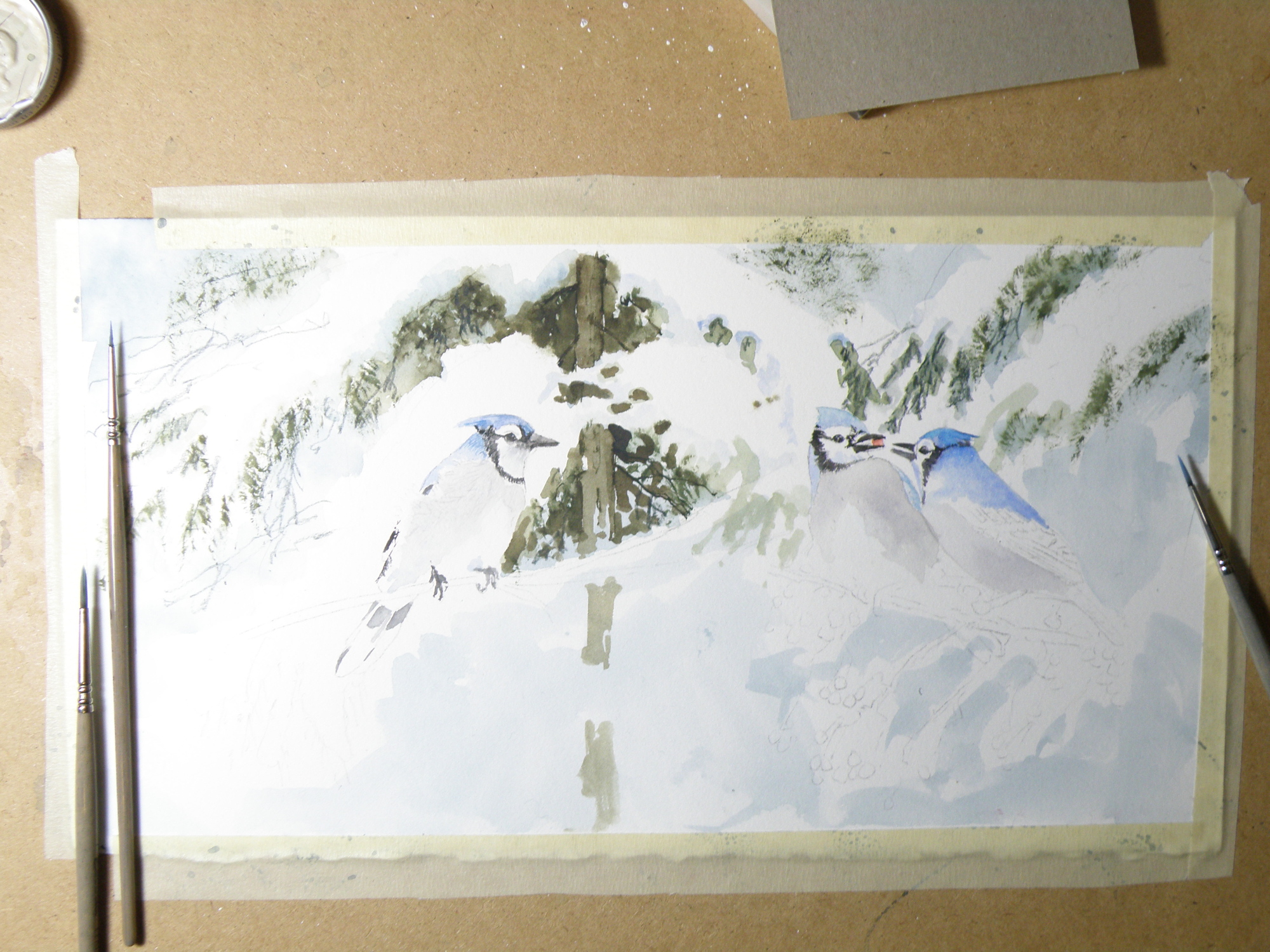
“American Blue Jays and Mountain Ash”, watercolour on Arches Hot Press 140# Paper, original available for purchase $85US (unframed, excluding postal charges), 5.5″ x 11.5″

From Canadian Author Sarah B. Hood [http://www.sarahbhood.com/]

“. . . A couple of years ago I made the wonderful discovery that the common ornamental tree I know as Mountain Ash is the fabled rowan tree, revered in the mythology of northern lands for its protective and divinatory properties. I was told about it by the mother of a friend who also informed me that rowan jelly is the traditional accompaniment to twelfth-cake in the Christmas season.

I have since looked at many different recipes for rowan berry jelly, and note that most of them advise one not to make jelly until the berries have been frozen (either on the tree or in the freezer), since this makes them sweeter. Apparently raw mountain ash berries can be toxic (I remember my father complaining that they were so acidic that they could eat holes in cars), but heat and freezing both change the chemical structure of the acids they contain.

Here’s a recipe that I’ve used. It came to a lovely set and a great colour, like rosé wine. The taste is something like a cross between grapefruit peels and cranberries: bitter, but tasty.”

Rowan Berry Jelly Recipe
Makes about 3 cups

  • About 4 cups of berries which have been frozen (unfrozen berries are very bitter)
  • About 1 cup of water
  • ¼ cup of lemon juice
  • About 1½ cups of natural pectin from apples (You can substitute commercial pectin, but you’ll have to change the quantity of sugar according to their instruction for a similar recipe such as grape jelly.)
  • About 3 cups of sugar
Day One
  1. Rinse berries and remove stray leaves, stems and shriveled berries
  2. Barely cover them with water and heat them to the boiling point, then cover and simmer until they have completely dissolved. You can use a potato masher to reduce them to a pea soup-like mush, as pictured below.
  3. Strain through a jelly bag. Hang the bag overnight to catch all the liquid, but do not squeeze the bag.
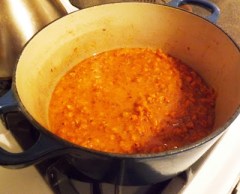
Day Two
  1. Use a turkey baster or pour carefully to extract the rowan berry juice without any sediment that may have collected. It should come to about 1½ cups (top up with extra apple juice if necessary).
  2. In a wide, deep non-reactive pot, combine rowan berry juice, apple pectin, sugar and lemon juice and bring to a rolling boil. It may be rather scummy, so skim if you like.
  3. When it reaches the setting point, ladle into jars and process for ten minutes.
  4. Label and date the jars, and refrigerate any jars that don’t seal.

One Jay we do not have in the West is the Blue Jay.  The ‘why’ of this is puzzling simply because the weather and climate here rather mirror that of Eastern Provinces and States (minus the humidity, thank heaven).

As annoying as this bird can be, the sheer pleasure it appears to take in creating continuous drama — the screeching cry it passes off as ‘song’ turns the lovely silence of a Sunday morning into a birdie alarm clock — makes the Blue Jay an attention receiver (like that kid you always remember from Grade 4).

And….the Blue Jay–like most Jays–is beautiful.

OLYMPUS DIGITAL CAMERA

Their blue, black and white colouration is as dramatic as the Blue Jay personality.  They have the ability to turn any bird feeder situation into a Three Stooges food fight.  And for all these reasons, make a great subject for painting.

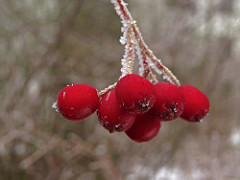
A favourite natural food in Winter is the Mountain Ash berry.

16449456800_9db81e018f_m

These trees are in abundance here in Southern British Columbia, and grow very large, and are responsible for allowing the N. American Robin to return very early–often at the end of February–sustaining them until the ground becomes warm enough for pursuing worms.

Choosing both Blue Jays and Mountain Ash in Winter makes for great contrast in colour, and a lively composition for painting.

Now we’ll just have to see how it all turns out….

….depicting snowy pines

October 22, 2015

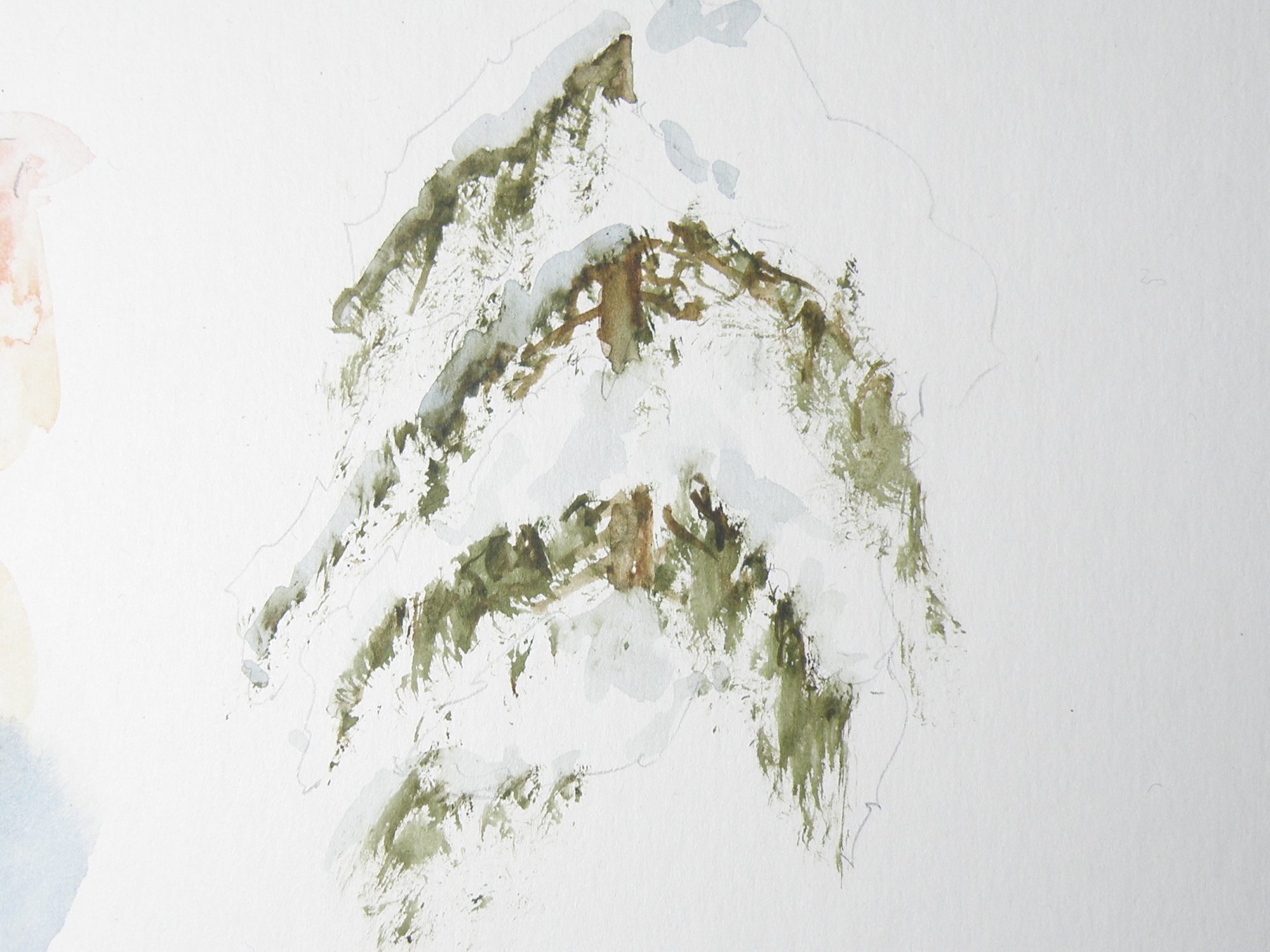
Snow-laden firs and pines aren’t the easiest of subjects for depicting in watercolour–(at least not for this painter).  The challenge comes in first understanding the effect snow has on branches, for, obviously, there is snow and then there is snow–each snowfall having its own unique effect.  That crystalline, hardened seizing of tender branches by icy snow pulls them heavily towards the ground, while sub-zero powdered flurries creates a mere dusting of needles–each presenting technical challenges.

Of course, the problem is one of always having to paint around the white of the paper allowing it to ‘be’ the snow in watercolour.  Given that opaque white can’t be used, a light dusting on pine needles becomes really quite a bit more difficult than painting the after-effects of a full-blown blizzard.  Leaving minute dots of paper surrounding green needles is a recipe for madness in my book.  Give me a snow-stormed pine any day of the week in its place.

OLYMPUS DIGITAL CAMERA

Figuring out just where branches are on a given variety of pine, fir, balsam, cedar or spruce is key to understanding where snow will sit when on them.  So it seems crucial that any study be limited to particular species, (in the above case, cedar) — otherwise, a painter of representational art will be in danger of ending up with a kind of ‘marshmellowed’, generic evergreen most often seen on Hallmark Christmas cards.

Truly, each variety of coniferous tree accepts snow in its own unique way.  A blue spruce, for example, with its stiff, jutting branches, is much more able to bear the weight of snow than the red cedar in the above study, whose branches are prone to drooping and bending.

This study was done on leftover piece of plain white matt board, using a chopped-up small fan brush to go after the greens, then a more pointed, conventional brush to soften the hard edges and provide shadowed depth to the snow.  The branches aren’t quite correct.  Once snow is included, it changes perception to such a degree, I have trouble understanding where it goes and branches fall.

The beauty of our being blessed with so many evergreens to choose from comes in knowing that each one offers the student of watercolour great and intriguing challenges, especially when brimming with that wonderful adornment–snow.

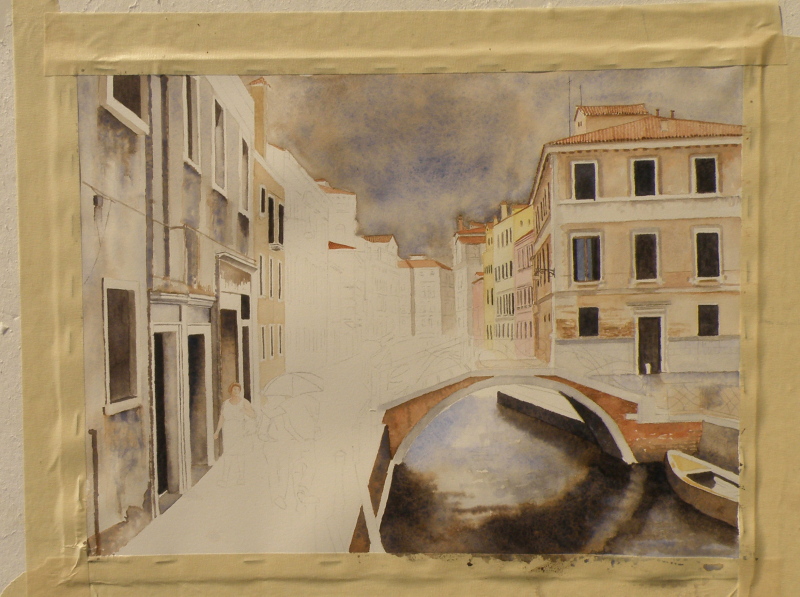
venice challenge

September 6, 2015

We’ve reached the finish line, limping all the way.  This was somewhat beyond my abilities as a painter. Whether a success or not, every endeavour provides a great learning experience.  All the watercolourists looked up to for advice offer the same counsel:  when it comes to watercolour as a medium, suggesting detail far surpasses actually getting bogged-down in it.  The pitfalls begin when the painter keeps trying to improve on what’s there.

Despite the overworked areas, enough aspects work to allow this to maybe escape the scrap heap — but probably not.  It would, however, be useful to begin it again and learn from the errors.

OLYMPUS DIGITAL CAMERA

OLYMPUS DIGITAL CAMERA

OLYMPUS DIGITAL CAMERA

OLYMPUS DIGITAL CAMERA

Draw A Bird Rewind . . .

September 1, 2015

Laura of Creatarteveryday has thrown down the gauntlet, and we’re rising to the challenge (even if it is a repost!)

So here goes, Laura. . . .

OLYMPUS DIGITAL CAMERA

Juvenile N. American Robin, done on commission for J. Leckie, Christmas, 2011

Your turn!  Follow Laura at https://wordpress.com/read/post/feed/32739058/794878009

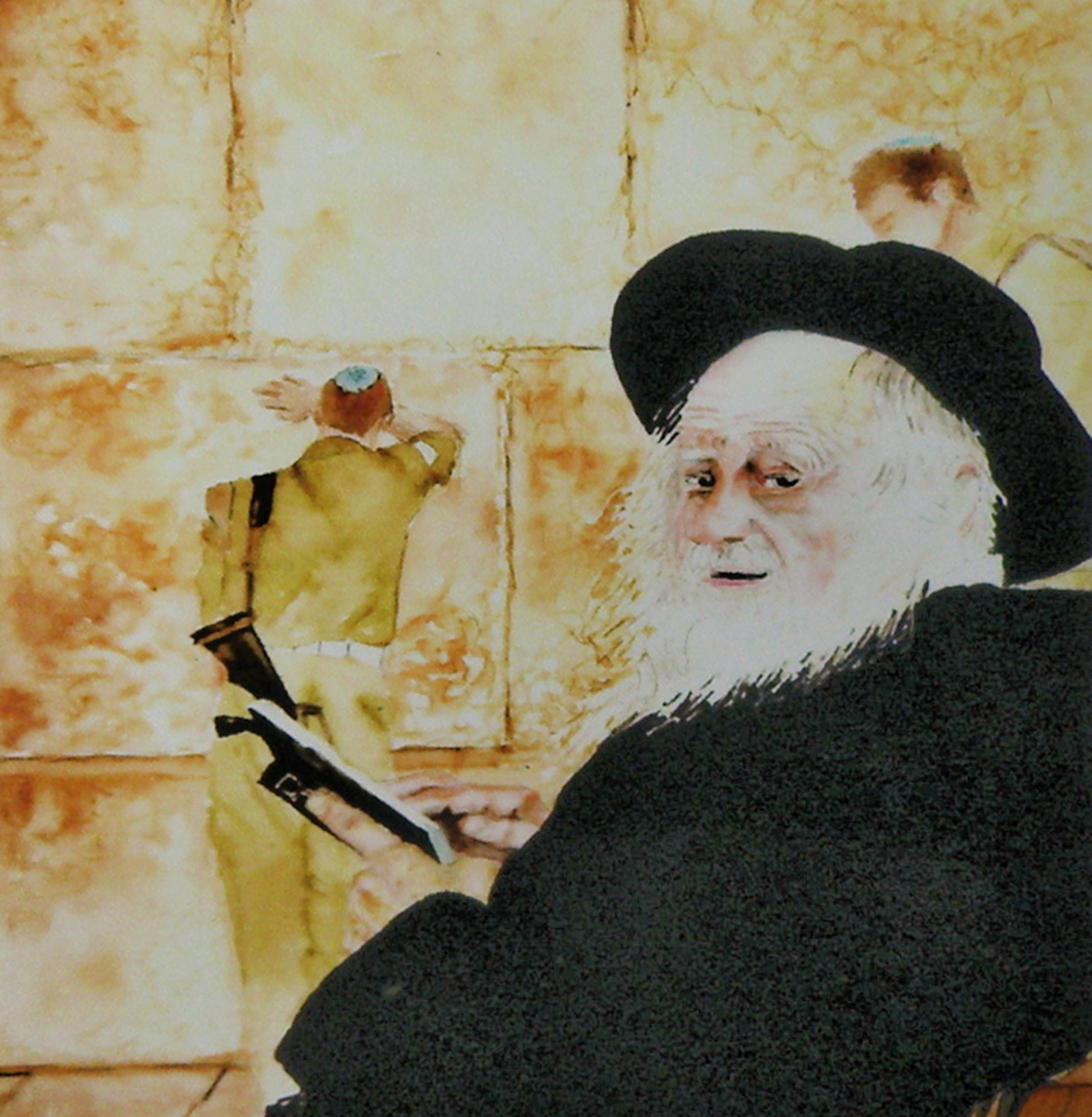
In January of 1990 I had the privilege of going on a tour of Israel conducted by an outstanding Orthodox guide named Joe, who was so completely well-versed in history and biblical understanding that archaeological sites acquired lively, humanized detail under his well-studied knowledge of what we believe took place there.

Though he was conducting about a dozen clergy, he was able to draw comparison between traditions which were tied to ha aretz (הארץ), to the land, helping us see the visceral, physical connections we’d only tried to understand through having read the ancient texts and stories.

OLYMPUS DIGITAL CAMERA

 ‘Western Wall Shacharit’

watercolour on Arches Hot Press 140# Paper, 10″ x 15″, sold

The Western Wall is almost certainly the most revered of all sites in Israel, as it physically connects worshipers to those before them who also had to struggle to build a homeland–who also had to appeal to that higher power to protect and defend them.

I felt privileged to have been able to see Israel at a time when the intifada was at a standstill and veritably every location in the country was accessible and security was more relaxed.  We could travel the Golan Heights as well as the West Bank, stand at the Lebanese border and visit the historic cities and towns throughout the land.

…this is a repost from an entry several years ago

hot

August 24, 2015

This has been one. hot. summer.  Right now smoke from fires burning on the Washington State/Canada border is blowing up our way due to Southwest winds.  It’s an acrid, doused campfire smell and hazy even when just looking across the street.

Weisser,Lance,SiltBluffsII,7.5x9.5,Watercolour,$185a

‘The Silt Bluffs, Kamloops’, watercolour on Hot Press #140 Arches, 19cm x 24cm, (7.5″ x 9.5″) sold

Oh yeah.  I’m done.  Bring me a nice serving of September.

ocean study

August 22, 2015

For many years I lived in Vancouver, B. C., which is considered one of the top 3 ‘most livable’ cities in the world.  One of its best features is being surrounded by water on three sides.  On one occasion I was painting a view from Locarno, one of the many beaches, and was suddenly overcome by a summer storm.  It seemed to descend out of nowhere.

As I was not going to escape getting soaked, I soldiered-on and managed to get as much as I could onto paper without the deluge completely washing away everything while working.

OLYMPUS DIGITAL CAMERA

‘ocean study Locarno Beach‘, Vancouver, 13cm x 18cm (5″ x 7″)

Fortunately I had some sort of makeshift shelter–even so, rain splattered onto the painting as I worked.

Painting on location has its rewards as well as its hazards.  In those years, I wouldn’t paint at all unless it was outdoors. I was something of a purist, and felt watercolour was meant to be done on location–its immediacy and qualities almost demand it being put to use that way. But bad knees are what they are, and now I almost can’t imagine having to go do that again–which is really a shame.  Working from photographs is not my idea of what watercolour should be about.

venice challenge 3

August 14, 2015

It is so affirming when blogging friends don’t find details about paint pigments and their sedimentation arcane.  One can easily picture guests around a table nodding-off face-first into their creme-brulee.

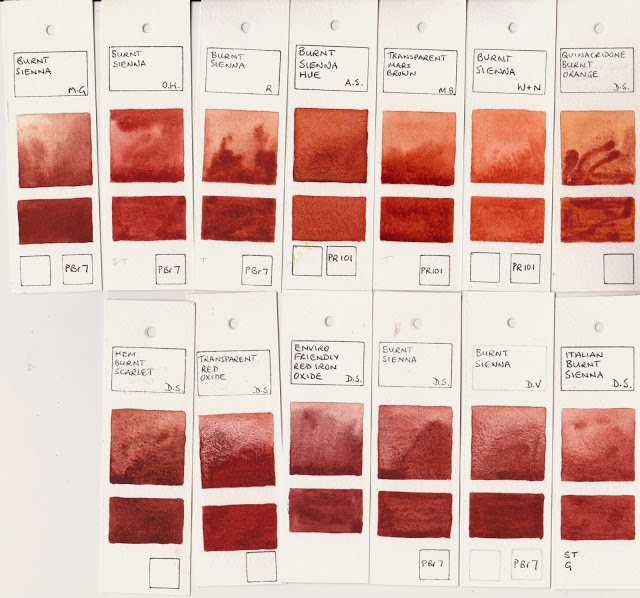
In the Renaissance, clay earth from Siena, Tuscany,  (Terra di Siena, “Siena ground”) rich in iron oxide and manganese oxide was used for pigments.  In its natural state, is a yellowish clay, and becomes raw sienna as a pigment.  When heated up, it turns reddish brown and becomes burnt sienna.

However, due to its being heated up, there is a variety of watercolour burnt sienna shades and hues among the various manufacturers because some heat it a little more, some a little less, making it somewhat more or less ‘burnt’.

burnt seinna options

http://janeblundellart.blogspot.com.au/2013/11/watercolour-comparisons-4-burnt-sienna.html

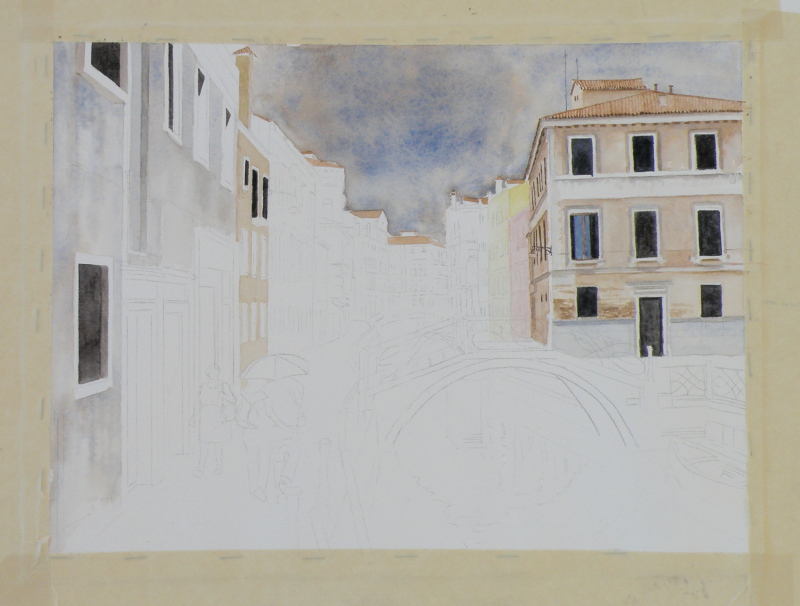
Ultramarine and burnt sienna will be the two colours for the whole piece with the exception of a bit of Rose Madder and Quin Gold for the more distant buildings.  Doing so (almost) guarantees integration.  That is because a viewer’s eye will find a colour harmony whenever the pallet is limited, as no one colour or tone will be glaringly different from the rest.

OLYMPUS DIGITAL CAMERA

stage two

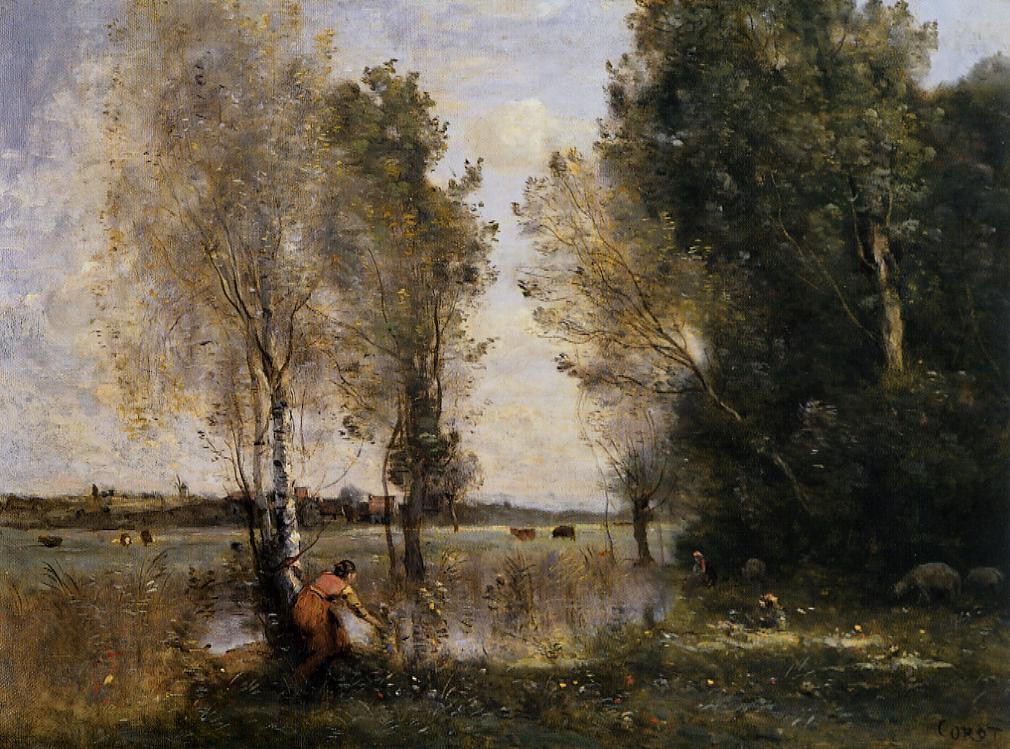
Focal points are achieved in limited-pallet paintings through value contrast (the dark windows against the lighter walls), rather than by there being a glaringly-different colour thrown in.  That said, some of the early masters used a glaringly-different colour to great visual effect, as in Corot, whose ‘signature’ accent was the use of a dash of scarlet in an otherwise integrated landscape….

jean_baptiste_camille_corot_b1147_paturage_dans_les_marais_small    woman-picking-flowers-in-a-pasture  Souvenir-du-Pont-de-Mantes

JEAN-BAPTISTE-CAMILLE COROT (1796 – 1875)

(sources for ‘burnt sienna’ from Jane Blundell and Wikipedia)


venice challenge 2

August 12, 2015

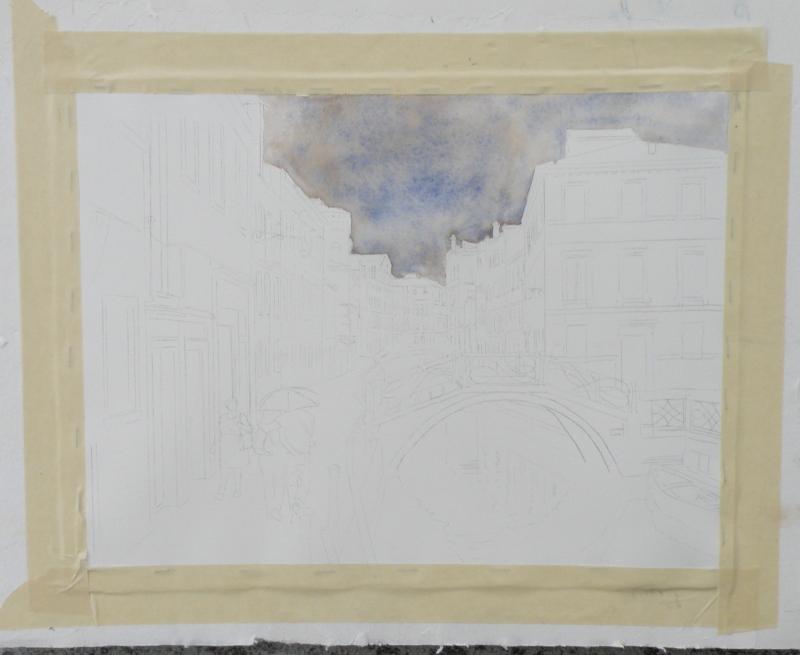
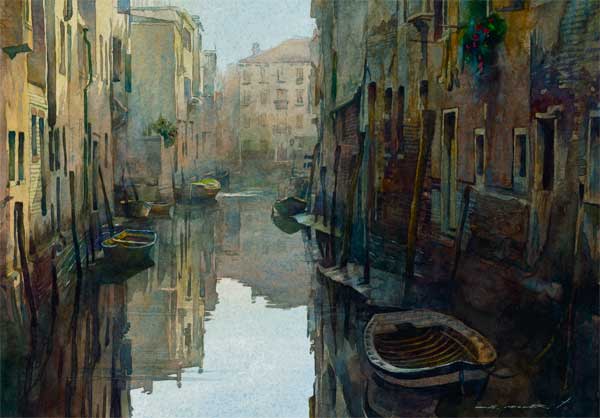
The ongoing quest to interpret in watercolour a photo of Venice by Frank Dwyer of our local Kamloops Photo Arts Club has begun to take shape with a decision to take this 11.5cm x 16.5cm image and paint it as bigger–28cm x 25.5cm (11″ x 14″) –simply because a miniature of such a complex scene might prove less successful.

venice001

So here goes….

OLYMPUS DIGITAL CAMERA

Arches Hot Press #140 lb. Paper, stretched and stapled onto gatorboard, then taped.

As much as the photo (entitled ‘The Blue Umbrella’) reveals damp pavement and the umbrella-holding couple, the sky isn’t quite as rainy-looking as perhaps it can be made to be for artistic interpretation purposes.  So ultramarine blue and burnt sienna were applied to the whole of the sky as a wash.

Ultramarine Blue has a nice quality of being one of the ‘granulating’ pigments of watercolour.  Its origins stem from the grinding of lapis lazuli, and received its name from the Latin ‘ultramarinus’ (meaning ‘beyond the sea’) .

So treasured and prized by the early painters, ground lapis (from Afghanistan, principally) was used by the painters of early icons as the garments for The Blessed Virgin.  (When The Holy Mother is depicted, her robes are red.)

In 1826 a synthetic version was created which itself derives from a mineral compound, lazurite, and is today the most complex of all pigments.  Being a ground mineral, ultramarine produces sediment that dries in a granular way when mixed with water.

To get this effect, however, the painter must apply ultramarine as a wash so the sediment can, in fact, separate and settle to create granulization.  That is why, then, the sky dropped into the first stage of the painting appears granulated and gives a kind of antique look.  If ultramarine is applied with only a bit of water, or straight from the tube (yikes), it will not granulate as such.

Some watercolourists are so avid about granulization, they buy a granulating medium from Daniel Smith, which, when mixed with most any watercolour paint, granulates.  However, the natural granulating pigments are raw umber, burnt umber, raw sienna, and some brands of burnt sienna.  That is because they come from the earth, and earth leaves sediment.

All of this material comes from a variety of sources, including http://janeblundellart.blogspot.com.au/ — (a very thorough and devoted watercolourist from Australia).

book cover

August 11, 2015

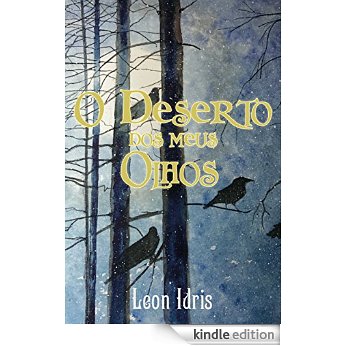
Leon Idriz Azevedo is a Brazilian author who requested the use of the painting “Raven Moon” for the cover of his recent Novel “The Desert of My Eyes” (“O Deserto Dos Meus Olhos”).

510ZtrZ8e3L._AA324_PIkin4,BottomRight,-54,22_AA346_SH20_OU15_

The Novel (currently available in Portuguese) finds the main character, Rupert Lang, thrown into a historic quest to seek the remains of what he stumbles upon as a ‘lost identity’ — taking him through ‘the Spanish court of the reign of Isabel II, the streets of Prague Johannes Kepler and the halls of a Buddhist temple built on a cliff in China’.

“. . . What could have been lived and what is suspected from the imagination receive equal value, challenging the reader to trust the chaos and find answers and truths in the improbable . . . “

A miniature of the new book’s cover has just been painted and is wending its (slow, ship-bound way) to Brazil, with best wishes and hopes Mr. Azevedo receives great reviews and even greater public readership of this new adventurous Novel.

My hope is that I’ll soon be able to read it in English.

STAN07  In his own words…

“I remember, when I must have been quite young, watching my older brother Greg draw. He was good. In the third grade our teacher taught us perspective, how to make a road go back and disappear into the mountains. I never forgot how to do that. When I was seven or eight years old, our family took a trip to Wisconsin to visit a friend of my Dads. He was a professional watercolorist. I remember the drive through the woods, walking up to his front door, through the entry, looking up at the walls as soon as I entered the house. I wanted to see his paintings. Randy Penner. I’ll never forget that name or that trip and the influence it had on me.

“In Junior High I took some art, mechanical drawing and enjoyed it. I wrote a career paper on becoming an artist but never really thought that it was possible. In college I decided to major in physical education since I considered an art major unrealistic. The second year I switched to a commercial art major since the community college had a good graphics program. It was during the three years of training to become a commercial artist that I took watercolor. My first watercolor class I got a “C”. The worst grade I had ever received in any art class. I was required to take it again the following year and it went much better. Not only did I get an “A”, but I fell in love with it. I started selling my paintings before I graduated for as little as $2. In the fall of 1973 I had made a decision to try to make a living as a full time, professional watercolorist and have managed to do that now for more than thirty years.”

Stan Miller

venicecalmlg30

“Venice Calm”, watercolour, Stan Miller, AWS (sold)

sundaymorning600

“Sunday Morning Snow” , Stan Miller
watercolour 18″ x 24″  (sold)

I have learned some important fundamentals by watching Stan Miller’s presentations on YouTube.  There are a cartload of painters offering ‘tips’ and ‘tricks’ on how to ‘do’ watercolours on YouTube, and while I do not always wish to pursue instruction beyond what the medium itself teaches me through trial and error, there are areas where I absolutely require help.

Searching for help regarding composition can be frustrating and fruitless.  That is because not every painter’s views on the subject resonate.  Gut feeling is something I have come to trust when it comes to watercolour, and many instructional videos on YouTube don’t ring true to my own personal approach.  That is not to say these videos won’t ring true to someone else’s taste and fulfil their ‘gut feeling’.

Stan Miller is plain spoken, down to earth and sensible about how he goes about painting.  There’s very little ‘artiness’ about the man.  Yet, what he accomplishes on paper is, to my eyes, lovely and true and a delight to the senses.

Here is his helpful short video on how to logically and sensibly approach the difficult area of composition–something I forever struggle with–which you might find helpful also.

http://https://youtu.be/W9JAaxDpwfY