Stage One: ‘Raven Winter’
February 13, 2018
My watercolourist friend Patricia Kellogg [https://www.facebook.com/Patricia-A-Kellogg-357357001050096/] and I are doing a painting exchange. I acquired one of hers of an artichoke plant in late autumn–that expressive form plants take when frost renders them lifeless, yet beautiful even so. And because she has a couple of mine with ravens in them, she wanted one more and so here’s the first stage of it.
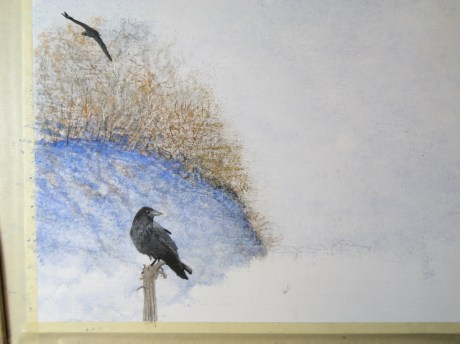
The surface for this painting is treated mat board and the medium is transparent watercolour. It is a 9″ x 12″ piece. Once it is finished I will enjoy taking it over to The Red Beard Cafe where we have our monthly coffee and seeing if she likes it. I’ll also bring a couple of others with me to provide a choice.
Stage Two: Waxwing Watercolour
February 5, 2018
1) They are named Waxing because they sport red wax-like accents on the tips of their secondary feathers;
2) Although they eat insects during Summer months, they thrive on berries the rest of the year and, in our part of British Columbia, go about in groups to feast on Mountain Ash berries;
3) If there is a cluster of berries hanging from the tip of a long branch that only a single bird can reach, sometimes the rest of the group will line up and pass berries beak-to-beak down the line allowing each bird the opportunity to feed.
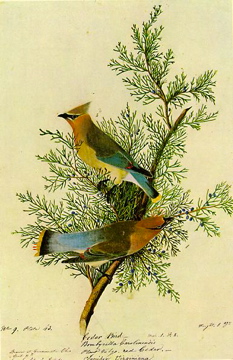
Audubon Print
Its fondness for the small cones of the eastern red cedar is why this particular Waxwing is called ‘Cedar’ Waxwing. (My first post is mistaken in assuming they are not found in Eastern N. America. They are–but I just wasn’t privileged to spot any when growing up in upper New York State.)
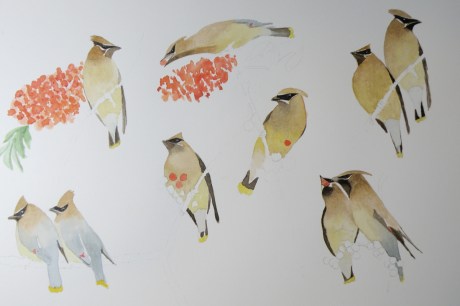
Cedar Waxwing watercolour-in-progress, Saunders Waterford Hot Press Paper 140 lb.
[above facts gathered from Cornel Ornithological and Wikipedia websites]
Work in progress: ‘An ear-full of Waxwings’
February 2, 2018
As a child there was probably no bird I wished more to see than a Waxwing. In on-location photographs they just looked so exotic and intriguing–their colouration and little tufted crowns–the whole package was and is so appealing.
In those days we lived in Eastern N. America where Waxwings aren’t found and so it took many decades–after I’d moved to British Columbia–for my chance to encounter these birds. And it happened as I stood at our front picture window looking out at the Red Maple just beyond the glass–a tree which had nestled within it a deserted Robin’s nest.
Suddenly there appeared a large group of birds I’d never before seen, Cedar Waxwings, darting about the nest, examining it animatedly and calling to one another. I watched in fascination as they systematically began dismantling this Robin’s nest, their little bandit’s masks seeming very appropriate to their deciding to make someone else’s home theirs for the taking.

‘An Ear-full of Waxwings’ — work in progress — Saunders Waterford Hot Press Paper, 140 lb.
A grouping of these birds is known as ‘an ear-full’ almost certainly because they go about in bunches and are constantly chattering in a distinctive, rather conversational voice that is more insistent than melodic or song-like, yet charming even so.
‘The Way Home’
January 24, 2018
In the spirit of watercolour experimentation, it was interesting to take ordinary white mat board and coat it with a thin layer of clear acrylic medium. The board then had to dry for a good 24 hours. The experience when painting is one of finding it acts as a kind of resist while providing a rather intriguing texturing quality.

It is a bit tricky because there’s no wet-in-wet opportunity, or much reworking/touching up or the acrylic medium will moisten and lift from the surface and become gummy. So getting one crack at it is pretty much all one gets, making every brushstroke really count.
Robber Baron
January 20, 2018
From the Cornel Lab of Ornithology:
“. . . A large, dark jay of evergreen forests in the mountainous West. Steller’s Jays are common in forest wildernesses but are also fixtures of campgrounds, parklands, and backyards, where they are quick to spy bird feeders as well as unattended picnic items. . . ”
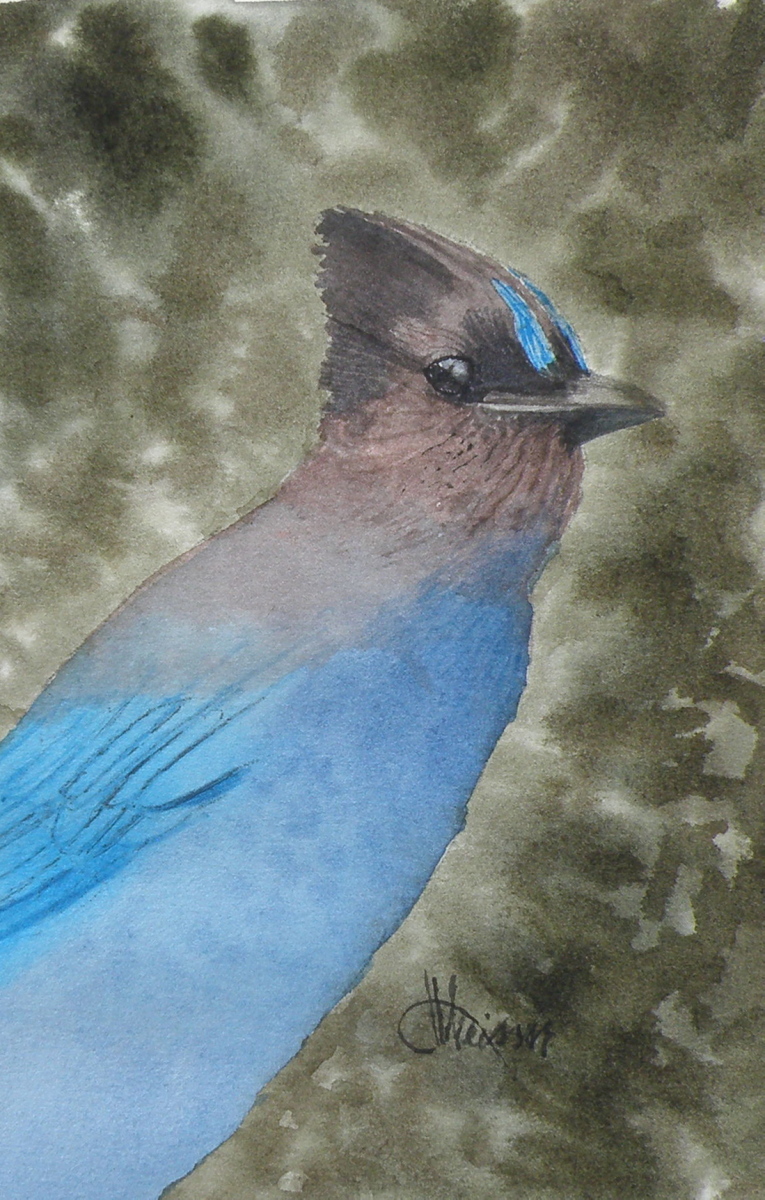
‘Steller’s Jay’, watercolour on Saunders Waterford Hot Press 90 lb., 4″ x 6″, Sold.
When we moved from Quebec to British Columbia and went camping, it was startling to hear this loud, rasping, strident taunting from high in the trees. Startling, because it was so like a Blue Jay, yet not–like a Blue Jay with the flu. And then this amazingly blue-black jay bounded down to the ground, looking up at us as though wondering why we were occupying its picnic table.
After returning from swimming, we found three of them pulling at the packaging of wrapped food and helping themselves to whatever they managed to expose. These are Blue Jays on steroids.
“. . . Steller’s Jays are habitual nest-robbers, like many other jay species. They’ve occasionally been seen attacking and killing small adult birds including a Pygmy Nuthatch and a Dark-eyed Junco. . . ” [Cornel Ornithology Lab]
But wow–how beautiful, how handsome, yes?
The Least Chipmunk
January 17, 2018
When taking our Jeep in for servicing, the attendant came to me with what had been an air filter and was now a chipmunk house. I instantly knew which one–the one which seemed to be everywhere as late Summer progressed and Autumn loomed.
The Least Chipmunk is so named because it is the smallest in our continent and can easily turn an air filter into a roomy apartment. It, like all its kind, eats just about anything, including insects, nuts, berries, mushrooms, and tree buds.

The Least is so small a full grown adult weighs only two ounces. There are plenty of predators in our area, including many hawks, coyotes, owls and rattlesnakes. There are also a variety of potential homes, including Jeep air filters.

‘Least Chipmunk’ watercolour on Arches Hot Press 140 lb., 4″ x 4″, sold
‘A Play of Jays’
January 13, 2018
We know the fun which comes from discovering how groups of birds are labelled and identified:
- a convocation of eagles
- a wake of buzzards
- a parliament of owls
- an exaltation of larks
- an ostentation of peacocks
Jays have two possibles–a ‘scold’, or a ‘play’–and given their feisty nature, both can be true at once. Here in Western Canada we have the Steller Jay, as well as the Whisky Jack or Grey Jay. Eastern Canada is home to the more familiar Blue Jay.
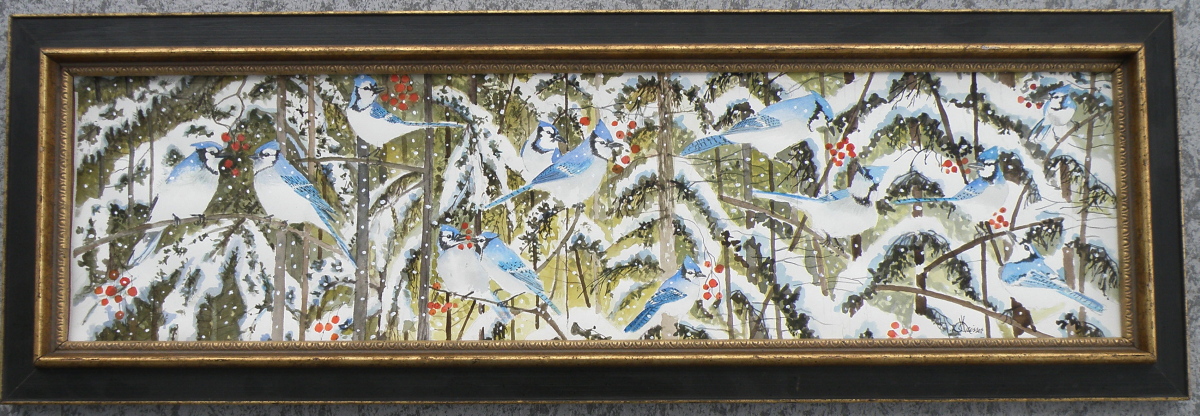
“A Play of Jays”, watercolour by Lance Weisser, 8″ x 30″, 140 lb. Saunders Waterford Hot Press Paper. Sold.
… a little Junco
May 3, 2016
My observations are that birds which winter over are more agreeable in disposition than birds which come here to breed. Case in point, Juncos, which winter over here and then head further North to breed. They are such a delightfully polite and agreeable little bird, not taken to fighting over the feeders, but rather preferring to peacefully forage below them.
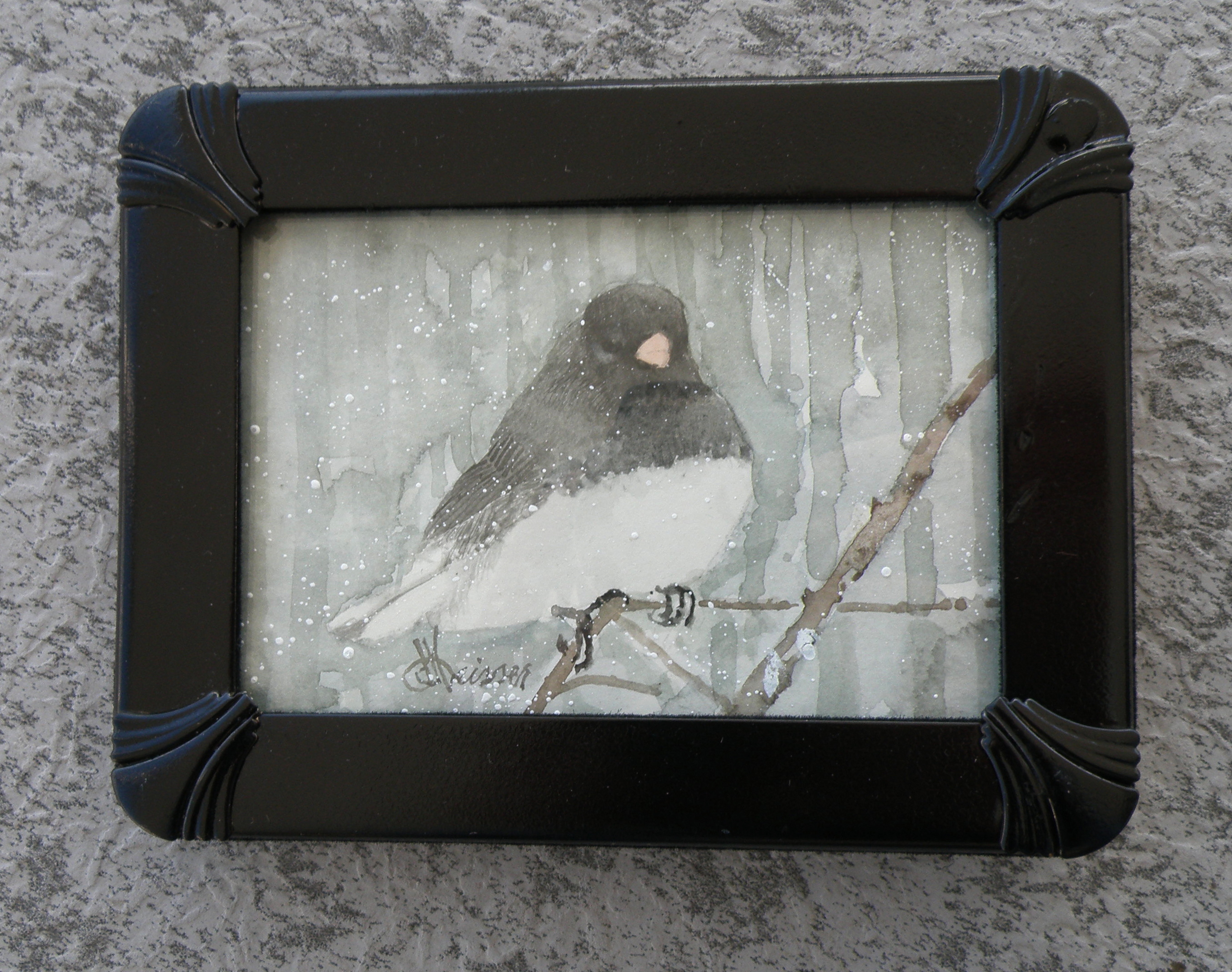
‘Dark-eyed Junco’
3″ x 5″, watercolour on Saunders Hot Press 140# Paper
On the other hand, birds which migrate here to breed, like the Common Grackle, dive-bomb me when I’m giving our dog Elmo his early morning walk, as though I am suddenly in my dotage going to start climbing trees to pull down their nests.
But blest be the birds which come here to winter over, like the so-lovely Common Redpoll and the Dark-eyed Junco. Although extremely territorial when nesting, we get to see Juncos when sex is the furthest thing from their bird-brained minds and finding seeds on the snow is all they care about.
Some birdie facts:
- Juncos are the “snowbirds” of the middle latitudes. Over most of the eastern United States, they appear as winter sets in and then retreat northward each spring. Some juncos in the Appalachian Mountains remain there all year round, breeding at the higher elevations. These residents have shorter wings than the migrants that join them each winter. Longer wings are better suited to flying long distances, a pattern commonly noted among other studies of migratory vs. resident species.
https://www.allaboutbirds.org/guide/dark-eyed_junco/lifehistory
….cedar waxwing
April 23, 2016
As a kid, having to enter the annual Science Fairs in Jr. High–the ones where invited experts walked around with clipboards trying to find possible prize winners–I had exhibits which were often concerned with birds–songbirds, usually–their migration patterns and predators, and fun facts.
I never won a prize. That usually went to kids who electrocuted themselves voluntarily in order to prove water and wires don’t mix–or the kids who cross fertilized seeds and created vegetative freaks.
The shortlist I had then in the 50s (living in upper New York State) was to see any kind of Bunting (they looked outrageously colourful), our State Bird the American Bluebird (which I never did see, and still haven’t), any kind of Tanager, and of course, any kind of Waxwing.
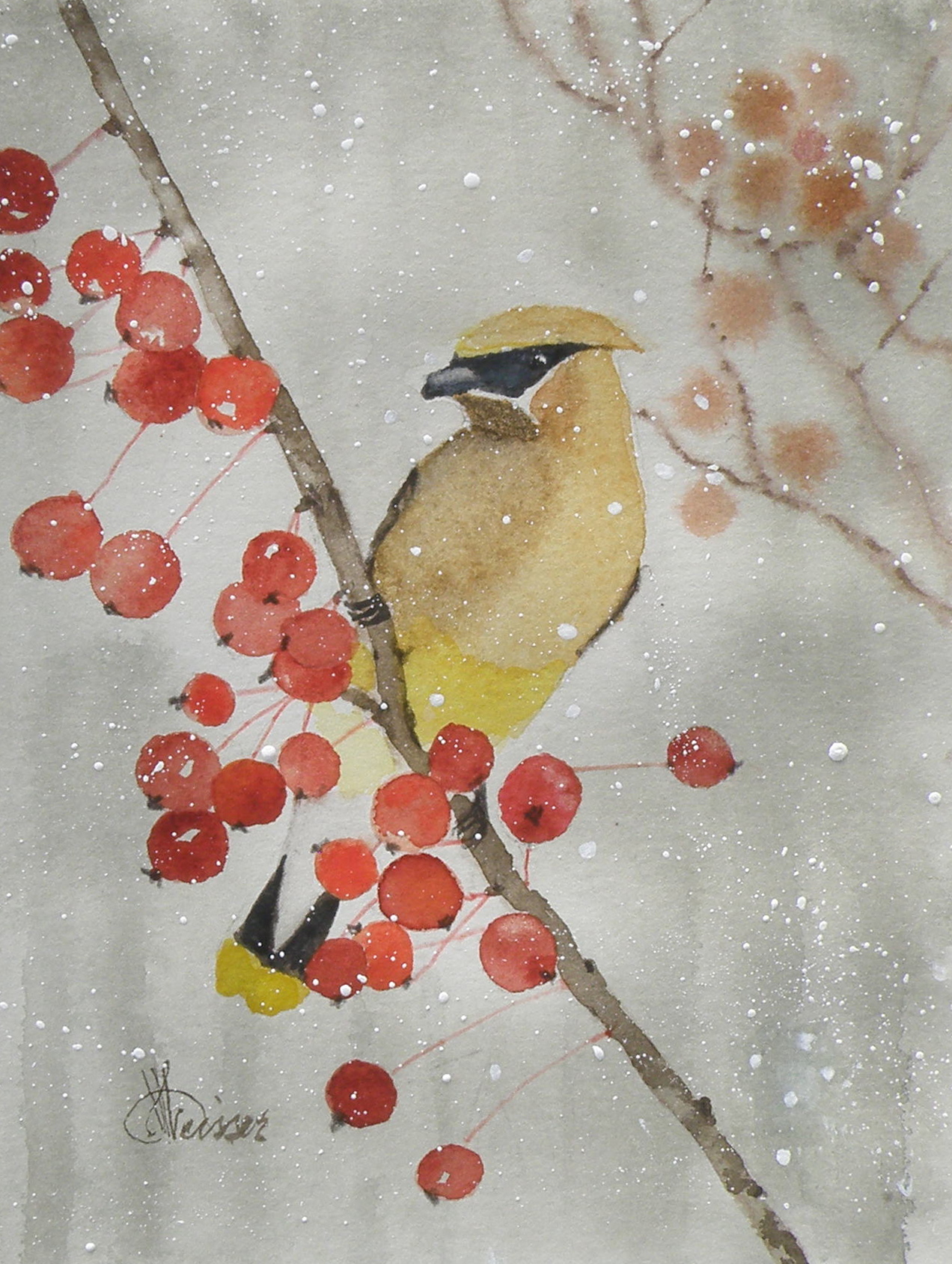
“Berry Picking”
Cedar Waxwing, 4″ x 6″, watercolour, Saunders Waterford Hot Press 140# Paper
Having lived now in seven different Canadian locations, from coast to coast, I’ve been able to photograph a Western Tanager in our front garden, a pair of Mountain Bluebirds (astonishingly blue), and a group of Cedar Waxwings which descended on our Red Maple branches and began dismantling a Robin’s nest, rather than having to bother scavenging their own material.
The Waxwings were much smaller than expected, and every bit as fascinating as I’d hoped. Their ‘bandit’s mask’ gives them an allure other birds lack, and their interesting ‘song’ and penchant for travelling about in flocks makes them worth having to wait 60 years to see them.
….Chickadee Miniature
April 21, 2016
This Winter along with the usual Mountain Chickadees at our feeders, we were pleased to have Black-Capped Chickadees as well. Coming from Eastern parts, they are the ones associated with childhood and so have a special place for me.
Right now we are experiencing amazingly warm temperatures–85F (30C)–and gardening is ramped up as a result. Dividing time between perennials and painting is a pleasure. As an Autumn and Winter person, I continue painting with that pallet of tones and colourations, and so ask you to cut some slack if/when I post snow scenes in April.
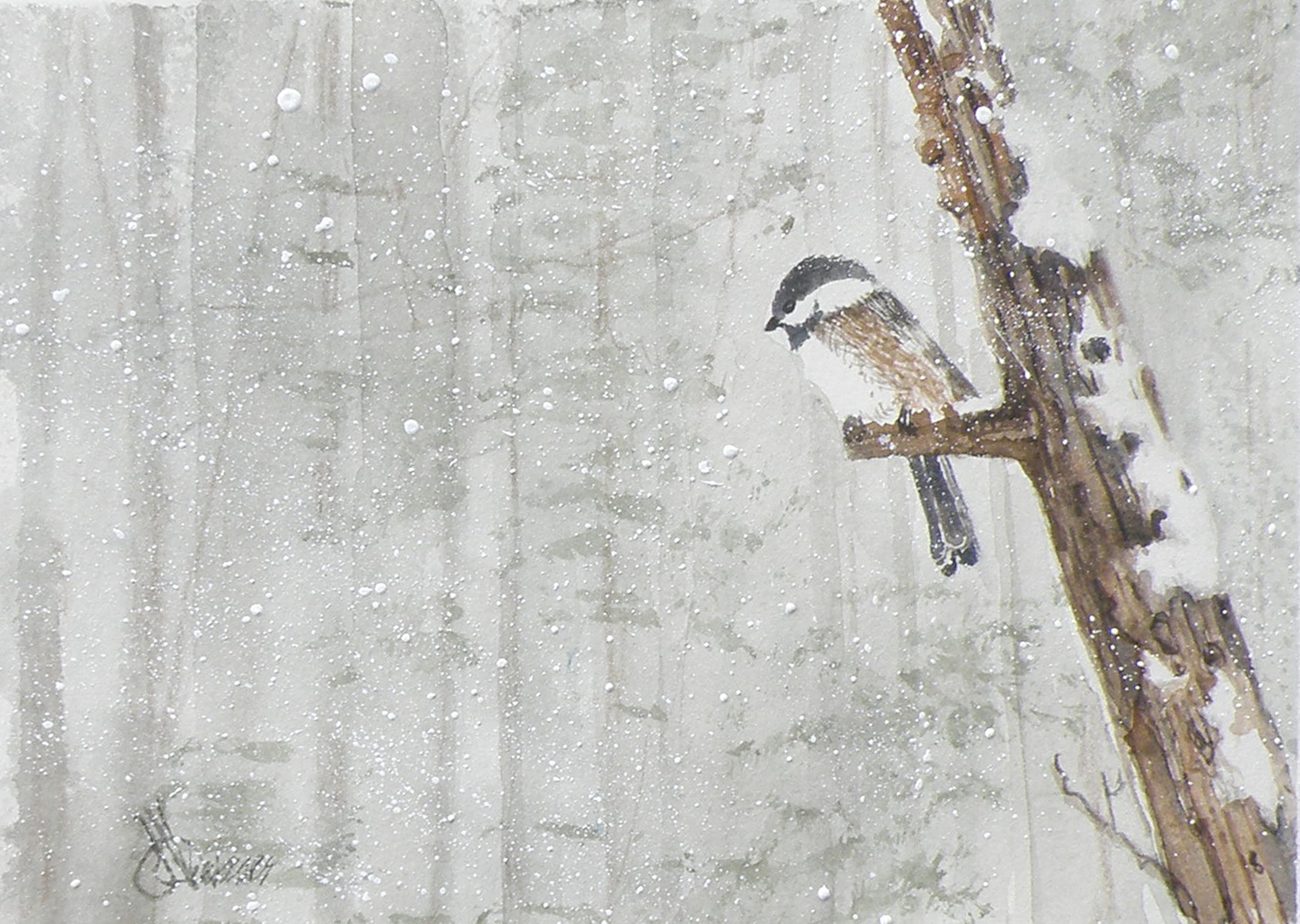
‘Pause That Refreshes’
5"x 7", Watercolour, Saunders Hot Press #140 paper
Cool Facts
- The Black-Capped Chickadee hides seeds and other food items to eat later. Each item is placed in a different spot and the chickadee can remember thousands of hiding places.
- Every autumn Black-capped Chickadees allow brain neurons containing old information to die, replacing them with new neurons so they can adapt to changes in their social flocks and environment even with their tiny brains.
- Chickadee calls are complex and language-like, communicating information on identity and recognition of other flocks as well as predator alarms and contact calls. The more dee notes in a chickadee-dee-deecall, the higher the threat level.
- Winter flocks with chickadees serving as the nucleus contain mated chickadee pairs and nonbreeders, but generally not the offspring of the adult pairs within that flock. Other species that associate with chickadee flocks include nuthatches, woodpeckers, kinglets, creepers, warblers and vireos.
- Most birds that associate with chickadee flocks respond to chickadee alarm calls, even when their own species doesn’t have a similar alarm call.
- There is a dominance hierarchy within flocks. Some birds are “winter floaters” that don’t belong to a single flock—these individuals may have a different rank within each flock they spend time in.
- Even when temperatures are far below zero, chickadees virtually always sleep in their own individual cavities. In rotten wood, they can excavate nesting and roosting holes entirely on their own.
- Because small songbirds migrating through an unfamiliar area often associate with chickadee flocks, watching and listening for chickadee flocks during spring and fall can often alert birders to the presence of interesting migrants.
- The oldest known wild Black-capped Chickadee was at least 11 years, 6 months old when it was recaptured and re-released during banding operations in Minnesota.
source: https://www.allaboutbirds.org/guide/Black-capped_Chickadee/lifehistory
….House Finch miniature
April 16, 2016
It is so heartening to have requests from bloggers and site visitors who have arranged to have original bird miniature paintings sent to them. The last posting of the Raven miniature, “Keeping Watch”, is currently winging its way to Hawaii, and the March 5th miniature entitled “Raven Moon” is sitting on Byron’s desk in Wisconsin. Another of a wintering Chickadee is with its new owner, Cynthia the poet, https://littleoldladywho.net/ in Maine.
Some bird species are seemingly germain to just about anywhere, the House Finch being one. When we moved from Eastern Canada to extreme Western Canada, there they were. And on fellow blogging sites like H. J. Ruiz’ Avian 101 (https://avian101.wordpress.com/), there they are in the Peach State of Georgia.
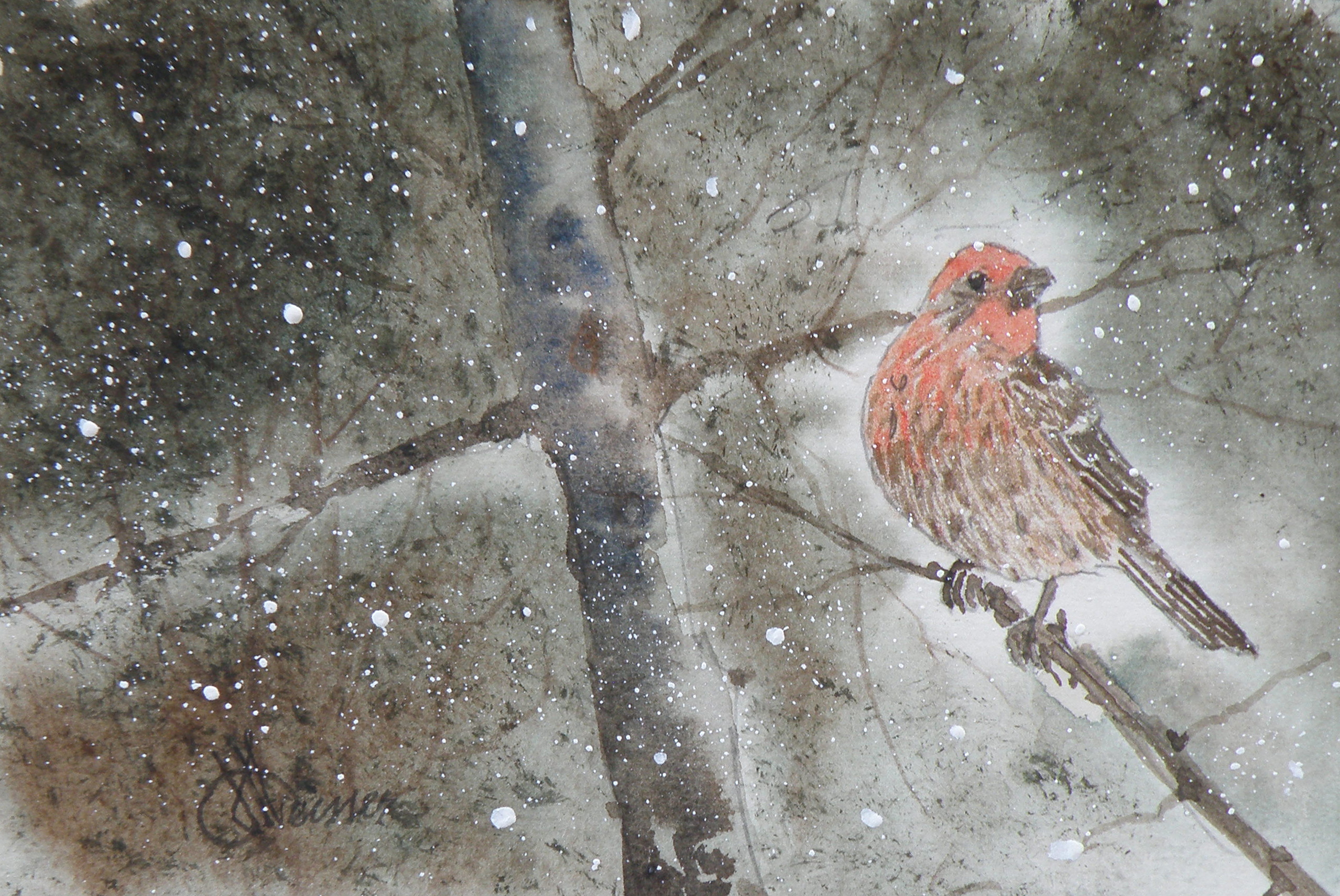
‘House Finch’ — watercolour on Saunders Waterford 140# Hot Press Paper, 2.5″ x 4″
They are, along with wintering Goldfinches, the most frequent visitor to our feeders, and have such a delightfully melodious song. Unlike the slightly larger Purple Finch which probably isn’t found in the West, they do not so much look like they’ve been dipped in raspberry concentrate, as they’ve stuck their heads in wild cherry cream soda. Their disposition is mild, insofar as they aren’t pushy or argumentative when at the feeders. If another species is bossy, they simply flit down to the snow and eat the remains below, along with the Juncos.
If you are ever interested in owning one of these posted bird miniatures, simply email me at: weisserlance@gmail.com and we’ll work out the arrangements. Thank you to all who are so very supportive in comments and visits!
…..Keeping Watch
April 7, 2016
Our little Gallery in the small city of Kamloops, B. C.’s historic Courthouse (1911) has a Featured Artist offering every month and May will be my month to put on a display of recent miniatures. So now it is a matter of working towards having a good showing.
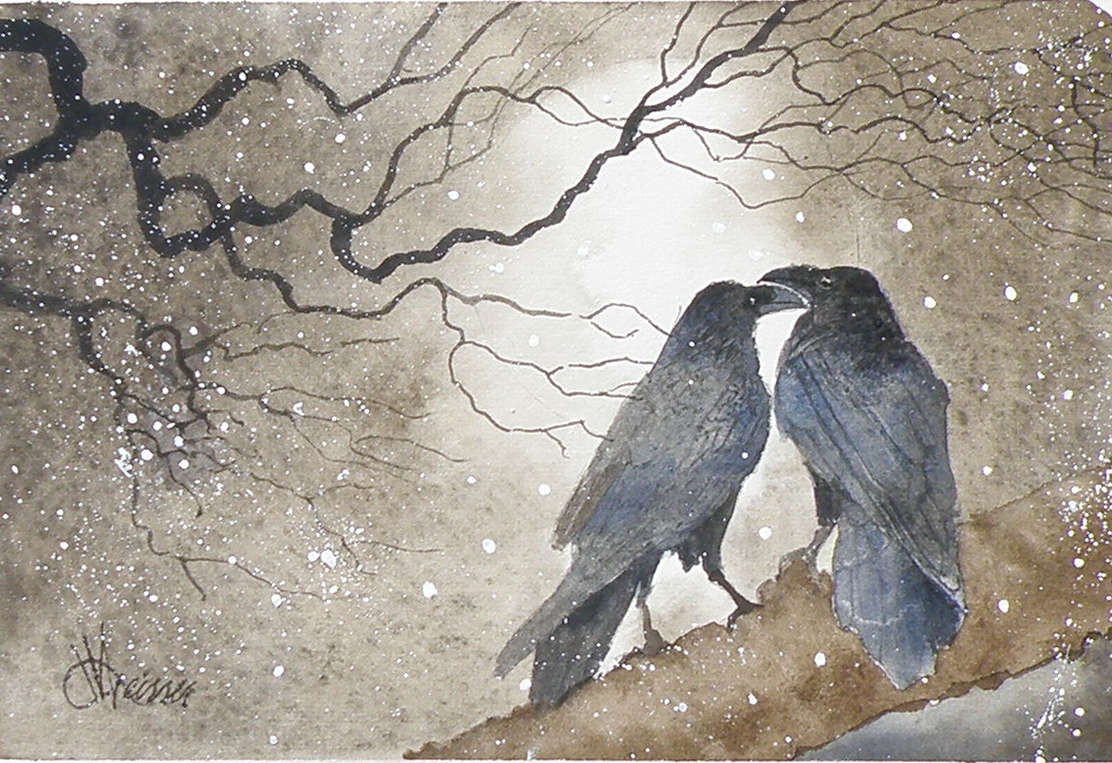
“Keeping Watch”
watercolour on Saunders Hot Press #140 lb paper, 4″ x 6″
I can’t quite explain why it is that depictions of Ravens sell so well, but they do. So it is a pleasure to be able to comply and feed the need, so to speak. They are indeed a very symbolic and ancient bird whose fame is heralded in many countries and cultural legends concerning them abound.
Out taking photographs of them this week, I came across a pair whose size was truly astonishing and whose throaty calls echoed off the nearby boulders and across the wide Thompson River. Once that is accomplished, it is a matter of trying to place them in a scene which has definite mood and emotional impact.
….draw a bird day
March 8, 2016
Teresa Robeson reminded me of ‘bird day’ (https://wordpress.com/read/feeds/4736591/posts/949345080#comments) with her striking rendition of an exotic Araripe Manakin from Brazil.
Here is a far more humble (don’t tell it that!) species, but at least I’m doing my birdy duty this Tuesday morning…..
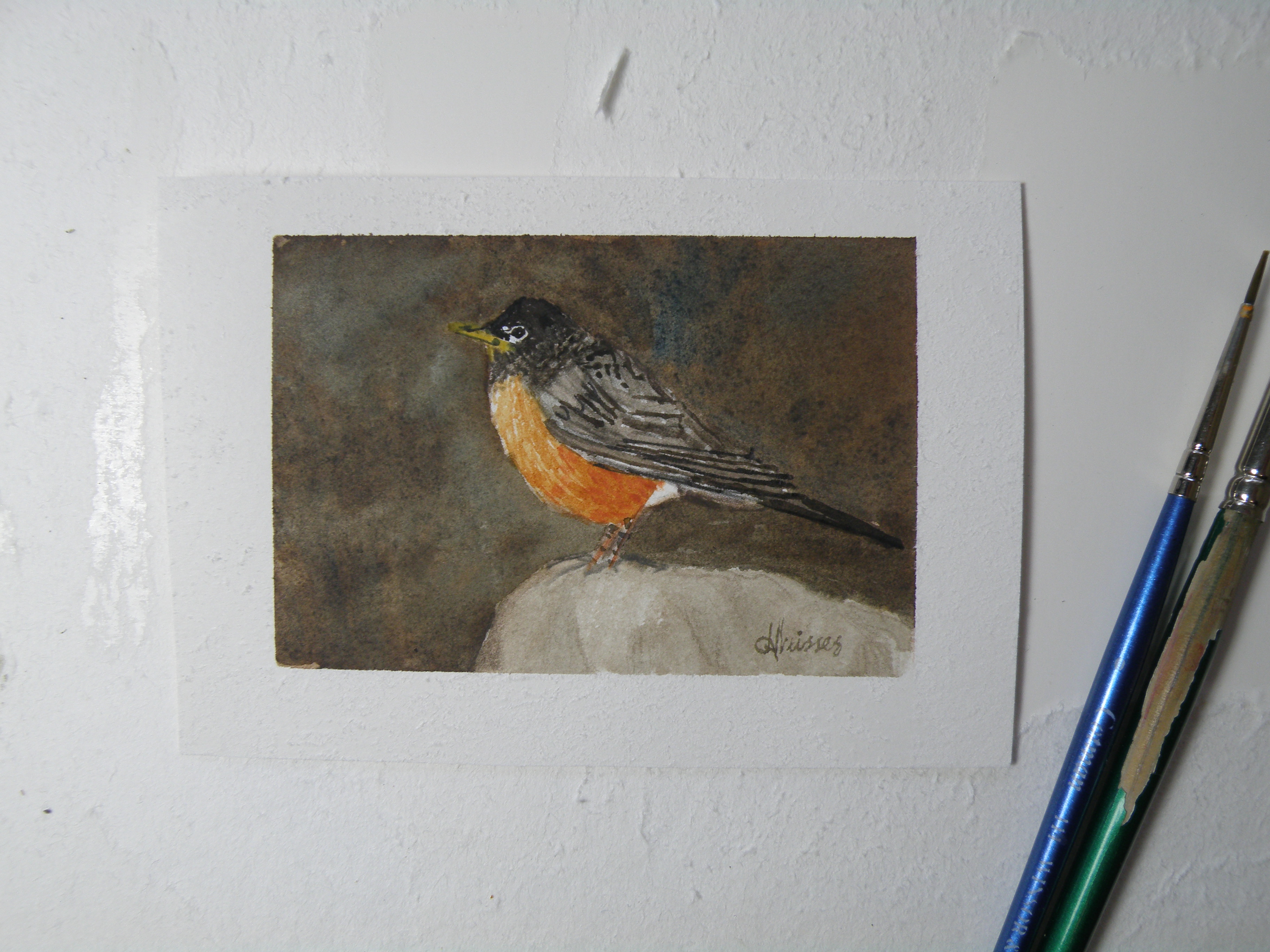
1.5″ x 2″ on Arches Hot Press 140# Paper
I saw my first one two weeks ago–around the third week of February–which is so early for this region, it is nuts. When they get here, they go for Mountain Ash berries and other withering, over-wintered types of fruit, until their usual fare of insects and worms become accessible. They are in breeding mode preoccupied with all their parental preparations.
…. Robin miniature 2
February 12, 2016
It has been an unsettlingly warm Winter here in interior British Columbia, with Spring bulbs actually starting to poke up through the ground. Unsettling, because being only mid-Winter, we might well suddenly get one of those Arctic inflows and see temps plunge to -20C, which would effectively ruin what shouldn’t have already begun sprouting, including fruit trees.
It wouldn’t be surprising at all to actually see Robins returning in February, when their normal return isn’t until mid-March. Being such avid worm-hunters, I have wondered at their early returns here, particularly as to what they find to eat. The answer is the Mountain Ash berry and other lingering berries. The danger, apparently, is eating ones which have fermented, thereby becoming naturally alcoholic and responsible for killing birds who eat too many.
This miniature is of the British/European Robin, which doesn’t reside in Canada. But English Robin miniatures are snapped up in our Gallery simply because they have established such a rich literary following, and also appeal to Canadian emigres.


The difficulty painting a bird the painter has never seen–and therefore isn’t familiar with–means it may not be true to how the bird actually looks. However, this particular bird has so frequently been depicted in book illustrations and greeting cards, that its persona lives beyond its ‘real life’ comings and goings. So here in Canada, getting the English Robin ‘right’ isn’t as stringent a matter as getting the Canadian Robin right–a bird everyone is familiar with, and therefore has to be flawlessly rendered.
They seem so very sweet.
…. mackerel sky
January 29, 2016
There is an Old English saying about weather which goes: “Mackerel scales and mare’s tails make tall ships carry low sails”. ‘Mackerel scales’ refers to Altocumulus clouds which (to some) resemble the markings on the sides of mackerel. ‘Mare’s tails’ refers to Cirrus uncinus clouds which–according to the saying–must, like mackerel scales, indicate strong winds, though the two types wouldn’t likely appear together in the same sky.

The subject is taken from a view of the British Columbia coast, beaten down by the effects of storm after storm. Having lived on Vancouver Island at one point, the weather forecast for the most northerly tip seemed to nearly always call for wind and rain which made me thankful we lived on the most southerly end. We received quite enough rain as it was. However, seldom was it ever a pelting, all-out soaking torrent–which made local people say to tourists complaining about the constant drizzle, “Yes, but it’s a dry rain.”
This was painted on treated illustration board.
…. Tranquille Creek Gorge
January 21, 2016
The watercolour video demonstrations of David Dunlop are challenging and yet simple. https://www.youtube.com/watch?v=Lgtg-Adql1Y&index=6&list=PLtEJwQmsB7SvVg8C4J2c4LDijerH7SSKF (I tried to embed the video itself in this post, but WordPress thought otherwise). But here is the blurb describing it….”Emmy Award winning David Dunlop takes you to his Connecticut studio to demonstrate a two minute watercolor, used as preparation for an oil sketch or to explore ideas“.
Mr. Dunlop is an artist/teacher from Connecticut, whose manner when teaching is inspiring and animated. He is a great follower of descriptive, energetic Masters like J.M.W. Turner and Winslow Homer, and seeks to employ their methods, while demonstrating their techniques.
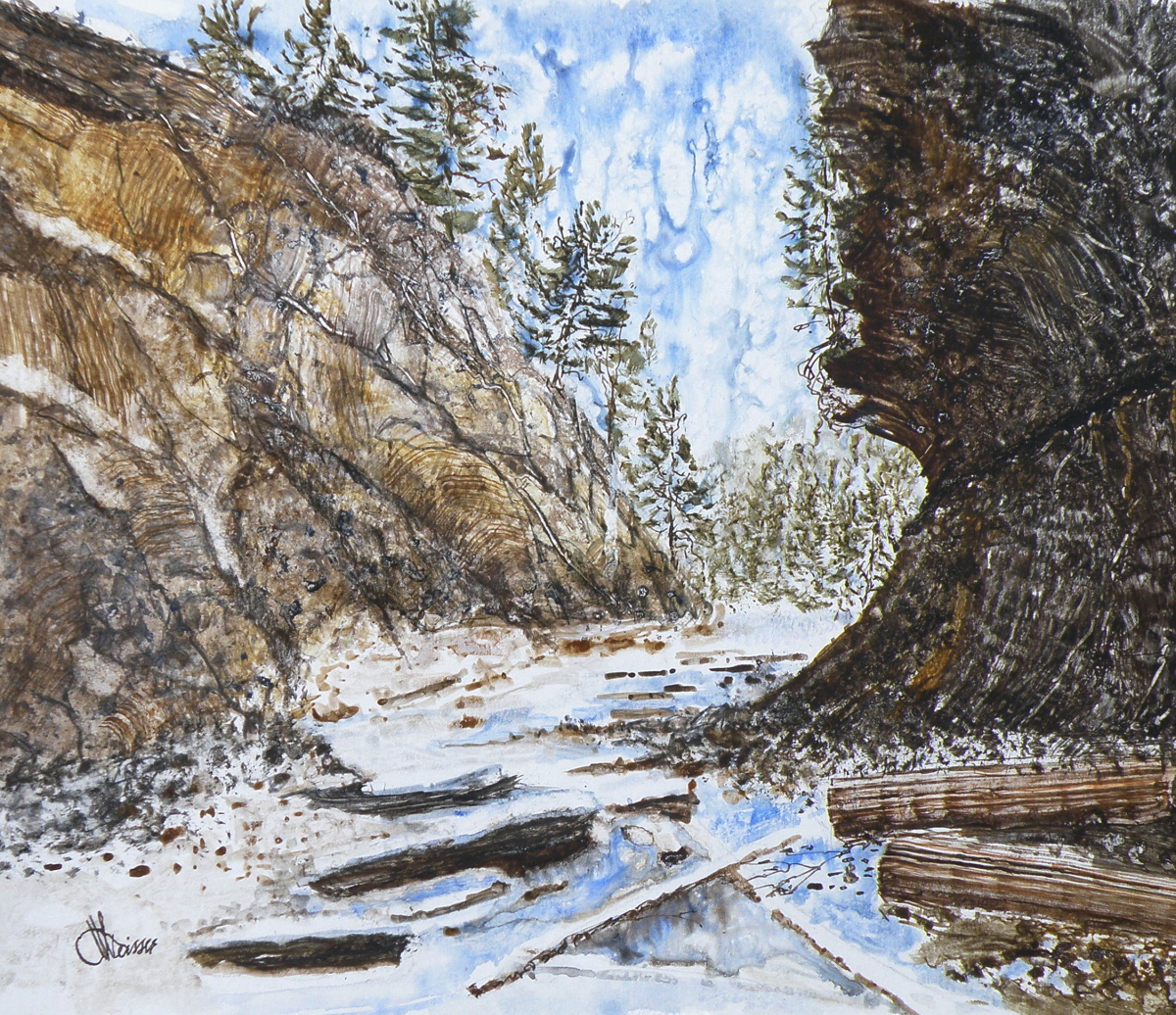
The video cited above challenges painters to do two to three minute painting sketches, which convey the movement and mood and spirit of the subject, without stopping to think and rework. In an effort to ‘do’ and not think, the subject chosen here is a favourite–a place about 20 minutes from our house–called Tranquille Creek Gorge.
Mr. Dunlop’s videos are quite dynamic and aimed more at oil painters a bit more than watercolourists, but full of very encouraging lessons because of the force of his optimistic personality and sense of fun. They are well worth watching, for those who enjoy painting as a means of expression.
….snow
November 25, 2015
We received about 12cm overnight and now everything’s white, with temperatures starting to drop to around -10C (16F) under strong winds.
The birds are in the branches of the large Red Maple just beyond our big front window–at the four hanging feeders and suet cakes. We get mostly goldfinches and house finches, chickadees, juncos, nuthatches, flickers, clark’s nutcrackers, pine siskins, ring-necked doves, occasional pileated and downy woodpeckers, grosbeaks, stellar’s jays, magpies, ravens, white-crowned sparrows, and when it gets really cold the sweetly-blushing redpolls come down from the Arctic (but not likely until January or so).
Occasionally we see a Northern Pygmy Owl which swoops in on the dining lot, lighting on a branch like a handful of fluff with alarming eyes and causes the rest to take off like an explosion. They are one of a few daylight-hunting owls, and for two or three days following, the feeders remain untouched, the memory of that fist-sized, feathered-danger keeping everyone away.
In honour of the occasion — the advent of real Winter — a wintry watercolour, not unlike what the countryside looks like presently. The subject no doubt wishes the wind were less than it is….
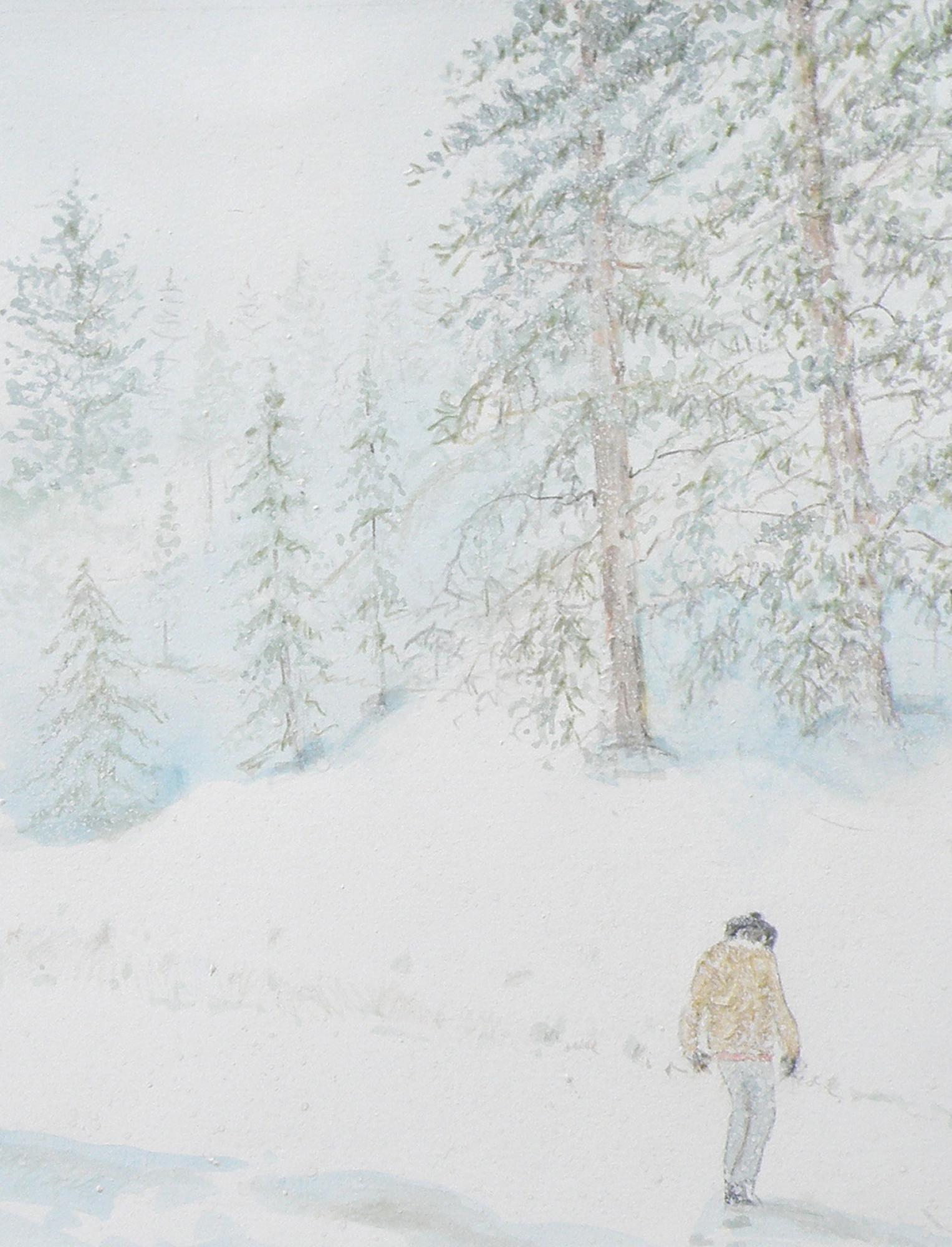
….but imagine the pleasures of fireplace and toddies once he gets back.
It’s an old painting–6 years–and approximately 8″ x 10″ on my favoured Arches Aquarelle Hot Press 140# paper. It took approximately 30 years to finally discover the right paper, having gone through all the choices of surface, weight, paper-maker (brand), and so on. Were it to be done again, the figure would be altered some, as there’s something anatomically odd about it.
….the silt bluffs
November 22, 2015
An area east of Kamloops, B. C., follows the South Thompson River which flows between dramatic limestone cliffs originally formed (it is estimated) 270 million years ago.
Among those cliffs is a gully–a waterworn ravine known as ‘the silt bluffs’, featuring very distinctive rock formations which have the look and feel of something out of a Western movie.
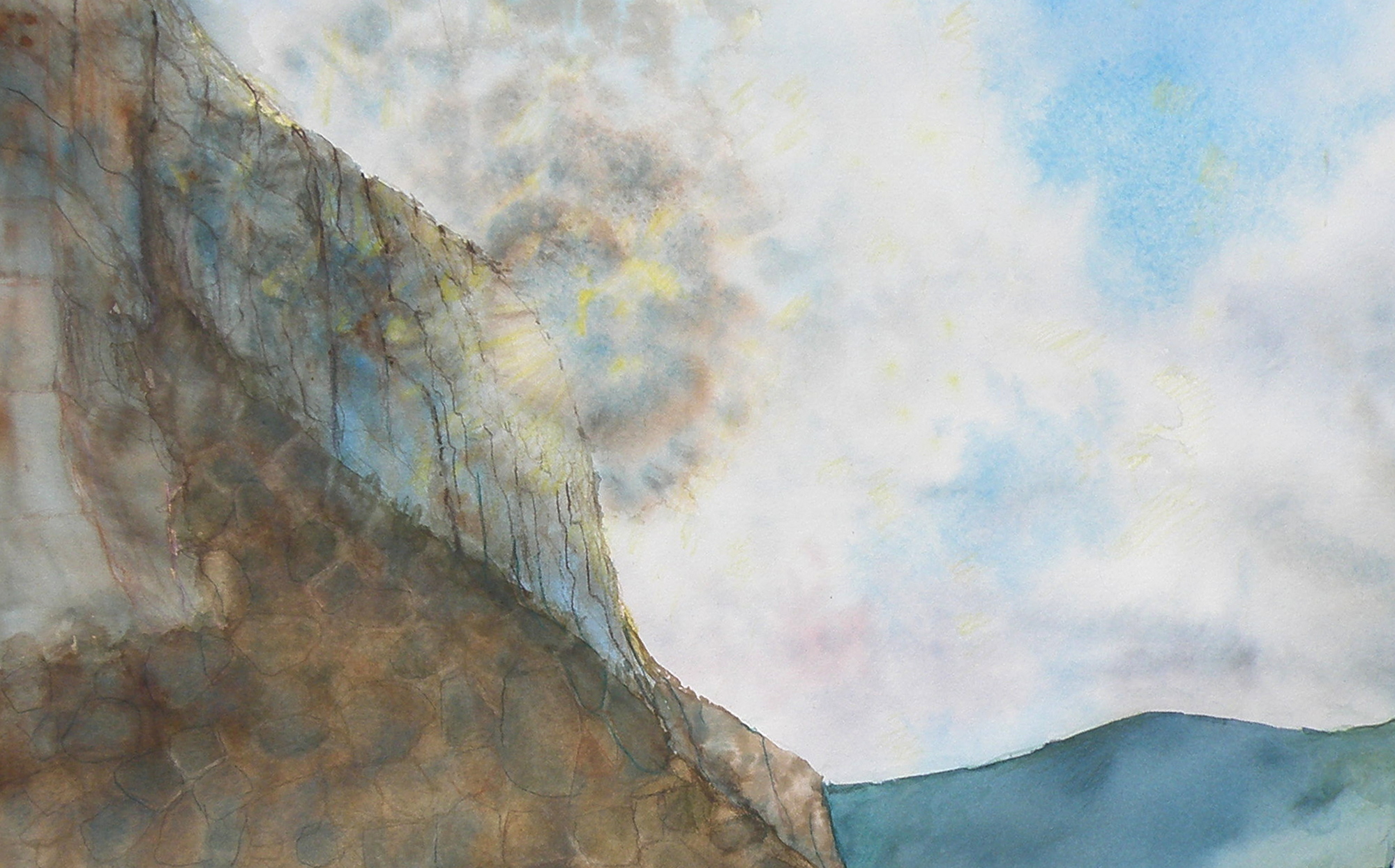
Massive geological formations such as these require some form of treatment by a painter in order to adequately convey their uniqueness and grandeur. This watercolour attempts to do that by purposely choosing to paint directly into the sun.
This part of our landscape gets quite literally baked by heat at midday, so when painting outdoors it is important to get it done quickly.
….November
November 14, 2015
It is the most blessed of months heralding the muted pallet–the toned-down greens, beefed-up greys, complex browns, accents of burnt orange, titian–trees simply/complexly themselves, displaying their line, frost-kissed leaves flashing their last colour, refusing dismissal.
Wonderous November--leaf-whipping, mini-cyclones, clouds suddenly letting forth face-lashing first flakes on towards frost-spongy earth–days framed by late mornings and early evenings, one’s home truly one’s castle, warming against the elements.
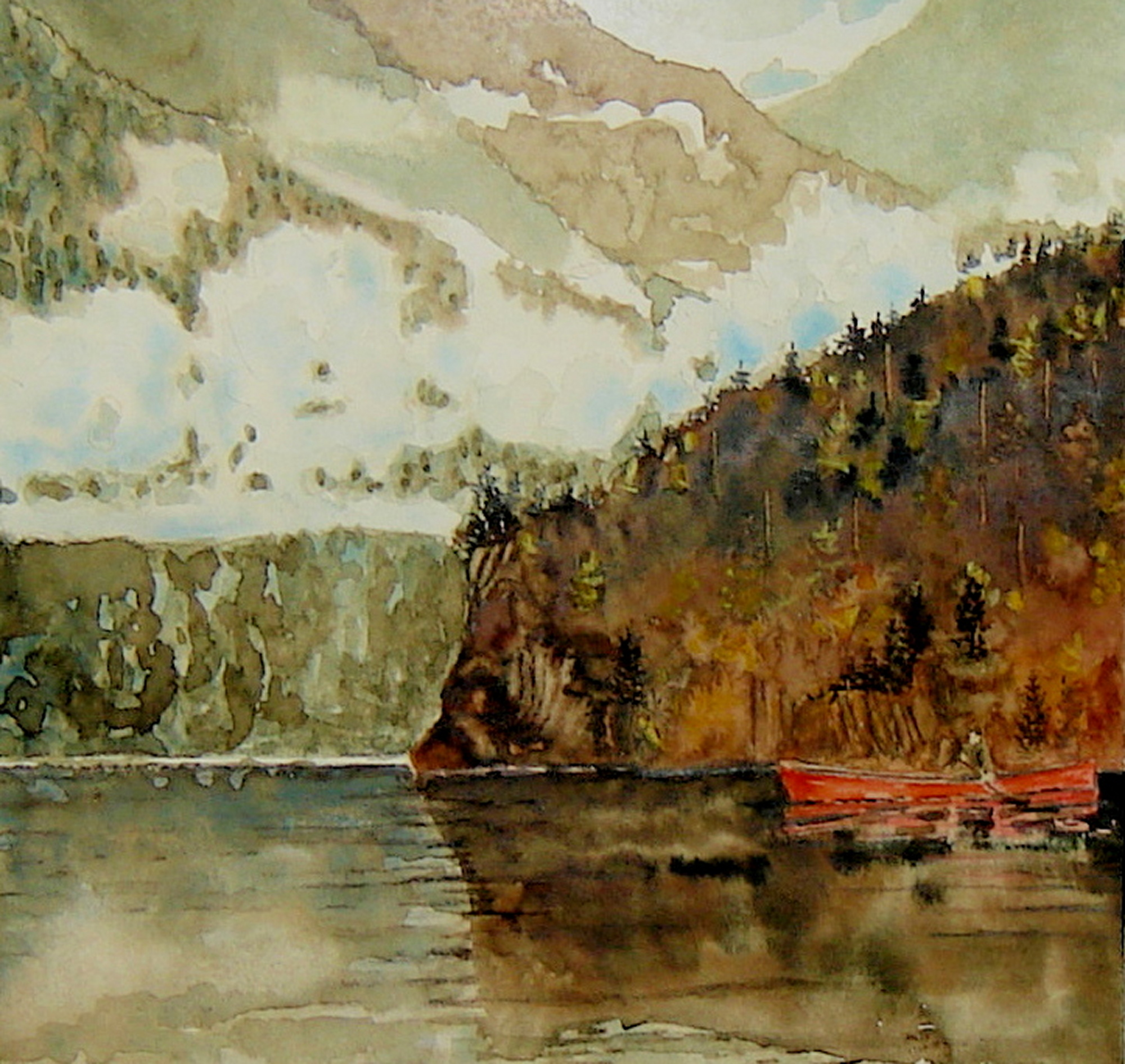
Showboats gone, one paddles purposefully, keeping warm, the lapping sounds musical, deep-throated rooks ricocheting their call round rocky bends echoing, bouncing off glassy surfaces, wood-smoky mists rising.
Banished is the garish, overly-festooned–any and all too-muchness falling away to let be what simply is…..
November
Winter’s cusp
Summer’s compliment
Spring’s concealer
…..downtown, phase 2
November 9, 2015
The Plaza Hotel (completed in 1928) is a five story Spanish Colonial Revival building in downtown Kamloops BC, Canada. It is listed as a cultural heritage site in the Canadian Register of Historic Places.
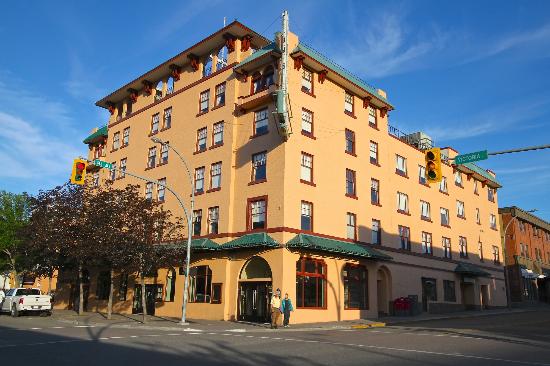
As is so often the case when seeking out subjects for painting, the postcard view isn’t usually very interesting.
The photo used for reference for this watercolour was taken from the rear alley of The Plaza.
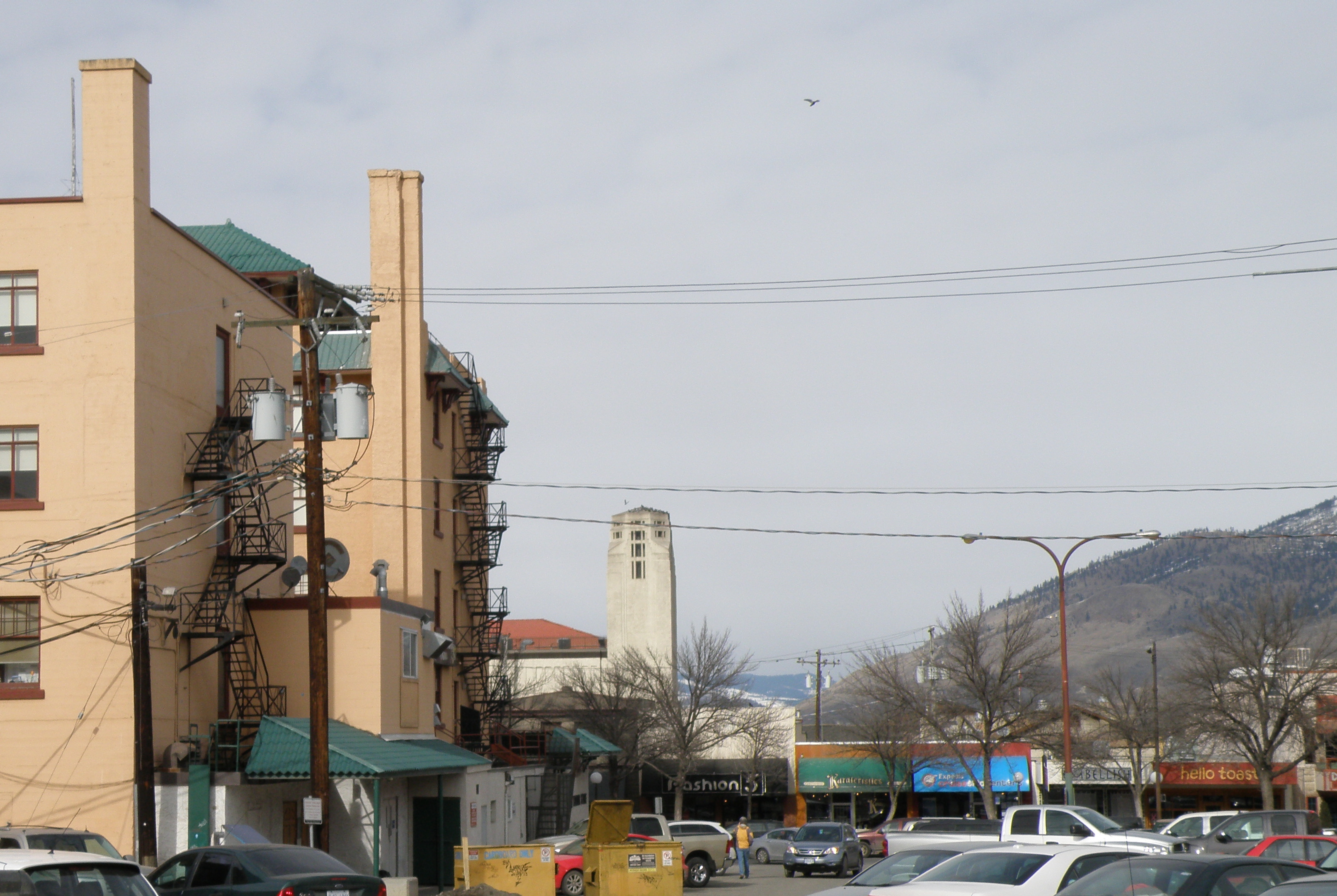
In view is the old Fire Hall tower, with belfry, 73 ft, built in 1935 at a cost of $24,500, when Kamloops had a population of approximately 6,000 (population today is about 100,000). It remains a distinctive landmark.
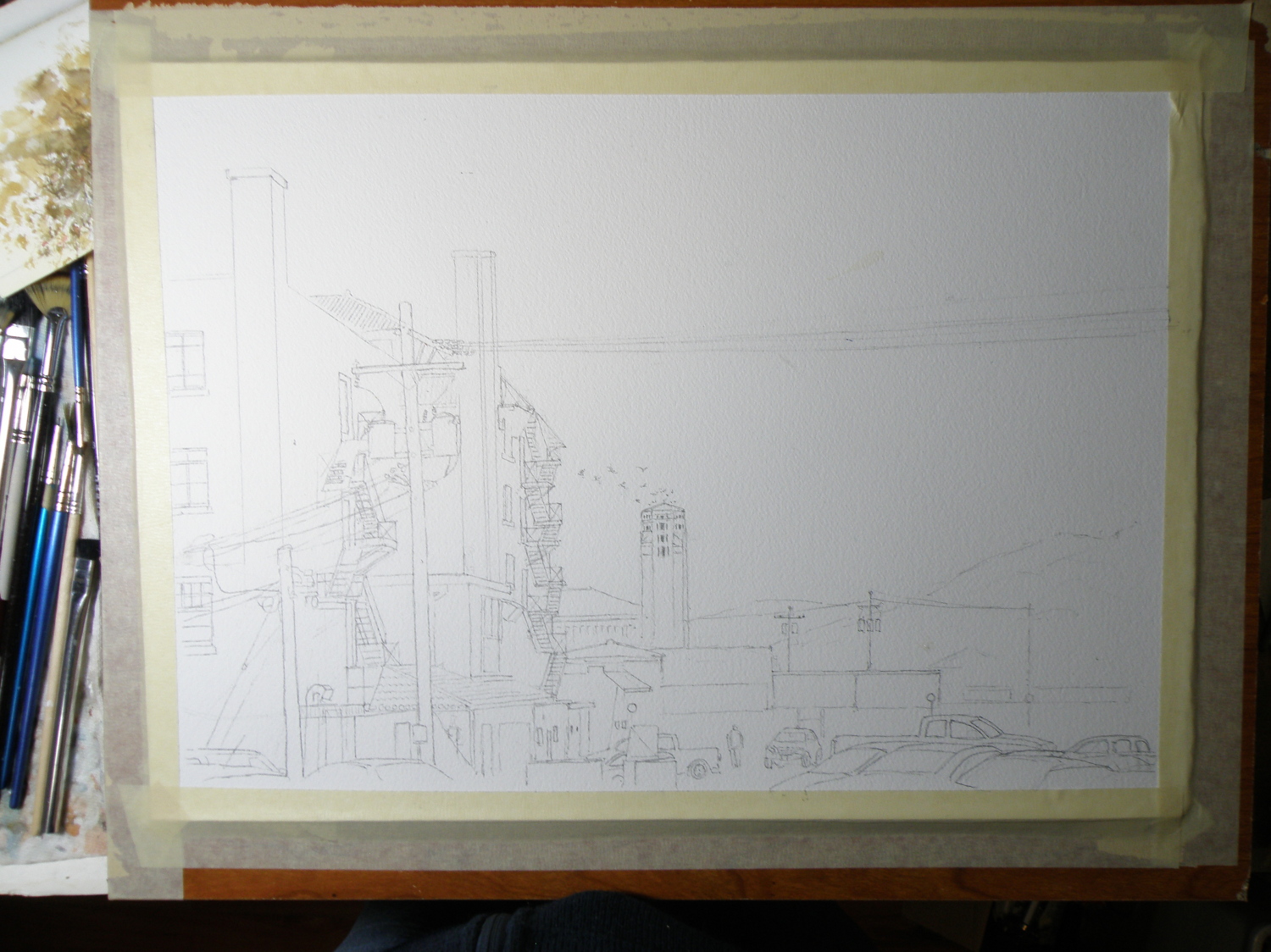
The decision to cast the subject in Winter has to do with wanting to bring some drama to the scene due to there being an overly abundant amount of sky. Pigeons have also been added to give more visual interest.
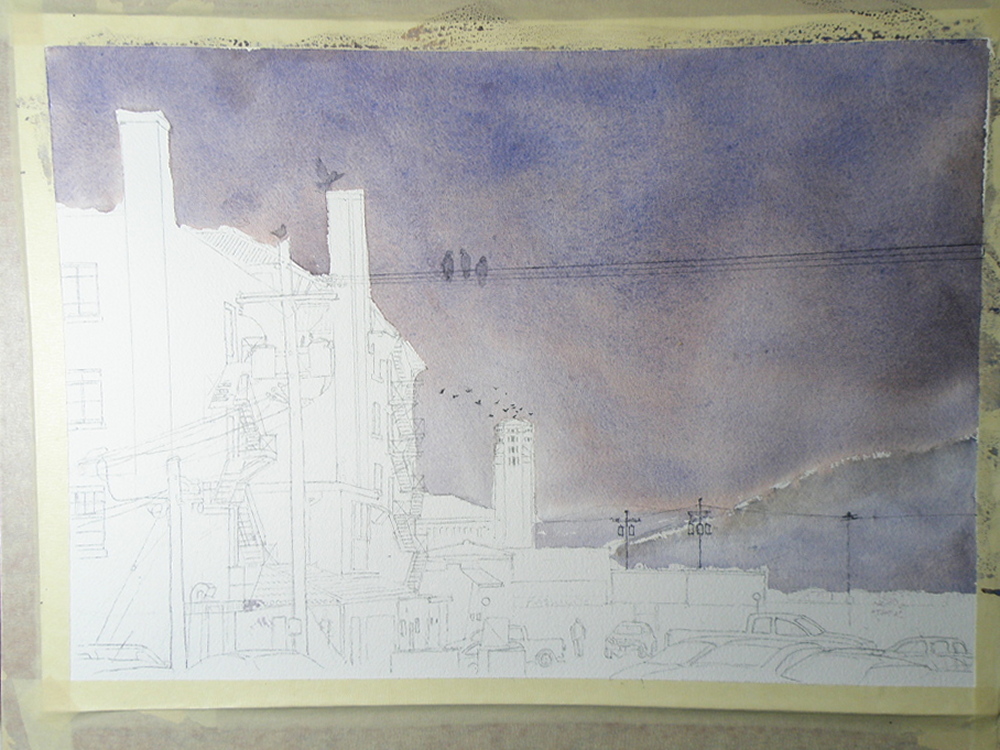
Because the hotel is a very light orange, (which gives off a bit of a pink cast in late afternoon), the sky is a wash of quin red, quin yellow and ultramarine blue in order to help incorporate the tones of the building into the rest of the painting. So quin red and quin yellow will be used as the shade of the hotel as the painting progresses.
breakers
July 22, 2015
The depicting of waves in watercolour is particularly challenging when one has decided on being a ‘purist’ by refraining from both opaque white and masking fluid. Personally speaking, masking fluid has become so offensive in terms of smell (its natural thinner, in case anyone wonders, is ammonia, which is why it smells so awful–but a little ammonia will indeed thin thickened masking fluid, if stirred in slowly), and damaging brushes (even when dipping them in soapy water first), and causing the hardest of edges when removed, that it’s rarely a choice for me. It does make for quite lovely snow squalls when flicked from a stiff toothbrush, I must say–and great fun, too.

‘Third Beach, Vancouver’, watercolour, painted on location, 35.5cm x 23cm (14″ x 9″), Arches Hot Press 140lb. Paper
Breaking waves challenge any student of watercolour (and every single person working in this medium will forever be a student) because of having to leave paper white for crest foam, swash, and the receding backwash effects. This, coupled with understanding which part of the wave receives more or less pigment, not to mention the change of pigmentation if backwash is curling up and drawing in sand at the same time, comes the added realisation that sky is being reflected off top surfaces the further from shore one looks.
There truly is nothing for it but to get right into the actual physics of spilling, surging, plunging, and collapsing breakers, each of which exhibits its own characteristic properties–ones our eyes are very accustomed to and therefore recognize in a flash when viewing surf–properties a viewer expects to be reproduced in paintings (if the painting is trying to conform to the challenges of representational art, that is).
https://en.wikipedia.org/wiki/Breaking_wave Drawing each of these examples over and over again makes wave action less of a mystery and eventually becomes familiar and far less challenging. However, a single line of waves is always backed by more, multiplying the visual dynamics, adding to the confusion of having to depict row upon row of breakers. Where does foam end and the gathering wave behind it start? For this, it is very instructive to carefully observe photographs and again draw over and over how this actually does look.(https://en.wikipedia.org/wiki/Breaking_wave) Only then, personally speaking, do I find painting on location not as daunting, for stopped action is easier to analyze than sitting in front of actual pounding surf.
Painting water is a dedicated pursuit all of its own. There is a painting friend of mine who includes water in every single piece he does because he is dedicated to the depiction of water, whether in the form of rain, surf, river, lake, stream, waterfall, because in each case there is a lifetime’s worth of challenge.
…..draw a bird day
July 8, 2015
Kwakiutl First Nation is a First Nations government based on northern Vancouver Island in British Columbia, Canada, focused on the community of Port Hardy, British Columbia in the Queen Charlotte Strait region.
A Kwakiutl Native legend has it that the eagle once had very poor eyesight. Because it could fly to the highest treetops, however, a Chief asked the eagle to watch for invading canoes. Anxious to assist, the eagle convinced the slug, which in those days had excellent vision, to trade eyes temporarily.
The slug agreed, but when the eagle’s sentinel duties were finished, the eagle refused to trade back eyes. Thus, goes the legend, not only is the eagle’s sharp vision accounted for, but also the slowness of the slug.
source: [http://www.baldeagleinfo.com/eagle/eagle-myths.html]
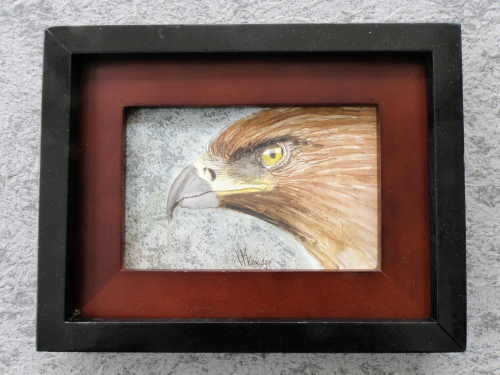
‘Golden Eagle’, watercolour, 9cm x 14cm (3.5″ x 5.5″), Arches 140 lb. Hot Press Paper
Laura, over at www.createarteveryday.com announced a challenge to draw birds today. And ‘Monday,Tuesday,Wednesday’ ‘s contribution was The Nevada State Bird, the magnificent Mountain Bluebird. Kirk’s contribution is The Baltimore Oriole, another gorgeous bird.
on display
June 22, 2015
THE OLD COURTHOUSE GALLERY CO-OP and Gift Shop got its start in 2007. The Courthouse itself is a Kamloops, B. C., landmark, built in 1909.
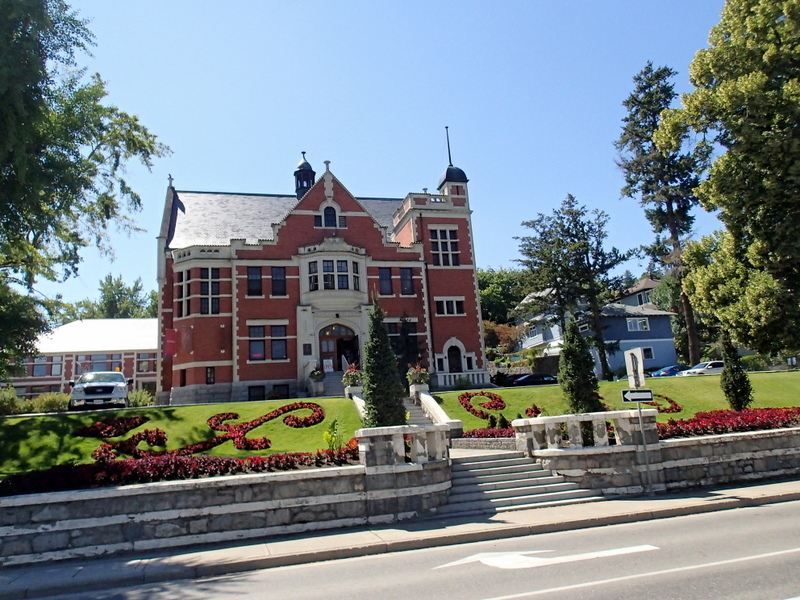
photo: Okanagan Art Review.com
A superb and intact example of the Edwardian Baroque style, its interior demonstrates an Arts and Crafts sensibility.
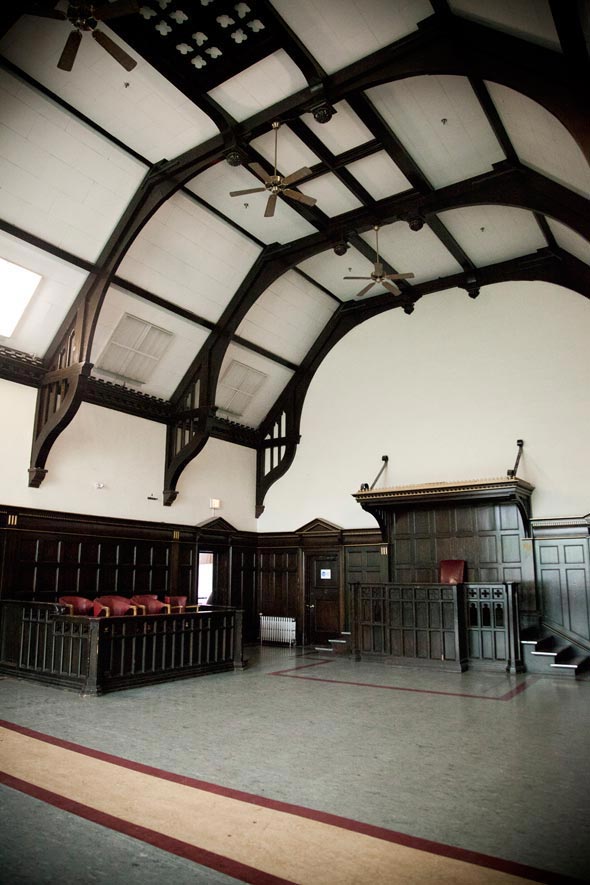
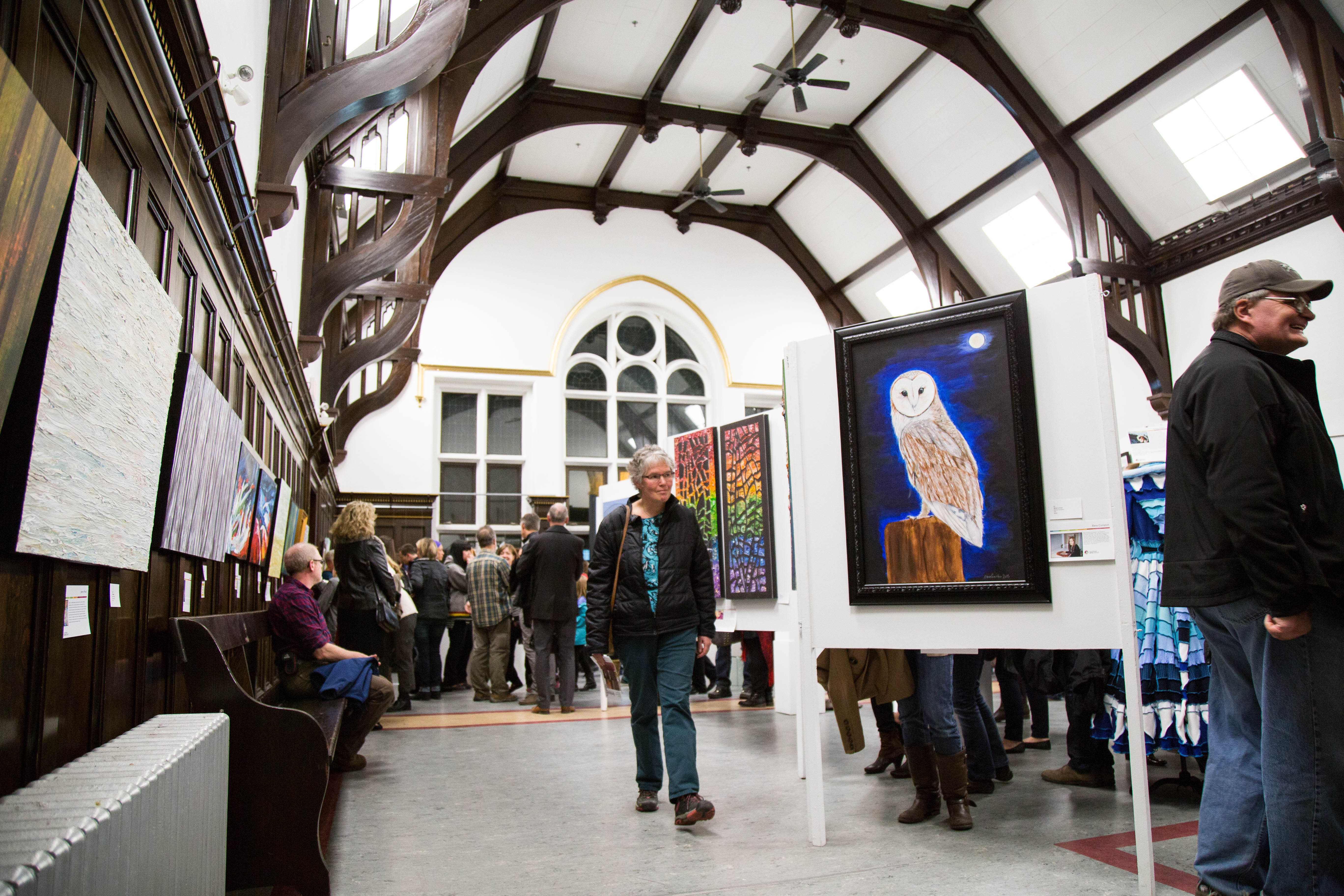
Mainly symmetrical, the building features an elaborate central entry, prominent parapet gables and a corner square-domed tower. It was constructed primarily of local brick, British Columbia stone such as granite, limestone and slate, and wood from local lumber mills. The choice of materials symbolized a commitment to the use of quality British Columbia products, a source of pride in this provincial building. An exceptional level of design and craftsmanship is evident throughout the building. It is one of the most accomplished designs of prominent architects Dalton & Eveleigh, and the stained glass came from the studio of Charles Bloomfield. (source: http://www.historicplaces.ca/en/rep-reg/place-lieu.aspx?id=12791)
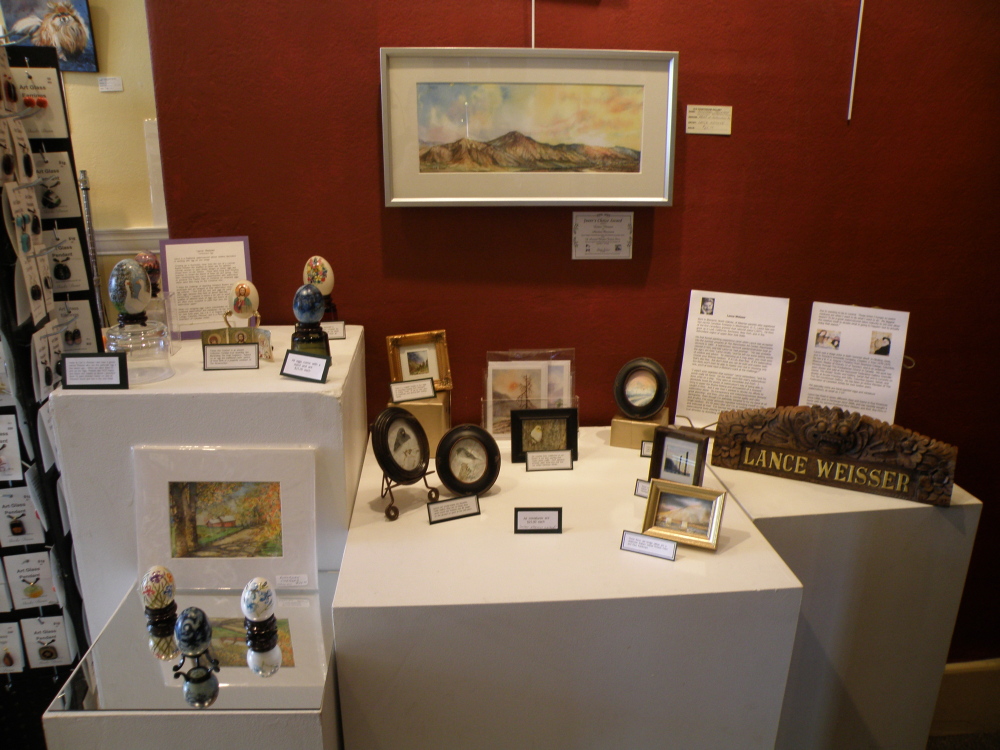
Our Artists’ Co-op now consists of sixteen local artists, whose work is on display within one of the rooms of the original Courthouse. We are a group made up of several potters, glassmakers, jewelry makers, painters, two photographers, one dollmaker, and one weaver. I am currently the President.

Every month we schedule one or two of us to be the Featured Artists who occupy a special area just inside the entrance.
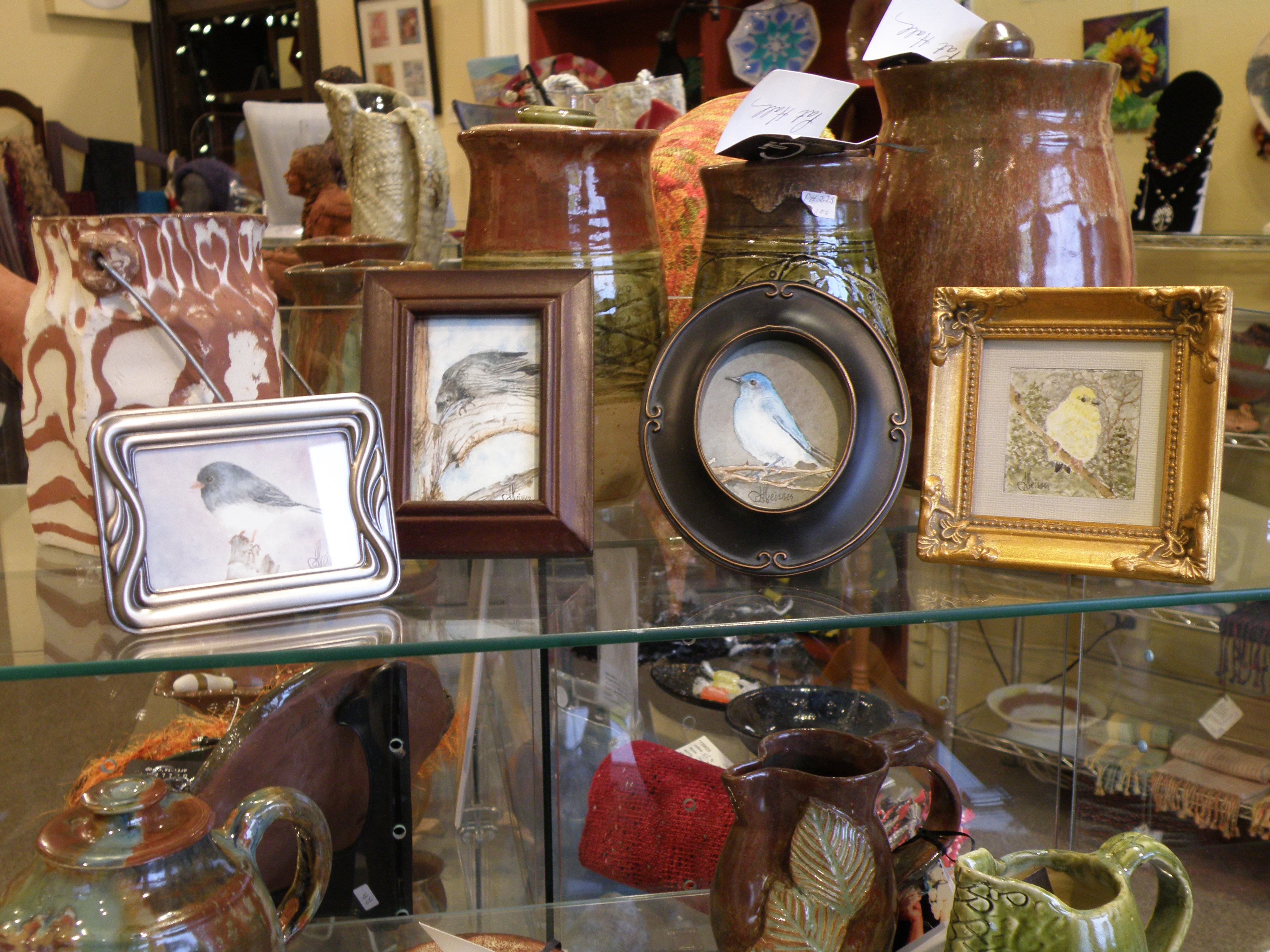
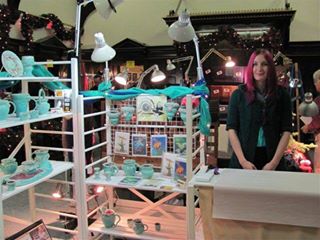
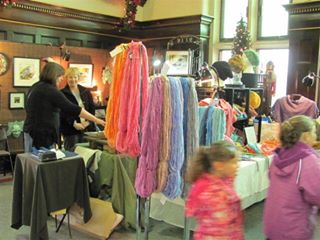
We are open five days a week, all year round, and our biggest event is called Christmas At The Courthouse where we invite and jury in arts and fine crafts vendors to sell their wares throughout the entire building . . .
tranquille creek gorge
June 3, 2015
ANCIENT FLOWS OF LAVA have left our regional landscape (Kamloops, B. C.) with dramatic canyons, a single lane dirt road skirting the edges.

‘Tranquille Creek Gorge’, watercolour 23cm x 41cm (9″x16″) Arches Hot Press 140 lb. Paper, sold
MY PAINTING FRIEND MAX drove me through this arid landscape, only 10 minutes outside a city of nearly 100,000. Every so often she’d tell me of cars which had not been successful at executing a snowy, icy, tricky piece of road only to careen down the sides. At one place, the car was still there, making me both dizzy and almost nauseous, leaning over to see its rusting bulk caught between broken pines and rock.
‘MY GOD, WHERE WERE THEY HEADED?’ I’d asked. ‘Home, of course’, Max pointed ahead. And there was a small grouping of houses not far from the road, some fencing in horses or livestock–one had alpacas–and looking semi-deserted, though that was far from the case. Dogs barked at Max’s pickup as we threaded through and headed into yet more wilderness. ‘They take this road to Kamloops and back?’ — it seemed to my chicken, urban-minded guardedness a scary place to build one’s home. ‘Only for shopping, or a night on the town’, Max said. ‘Which is why someone sometimes doesn’t make it home–especially in the Winter.’
geology and art
May 31, 2015
ACCORDING TO GEOLOGIC FINDINGS, Kamloops, B. C., has limestone which dates back 270 million years. The earth itself is estimated to be some 4.5 billion years old. So the rock and sediment of Kamloops is relatively young in comparison, which is due to it having once been part of the ancient Pacific Ocean floor. Fossils in the area show ancient ocean plankton.
THE DOMINANT AND STRIKING, ANCIENT, WORN-DOWN MOUNTAINS within City Limits are the remains of ancient volcanic activity, and are remarkably bare of trees, gaining beauty from sunrises and sunsets, moonlight, and an annual ‘greening’, when the rains of Spring bring out the new leaves of Sagebrush and native grasses.
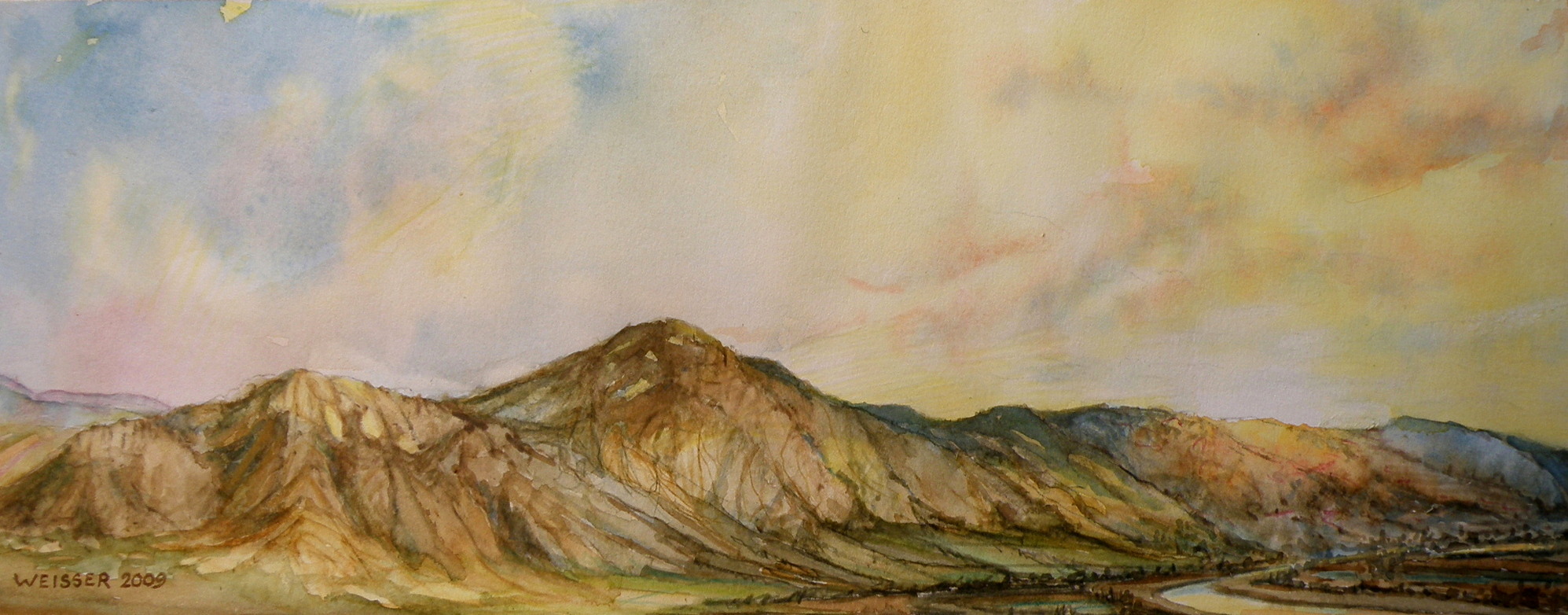
‘Signature Mountains of Kamloops, B. C.’, watercolour on Arches Hot Press Paper 140 lb., R. Foster Collection
 weisserwatercolours