…..carabao
July 11, 2015
MY PARTNER RAUL is from The Philippines, and we’ve been together now 12 years, married (with my sister officiating) in 2008. We met online in 2003, and a month later I flew to Manila where he met me at Aquino International Airport. My sponsorship of him as my ‘conjugal partner’ brought him here in 2007, and Raul is now an LPN, whose specialty area is Geriatrics.
The small Barangay of San Jose, Plaridel, Bulacan, features rice fields whose rhythms set the tone for the annual life cycle of villagers and livestock, including the stolid and dependable beast of burden, the Carabao.
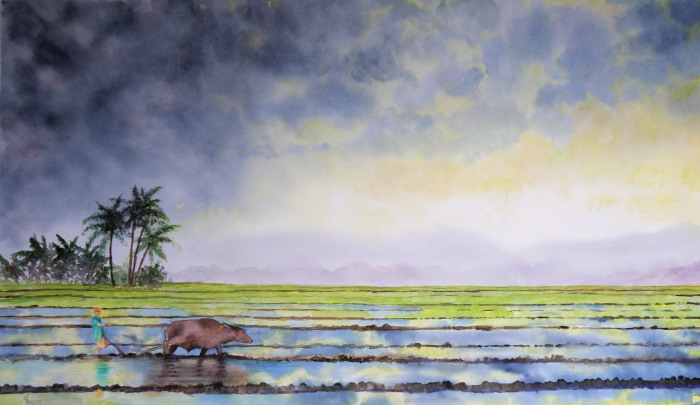
“Bulacan Dawn”, watercolour, 43cm x 74cm (17″ x 29″), Arches Cold Press Paper 140 lb
Water buffaloes are well adapted to a hot and humid climate. Water availability is of high importance in hot climates since they need wallows, rivers or splashing water in order to reduce the heat load and thermal stress. They thrive on many aquatic plants and in time of flood will graze submerged, raising their heads above the water and carrying quantities of edible plants. They eat reeds, giant reeds, bulrush, sedges, water hyacinth and marsh grasses. (source: https://en.wikipedia.org/wiki/Carabao)
There is something so completely humbling about how humans are graced with the educational presence of massively-strong animals whose disposition is nonetheless docile, coupled with a willingness to be put to work with little being asked in return. My three stays in The Philippines of some 6 weeks each, allowed me to learn from the perfect symbiosis of rice worker and carabao, whose calm partnership in the tending of the greenest of green fields was both reassuring and a powerful living metaphor.
…..draw a bird day
July 8, 2015
Kwakiutl First Nation is a First Nations government based on northern Vancouver Island in British Columbia, Canada, focused on the community of Port Hardy, British Columbia in the Queen Charlotte Strait region.
A Kwakiutl Native legend has it that the eagle once had very poor eyesight. Because it could fly to the highest treetops, however, a Chief asked the eagle to watch for invading canoes. Anxious to assist, the eagle convinced the slug, which in those days had excellent vision, to trade eyes temporarily.
The slug agreed, but when the eagle’s sentinel duties were finished, the eagle refused to trade back eyes. Thus, goes the legend, not only is the eagle’s sharp vision accounted for, but also the slowness of the slug.
source: [http://www.baldeagleinfo.com/eagle/eagle-myths.html]
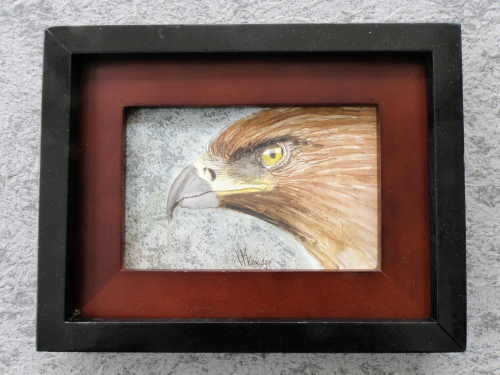
‘Golden Eagle’, watercolour, 9cm x 14cm (3.5″ x 5.5″), Arches 140 lb. Hot Press Paper
Laura, over at www.createarteveryday.com announced a challenge to draw birds today. And ‘Monday,Tuesday,Wednesday’ ‘s contribution was The Nevada State Bird, the magnificent Mountain Bluebird. Kirk’s contribution is The Baltimore Oriole, another gorgeous bird.
tiny robin
June 28, 2015
There is a woman named Robin who comes to the Gallery looking for namesake treasures. It is my personal pleasure to keep her mission accomplished.
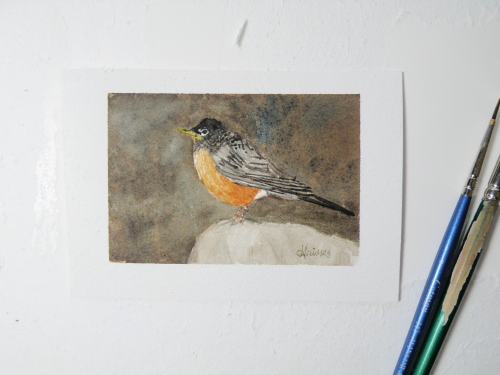
‘N. American Robin‘, 4cm x 6cm, (1.5″ x 2.5″), watercolour miniature, sold
I have a niece named Robin. What’s cool about her is that she is married to Peregrin. And the relieving detail is that they chose not to name any of their three children after birds.
I went to school with a girl named Candi Barr. When I was a kid, our next door neighbour’s maiden name was Olivia Greene. Fortunately, none of my (known) relatives ever named their son Bud.
Please provide some examples of your own known ‘unfortunate’ names. We could all do with a smile.
chestnut chickadee miniature
June 16, 2015
The Chestnut-backed Chickadee uses lots of fur in making its nest, with fur or hair accounting for up to half the material in the hole.
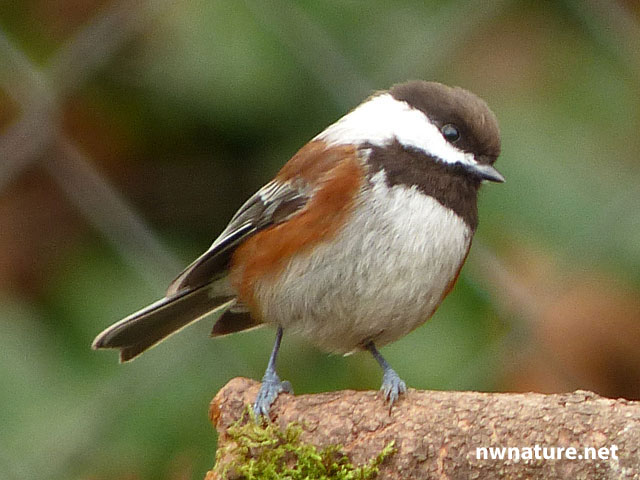
nwnature.net
Rabbit, coyote, and deer hair are most common, but hair from skunks, cats, horses, or cows appears in nests as well. The adults make a layer of fur about a half-inch thick that they use to cover the eggs when they leave the nest. (source: allaboutbirds.org)
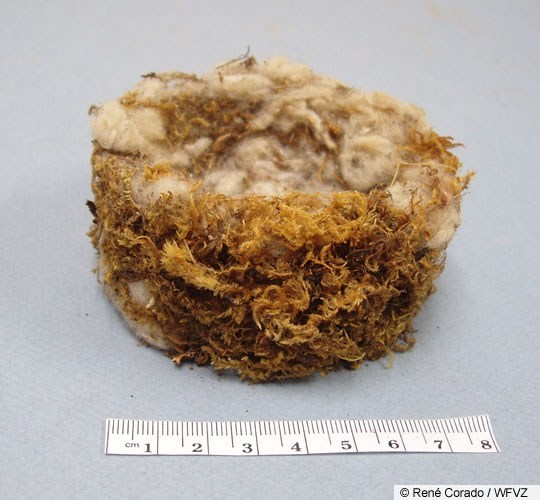 © René Corado / WFVZ
What’s not to like about these chittery, agile, and nimble bits of joy–so accommodating, they’re willing to eat out of an uplifted palm. At feeders, they flit in, impetuously seize a seed, cock their heads and in a mercurial moment are pounding the life out of their shell-encased prize, hammering against a solid branch.
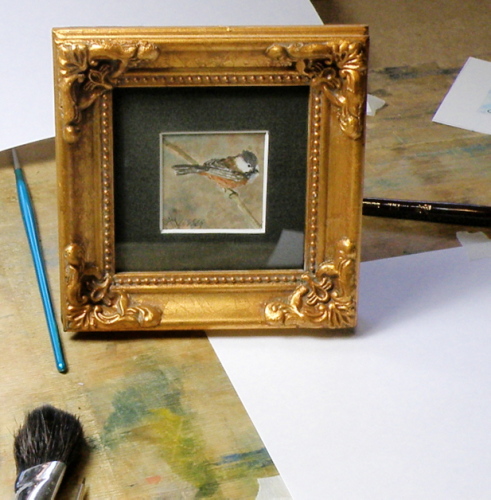
“Chestnut Chickadee”, 2.54cm x 2.54cm (1″ x 1″), watercolour on Arches Hot Press Paper, sold
When annoyed, they chee-chee-chee-chee at any feeder chaos, curtly muscle back in, and sprightly dart back up to pummel their sunflower seed in privacy.
barn swallow
June 9, 2015
A FEW INTRIGUING FACTS about Barn Swallows:
(source: allaboutbirds.org)
- Although the killing of egrets is often cited for inspiring the U.S. conservation movement, it was the millinery (hat-making) trade’s impact on Barn Swallows that prompted naturalist George Bird Grinnell’s 1886 Forest & Stream editorial decrying the waste of bird life. His essay led to the founding of the first Audubon Society.
- According to legend, the Barn Swallow got its forked tail because it stole fire from the gods to bring to people. An angry deity hurled a firebrand at the swallow, singeing away its middle tail feathers.
- The oldest known Barn Swallow in North America was 8 years, 1 month old.

‘Male Barn Swallow‘, watercolour, 7.5cm x 12.5cm, 3″ x 5″, Arches Hot Press 140# Paper, L. Rice-Sosne Collection
Barn Swallows don’t come to seed or suet feeders, but they may take ground-up eggshells or oyster shells placed on an open platform feeder. If you have a suitable outbuilding, leaving a door or window open can encourage Barn Swallows to build a nest inside. Providing a source of mud will also help with nest building. Barn Swallows may use artificial nest cups attached to an appropriate surface.
Barn Swallows also drink and even bathe on the wing, dipping down to take a mouthful of water or touch their belly to the surface for a quick rinse. Males defend a small territory around the nest site and aggressively chase away other males, even grabbing them with their feet and tumbling to the ground. Individuals or groups of Barn Swallows mob predators such as hawks, gulls, or grackles that approach nests.
showstoppers
May 22, 2015
SOME BIRDS ARE JUST LOOKERS. Here in the Southern Interior of British Columbia we have a few worthy of stopping traffic.
NOT BEING MUCH OF A PHOTOGRAPHER–a person who snaps pictures, really–I can only share my photos of some of our local showstoppers, the first being a …..
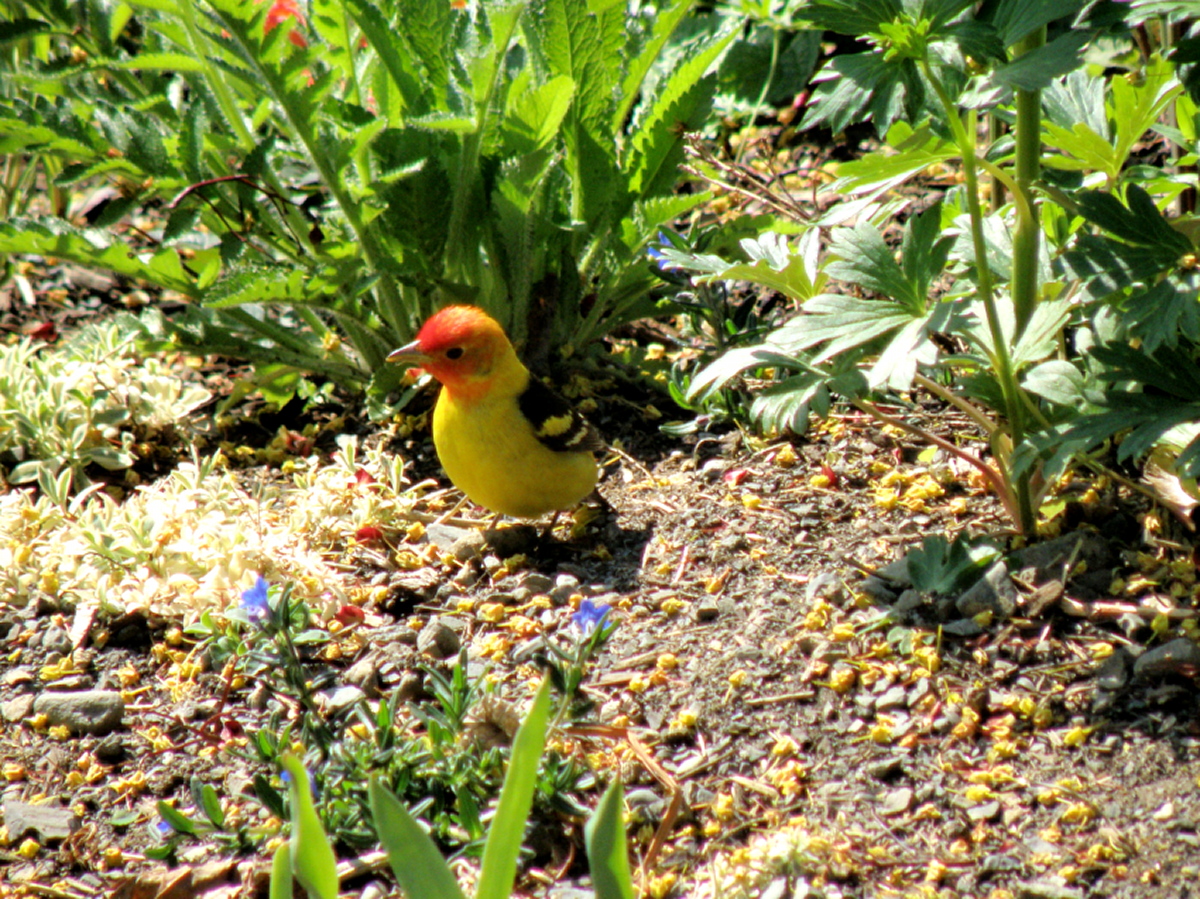
Western Tanager in the front garden
Tanagers come here to nest, as do many songbirds
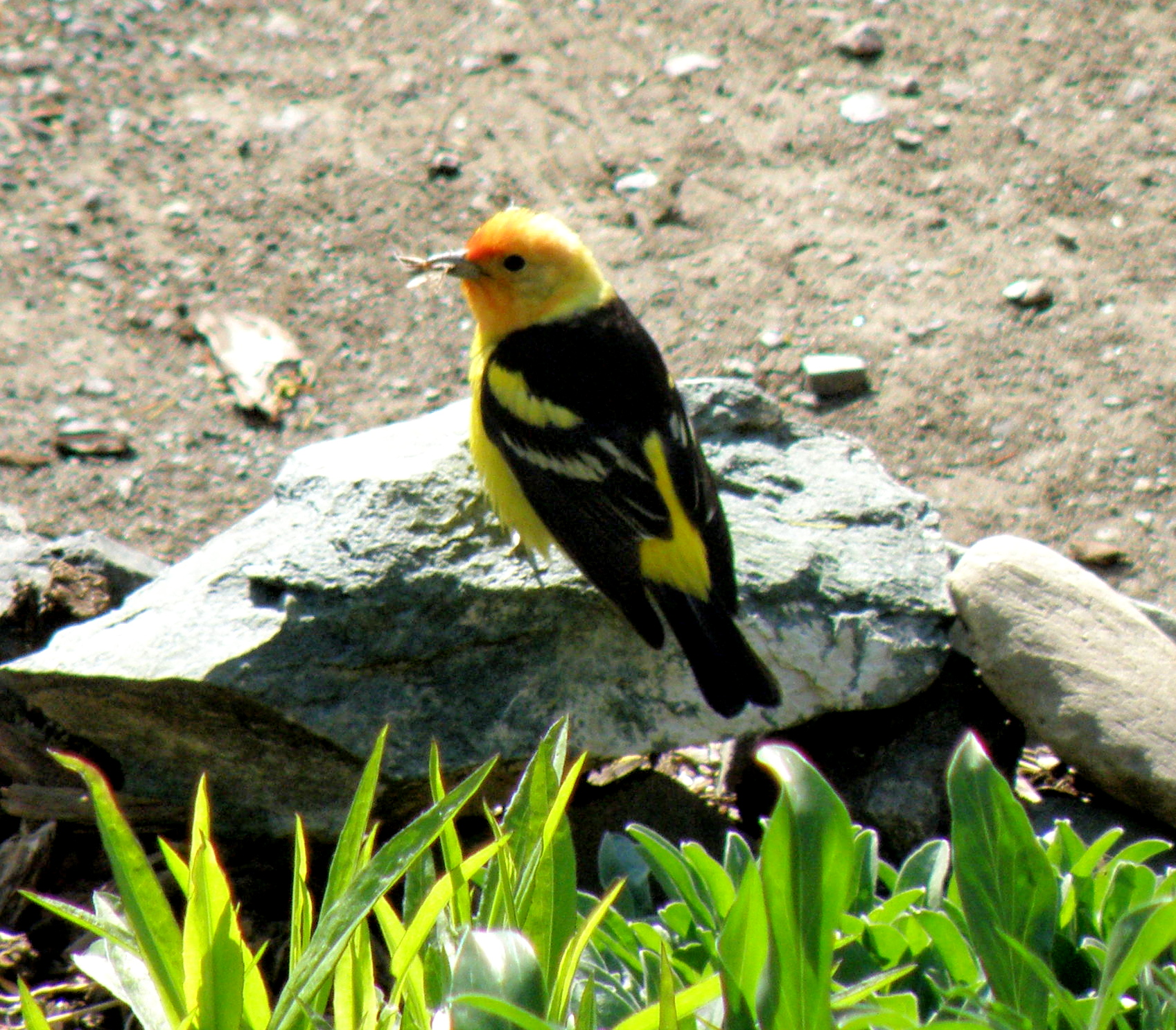
Spring, 2011
ANOTHER LOOKER OF A BIRD is the …..

Pileated Woodpecker, January, 2011
AND A GREAT FAVOURITE OF MINE IS a. . . .
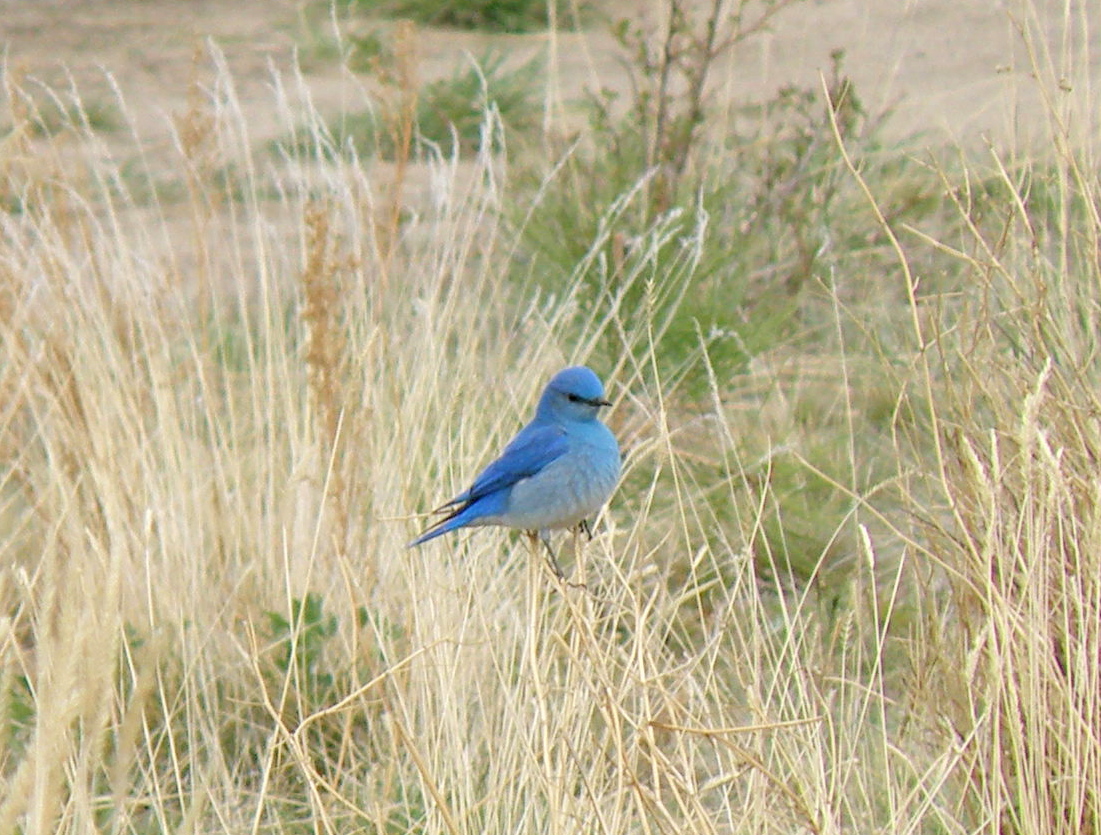
Mountain Bluebird, Summer, 2012
THE MOUNTAIN BLUEBIRD is found here in our abundant grasslands, and are encouraged to remain by our local people building and mounting birdhouses meant especially for them. And truly there are no blues quite as brilliantly displayed as on a male Mountain Bluebird, who, while I was snapping away and adjusting my lense, remained surprisingly still and unperturbed, as though enjoying (and deserving) the attention.

Male Mountain Bluebird, Kamloops, B. C., 2012
RECENTLY I WAS ASKED TO PROVIDE A MINIATURE of a Male Northern Cardinal, a bird not found in Western Canada. Having to rely on images not my own, and hoping the result would do justice to the actual bird itself . . . .
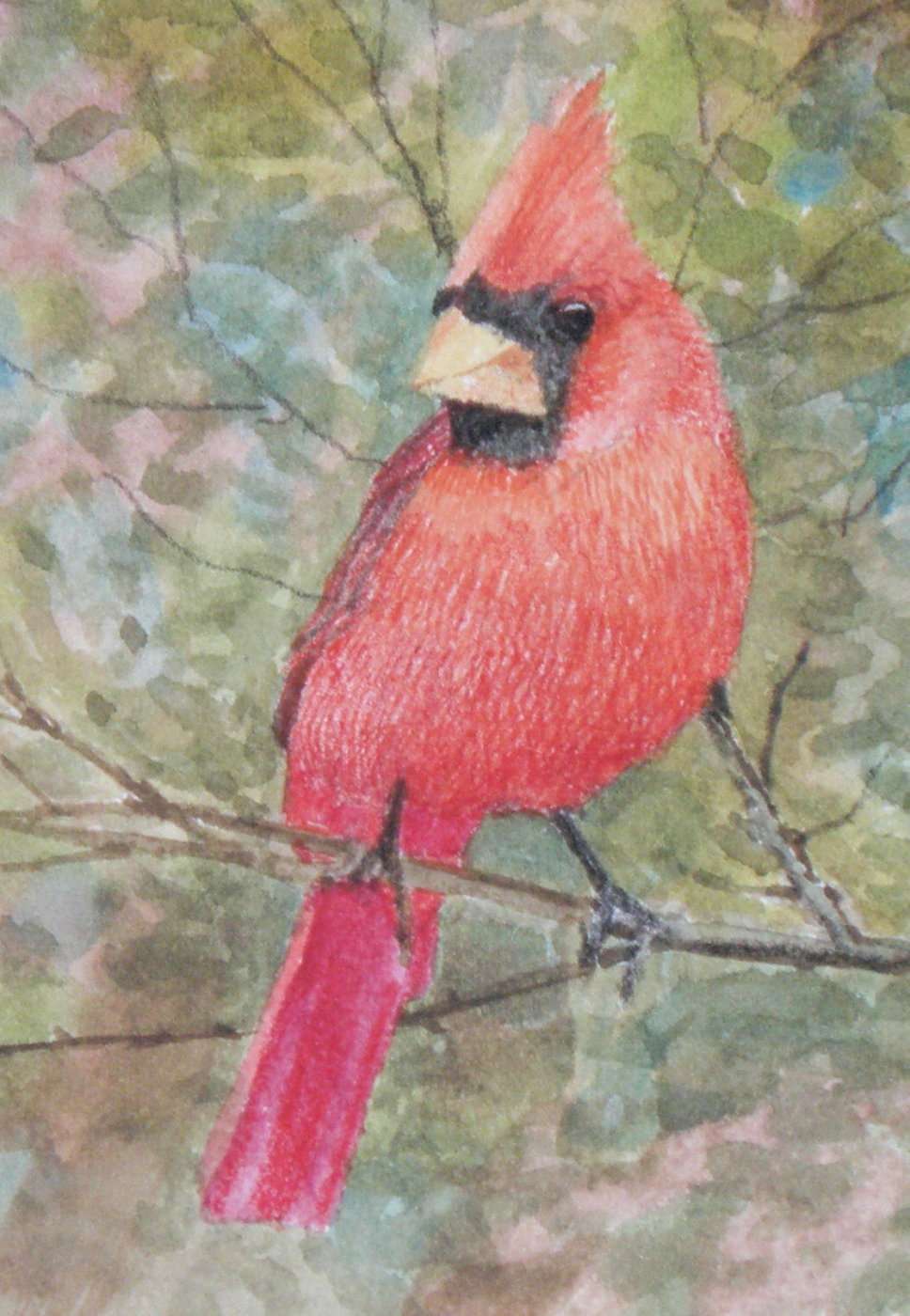
‘Northern Cardinal’ watercolour, arches hot press paper 9cm x 6cm (2.5″ x 3.5″)
IT IS BEING SENT OFF TO a patron in New York City, where I believe a Northern Cardinal might be seen gracing the beautiful environs of New York’s Central Park.
raven moon
May 20, 2015
PAINTING NIGHT has become something of a preoccupation. On a very bald and pedestrian level, one could simply say that ‘night sells’. However, it is the ‘why’ which is intriguing–why do scenes of watercolour-rendered night have an appeal.

‘Raven Moon’, watercolour, 35cm x 25cm (14″x10″), Art Board, (sold)
THERE IS A FASCINATION over what goes on in nature while we are sleeping. When walking the dog at 4 a.m., there are owls hooting, deer eating in people’s yards, the occasional cries of coyotes, and the enduring scent of lilac.
HEARING, TOUCHING, SMELLING all come alive, while seeing is at the pleasure of the muted moon–at once reassuring and mysterious.
painting night
May 18, 2015
THERE IS A FASCINATION surrounding night, when all is cloaked in darkness and the earth dons a mysterious manteau.
WE SEE, and yet we don’t. Depicting night is a painting fascination because I personally do not have a firm visual anamnesis of what exactly night ‘looks like’.
FOR EXAMPLE, is the moon really white–or silvery? Or is it, rather, lemony–or perhaps, blue?
A NUMBER OF RENOWNED NORTH AMERICAN PAINTERS made the depiction of night their signature subject. Some, like the famous Western painter, Remington, chose to depict moonlight as a bit of each, including even at times, degrees of green….


IT IS SOMEWHAT OF A MYSTERY as to what our eyes truly see, in terms of chromaticity, when looking at night, and particularly, moonlight. Painting night offers an enjoyable challenge: convincing viewers that what has been painted corresponds to their personal, nightly experience.
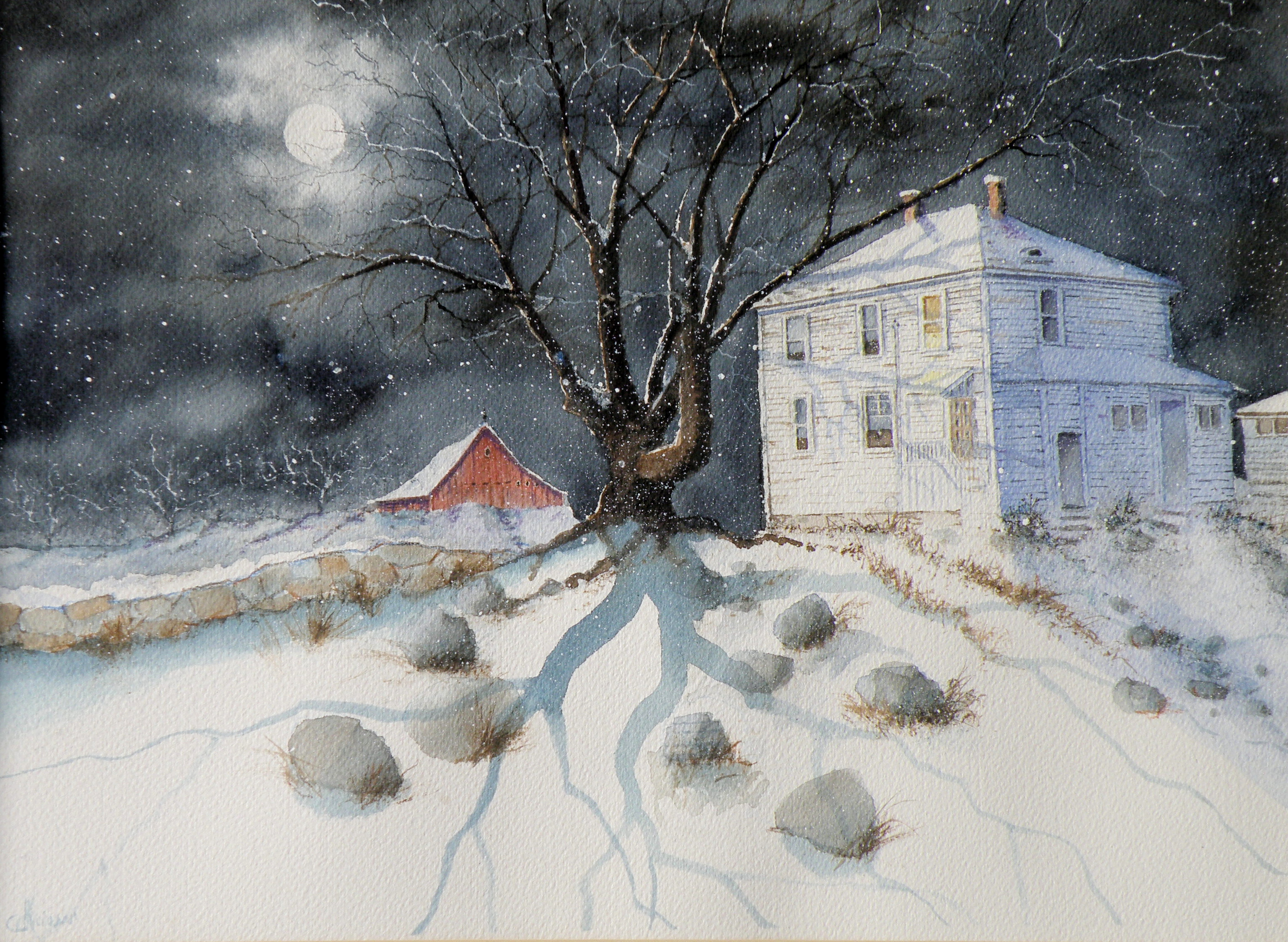
‘Up Late’, watercolour, Arches Hot Press Paper, “14×18”, (sold)
THIS IS ANOTHER heritage home in Kamloops, known locally as Fort House, because it was built on land originally used as a Fort by The Hudson Bay Company when Kamloops was established in 1812. At present, this early 20th century farmhouse is a rather rundown rooming house.
Bacon & Eggs
May 10, 2015
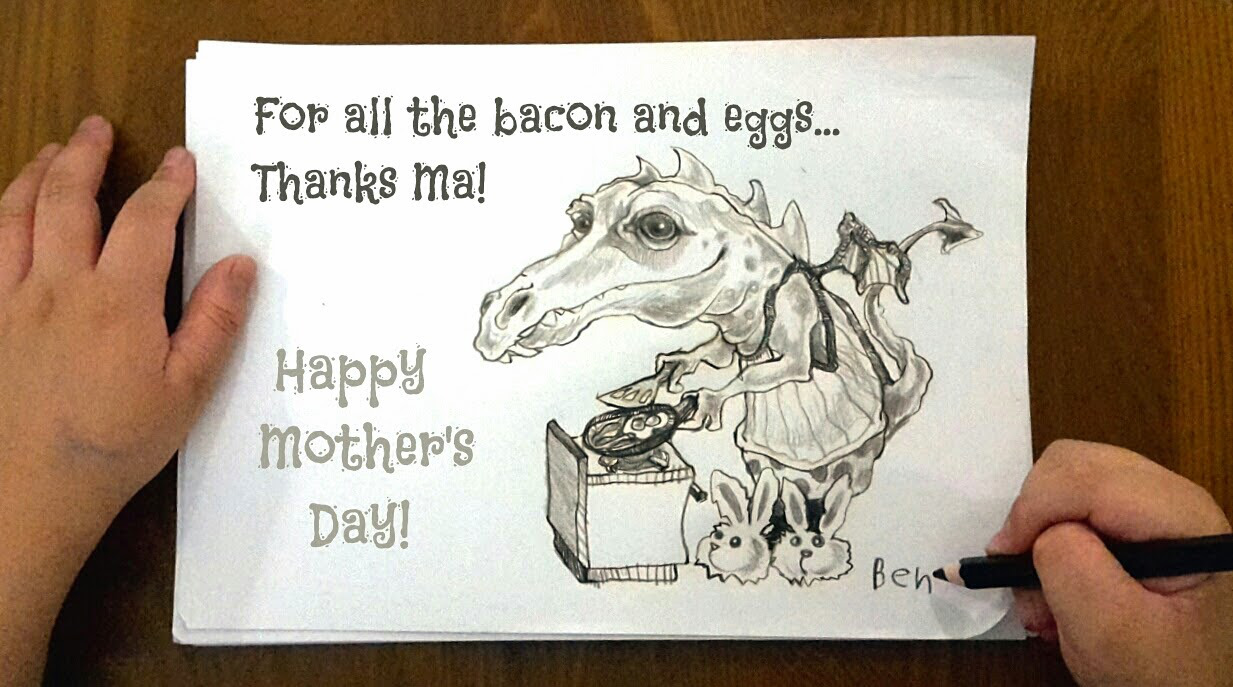
What a way to bring joy to a very nurturing Mom…

Silt Bluffs
April 26, 2015
THE KAMLOOPS REGION is a geological wonder. 50 million years ago, volcanoes erupted and volcanic ash and lava covered the land, and their record is preserved in fossil beds throughout the area. Ancient rivers carved the landscape, forming the modern valleys of the Thompson Rivers and, during the Ice Ages, ice sheets carved the valleys and rounded the plateaus and mountains in the Kamloops area. (sourced from ‘Tourism Kamloops’ website)
THIS PAINTING is of a local geological formation called The Silt Bluffs. In the height of summer they are baked by a 40C sun, and are the home of rattlesnakes and cacti . . . and Ravens.

“The Silt Bluffs”
23cm x 30.5cm (9″ x 12″), watercolour, 140 lb. Arches Hot Press Paper, sold
name that bird . . .
April 25, 2015
SOME LONG WHILE AGO now (years)–through this blog–I received a request by email from a blogger to complete a miniature of a bird, which I did, and sent off to his/her satisfaction, receiving back in the mail remuneration.
THE DIFFICULTY FOR ME in this moment is that I still have the image of that little bird painting the way it looked when I was working on it . . . here it is . . . not a very sharp photo. .
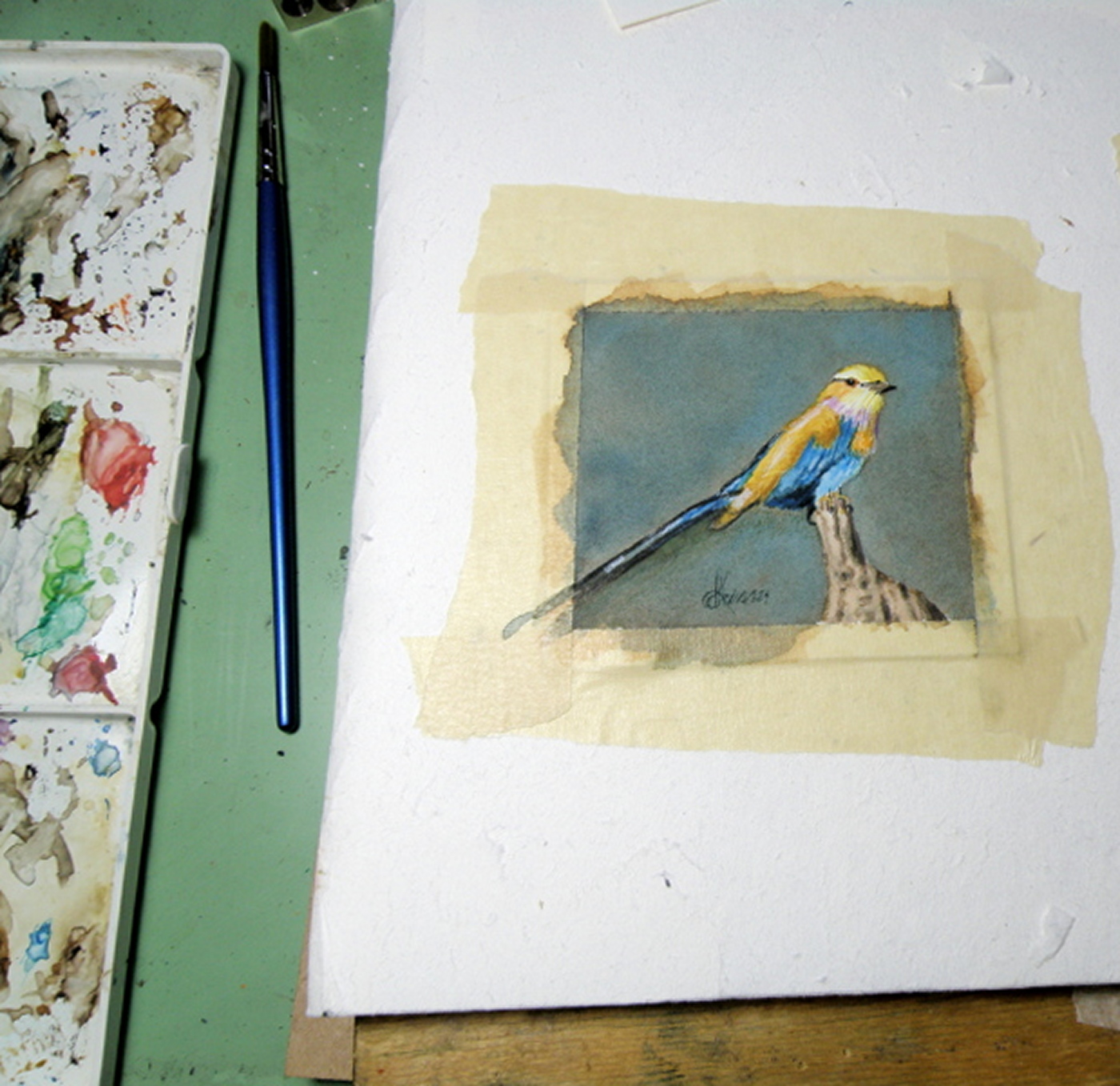
. . . BUT MY PROBLEM in displaying it here, is that I no longer have a clue what kind of bird it is. All I can recall is that it is a species from a tropical region, and probably in the Central Americas. It is not a bird I have myself ever seen with my own eyes, so it lacks my personal experience, and therefore lacks a place in my memory bank . . . so . . . I’m asking . . .
DO YOU KNOW THE NAME of this bird?
a constable of ravens
April 24, 2015
YOU’VE HEARD OF ‘a murder of crows’, a ‘volery of birds’, a ‘brood of chickens’. The term for the groupings of Ravens is less fixed. Ravens were/are often seen gathering about The Tower of London, and in meaner times, The Tower was a Royal place of execution (Anne Boleyn, et al) .
AN UNKINDNESS OF RAVENS is what a grouping of them was called when a Royal was awaiting death–as though their presence was a foreboding, a cruel anticipating, a sign of ill will.
A CONSTABLE OF RAVENS is what their grouping was called when The Tower was no longer sinister, but rather a symbol of The Monarchy itself. Their presence in such times meant they were keeping guard over the Royal Family. Ravens were a constance, a watchful presence–a constable.
A CONSPIRACY OF RAVENS is another label for their gatherings, stemming from their ganging together whenever there’s carrion or bodily remains to be picked apart and eaten. Ravens don’t allow other than their own to share in the find.
A WOMAN IN OUR TOWN THUMBS HER NOSE AT by-laws and ritualistically feeds Ravens all through the Winter months by pouring out cat kibble in several of her collection of decorative cement-cast bird baths around the yard of her time-worn and historic home.
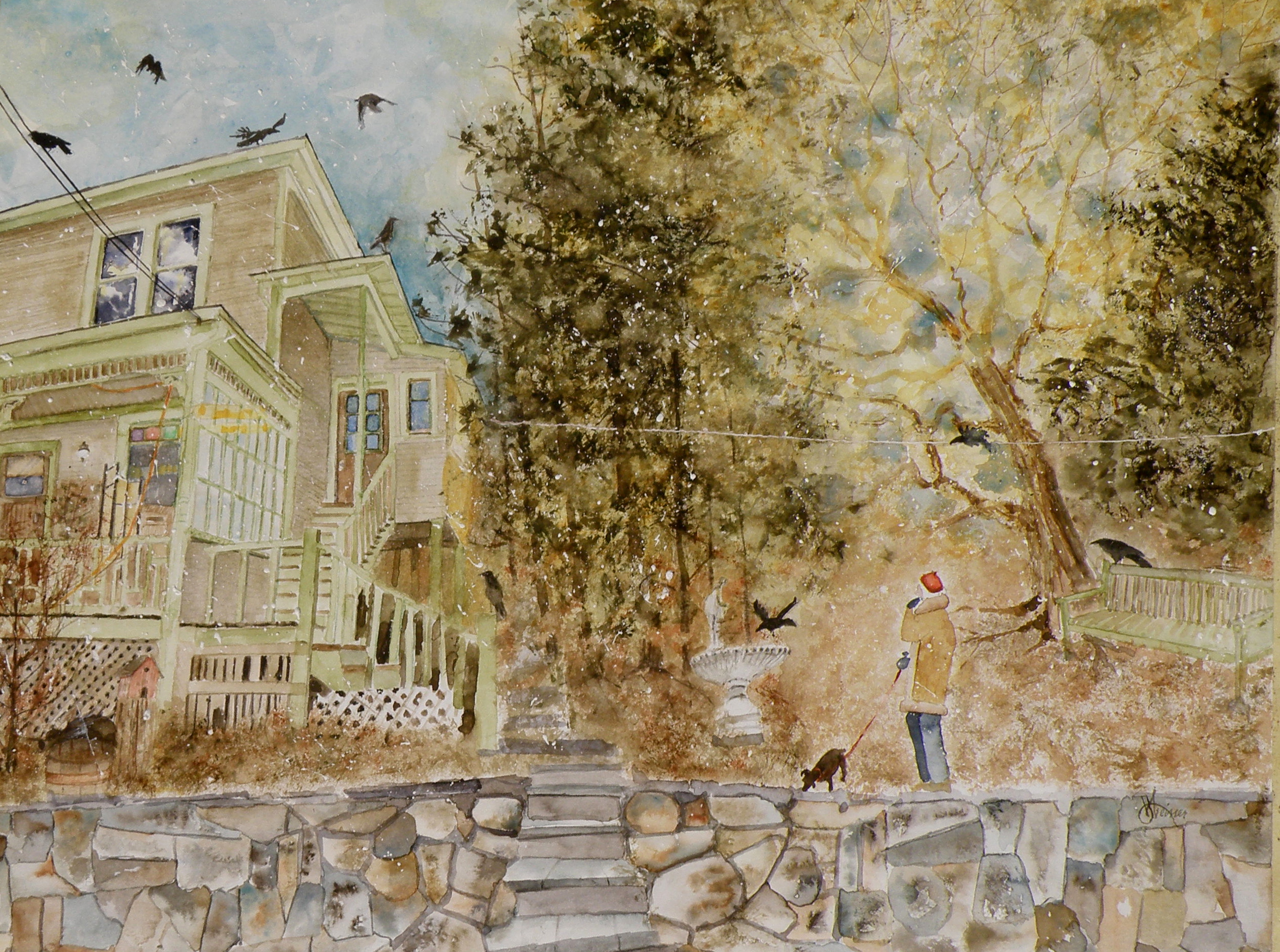
‘Where The Heart Is’
watercolour, 41cm x 50cm (16″ x 20″), 140 lb. Arches Hot Press Paper, J. R. Weisser Collection
THE INTENTION of this rather busy piece of work is simply to allow the viewer entry into Joan’s world. Sometimes our hearts want to be filled–if not by another’s affections, then by the things we’ve grown fond of–and sometimes, not just filled, but rather overflowing with so much that we’ve come to take heart in, that its accumulated presence brings with it a comfort.
A CONSTABLE OF RAVENS watches over and protects and guards the fading beauty of Seasons gone by, loves had and interred, and a lasting, loving sanctuary of the heart–as yet another Autumn invites one inside to sit by the fire and grow warm, and remember.
The Common Raven (corvus corax)
April 21, 2015
THE COMMON RAVEN is amply represented in British Columbia and enjoys the distinction of co-existing with people for thousands of years, to the point where–in Haida Nation tradition–the Raven has god-like qualities. It was the Raven which released the Sun from its little box–made the stars and moon–and even brought people out of the earth in order to populate a party being thrown. But in traditional stories Raven doesn’t actually create (make things out of nothing), so much as steal, exchange, rearrange and redistribute and generally push things around into new combinations. If that isn’t humanlike, I don’t know what is, lol.

“Spring Thaw”
watercolour on art board, 20 cm x 28 cm (8″ x 11″), sold
In Kamloops it is against the law to feed them, as well as crows. A buyer of my work named Joan pours bags of cat kibble into her elaborate and large cement bird baths in the Winter and revels in their continuous, noisy presence. The neighbours? not so much. When they report her, she just pays the fine and keeps at it.
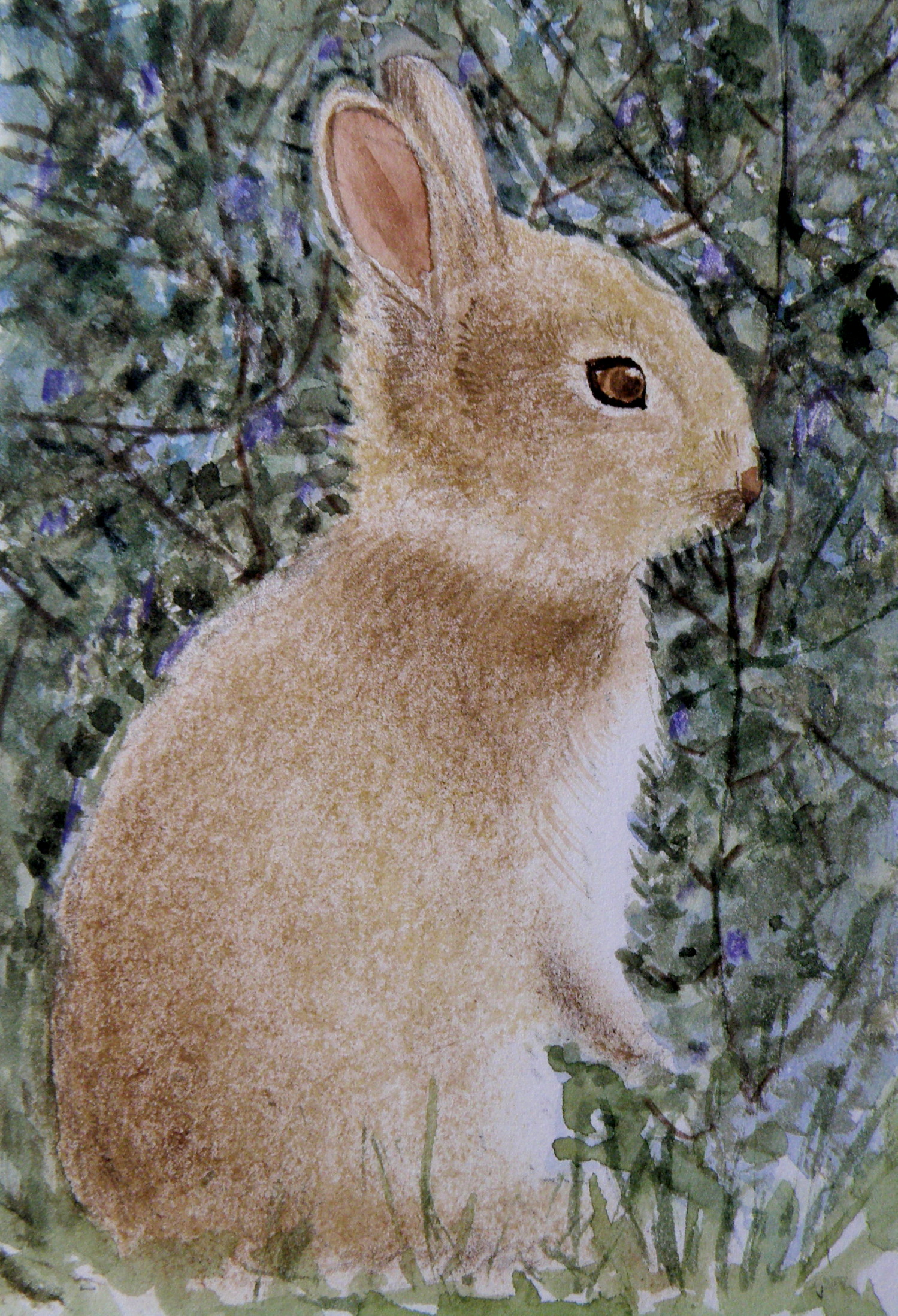
Spring means….bunnies
April 17, 2015
Finished work….”Logged-In”
April 16, 2015
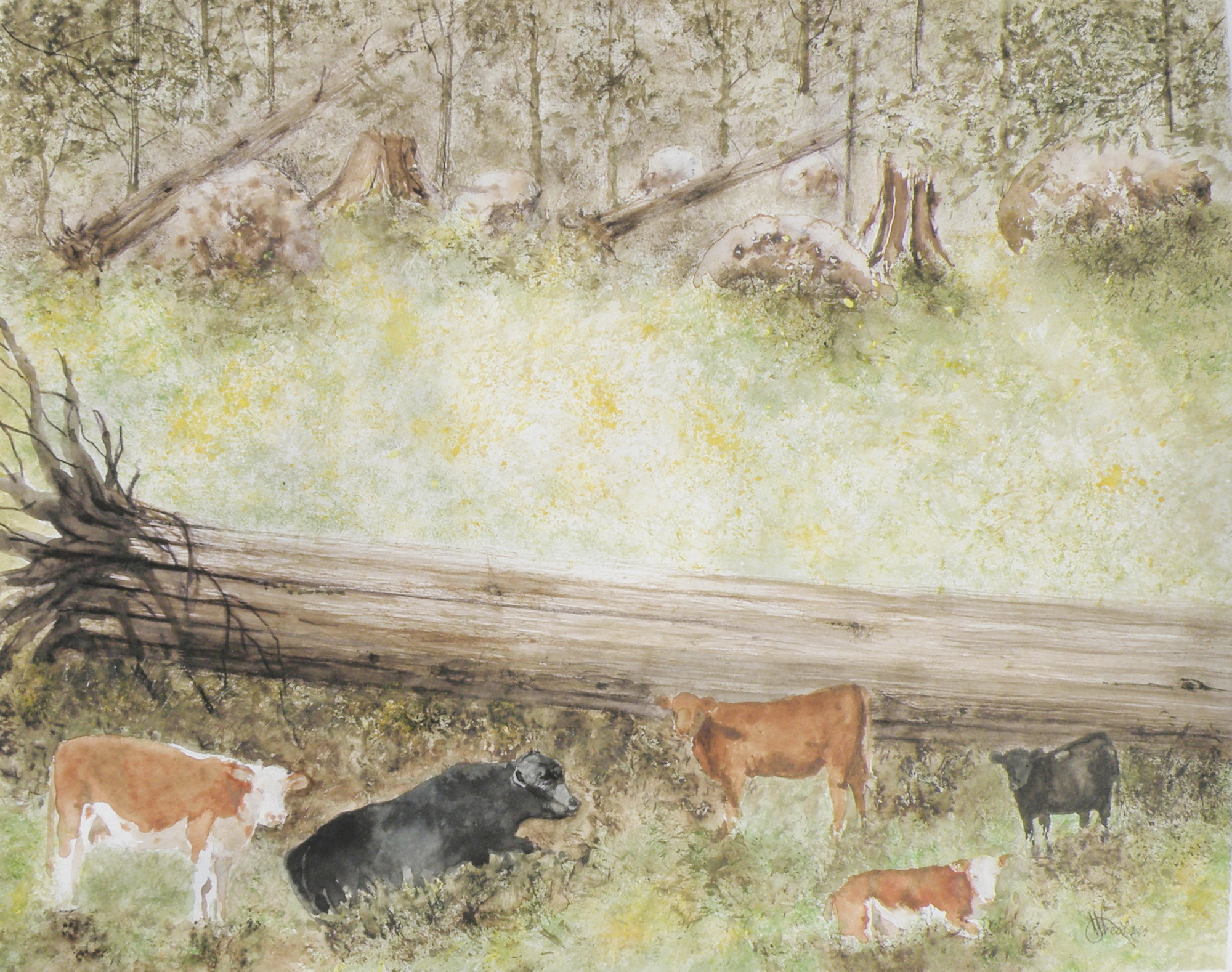
“Logged-In”, 25.5 cm x 35.5 cm (10″ x 14″), Watercolour on Arches 140 lb Hot Press paper, (donated to Kamloops Art Gallery Annual Art Auction)
painting progression 4 . . . “Cows”
April 15, 2015
THESE ARE BEEF COWS, Herefords, the breed most favoured by ranchers in our region. Their origins descend from small red cattle introduced by The Romans in ancient Britain, along with breeds from old Wales, their subsequent nurtured evolution taking place in Herefordshire where the Hereford is king. Today more than five million pedigree Hereford cattle exist in over 50 countries.

BECAUSE THE LARGE FALLEN CEDAR is indicated with only a minimum of brushwork it is necessary to help give it size, weight and substance through the simple use of shadow.
painting progression 3 . . . . “Cows”
April 14, 2015
THE SUBJECT MATTER comes from this photo, very quickly taken when we’d stopped the car on the dirt road running through The Dewdrop Valley (just outside the city limits of Kamloops) after I’d yelled, ‘Cows!’
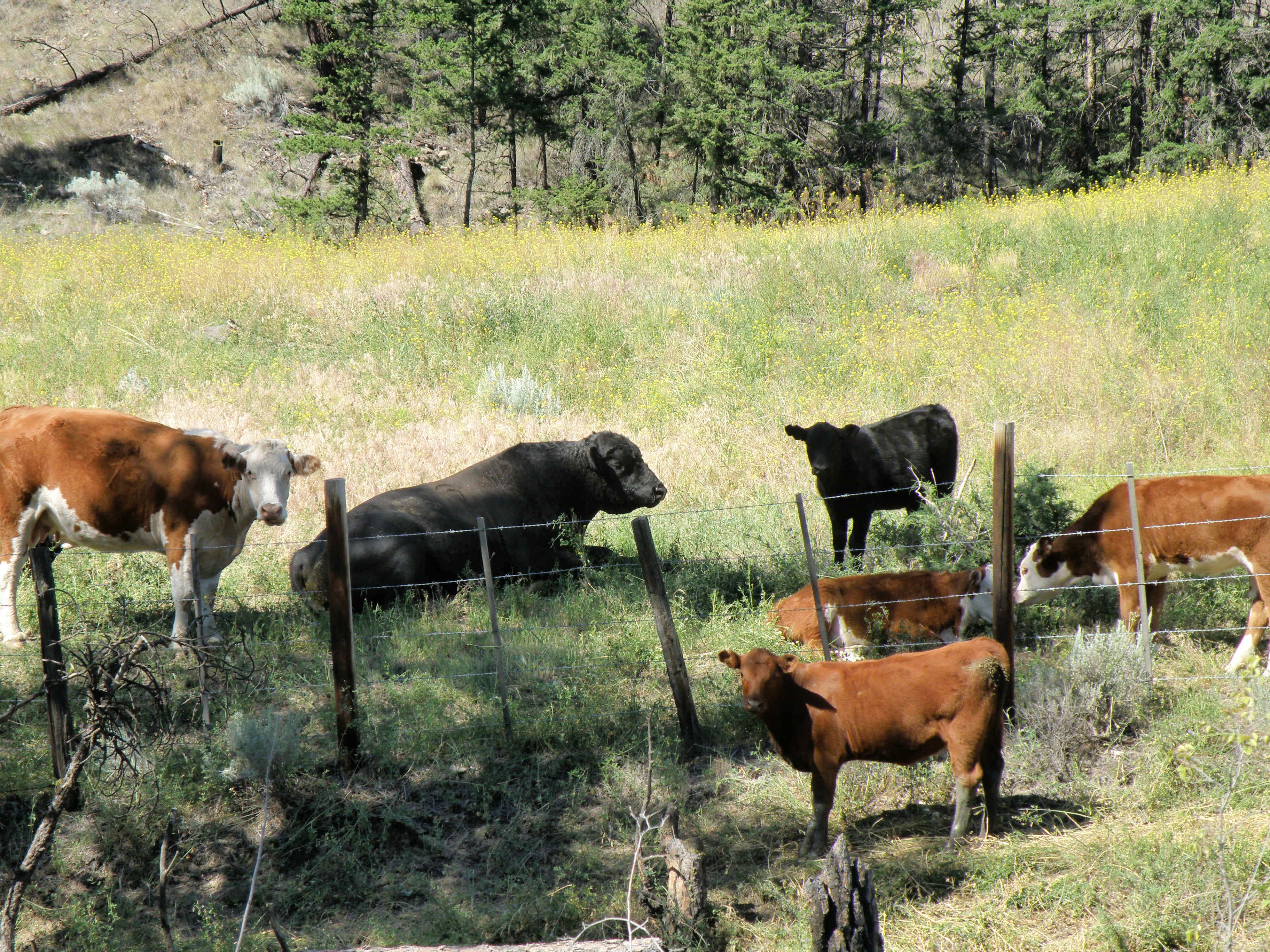
This grouping was described to me by my friend Max as a perfect example of a bull and his harem–and the ‘harem’ got nervous and didn’t remain in place very long once I began snapping pictures. The bull couldn’t have cared less what I was up to, and just lay there chewing.
The very prominent tree in the painting is placed to provide focus. Rather than leave in the barbed wire fence (in front of them), a natural enclosure is placed behind to sneak a storyline into the scene (the best grass lies out of reach)—that, and taking out the wire fence gives a more natural feel to the setting.
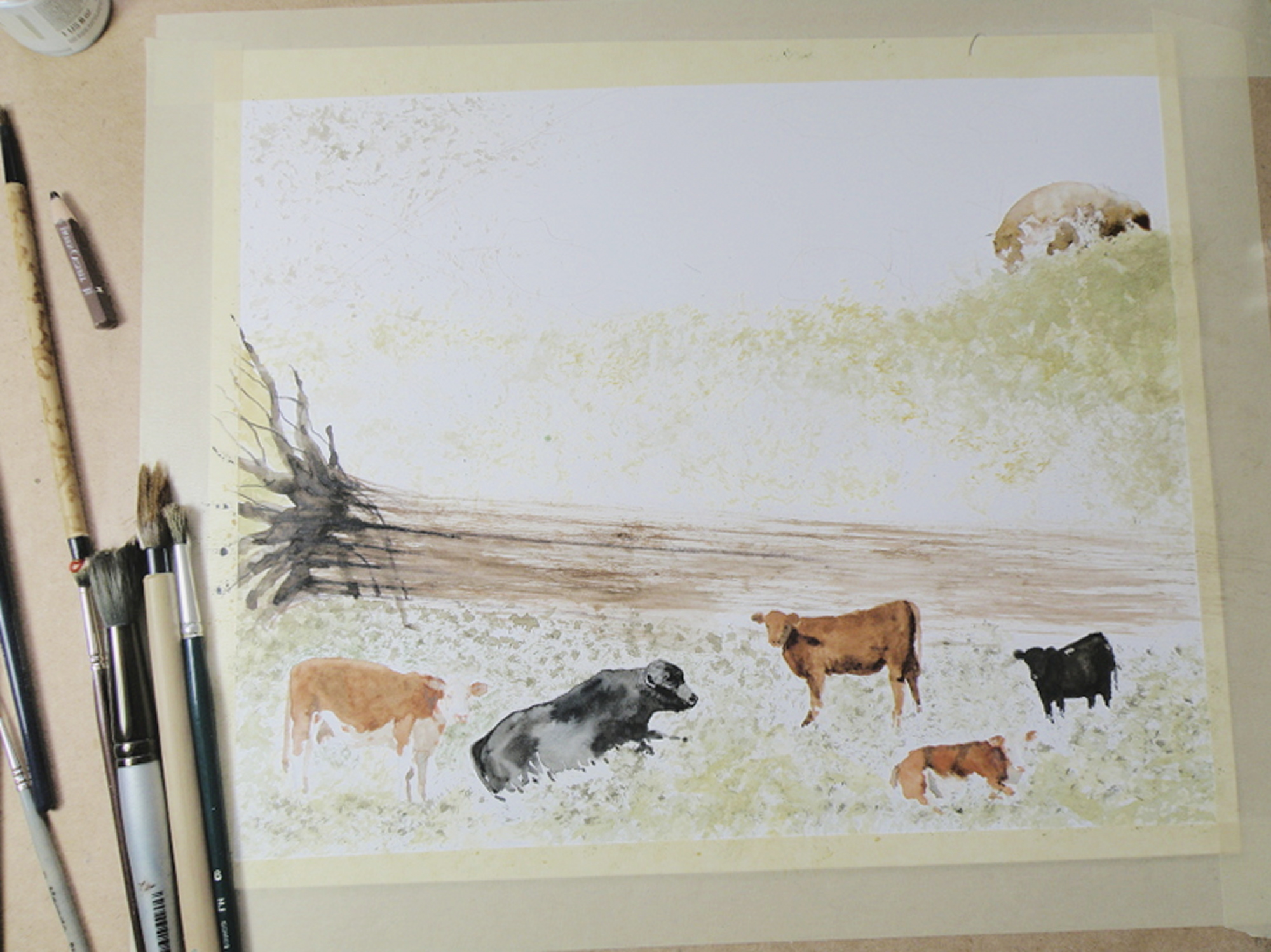
IN THIS GRASS RICH region, cattle roam all over boulder-strewn and mountainous terrain throughout the Spring and Summer. They are finally rounded up on horseback in classic cowboy style in the Autumn. Because of this, the beef from Kamloops is renowned for its organic, grass fed superior flavour and quality.
painting progression . . . 2 “Cows”
April 13, 2015
THE PAPER IN USE HERE is a very smooth-surfaced one called Hot Press (140 lb.) by the French Company, Arches (a very old watercolour paper maker). Hot Press paper has virtually no surface texture at all and is slightly cream-toned. When papers are this smooth, the paint initially floats on top before being absorbed. This floating quality creates effects a rough surfaced paper can’t deliver.

So Hot Press paper looks and feels pretty much like dollar store poster paper–smooth, shiny, and about the same thickness. And because it is not a heavy paper, and because it is so smooth, Hot Press watercolour paper cannot take a lot of scrubbing out if mistakes are made. The painter needs to be rather confident about the strength and amount of pigment to use before putting brush to paper. So because I am always a bit tentative when beginning to paint something as challenging as an animal, I gain confidence by always having a scrap piece of watercolour paper handy to try things out on first. Once I see how to do it on a scrap piece of paper, then I have confidence to do the same thing on the painting itself.
It needs to be stressed that Arches paper is superb and bears absolutely no comparison to poster paper when paint is applied to it. The weight (140 lb) is how thick the paper is. 300 lb. paper is very thick and therefore can take a lot more scrubbing and multiple washes, without losing luminosity. The downside is that 300 lb. watercolour paper is quite a bit more expensive. And when I work on very expensive paper, I am too aware of its cost. That makes me somewhat nervous about possibly ruining the painting. So I usually choose 140 lb. paper because if it gets ruined, I am not that concerned, and so therefore approach the painting with more boldness which gives a better result.
Painting progression 1. . . ‘Cows’
April 11, 2015
THE DEWDROP VALLEY is a local site and part of a much larger area near Tranquille River and the Tranquille River Gorge. In essence, the Dewdrop is really rocky, hilly, grass-and-tree- covered pasture for cows and cattle during the Spring and Summer months. The Kamloops Thompson Nicola Shuswap Region is no-nonsense cowboy rancher country, complete with serious Rodeos and horse and rider cattle round-ups in the Autumn.
This is the first of recording daily progress towards completing a watercolour depicting a typical scene in The Dewdrop Valley . . . .
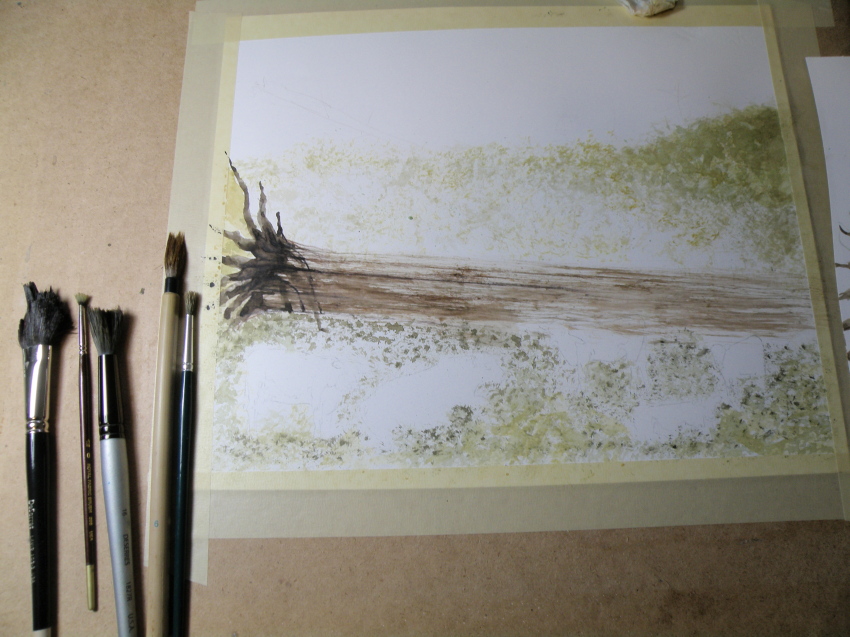
ON DISPLAY are a fine collection of tortured brushes. Some are from dollar stores or second hand bargain stores, and as soon as they get into the spare bedroom cum studio they’re cut up with scissors. None of them cost more than $2, and who knows what they’re made of–Moose? Sasquatch hair, perhaps. Each, however, is priceless.
Miniatures: Chipmunk
April 10, 2015
AS CHILDREN we always gravitated towards Chipmunks, squatting in total stillness with extended hands, hoping one would overcome its natural wariness and take the peanut being offered. The sprightly flicks of tail and peppy darts forward to snatch the gift–so quickly and deftly we didn’t see or feel it leave our palm–only added more charm to their compact, large-eyed, tiny bodied allure. On the other hand, the Grey Squirrel was just a nuisance. I guess size and colour made all the difference in our juvenile minds between one rodent’s mystique and another’s ho-hum plainness. We didn’t entice Squirrels. We threw sticks at them. Their raiding our bird feeders didn’t win them any points, either, I must say….
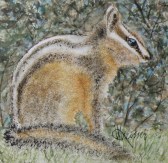
watercolour, 10cm x 10cm (4″ x 4″), art board
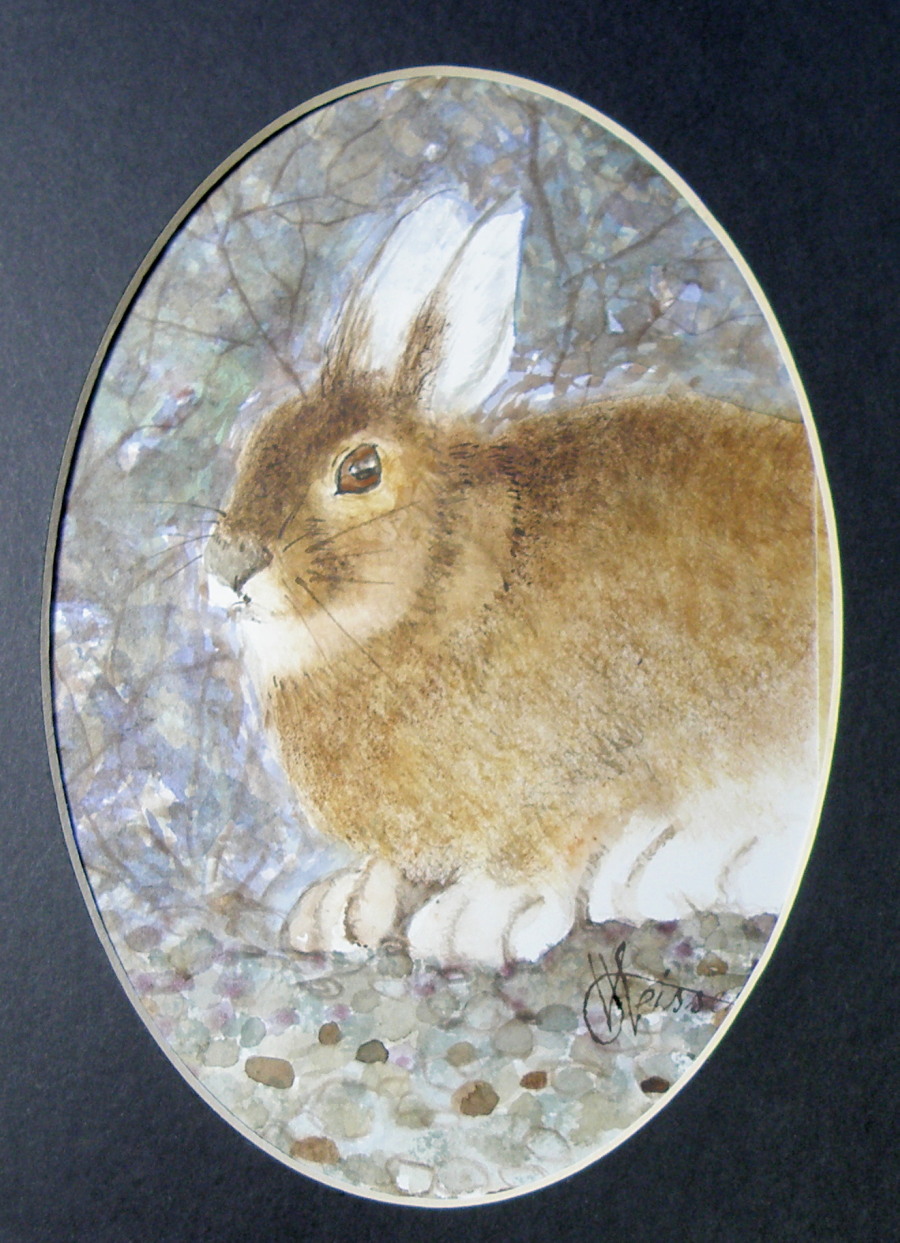
Arctic Hare
March 11, 2015
 weisserwatercolours