Mount Peter
January 21, 2012
To look up the face of Mount Peter– (the sibling of the larger Mount Paul), the signature mountains overlooking our city of Kamloops, B. C.–is to look upon the core of a mountain. These are mountains so ancient, all that remains are the inner cores–their souls. Time and erosion have scarred and left them displaying a beauty it takes the eye a while to appreciate.
The roads about their base feature yellow diamond warning signs cautioning drivers to watch for Big Horn Sheep.
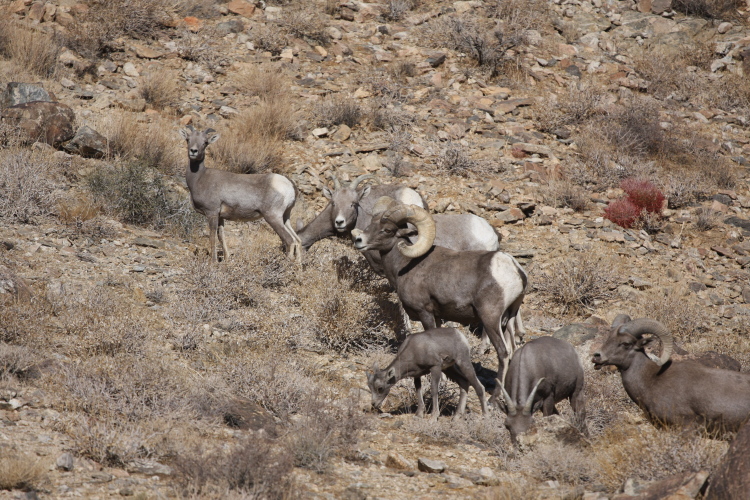
Big Horn Sheep (courtesy Wikimedia)
As a watercolourist, it took me a good two years before I attempted the challenge. They are unusual subjects, and not easily rendered. It was wise for me to wait, simply because I was so accustomed to the forested peaks of the Coastal Mountains that I regarded these as ugly. Until they finally become beautiful to the newly-arrived, these ancient and weather worn heights are probably best not attempted at all by art enthusiasts like me.

'Peter's Face'
Schoolhouse Dreams
January 21, 2012
My mother taught one room school in Rosetown, Saskatchewan, in the ’30s. There was such an age difference between herself and her sister that my Aunt ended up being her student. When my mother had no choice but to keep her after school for talking back, that was the beginning of a lifelong distance between them. They got along–don’t get me wrong–but they weren’t ever the best of friends.
The notion of a one room school has always been appealing to me, personally. I would have bloomed in such a setting, and benefited from having both older and younger learning their lessons in the same room at the same time–(though probably not if the teacher had been my mother).
This painting, entitled ‘Schoolhouse Memories’ is based on a dream I had not long ago, of heading towards a building like this, in a setting like this, on a warm day at dawn, yet never reaching the front door.
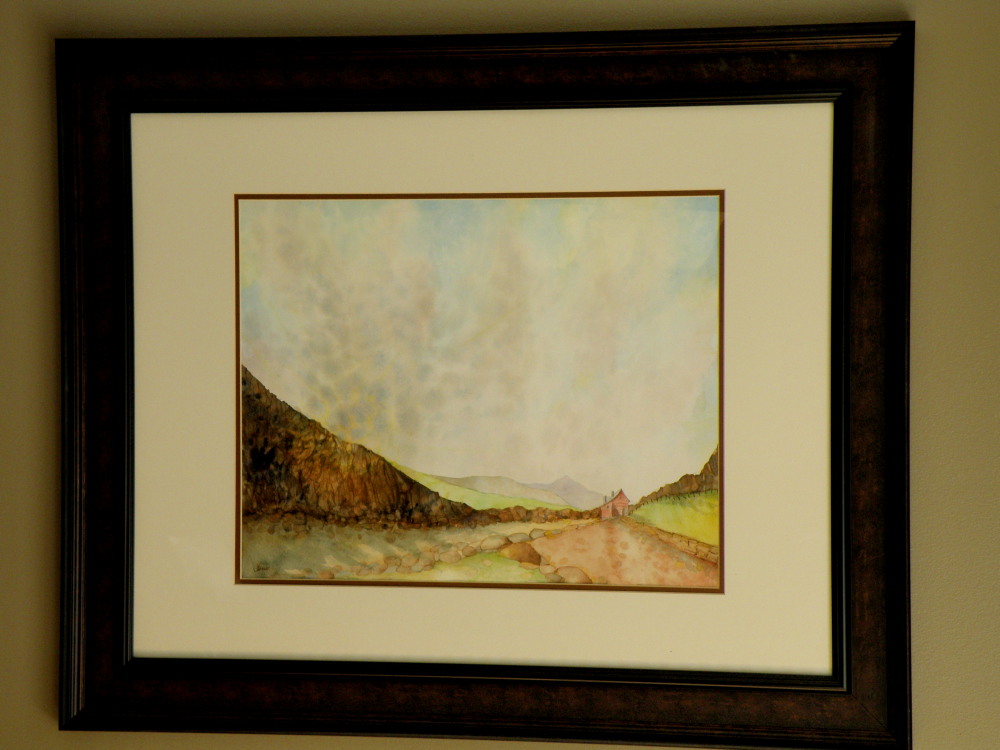
It was in the Federation of Canadian Artists’ Open Show in April of 2010.
Paint-off Challenge
January 20, 2012
A few years back I belonged to The Artists’ Studio, and the twenty of us each submitted a favourite photo which we thought would make for a good painting. Those twenty photos were then subjected to a voting process whereby a single photo would end up becoming the subject which all twenty of us would base a painting on.
So–one photo–twenty artists–twenty different paintings based on the same photo. And the winning photo was taken by a Member of The Artists’ Studio of The Icicle River in Levenworth, Washington, U. S. A.
-
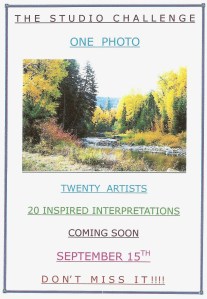 studio challenge poster

And here then, is both the photo and my treatment of it . . . (but I addded a couple of hikers and a little dog just for interest) . . .

- photo and framed watercolour

Third Beach
January 19, 2012
Ten percent larger than New York’s Central Park, is Vancouver’s Stanley Park–1001 acres of enormous cedars, Totems, hidden pathways, creeks, ponds, ocean views, as well an amphitheatre and The Vancouver Aquarium. It was named after Lord Stanley, the Governor General of Canada in 1888 (and also the person who donated the famous Stanley Cup for the emerging hockey teams of the day to compete for). Lord Stanley became the first Governor General to visit British Columbia when the Park was being dedicated.
This painting was done on location within the Park while sitting on one of the many available sand-encased logs. The spot is known simply as Third Beach, and looks out towards a very distant (not always visible–and not in this painting) Vancouver Island.
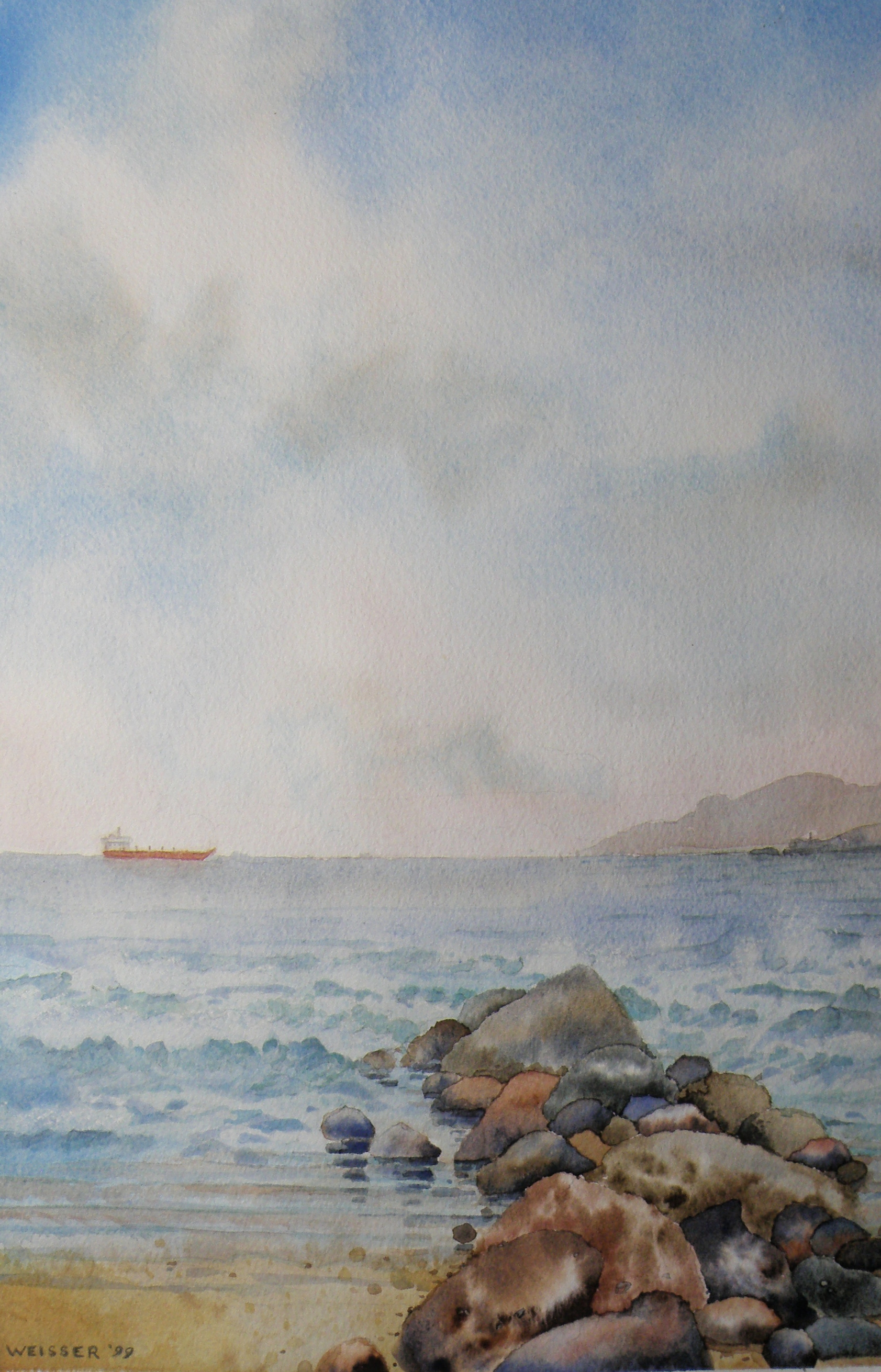
'Third Beach, Vancouver'
It took most of the day, and while there a baby seal washed up on shore. Being tied down to all my spread-out gear, I called out to those closest. Mobile phones weren’t as prevalent then as now, and it took the gathering crowd quite a while before attendants from The Vancouver Aquarium came to rescue the little guy. They have an adoption program which results in a release later on after the animals have matured.
Great Nephew II
January 17, 2012
About the scariest thing in my younger days was our basement, which featured a gigantic coal-fed furnace complete with horrifying facial qualities. The grill was its mouth, and I went down there only to fling my soggy snowsuit over one of its tentacle arms in order to then put on a freshly-dried suit. Once done, I’d try not to peek at the flames licking at the hideous mouth as I raced back out into the snowball fight du jour.
Tied for second in the scary department was the black-and-white-filmed 1951 classic “A Christmas Carol” starring Alistair Sim, (whose facial qualities were probably borrowed by the designer of the furnace grill). It was back then a relatively new movie and always gave me recurring nightmares.
I happened to be taking a few snapshots when the older of my two Great Nephews was watching that very same 1951 “A Christmas Carol’ in 2006. Up till then he wasn’t allowed to see it (which restriction I wish my own parents had imposed on me), so this was his very first glimpse at Jacob Marley screaming his way through Scrooge’s bed chamber walls.

'Marley's Ghost Makes an Appearance'
His Aunt and Uncle are obviously ‘Christmas Carol’ vets, regarding the shrieking spirit as ‘just an undigested bit of beef’.
This painting was juried into one of The Federation of Canadian Artists’ Open Shows a couple of years ago. The words ‘Open Show’ indicates that the show is open to all qualifying artists across Canada.
Great Nephew
January 16, 2012
One of my great nephews, at three years old, was particularly creative. You didn’t want to be assuming anything past 5:00 a.m., when a peaceful house usually meant he was in the scrap-booking room or the pantry; and there were things going on involving lipstick and cats, or crayons and clothes dryers. This particular watercolour was done on Arches 140 lb Hot Press paper. It is intentionally given a light treatment because the day was such that the sun was near to dazzlingly intense.
Here’s a random moment between takes when he’s on the loose at his brother’s birthday party. His sapphire eyes are looking around at what might next need destroying before it’s even been unwrapped.
He’s one of the most delightful children I’ve ever known–but I was very happy to have been only the Great Uncle (and not the parent) when he was three.
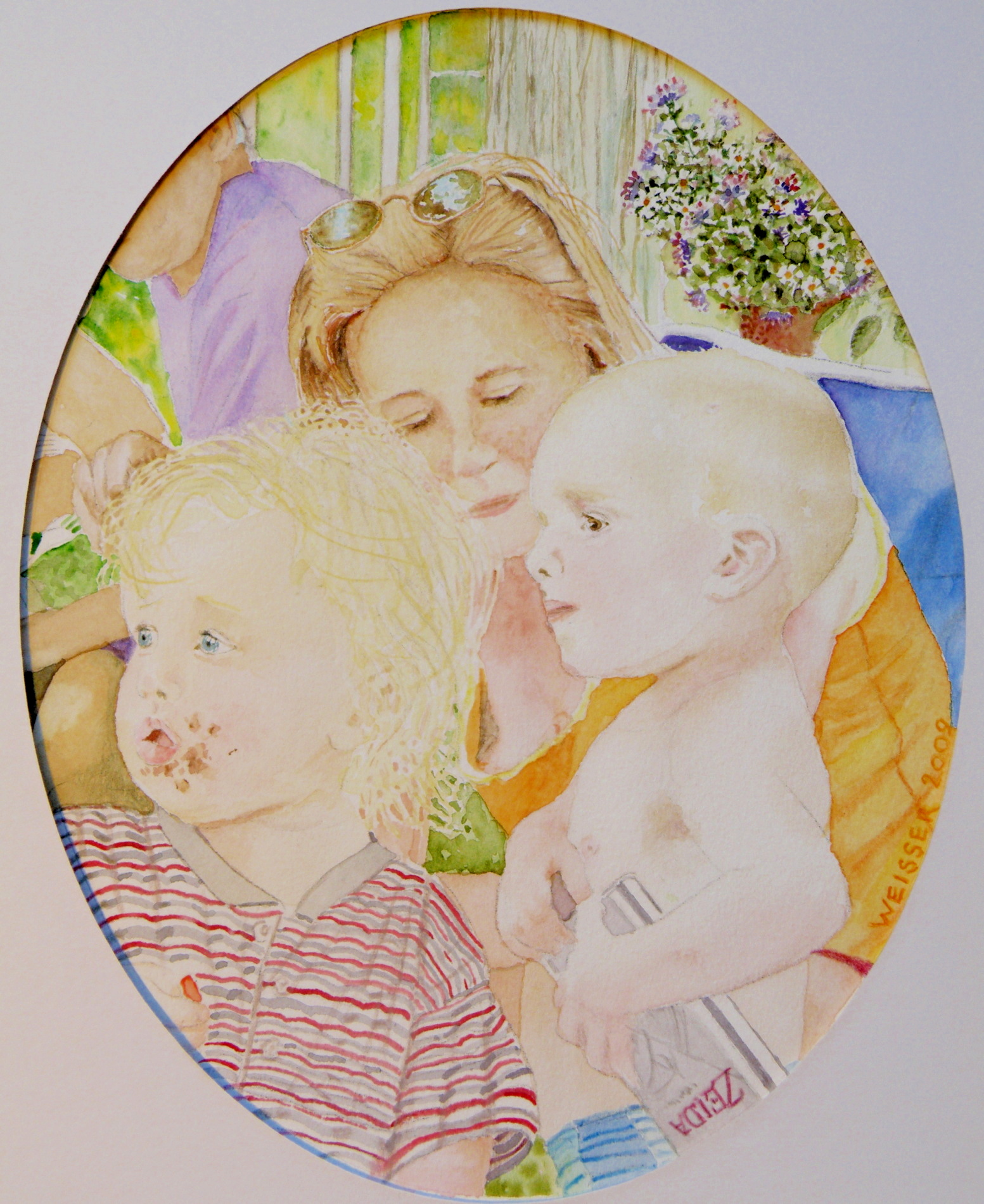
"After the Cake"
North American Robin (Turdus migratorius)
January 15, 2012
Pushing my cart into the supermarket yesterday I almost ran someone over. I’d jerked my head around to make sure I was seeing correctly–there in the middle of the aisle was a big fat display of this year’s new vegetable and flower seeds!
I mean to tell you, it is -10C, and snowing out there right now like it’s just going to keep on all night, and they want me to start planting seeds?
So okay–in the spirit of all that, raise your glass. Here’s to a touch of Spring . . .

"Juvenile North American Robin"
Hot
January 12, 2012
When we moved to Kamloops from Vancouver, we weren’t really prepared for the heat. Being a coastal city, Vancouver rarely sees temperatures over the high 20’s. Kamloops on the other hand, is in the South West Interior and is arid and hot — very hot. Summer temperatures can crest 45C, which is hot for Canada.
There’s sagebrush and Ponderosa Pines and cacti and lots of barren, weather-worn rock. The painting below was done in a location called Silt Bluffs which are full of character and stand above the North Thompson River. This scene is only about ten minutes away from downtown.

'Silt Bluffs on Shuswap Road'
Bulacan Backyard
January 12, 2012
In 2003 I visited The Philippines after meeting the person online who would turn out to be my partner and husband. This part of the country is just outside Manila in the Province of Bulacan (the word ‘bulak’ means cotton, which there was quite a bit of when King Philip of Spain took over the islands in the 16th century). The little barangay (community) of San Jose is part of the larger municipality called Plaridel.
In the yard of the family I was staying with in San Jose were all kinds of trees and plants. This was to be the first of three visits I made over three years until I brought my partner to Canada in 2007. He is now an LPN in a geriatric facility here in Kamloops, and a Canadian citizen, and has come to love our -20C winters and +40C summers. We were married by my Pastor sister in 2008 in Clearwater, B. C., at a beautiful resort there.
This painting was done while sitting on the porch, and reminds me of that first, personally-momentous visit over eight years ago . . .

'Bulacan Backyard'
Sunshine Coast
January 11, 2012
Taking the 40 minute ferry from Vancouver one reaches Gibson’s Landing, the beginning of the 85 km. stretch known by British Columbians as The Sunshine Coast. The road leads North towards Alaska, but ends at Powell River–the furthest major city on the coast–and visitors simply have to either turn around and come back, or decide to permanently stay.
This watercolour was painted on location on a section of the Sunshine Coast near the town of Sechelt. The wind was blowing across the Pacific, creating large breakers and bringing in a bank of fog which made it difficult to dry my paper enough to keep going.

"Breakers"
Dr. M. S. Wade House, c.1905
January 10, 2012
Kamloops, British Columbia, is privileged to have an area within walking distance of the downtown core that features many historic and stately homes. These Heritage Houses were built around the turn of the 20th Century when Kamloops was still a relatively new Incoporated Municipality (1893).
This particular home is known as the Dr. Mark S. Wade House, built in 1905 by the Eye, Ear and Throat Specialist who came to Kamloops in 1895 from Victoria, B. C. It is located at 95 St. Paul Street West, a street known for its Victorian houses, many featuring a prominent veranda. Because Kamloops can get significantly hot in the summer, the front porches still provide a welcome respite from the heat of the day.

'59 St. Paul West'
High Country
January 9, 2012
Within the Kamloops city limits lies The Lac du Bois Grasslands Protected Area, dedicated to preserving native grasslands and the sweeping vistas of this special region. Old time ranching and a culture of horses and cattle survives.
This is a region of British Columbia with wide open spaces, with sagebrush and cactus and Ponderosa Pines. It’s a land of Eagles, Hawks, Owls and Ospreys. Through it winds the North and South Thompson Rivers and above their winding, watery ribbons is high country.

'High Country"
North of Clearwater
January 9, 2012
The official website of the newly-created (2007) District of Clearwater reads: ” . . . Located in the heart of British Columbia and Wells Gray Country, Clearwater, B.C., is the gateway to Wells Gray Provincial Park and is surrounded by the Trophy Mountains, Raft Peak, Grizzly Peak and Dunn Peak. This rural community is truly a place for all seasons. . . ”
They aren’t bragging. I encourage you to go to ‘www.districtofclearwater.com’ and see the gorgeous photos for yourself.
Kamloops–where I live–is about an hour’s drive South of Clearwater. The Interior of British Columbia is highly mountainous and sudden storms and weather systems are normal when living in higher elevations. One half of the sky can be as blue as sapphire, but just behind me things will be ominous and threatening.
This painting–now in a private collection–attempts to capture the spirit ‘North of Clearwater’ . . .

'North of Clearwater'
Winter
January 8, 2012
It has been quietly thrilling to once again become reaquainted with the four seasons. Vancouver–my city for over twelve years–effectively enjoys a very prolonged Spring and a very prolonged Autumn. Indeed, on rare occasions there are days of snow, and days of oppressive heat, but they remain rare.
Moving to the Interior–specifically to Kamloops–in December of 2007, was a sudden re-introduction into what Winter truly is all about. The day of our move turned into the biggest blizzard I’ve ever experienced, then or since. Driving up the Coquihalla Highway was treacherously risky, its two lanes effectively reduced to a cow path. And from that moment on, I have learned to love all over again the unique characteristics of each of the Four Seasons, for Kamloops is surrounded by a wonderful and distinctly different landscape which has captivated my artistic spirit!
Above all, it is Winter which I’ve come to revel in the most. . . .
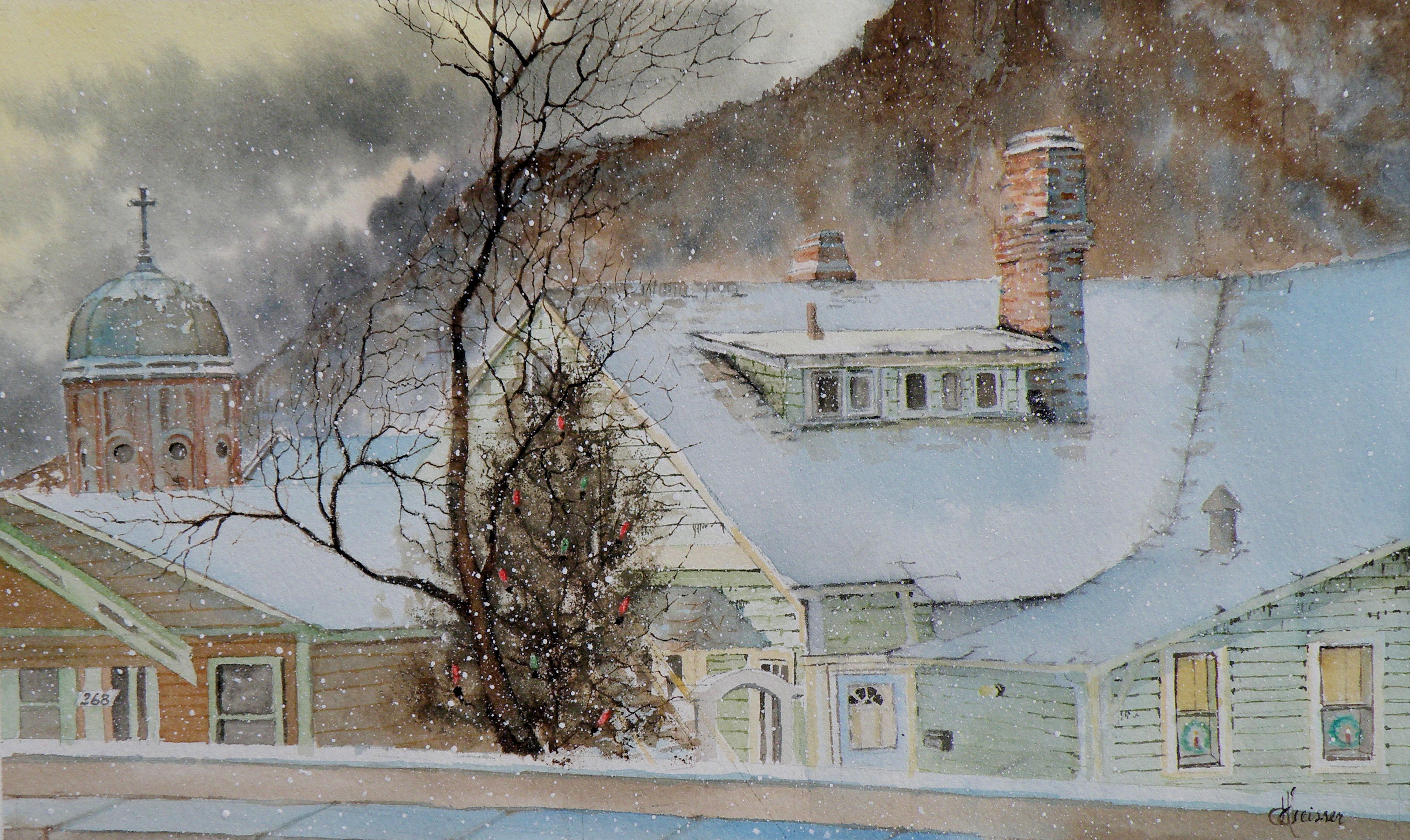
"Columbia Street Noel"
November
January 7, 2012
About the most exciting month is November. Moody, always in flux, caught between Autumn and Winter, November features days that are intriguing to wake up to. I never know if, when glimpsing out the window first thing in the morning, I’m going to see flakes of snow drifting down or one of those assure November skies.
Not far from the town of Clearwater, British Columbia, (about an hour’s drive North) is Wells Gray Provincial Park. One of its most pristine lakes is Mrytle Lake, and I’ve done two watercolours of this same lake.
The first is rendered in a very traditional style, relying on a photograph . . .
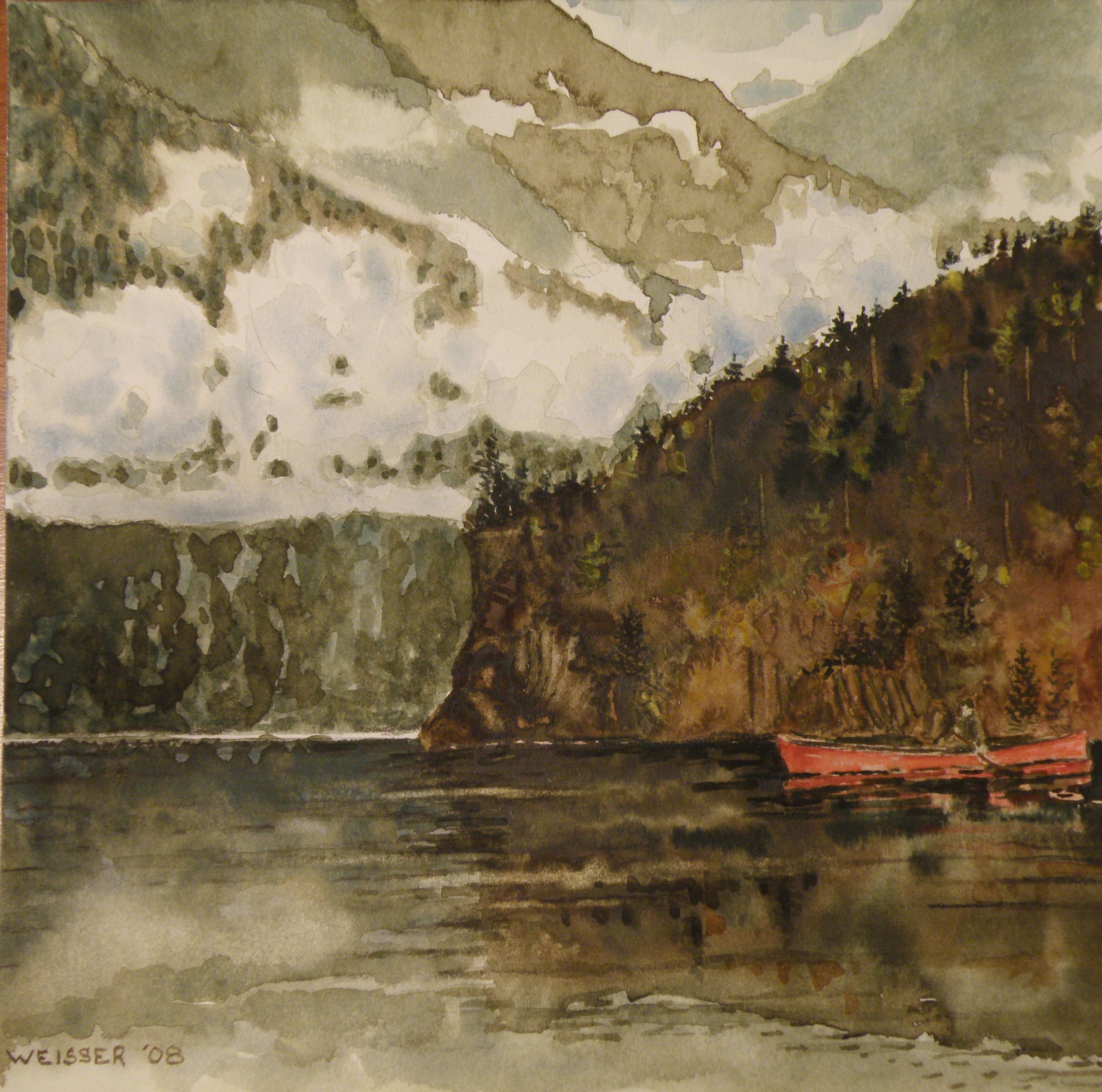
"Wells Gray November"
Another version of the same painting was done from memory, not relying at all on any photographic image. Both paintings are now in private collections.
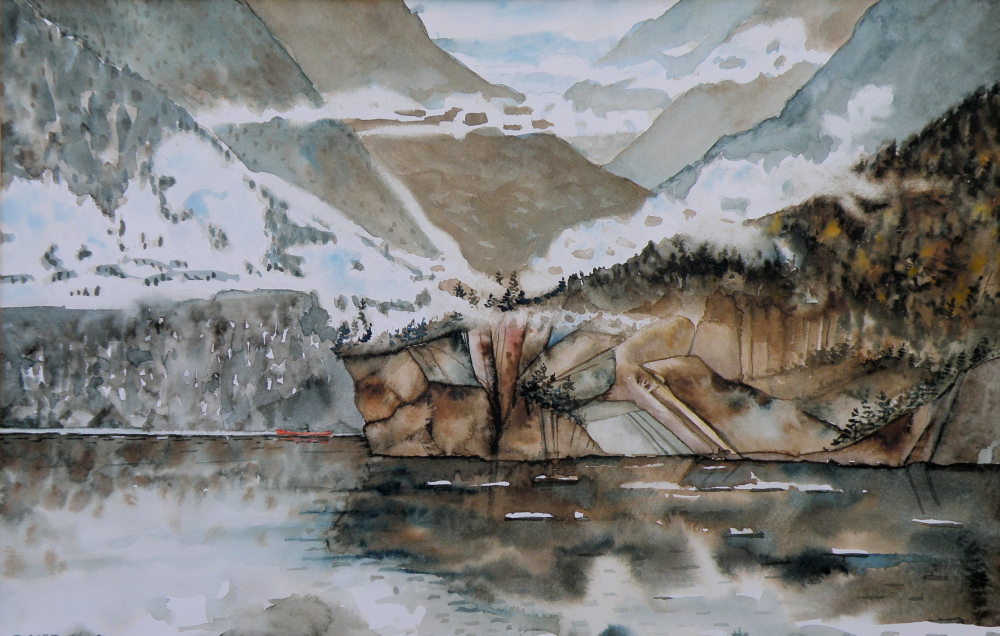
"Wells Gray November"
Autumn
January 5, 2012
Autumn. The very word speaks in tones that touch something deep and still. In my youth it was an invigorating Season, full of piles of leaves we’d shape into forts or rooms. The air would be tinted with a hint of smoke, the chill of it pinking my ear lobes and rouging my cheek. Teachers would begin rehearsing things for Christmas. There was an unspoken wonder over feeling the days shorten, and a little thrill over seeking out a forgotten, yet familiar scarf and hat. Underneath was an anticipation over when the first snowflakes would drift down, hoping it would be during waking hours–and then came the day when the shout of a classmate interrupted a math or geography lesson– “Look! It’s SNOWING!” , followed by a crush of bodies as we pressed against the windows, marvelling, wishing it would just keep going until there was nothing for it but to hunt in the attic for our sleds.
And now? I’m in the Autumn of my life. Who knows, but maybe even the Winter. The Season is now pensive, thoughtful. There’s a contemplative quality watching the last of our Red Maple’s orange hands let go and join the others. One thinks of endings more than beginnings–pasts more than futures. But the sweetness if anything, is made the more complex–like a well-mulled cider–for Autumn is made for memories– for kicking through the remains of the Summer and recalling Seasons long gone, while hoping for one or two more . . .
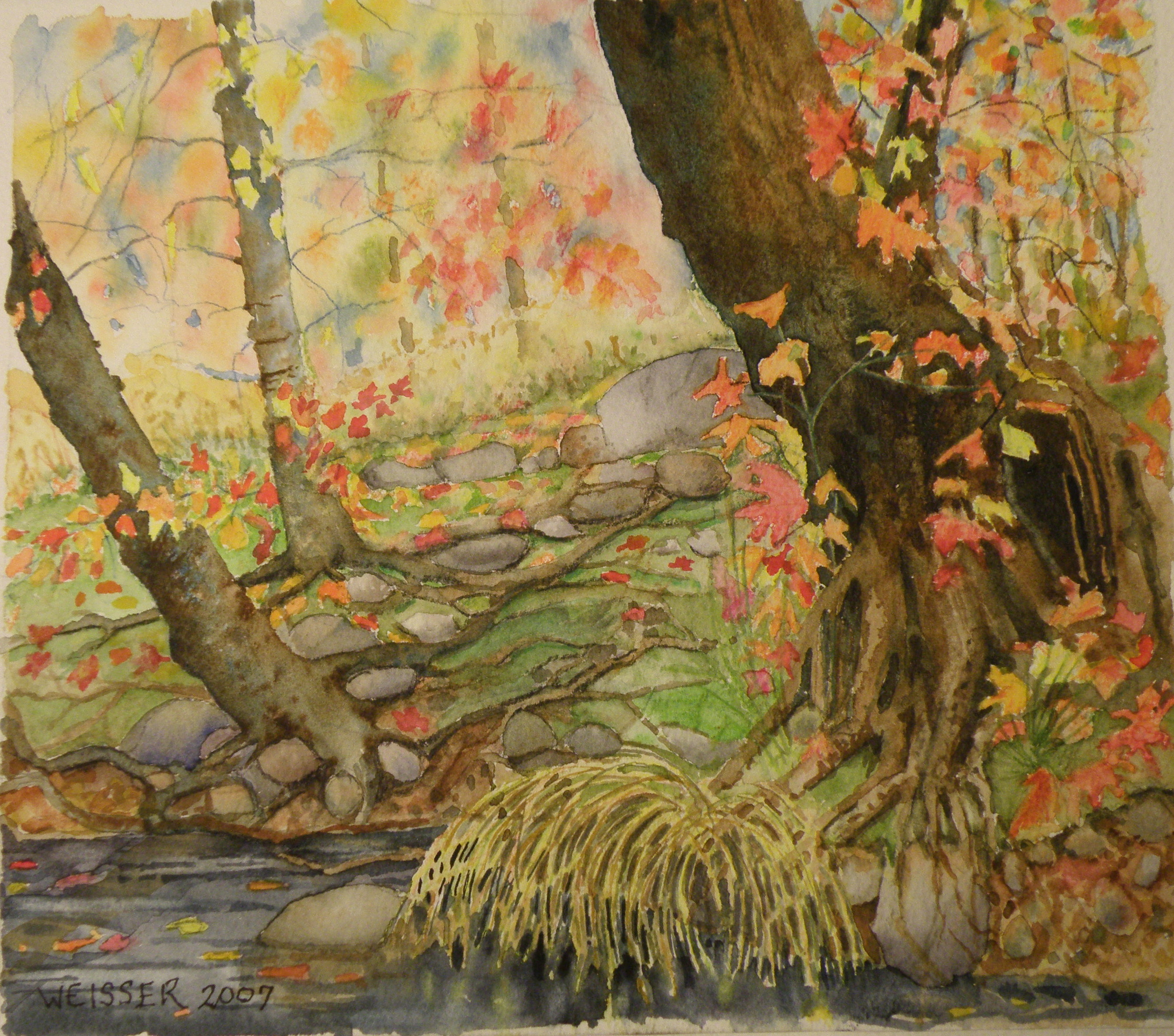
"Autumn Wood"
Miniature Watercolours
January 4, 2012
I usually spend my painting days alternating between very large watercolours and tiny, intimate pieces. The miniatures sell exceedingly well, for after all, even if collectors truly can’t fit yet another painting on their walls, there’s always room for a wee one on a table, desk or mantle.
It’s birds which often become my subject of choice because many species are small and lend themselves well to the petite oval frame, or tastefully-tiny square. It’s such a joy depicting the finches and juncos I glimpse just beyond our living room window, attacking the feeders, nudging each other aside in order to get at the goodies.

"a gathering of miniatures"
Here’s a close-up of a landscape based on our British Columbian, mountain-surrounded Interior:
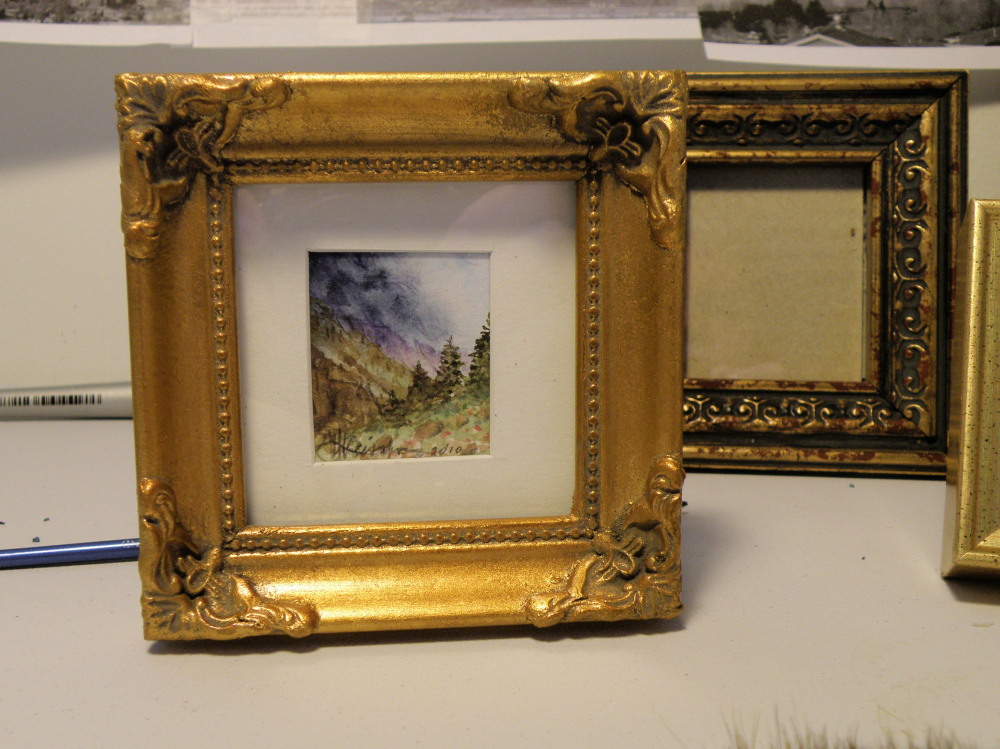
'A 1" x 2" Kamloops Alpine View'
A bit of New York
January 4, 2012
I was raised in Rochester, New York, and then later on the New York / Vermont border. At some point we had occasion to visit the town of Saranac Lake, New York, which hosted the 1980 Winter Olympics and much earlier in its history was one of North America’s best known tuberculosis sanatorium locales. Patients went there to receive plenty of sunshine and fresh air.
Kamloops, British Columbia, my present home, was also chosen as a prime location for a TB sanatorium and it was located just outside the city limits at Tranquille, B. C., beside Kamloops Lake. The air here is dry, without even a hint of humidity in the Summer and bracingly-cold in the Winter.
I loved staying in Saranac Lake that one week in January. The lake itself was completely frozen over, with a fresh layer of snow and a blindingly-bright sun.

'A Frosty Saranac Lake, Saranac Lake, New York, c1989'
Egg Art
January 4, 2012
I first experimented with painting eggs in the late ’70’s by using the Ukrainian method of alternating vegetable dyes with finely applied bees wax. Not a great fan of geometric patterns, my goal was to take the same technique and compose actual scenes. I produced a series of Christmas tree egg ornaments of villages in the snow and moonlit landscapes until I discovered how well eggs received watercolour. Since then I have confined my efforts to the use of watercolours on blown eggs.
By far the best eggs for watercolour are duck eggs. The surface is creamy white and satiny, and the eggs themselves can be very large indeed. Goose eggs are even larger, but not quite as lovely to paint on. My least favourite surface is a chicken egg due to its chalky white quality.
Here are some examples of egg watercolour art:
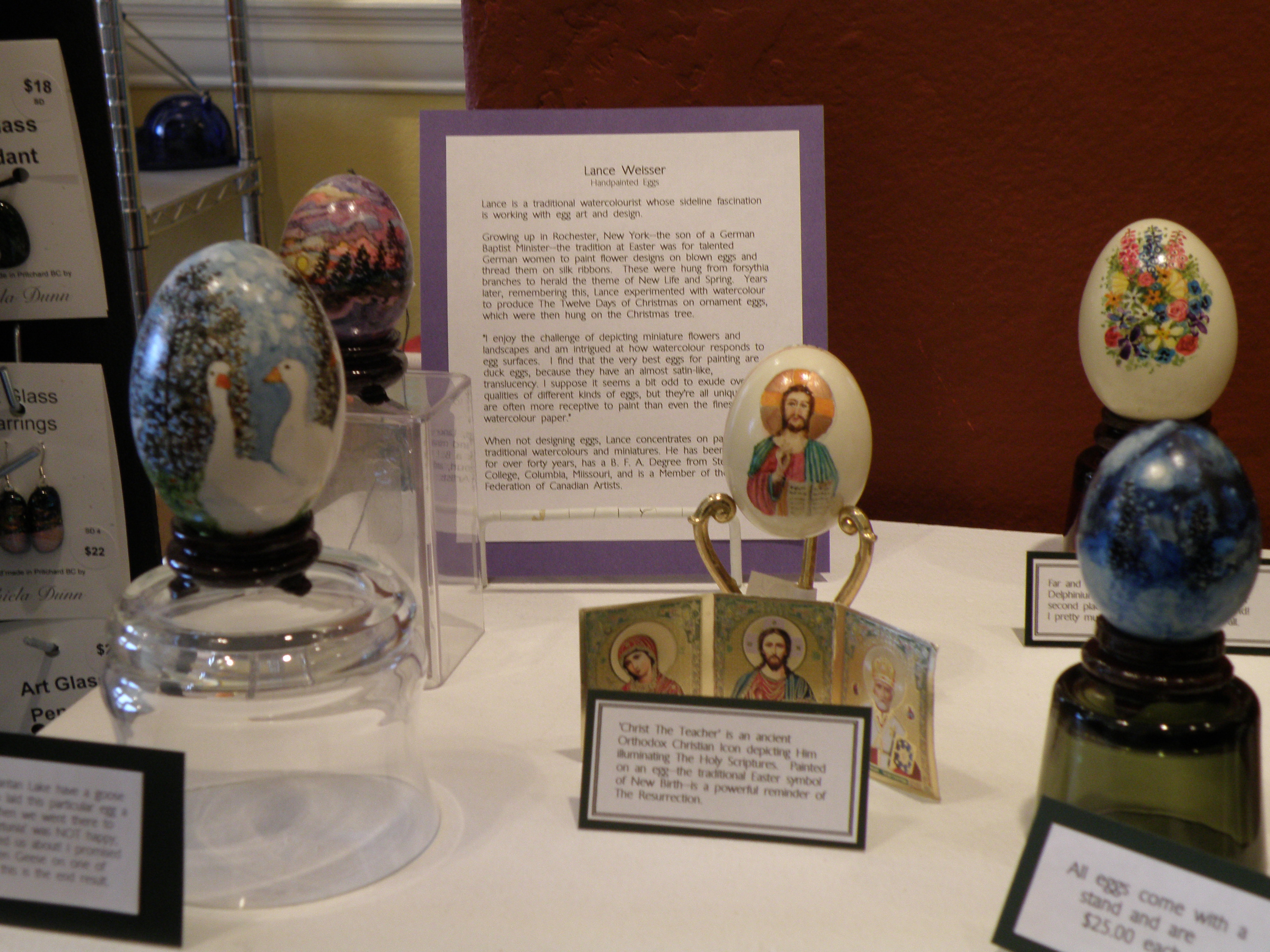
Hand-painted egg display
This egg was painted as a Christmas Tree ornament, depicting one of the Twelve Days of Christmas:
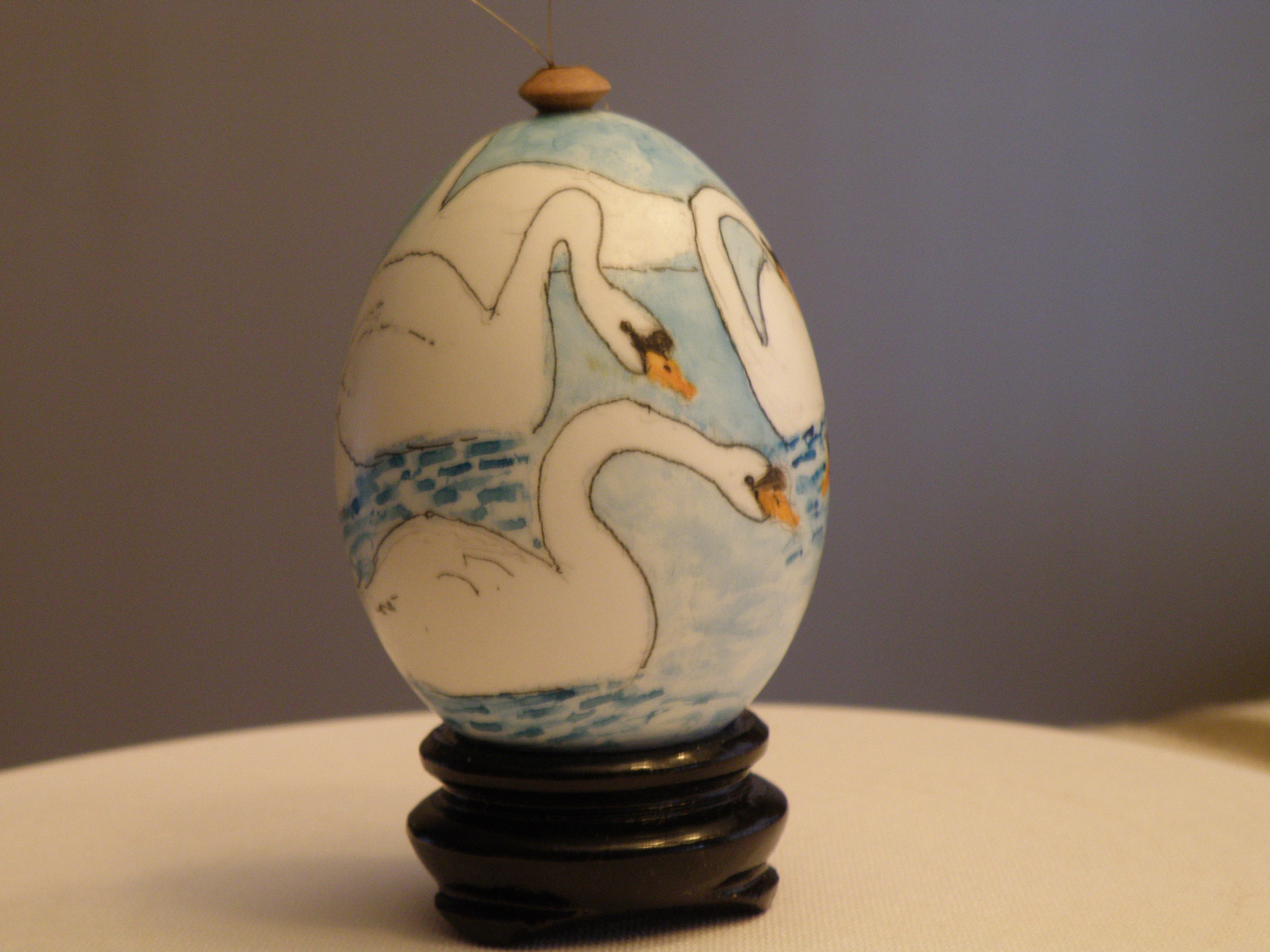
Christmas Tree Ornament Egg
One Room School
January 3, 2012
Not far from Kamloops is the lovely rural town of Pritchard. On Duck Range Road was an old one room schoolhouse that was ‘adopted’ by a local farmer who had attended it as a boy and hoped some community-minded group would see to its preservation and restoration.
Unfortunately, that never happened and in the summer of 2011, it was finally knocked down. Although this painting takes some liberties over the school’s original setting, the rendering of the building itself is true to the way it looked. It was hung in The Federation of Canadian Artist’s Open Show in The Old Kamloops Courthouse, and was a favourite in a fund-raising draw for The Federation.
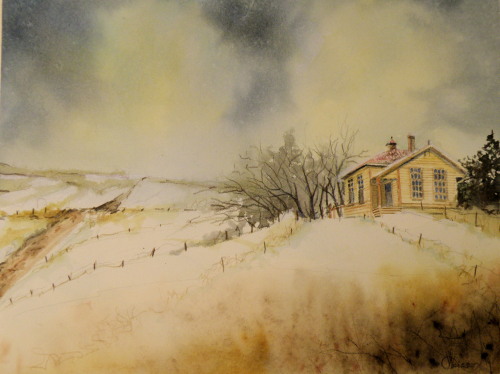
"One Room School, Duck Range Road, Pritchard, B. C."
Fort House
January 3, 2012
Kamloops (a native word meaning ‘the joining of two rivers’) has evolved from an c1812 outpost of The Hudson’s Bay Company and an early Railroad and Gold Rush centre into the largest city in the Thompson-Nicola Region of British Columbia’s Interior.
One of our most distinctive houses situated near the North Thompson River, was built in 1907 for a farmer, Archie Davis, who had purchased land originally belonging to Fort Kamloops. It sits at the corner of Fortune Drive and Fort Avenue, and is simply referred to as ‘Fort House’. No longer in the Davis family, its acreage has been reduced to a lot-sized yard, and its classic box design has been altered so that now it is a rooming house with various entries and stairs added.
Wanting to depict it as it once was, this painting imagines a moonlit night with one lone window indicating activity, perhaps Archie Davis preparing to get up–pre-dawn–to attend to his animals and daily chores. It was purchased almost as soon as it was displayed, by a young couple who have a fondness for this familiar Kamloops landmark.

"Up Late"
 weisserwatercolours