….composition exercise 2
January 17, 2016
Continuing on with an attempt to test out the compositional dictum known as ‘the rule of thirds’, which was conceived and named by John Thomas Smith in 1797 :
“. . . Analogous to this “Rule of thirds”, (if I may be allowed so to call it) I have presumed to think that, in connecting or in breaking the various lines of a picture, it would likewise be a good rule to do it, in general, by a similar scheme of proportion; for example, in a design of landscape, to determine the sky at about two-thirds ; or else at about one-third, so that the material objects might occupy the other two : Again, two thirds of one element, (as of water) to one third of another element (as of land); and then both together to make but one third of the picture, of which the two other thirds should go for the sky and aerial perspectives. . . “
To illustrate its basics…..

Once again, this is the drawing I did initially, to put this into practice….
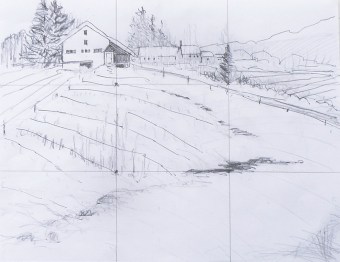
And this is the first go at painting the scene….

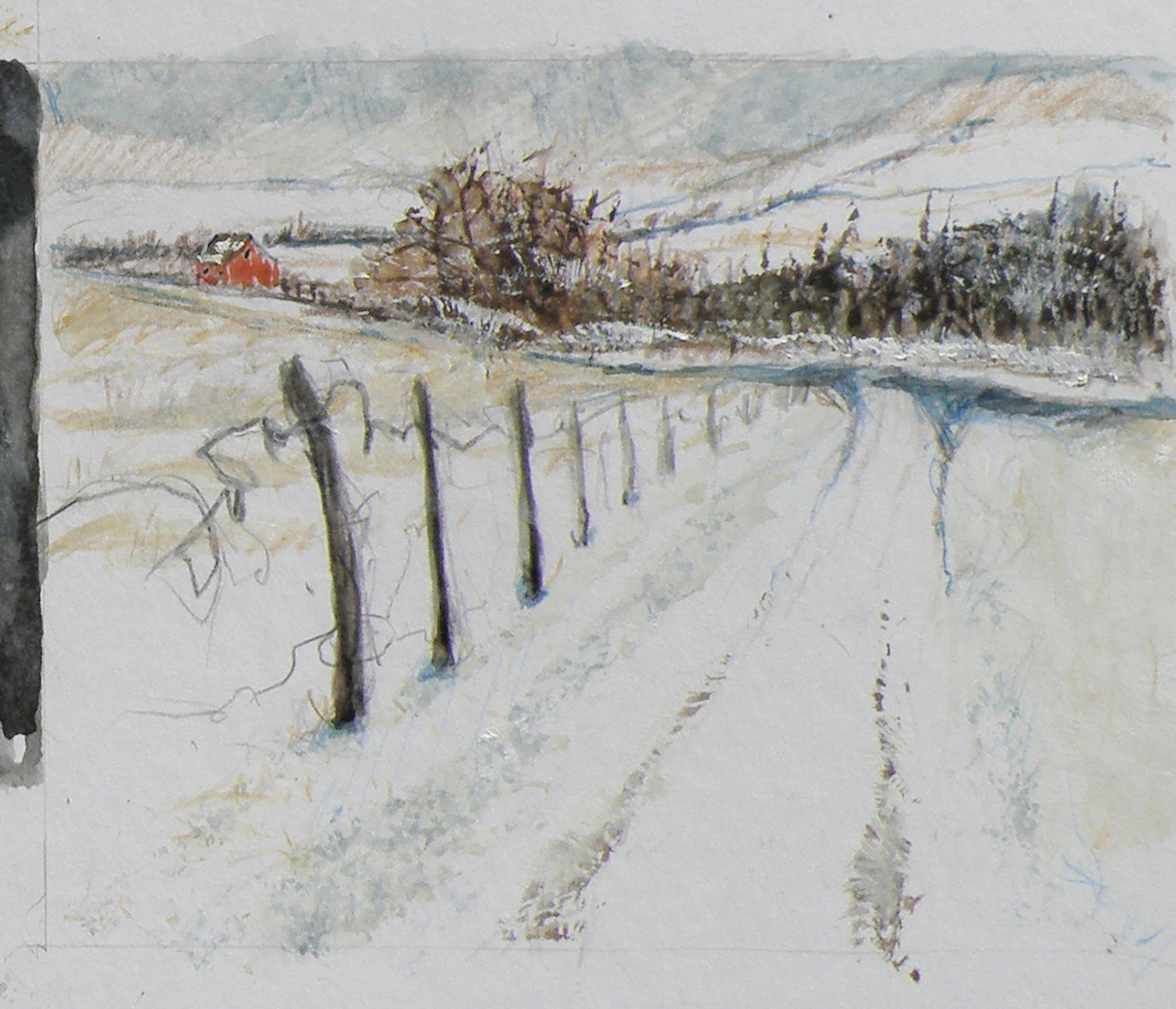
And now today, here is the progress so far, attempting to locate some visual interest at each of the four intersections within the piece, the barn being the first and the pine being the second and the creekbed being the third…..
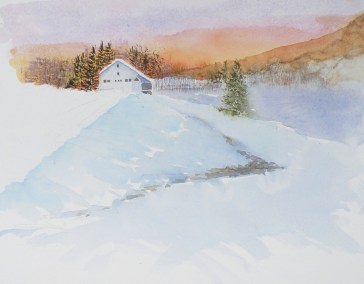
The darkest darks and greatest contrast will remain with the barn, for that is the intended focus for the picture, when completed.
The ‘rule of thirds’, as stated above, holds that generally two-thirds of a landscape be devoted to the sky, with one-third given to the land below (the sky being such a vast and dominant feature). In this case two-thirds is dedicated to the land and a very high horizon means that the one third is devoted to the sky area.
….snow
November 25, 2015
We received about 12cm overnight and now everything’s white, with temperatures starting to drop to around -10C (16F) under strong winds.
The birds are in the branches of the large Red Maple just beyond our big front window–at the four hanging feeders and suet cakes. We get mostly goldfinches and house finches, chickadees, juncos, nuthatches, flickers, clark’s nutcrackers, pine siskins, ring-necked doves, occasional pileated and downy woodpeckers, grosbeaks, stellar’s jays, magpies, ravens, white-crowned sparrows, and when it gets really cold the sweetly-blushing redpolls come down from the Arctic (but not likely until January or so).
Occasionally we see a Northern Pygmy Owl which swoops in on the dining lot, lighting on a branch like a handful of fluff with alarming eyes and causes the rest to take off like an explosion. They are one of a few daylight-hunting owls, and for two or three days following, the feeders remain untouched, the memory of that fist-sized, feathered-danger keeping everyone away.
In honour of the occasion — the advent of real Winter — a wintry watercolour, not unlike what the countryside looks like presently. The subject no doubt wishes the wind were less than it is….
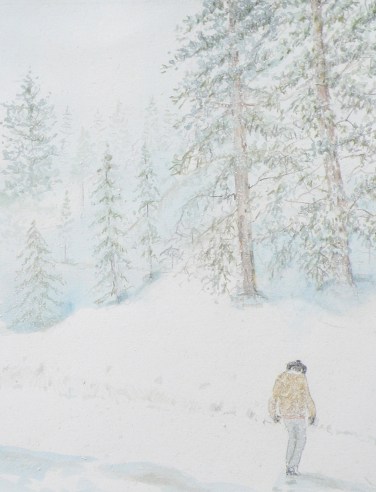
….but imagine the pleasures of fireplace and toddies once he gets back.
It’s an old painting–6 years–and approximately 8″ x 10″ on my favoured Arches Aquarelle Hot Press 140# paper. It took approximately 30 years to finally discover the right paper, having gone through all the choices of surface, weight, paper-maker (brand), and so on. Were it to be done again, the figure would be altered some, as there’s something anatomically odd about it.
….the silt bluffs
November 22, 2015
An area east of Kamloops, B. C., follows the South Thompson River which flows between dramatic limestone cliffs originally formed (it is estimated) 270 million years ago.
Among those cliffs is a gully–a waterworn ravine known as ‘the silt bluffs’, featuring very distinctive rock formations which have the look and feel of something out of a Western movie.
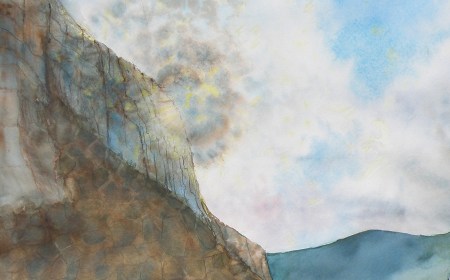
Massive geological formations such as these require some form of treatment by a painter in order to adequately convey their uniqueness and grandeur. This watercolour attempts to do that by purposely choosing to paint directly into the sun.
This part of our landscape gets quite literally baked by heat at midday, so when painting outdoors it is important to get it done quickly.
wee glimpses
May 26, 2015
PAINTING OUTDOORS has a way of getting a person to make judgment calls quickly, and in our area it is quite simply the heat of the day.
KAMLOOPS, B.C., IS UNIQUE IN THAT its mountainous hillsides are grass-covered with considerable sagebrush but little tree growth to the 900m level, creating what is known as an inverted tree line.
IN MOST PLACES TREES WON’T GROW above a certain level due to the lack of precipitation, but in Kamloops, they won’t grow below a certain level due to the lack of precipitation. We are known as The Sunshine Capitol of Canada, receiving over 2,000 hours of sun annually.
IOW, IT IS HOT. And since sun and heat are our landscape’s signature features, painting a local watercolour outdoors demands sitting right the heck out there.
THAT IS WHY IT MAKES GREAT SENSE to me to choose to do this by way of painting miniatures.
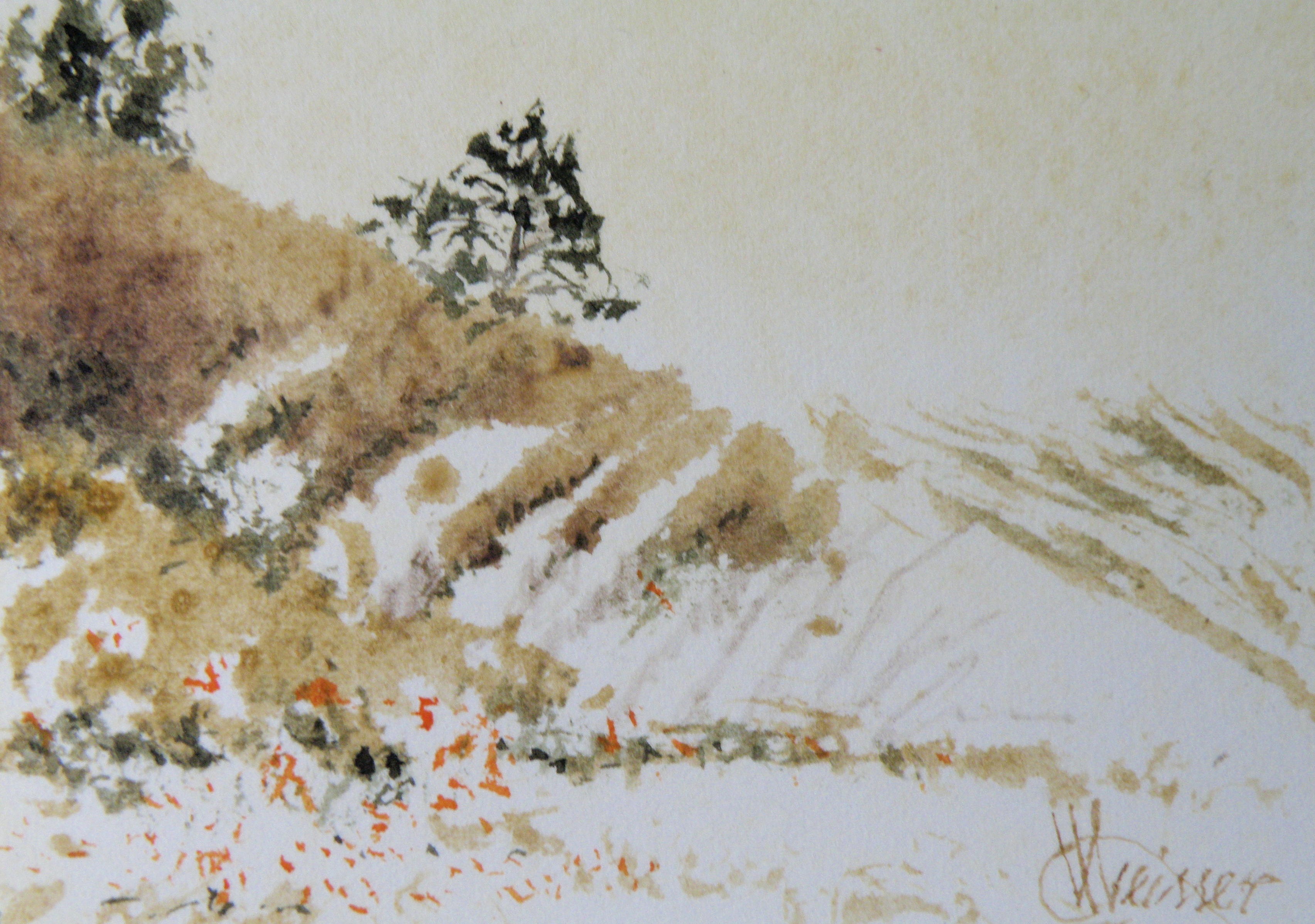
‘A Kamloops August’, watercolour, 6.35cm x 8.90cm (2.5″ x 3.5″), Arches Hot Press 140 lb. paper
MINIATURES demand quick thinking and choosing the elemental–the scene’s compositional essences–getting them down efficiently and thoughtfully, though, at the same time, quickly.
A GOOD MINIATURE can serve as the template for a much larger, studio piece. And good miniatures stand up very well all by themselves. This particular one has been accepted into two different juried Federation of Canadian Artists Shows, including the annual ‘Small, Smaller, Smallest’. It was, in that show, the very smallest of the lot. And that made me very happy!
composition woes….
May 3, 2015
MY GREATEST CHALLENGE when painting anything is composition. For years I felt I was being a ‘purist’, insisting that I always paint on location, never in a studio setting. And once at the location, I convinced myself that if a tree was in that spot, then that was how it needed to be depicted.
IT WAS ALL DUE TO my tendency to early-on stop referring to the subject in front of me and become more and more involved in what was happening on paper, to the point where I may as well have not been on location at all. So in an effort at self-discipline, I decided that not only should I paint what things actually look like, I shouldn’t muck around with how and where ‘mother nature’ placed them.
THE SILLY THING WAS, I ended up choosing a composition by default because of course, I couldn’t paint everything my eyes saw in front of me. And more often than not, it was not a good composition. So now, not only do I go to some lengths to study the skill of creating an interesting arrangement, I realise it is the painter’s task to take what ‘mother nature’ provides and make art out of that. Fences do need to be repositioned, as do trees and hills and clouds.
SO NOW I MAKE thumbnail studies first on matt board before beginning anything . . .
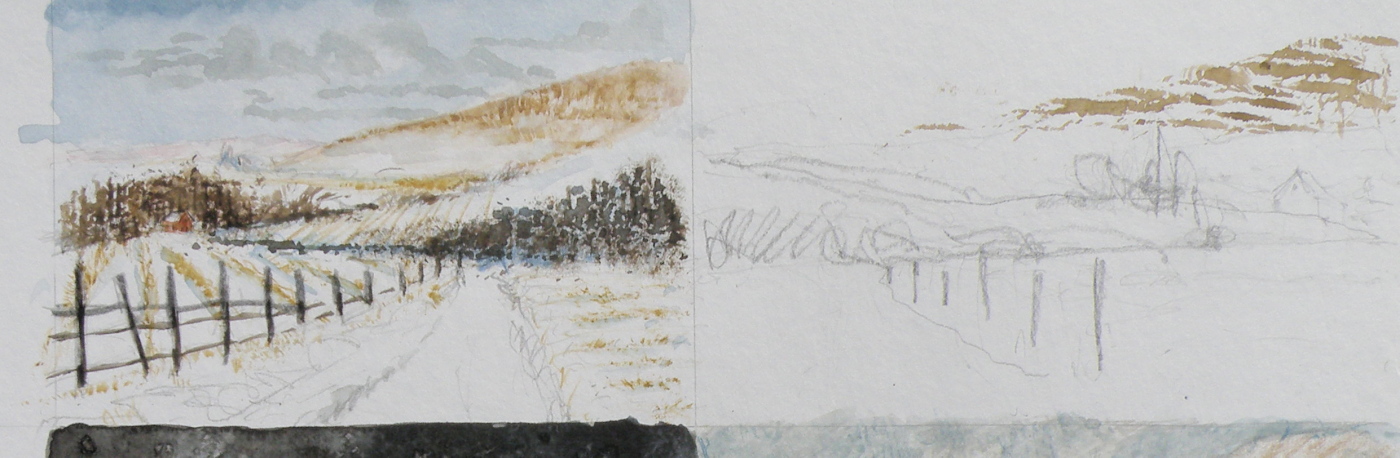
THE OBJECTIVE is to provide a focal point, a visual way in towards it, then additional visual interest so the eye has more to discover by wandering beyond the subject itself. These thumbnails are exploring the use of a compositional figure ‘Z’ shape to lead the eye of the viewer.
ACEOs (Art Card Editions and Originals)
April 20, 2015
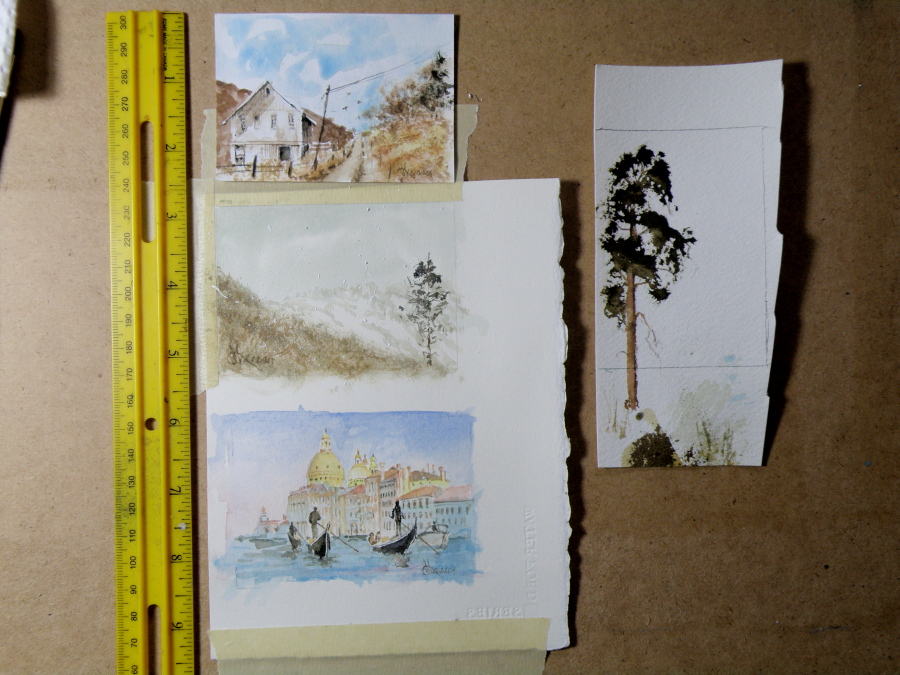
ARTIST TRADING CARDS aka ART CARD EDITIONS AND ORIGINALS are popularly known as ACEOs. ACEOs are the size of baseball cards–65mm x 89mm (2.5″ x 3.5″) and are purchased and then traded and sold the way sports cards are. The ACEO movement originated in Switzerland in the 90s but grew in popularity through eBay, where art cards are now sold and bought on a 24hr basis.
They require precision and are very enjoyable to do. But then, who wouldn’t be fascinated by the challenge of painting tiny things (smile). The subject matter can be chosen by the purchaser, and the painting done accordingly.
 weisserwatercolours