……’why the moon glows’, by Ane Jones (age 8)
March 25, 2015
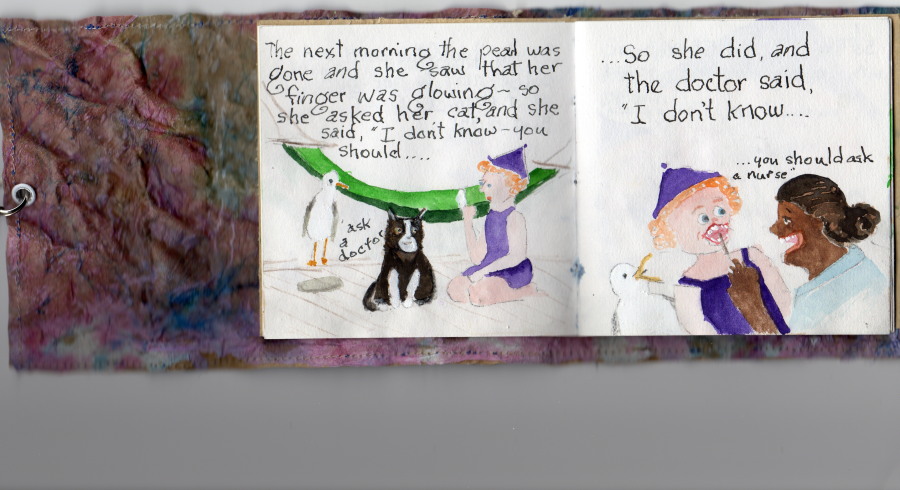
……’why the moon glows’, by Ane Jones (age 8)
March 24, 2015
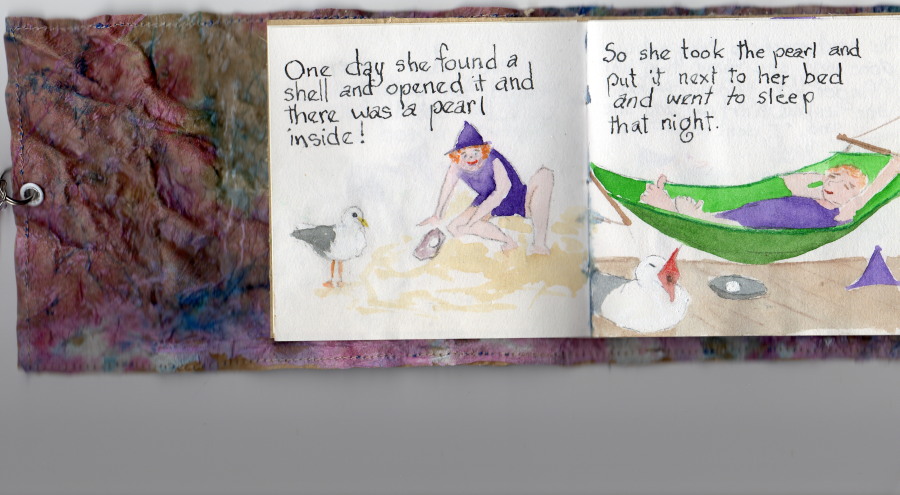
……’why the moon glows’, by Ane Jones (age 8)
March 23, 2015

Local Cliffs, Finished Piece
April 25, 2012
D Day for me is May 1st. That is when Lynda Jones and I are teaming up to be The Featured Artists at The Old Courthouse Gallery here in Kamloops. Lynda is a rare and amazing potter who specializes in highly burnished smoke-fired pieces and counts among her collectors the former U. S. President Clinton.
Here is the fantastic poster she has designed:
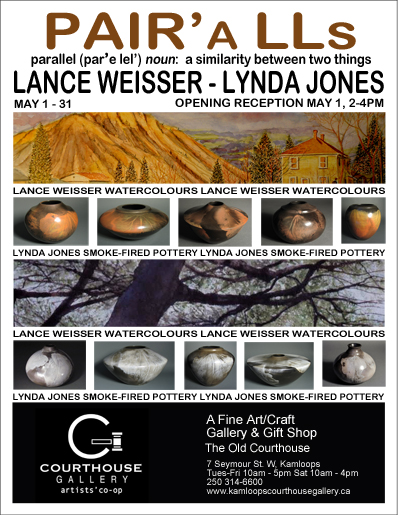
PAIR' A LLs E-POSTER MAY 2012 Courthouse Gallery
The Local Cliffs subject I’ve been doing studies of has finally been completed as a work I’m satisfied enough to allow to be matted and framed.

"Cinnamon Ridge Signal" 7.5" x 9", Arches 140 lb. Cold Press Paper
One thing I’ve learned through doing it, is that this small size of 7.5″ x 9″ is very pleasing for me. It is large enough to include a good amount of detailing, and small enough to get finished in a timely way.
And now it is on to getting painting #2 for the show done before our May 1st opening. Thank you for your previous comments which helped me in producing the final result!
Horse Study Continued ….
March 28, 2012
[I apologize to my blogging friends for falling behind in viewing your many entries. There have been a number of deadlines I’ve been facing, and now I feel somewhat negligent in posting and commenting.]
In continuing to try and improve on my initial study of a pair of horses, I have placed them in a more complex setting.
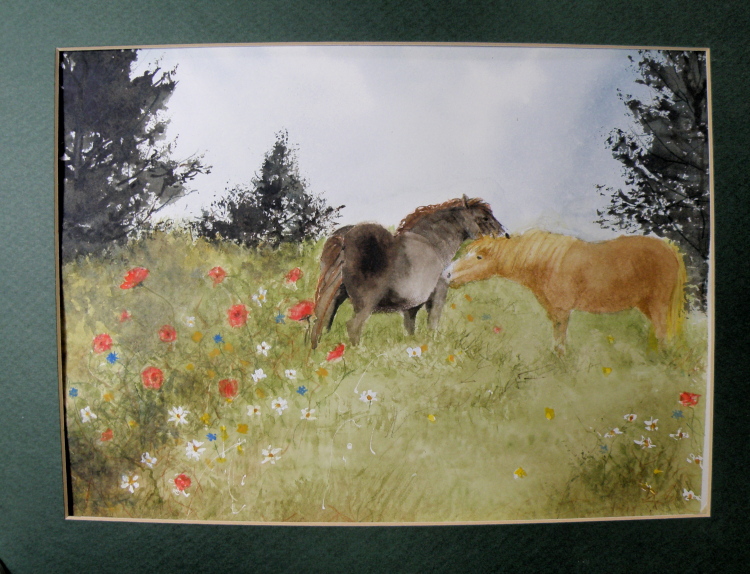
Icelandic Horses "Odur" and "Lettir"
I am somewhat more satisfied with this result, and have been learning a great deal in the process. This is Arches Hot Press Paper which is has a very smooth surface and is slightly creamy in tone. It has the qualities of illustration board. The demand on the painter with Hot Press is the need to lay the initial wash down with the hope of not going back into it, or back over it. Because there’s no ‘tooth’ to the paper, the paint floats on the surface before finally being absorbed.
Although the flaws of this scream out at me, the reason watercolour is considered the most demanding of painting mediums is simply because trying to correct the flaws will result in outright catastrophe.
All I can hope for is renewed confidence and another attempt. However, I remain pleased with the composition, if not some of the particulars.
My painting mentor taught me to adhere to the “20 to 1 principle”–‘for every painting you keep, throw out 19’.
Horse study . . .
March 18, 2012
I have been endeavouring to paint a fondly-loved pair of horses for a friend of mine. Were I to choose my own equine subject matter, I would likely have preferred more than two, or where they weren’t quite so front and centre. I have painted horses before, but lack confidence due to not being raised around them. I lack fundamental knowledge of what they are like, i.e. horse sense (groan).

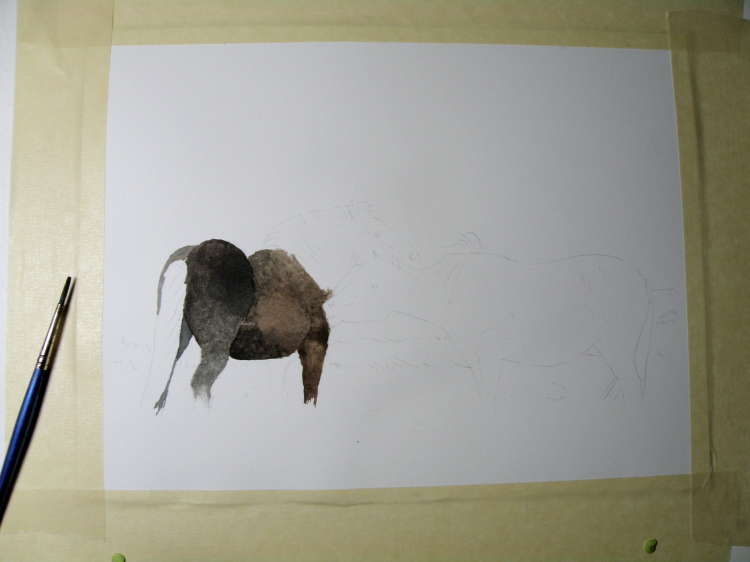
Starting from behind . . .

"Odur" nears completion . . .
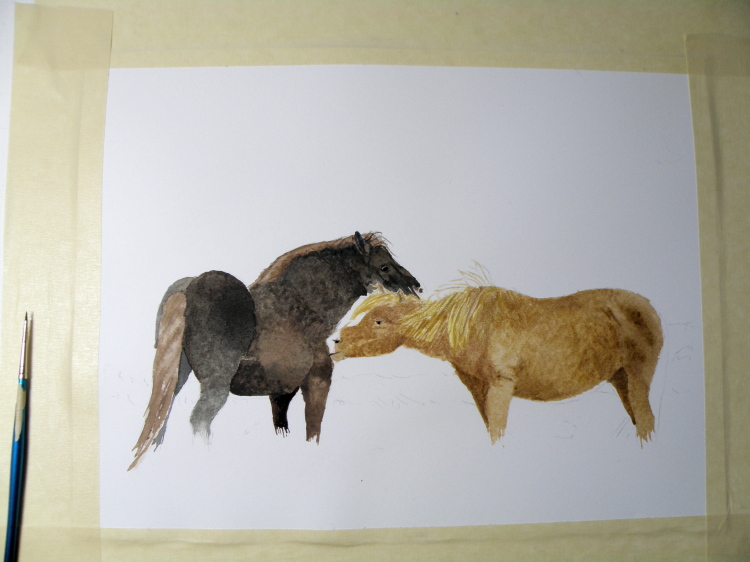
"Lettir" joins "Odur"

wash of sky is dropped in with a few strokes . . .
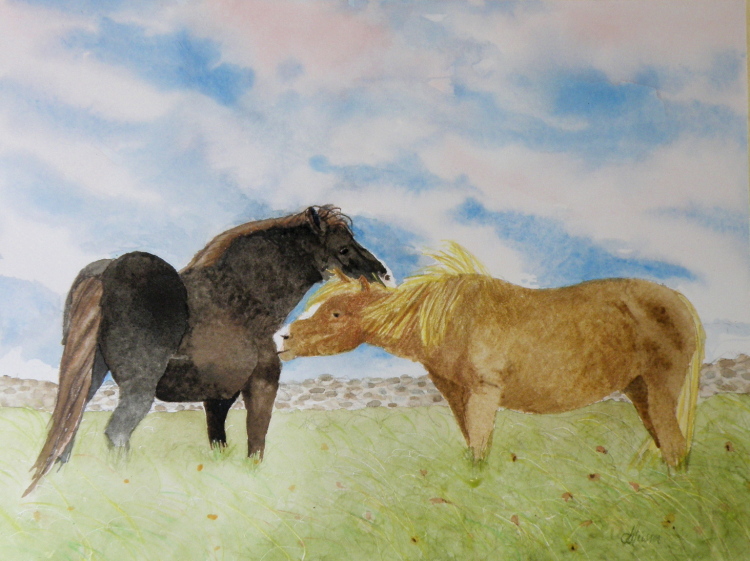
"Odur" and "Lettir"
The horses aren’t too bad, but the sky is too blue, and the field too green. I am also not thrilled I added the stone wall, as it cuts a swath right through the middle. So . . . back to the proverbial drawing board. I will keep you posted, and provide the next instalment.
‘The Silt Bluffs II’
February 26, 2012
The landscape of Kamloops, British Columbia, (native word meaning ‘dividing of waters’–the Thompson River divides mid-city to create the North and South Thompson), varies remarkably.
Think of a city at 1132 ft. elevation with homes built in terraced-layers down one mountainside and up another, all finding bottom along the broad Thompson River which attracted the attention of The Hudson Bay Company in 1811. Since then Kamloops has become a train hub, a location for gold prospectors seeking their fortunes, and more recently a centre for the forest industry.
It is arid here. Summers are hot and dry, and rain is an event. Winters are cold, windy, with average amounts of snow, and a major spot for skiers and snowboarders at the highest elevations. When I walk the dog at 5 a.m., I always hear owls and sometimes coyotes, and occasionally spot a few deer searching for something in the yards below the mountain ridge we hug up against. I’ve also come across black bear in the car port, and seen the evidence of moose.
This painting is of what’s locally referred to as The Silt Bluffs. They feature hoodoos, free-standing rock formations caused by wind erosion.

'The Silt Bluffs', 5" x 7" Original and signed Watercolour on Arches Hot Press 140 lb. Paper, $100.00 black-matted & framed in gold
The most prevalent raptors in our area are the Red-Tailed Hawk, Golden and Bald Eagles, Osprey, and Turkey Vultures.
To hell with Winter . . .
January 26, 2012
Actually, I’m joking. I’m a winter person through and through! This is the Season when I thrill at the photos of my favourite bloggers on ‘WordPress’, whose will is such that they are out there when the pale sun is orangey and the naked trees throw indigo and mauve stripes on the lapis snow. The lone leaf clinging yet to the branch moves me. The icicle tear surrounding a burnt-sienna rosehip speaks of life still sparking inside that crystal casing. Winter is the freezing of time–everything locked in icy suspension while we stand dazzled on chilled mornings over what happened as we slept.
A week ago it was -37C (with the wind chill factored in). Our pipes froze and plumbers had to repair them. The bird feeders were so busy, I had to tend them twice a day. And yet. And yet. And yet I knew even as we risked frostbite to walk our little Bichon dog, Elmo, that under all that concrete ground there were bulbs not only surviving, but actually thriving. The red maple in our yard is busy plumping up its buds. Things are happening, though for humans, an hour out there with little protection is a cruel fate.
But here’s to Summer, in the midst of Winter. Here’s to what I can’t wait to tend to when my favourite Season ends and the growing Season begins.

"Peace"
Rainy Day Study I
January 23, 2012
Golden Ears Provincial Park is one of the largest in British Columbia (over 62,500 hectares;1 hectare=2.47 acres) and features the pristine Alouette Lake. It also has three campgrounds and hiking trails through extremely rugged terrain. Vegetation is typical of the coastal western Hemlock forest of BC and the mountainous backcountry is not only rugged but has–almost annually–proven fatal to the unprepared. Those who go off are cautioned to understand what they’re getting themselves into.
Normally, Alouette Lake looks just like this . . .
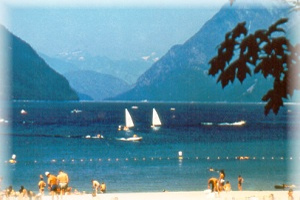
Alouette Lake, Golden Ears Provincial Park (courtesy of Parks B. C.)
But the day I attempted to paint this scene, it started out very foggy, then changed to drizzle, then showed some promise of clearing-up. I was in the camping area that was the most primitive, and of course only when I decided to begin painting did it actually start to full-out pour. By then I was so into it that I had to keep going, even though drops were falling directly onto my work-in-progress (though I did have a make-shift tarp). But to this day, this is one of my most favourite paintings because even though it has its distortions, I didn’t give in and stayed until I finished it . . .

'Alouette Lake Study'
I can still smell the coleman stove coffee and feel the warmth of the mug against my numb fingers as I celebrated by putting my brushes away–and swearing I’d never paint another #%$#!@# watercolour again in my life.
Great Nephew
January 16, 2012
One of my great nephews, at three years old, was particularly creative. You didn’t want to be assuming anything past 5:00 a.m., when a peaceful house usually meant he was in the scrap-booking room or the pantry; and there were things going on involving lipstick and cats, or crayons and clothes dryers. This particular watercolour was done on Arches 140 lb Hot Press paper. It is intentionally given a light treatment because the day was such that the sun was near to dazzlingly intense.
Here’s a random moment between takes when he’s on the loose at his brother’s birthday party. His sapphire eyes are looking around at what might next need destroying before it’s even been unwrapped.
He’s one of the most delightful children I’ve ever known–but I was very happy to have been only the Great Uncle (and not the parent) when he was three.
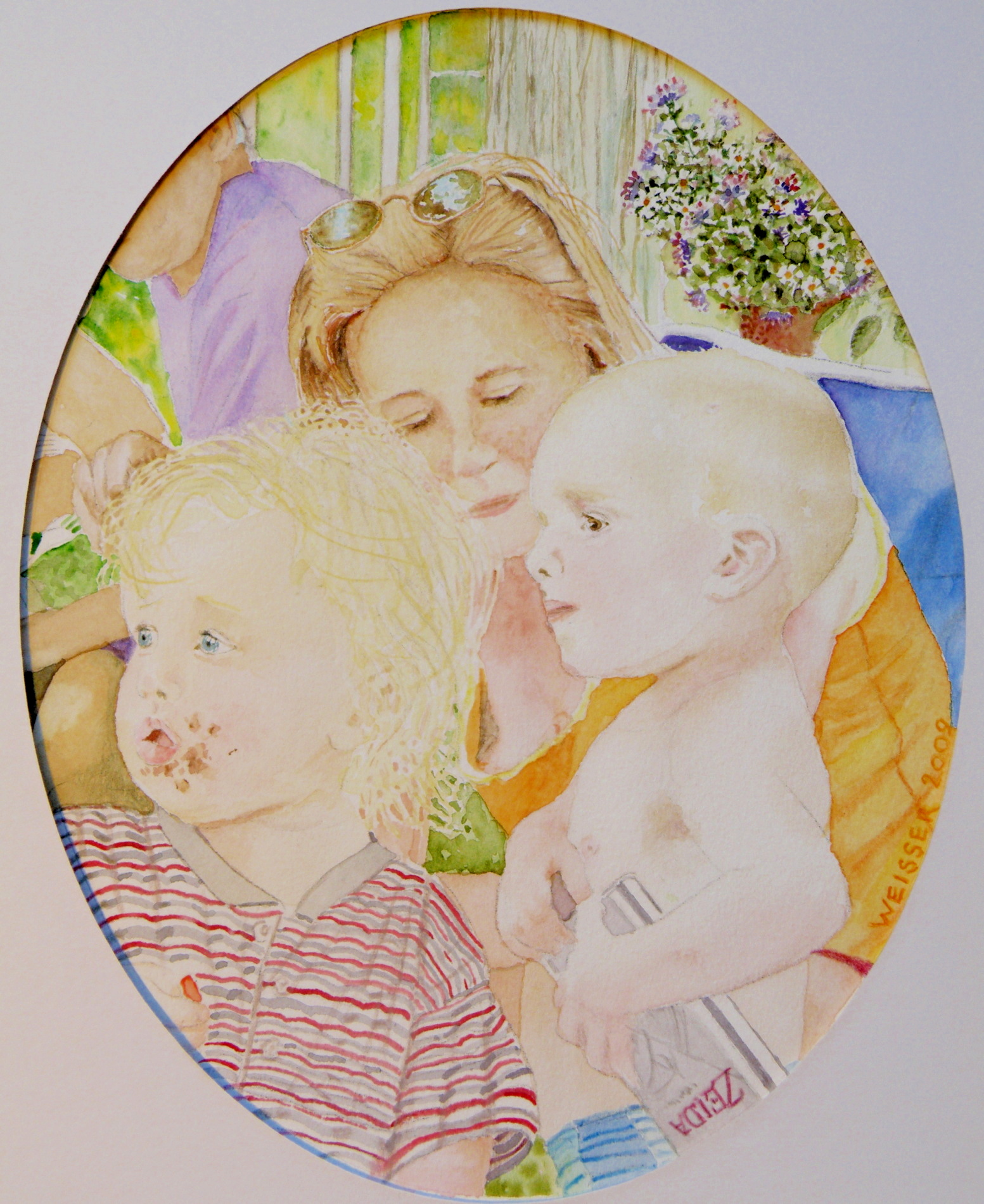
"After the Cake"
Hot
January 12, 2012
When we moved to Kamloops from Vancouver, we weren’t really prepared for the heat. Being a coastal city, Vancouver rarely sees temperatures over the high 20’s. Kamloops on the other hand, is in the South West Interior and is arid and hot — very hot. Summer temperatures can crest 45C, which is hot for Canada.
There’s sagebrush and Ponderosa Pines and cacti and lots of barren, weather-worn rock. The painting below was done in a location called Silt Bluffs which are full of character and stand above the North Thompson River. This scene is only about ten minutes away from downtown.

'Silt Bluffs on Shuswap Road'
 weisserwatercolours