Horse study . . .
March 18, 2012
I have been endeavouring to paint a fondly-loved pair of horses for a friend of mine. Were I to choose my own equine subject matter, I would likely have preferred more than two, or where they weren’t quite so front and centre. I have painted horses before, but lack confidence due to not being raised around them. I lack fundamental knowledge of what they are like, i.e. horse sense (groan).

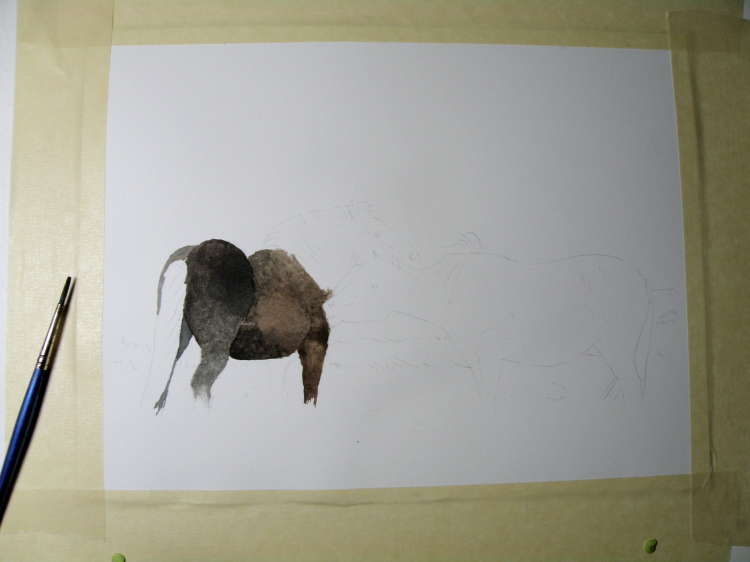
Starting from behind . . .

"Odur" nears completion . . .
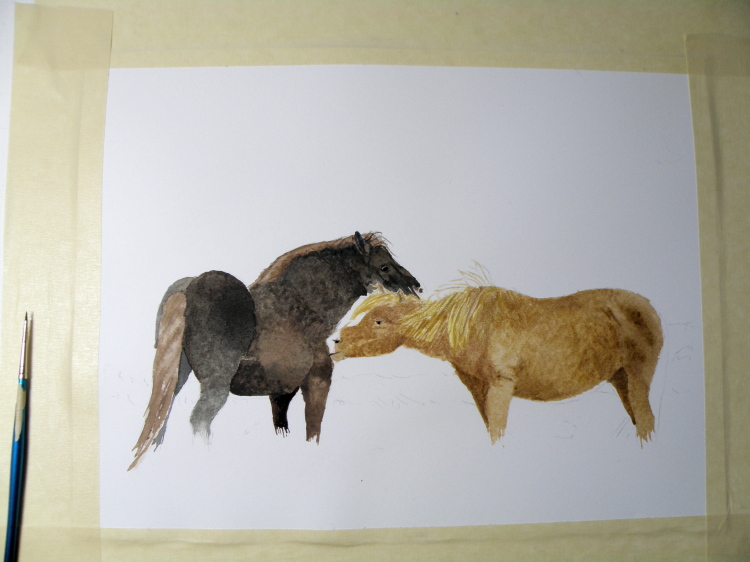
"Lettir" joins "Odur"

wash of sky is dropped in with a few strokes . . .
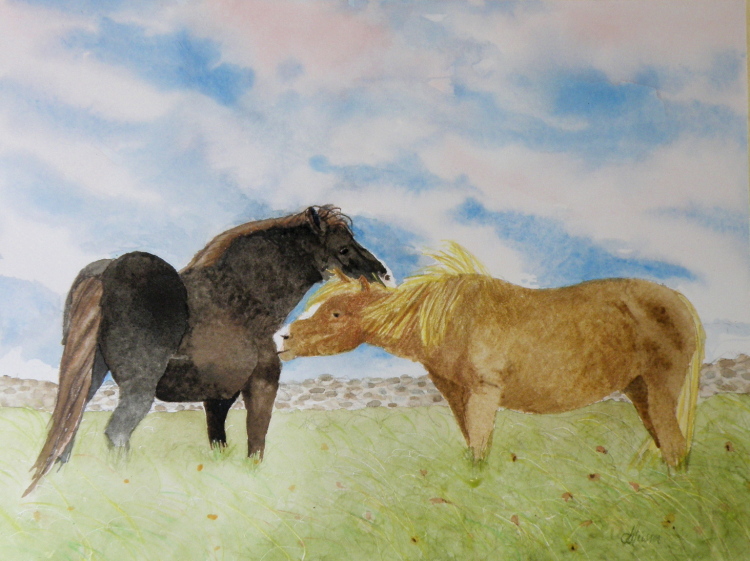
"Odur" and "Lettir"
The horses aren’t too bad, but the sky is too blue, and the field too green. I am also not thrilled I added the stone wall, as it cuts a swath right through the middle. So . . . back to the proverbial drawing board. I will keep you posted, and provide the next instalment.
‘The Silt Bluffs II’
February 26, 2012
The landscape of Kamloops, British Columbia, (native word meaning ‘dividing of waters’–the Thompson River divides mid-city to create the North and South Thompson), varies remarkably.
Think of a city at 1132 ft. elevation with homes built in terraced-layers down one mountainside and up another, all finding bottom along the broad Thompson River which attracted the attention of The Hudson Bay Company in 1811. Since then Kamloops has become a train hub, a location for gold prospectors seeking their fortunes, and more recently a centre for the forest industry.
It is arid here. Summers are hot and dry, and rain is an event. Winters are cold, windy, with average amounts of snow, and a major spot for skiers and snowboarders at the highest elevations. When I walk the dog at 5 a.m., I always hear owls and sometimes coyotes, and occasionally spot a few deer searching for something in the yards below the mountain ridge we hug up against. I’ve also come across black bear in the car port, and seen the evidence of moose.
This painting is of what’s locally referred to as The Silt Bluffs. They feature hoodoos, free-standing rock formations caused by wind erosion.

'The Silt Bluffs', 5" x 7" Original and signed Watercolour on Arches Hot Press 140 lb. Paper, $100.00 black-matted & framed in gold
The most prevalent raptors in our area are the Red-Tailed Hawk, Golden and Bald Eagles, Osprey, and Turkey Vultures.
The Columbias
February 10, 2012
For seven summers I was the cook for The British Columbia Natural History Society. In 1994 I graduated from The Dubruelle French Culinary School in Vancouver, and ran a kitchen at a small residence on the UBC Campus. This left my summers free, and I took on the task of prepping to feed upwards of sixty hikers at elevations upwards to some 3000 m., or approximately 10,000 ft.
It involved cooking and then packing vacuum-sealed , frozen meals in large chests with dry ice before joining the caravan of cars towards the mountain destination of choice. Once at the base, everything–including me–was hauled to the summit in a net-outfitted helicopter, and the business of setting up the huge kitchen and dining tents was begun. Frequently it was snowing up top–though only twenty minutes before I’d been roasting in the July heat–leaving me scrambling to find my parka.
The challenge was to get everything unboxed and laid out in some semblance of order–while ensuring the burners were properly hooked up to giant propane tanks–so that all-important first meal could be served some three hours later. After that, I could do the washing-up and at least semi-relax by first getting my little tent set up and then getting myself organized enough to be able to do breakfast when I awoke at 4 a.m.
By Day Three (of the ten day experience), it felt like I’d lived there my whole life, and could spend my days doing watercolours while the hikers tramped all over the rugged terrain carrying the bagged lunches they packed for themselves after dinner the night before. Once I’d served their breakfast, they’d stroll about with final cups of coffee making sure I overheard their latest Grizzly Bear spotting stories. Then they’d be off, leaving me sitting there all day minding that food all by myself.
Here is a painting from one of those seven summers. And though I can’t be entirely positive, I believe this particular view is from the Eastern British Columbia Mountain Range known simply as The Columbias.
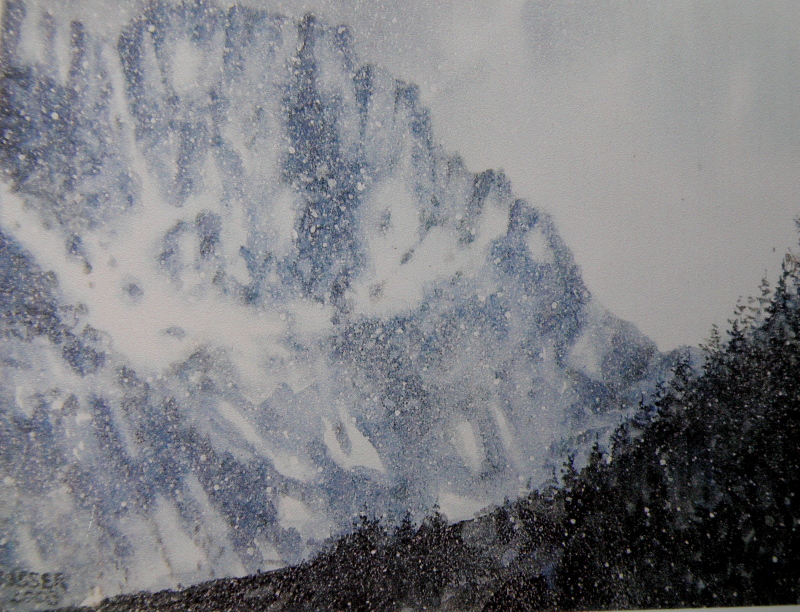
Glaciers in The Columbias
And yes, I did see Grizzlies, but only from a distance.
thank god.
Gettysburg
January 28, 2012
Gettysburg. The very name sends all manner of emotion through my heart and out the other side.
I began studying this famous American Civil War Battle (July 1,2,3, 1863) some twenty years ago and then in 2001 I simply bought a plane ticket and up and went there to see the place for myself. My sister and brother-in-law met me in Syracuse, New York, and drove me down to Southern Pennsylvania to spend five days absorbing the importance of those hallowed forests and fields.
I’m no fan of war, believe me. But having been born an American yet having now lived more than half my life as a Canadian, I study the differences between the two countries. Both British Colonies, the one revolted over taxes and the other still has The British Monarch as its Head of State. One couldn’t find the means to end slavery peacefully, while the other saw it dissolved once and for all under Britain’s 1834 Slavery Abolition Act.
Having studied in detail The Battle of Gettysburg, and while there in June of 2001, I brought along my paints and did on-the-spot watercolour sketches of the most poignantly-historic locations among those now-peaceful fields.

'The Copse Of Trees -- Gettysburg'
On July 3rd, 1863, on a stiflingly-hot afternoon, after two entire hours of constant cannon bombardment of the Yankee position on Cemetery Ridge, General Robert E. Lee ordered a massive charge across a mile-wide expanse of field. This was the concluding, and most desperate action of the horrific three days as tens of thousands Southern troops marched shoulder-to-shoulder into the deadly cannonading of Northern forces.
They were instructed to aim for an inconspicuous, yet noticeable ‘copse of trees’, dead centre in the Union Line. Only one hundred or so made that destination, the more than 20,000 others suffering an indescribable onslaught of cannon and massed rifle fire.
After painting this little painting, I solemnly walked the distance to those trees. It was a sobering, awful, respectfully-difficult-yet-important mile-long journey through the wind-blown grasses of a place now very hushed and calm. I’ve never been quite the same before, or since.
What an enormous difference between two neighbouring countries, all due to differing attitudes to being deemed ‘Colonists’.
A little ‘cheating’ . . .
January 25, 2012
Watercolour has its limitations and its unique requirements. About the biggest challenge is the understanding that anything white in a watercolour is the paper left blank. So white clouds are achieved by painting blue around them. Whitecapped waves are accomplished by painting the dark part of the wave and leaving the paper white for the crest. The same goes for snow, of course, and really anything at all that’s white.
The famous British painter, J. M. W. Turner (23 April 1775 – 19 December 1851) is widely regarded as the artist who took watercolour to its pinnacle–who forced it to be considered a serious medium, alongside oil (though even today watercolour is not treated with the same gravitas as oil). His work is nothing short of astonishing. And apparently he often achieved some of his whites by ripping at the paper with a long fingernail.
My training was such that the use of opaque white was absolutely forbidden. It was considered a breaking of the most important ‘rule’ of watercolour: that only the white of the paper (called ‘reserved white’) was acceptable in a pure, transparent watercolour.
I have, though, been talked into letting myself experiment with a limited usage of opaque white. A great many watercolourists use it, though sparingly.
The following picture was my first attempt at using a bit of opaque white in the branches of the trees. The clouds, grasses, snow, and other whites were achieved by reserved whites (leaving the paper blank) and/or scratching out with a knife (my fingernails aren’t nearly long enough).
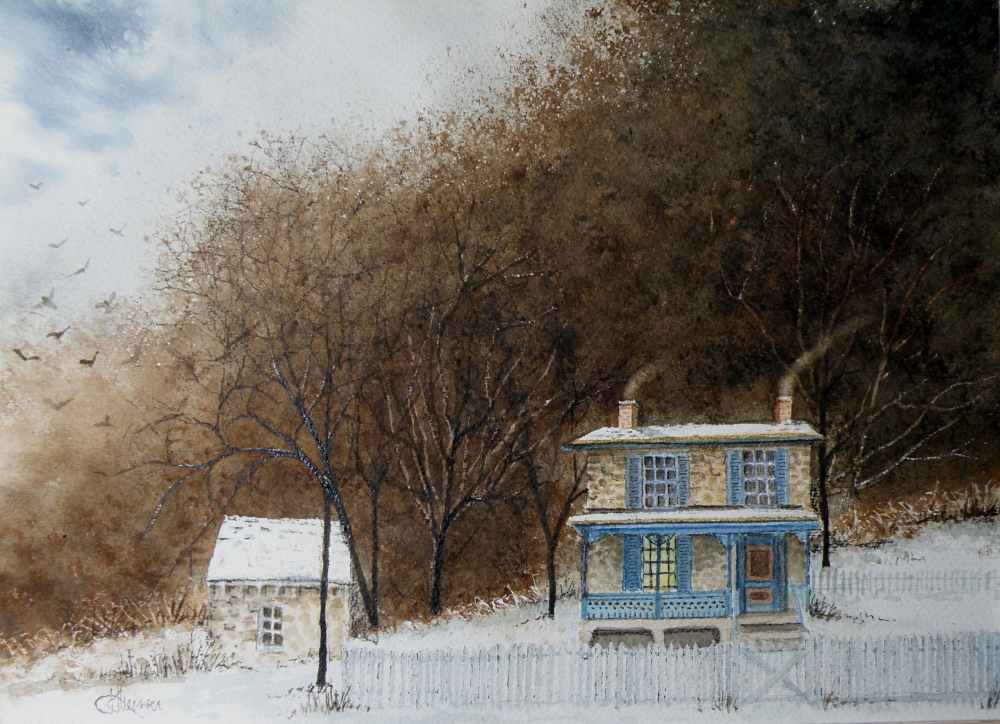
"Snug"
Mount Peter
January 21, 2012
To look up the face of Mount Peter– (the sibling of the larger Mount Paul), the signature mountains overlooking our city of Kamloops, B. C.–is to look upon the core of a mountain. These are mountains so ancient, all that remains are the inner cores–their souls. Time and erosion have scarred and left them displaying a beauty it takes the eye a while to appreciate.
The roads about their base feature yellow diamond warning signs cautioning drivers to watch for Big Horn Sheep.
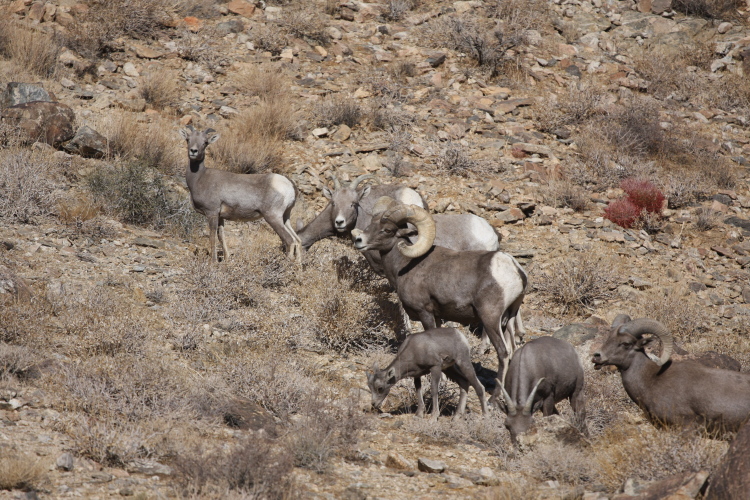
Big Horn Sheep (courtesy Wikimedia)
As a watercolourist, it took me a good two years before I attempted the challenge. They are unusual subjects, and not easily rendered. It was wise for me to wait, simply because I was so accustomed to the forested peaks of the Coastal Mountains that I regarded these as ugly. Until they finally become beautiful to the newly-arrived, these ancient and weather worn heights are probably best not attempted at all by art enthusiasts like me.

'Peter's Face'
Schoolhouse Dreams
January 21, 2012
My mother taught one room school in Rosetown, Saskatchewan, in the ’30s. There was such an age difference between herself and her sister that my Aunt ended up being her student. When my mother had no choice but to keep her after school for talking back, that was the beginning of a lifelong distance between them. They got along–don’t get me wrong–but they weren’t ever the best of friends.
The notion of a one room school has always been appealing to me, personally. I would have bloomed in such a setting, and benefited from having both older and younger learning their lessons in the same room at the same time–(though probably not if the teacher had been my mother).
This painting, entitled ‘Schoolhouse Memories’ is based on a dream I had not long ago, of heading towards a building like this, in a setting like this, on a warm day at dawn, yet never reaching the front door.
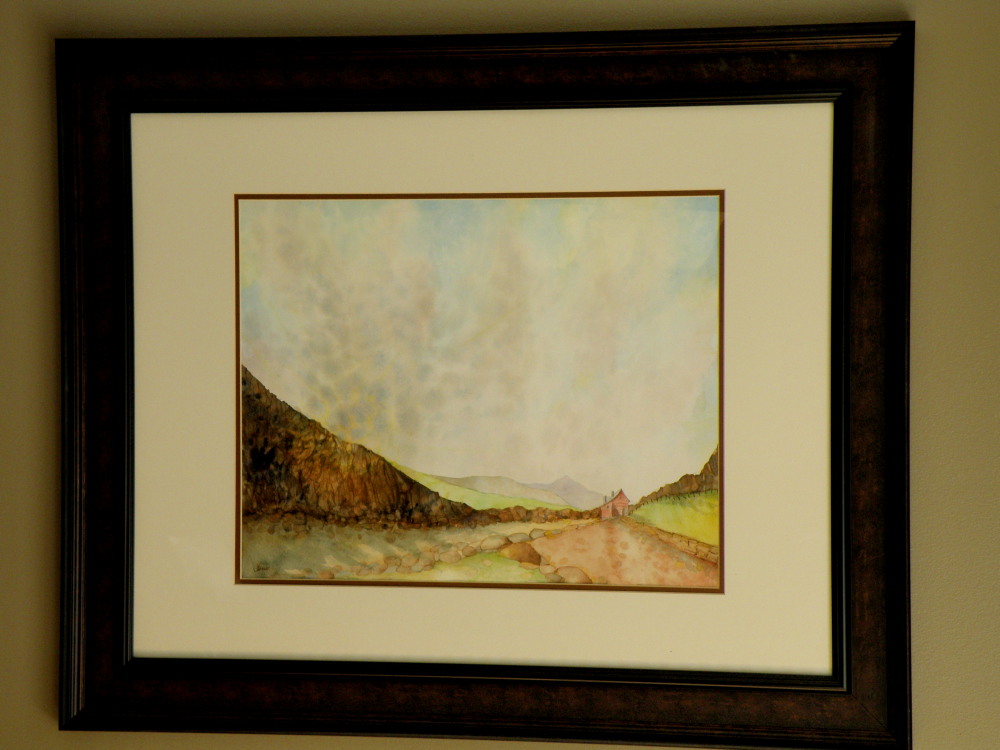
It was in the Federation of Canadian Artists’ Open Show in April of 2010.
Paint-off Challenge
January 20, 2012
A few years back I belonged to The Artists’ Studio, and the twenty of us each submitted a favourite photo which we thought would make for a good painting. Those twenty photos were then subjected to a voting process whereby a single photo would end up becoming the subject which all twenty of us would base a painting on.
So–one photo–twenty artists–twenty different paintings based on the same photo. And the winning photo was taken by a Member of The Artists’ Studio of The Icicle River in Levenworth, Washington, U. S. A.
-
 studio challenge poster

And here then, is both the photo and my treatment of it . . . (but I addded a couple of hikers and a little dog just for interest) . . .

- photo and framed watercolour

Hot
January 12, 2012
When we moved to Kamloops from Vancouver, we weren’t really prepared for the heat. Being a coastal city, Vancouver rarely sees temperatures over the high 20’s. Kamloops on the other hand, is in the South West Interior and is arid and hot — very hot. Summer temperatures can crest 45C, which is hot for Canada.
There’s sagebrush and Ponderosa Pines and cacti and lots of barren, weather-worn rock. The painting below was done in a location called Silt Bluffs which are full of character and stand above the North Thompson River. This scene is only about ten minutes away from downtown.

'Silt Bluffs on Shuswap Road'
Autumn
January 5, 2012
Autumn. The very word speaks in tones that touch something deep and still. In my youth it was an invigorating Season, full of piles of leaves we’d shape into forts or rooms. The air would be tinted with a hint of smoke, the chill of it pinking my ear lobes and rouging my cheek. Teachers would begin rehearsing things for Christmas. There was an unspoken wonder over feeling the days shorten, and a little thrill over seeking out a forgotten, yet familiar scarf and hat. Underneath was an anticipation over when the first snowflakes would drift down, hoping it would be during waking hours–and then came the day when the shout of a classmate interrupted a math or geography lesson– “Look! It’s SNOWING!” , followed by a crush of bodies as we pressed against the windows, marvelling, wishing it would just keep going until there was nothing for it but to hunt in the attic for our sleds.
And now? I’m in the Autumn of my life. Who knows, but maybe even the Winter. The Season is now pensive, thoughtful. There’s a contemplative quality watching the last of our Red Maple’s orange hands let go and join the others. One thinks of endings more than beginnings–pasts more than futures. But the sweetness if anything, is made the more complex–like a well-mulled cider–for Autumn is made for memories– for kicking through the remains of the Summer and recalling Seasons long gone, while hoping for one or two more . . .
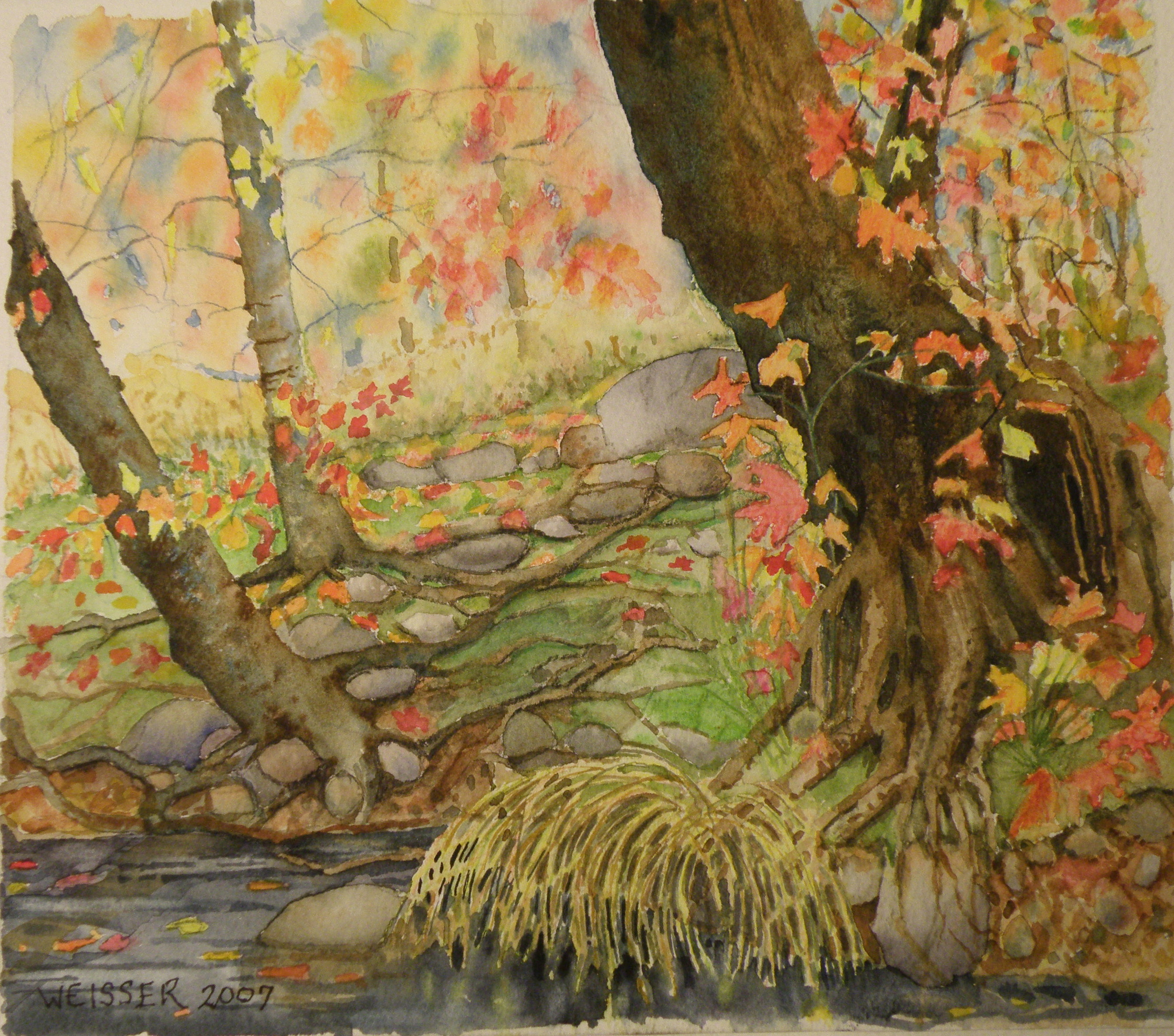
"Autumn Wood"
A bit of New York
January 4, 2012
I was raised in Rochester, New York, and then later on the New York / Vermont border. At some point we had occasion to visit the town of Saranac Lake, New York, which hosted the 1980 Winter Olympics and much earlier in its history was one of North America’s best known tuberculosis sanatorium locales. Patients went there to receive plenty of sunshine and fresh air.
Kamloops, British Columbia, my present home, was also chosen as a prime location for a TB sanatorium and it was located just outside the city limits at Tranquille, B. C., beside Kamloops Lake. The air here is dry, without even a hint of humidity in the Summer and bracingly-cold in the Winter.
I loved staying in Saranac Lake that one week in January. The lake itself was completely frozen over, with a fresh layer of snow and a blindingly-bright sun.

'A Frosty Saranac Lake, Saranac Lake, New York, c1989'
Fort House
January 3, 2012
Kamloops (a native word meaning ‘the joining of two rivers’) has evolved from an c1812 outpost of The Hudson’s Bay Company and an early Railroad and Gold Rush centre into the largest city in the Thompson-Nicola Region of British Columbia’s Interior.
One of our most distinctive houses situated near the North Thompson River, was built in 1907 for a farmer, Archie Davis, who had purchased land originally belonging to Fort Kamloops. It sits at the corner of Fortune Drive and Fort Avenue, and is simply referred to as ‘Fort House’. No longer in the Davis family, its acreage has been reduced to a lot-sized yard, and its classic box design has been altered so that now it is a rooming house with various entries and stairs added.
Wanting to depict it as it once was, this painting imagines a moonlit night with one lone window indicating activity, perhaps Archie Davis preparing to get up–pre-dawn–to attend to his animals and daily chores. It was purchased almost as soon as it was displayed, by a young couple who have a fondness for this familiar Kamloops landmark.

"Up Late"
 weisserwatercolours