……’why the moon glows’, by Ane Jones (age 8)
March 23, 2015

Miniatures
March 20, 2015
THE DARK-EYED JUNCO ignores the feeders hanging in the red maple just beyond the front window, shunning the bossy finch rabble bumping one another off the perches. A Junco will head below, delighting in the shower of sunflower crumbs spit from Goldfinch beaks, already shelled, served on a bed of fresh snow.
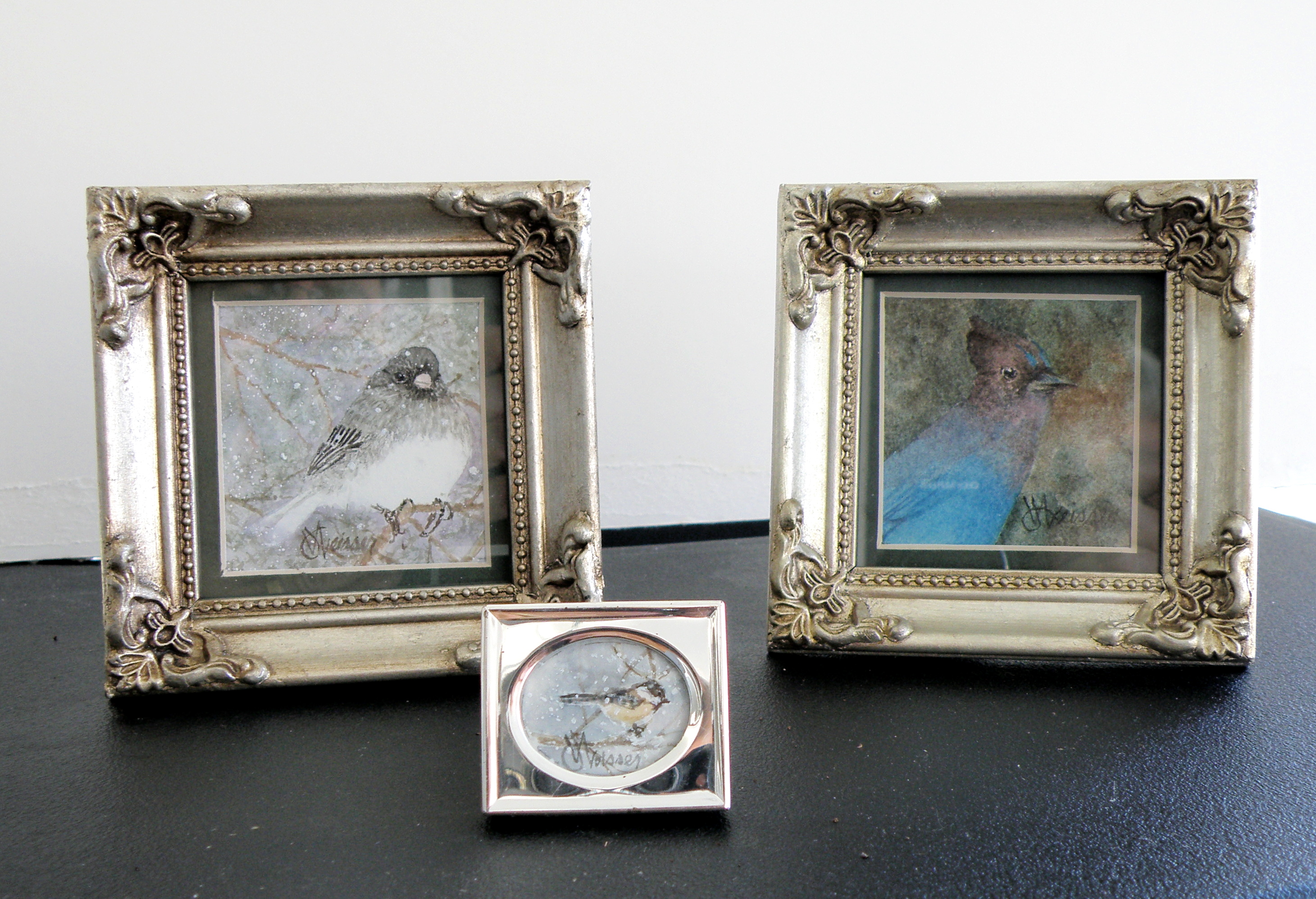
STELLAR JAYS have the tact and grace of a sociopath. Self-absorbed to the point of being incognizant there even are other lifeforms, they bray and scatter seed as though perpetually going through puberty. Once chaos has been accomplished, they go over to our neighbour, Brenda, and do the same with her feeder.
BLACK-CAPPED CHICKADEES dart in to claim a single seed, flit to a branch, hammer the shell apart, then dart in again–chee-cheeing a mantra as though making merry to themselves alone.
2″ x 2″, and 1/2″x 3/4″ , watercolour on Arches 140 lb. Hot Press Paper
Barn Owl Miniature
May 23, 2012
Whine Alert! I threw my back out and even my regular swimming routine isn’t helping restore things. It has been over a week and sitting at the computer only seems to aggravate it. Oddly, standing offers the most relief, so I’ve been painting.
My apologies for not leaving comments on my favourite sites. Even this just sitting here is causing shooting pains.
This pair of Barn Owls is from a photo on the BBC Website, without credits as to whom the photographer was/is. I’m in the process of offering compensation for my using the image as reference.
The Barn Owl (Tyto alba) is, oddly enough, common in a great many countries but not here in Canada. From Wikipedia: “. . . It is known by many other names, which may refer to the appearance, call, habitat or the eerie, silent flight: White Owl, Silver Owl, Demon Owl, Ghost Owl, Death Owl, Night Owl, Rat Owl, Church Owl, Cave Owl, Stone Owl, Monkey-faced Owl, Hissing Owl, Hobgoblin or Hobby Owl, Dobby Owl, White-breasted Owl, Golden Owl, Scritch Owl, Screech Owl, Straw Owl, Barnyard Owl and Delicate Owl. “Golden Owl” might also refer to the related Golden Masked Owl (T. aurantia). “Hissing Owl” and, particularly in the USA, “screech owl”, referring to the piercing calls of these birds. . . ”
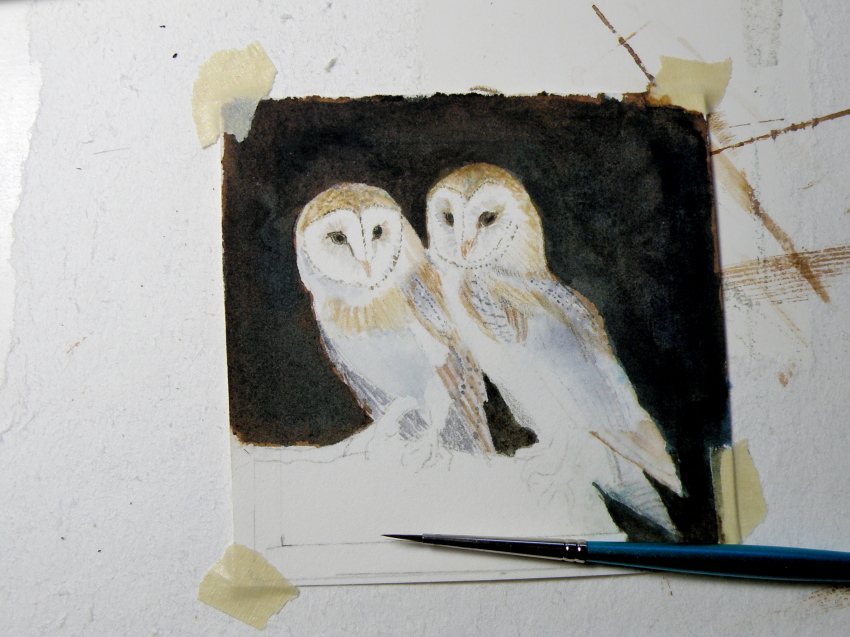
Work in progress . . .
The finished piece–a birthday gift for my friend Shiela

“Barn Owls”, watercolour on Hot Press Arches 140 lb. Paper
image: 2.5″ x 2.5″
framed size: 4″ x 4″
Thank you for your patience and support. I’ll be seeing my doctor soon, and hopefully we’ll get to the cause of the problem.
Teeny Weeny
March 11, 2012
These two frames were recently given to me by my friend Shiela, and truly are the smallest I’ve ever come across. Measuring 1.5″ x 1.5″, or 3.5cm x 3.5cm, the paintings themselves had to be 1″ x 1″ or 2.5 cm x 2.5 cm in order to fit within the glass.

I used as subjects, birds based on the photographs of Cornel Apostol at http://apostolcornel.wordpress.com, who has introduced me to species we don’t have here, but ones he has at his feeders in Romania. I believe the first one is a Chaffinch or ‘fringilla coeleb’ and the one on the right is a Great Tit, or ‘parus major’.
‘The Silt Bluffs II’
February 26, 2012
The landscape of Kamloops, British Columbia, (native word meaning ‘dividing of waters’–the Thompson River divides mid-city to create the North and South Thompson), varies remarkably.
Think of a city at 1132 ft. elevation with homes built in terraced-layers down one mountainside and up another, all finding bottom along the broad Thompson River which attracted the attention of The Hudson Bay Company in 1811. Since then Kamloops has become a train hub, a location for gold prospectors seeking their fortunes, and more recently a centre for the forest industry.
It is arid here. Summers are hot and dry, and rain is an event. Winters are cold, windy, with average amounts of snow, and a major spot for skiers and snowboarders at the highest elevations. When I walk the dog at 5 a.m., I always hear owls and sometimes coyotes, and occasionally spot a few deer searching for something in the yards below the mountain ridge we hug up against. I’ve also come across black bear in the car port, and seen the evidence of moose.
This painting is of what’s locally referred to as The Silt Bluffs. They feature hoodoos, free-standing rock formations caused by wind erosion.

'The Silt Bluffs', 5" x 7" Original and signed Watercolour on Arches Hot Press 140 lb. Paper, $100.00 black-matted & framed in gold
The most prevalent raptors in our area are the Red-Tailed Hawk, Golden and Bald Eagles, Osprey, and Turkey Vultures.
Little Bird Miniatures
January 29, 2012
My home, Kamloops, British Columbia, is one of the locations in North America where the Mountain Bluebird nests. They are stunningly blue–shockingly so, and are appreciated by birders the world over. A monogamous species, the Mountain Bluebird mates for life and prefer nesting boxes which local people here build especially for them.
Another favourite bird of mine is the American Goldfinch which is startlingly yellow and black in the Summer, but moults into a very modest olive green shade in the Winter. They are rampantly at our feeders these days, up to sixty at a time. They are acrobatic in their jostling for position and make me smile to watch them nudge one another off the perches.
There are many Ravens in our region which are larger than Crows and stir many feelings within me when I hear their calls.
Perhaps my most favourite bird in Winter is the Junco, because they appear to be timid (they don’t generally feed at the feeders, but prefer to pick at what’s on the ground) yet won’t be bossed around, especially by Goldfinches. I absolutely love their grey, white and brown feathers and their pert, quick ways.

Junco, Raven, Mountain Bluebird, Goldfinch Miniatures
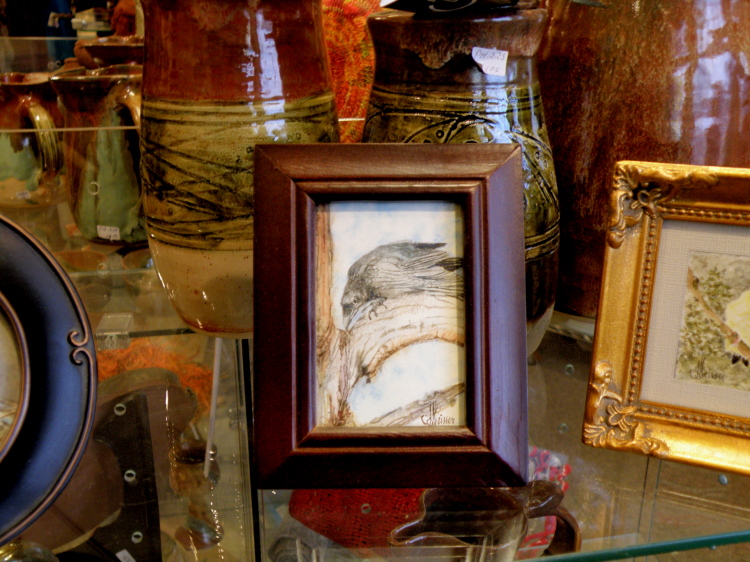
Raven Miniature (closeup)
I hope some of you will give some thought to framing some miniatures of your own. The two frames on the left were gleaned from flea markets, while the two frames on the right were imported from Italy. Of course, photos are equally pleasing in these tiny frames–and are perfect for Valentine’s Day. In case you’re wondering, I usually sell these at $25,00 each, depending on the quality of the frame and the length of time it took to paint the bird. That doesn’t make for huge profits, but it means being able to provide an original watercolour for not a whole lot of money.
A little ‘cheating’ . . .
January 25, 2012
Watercolour has its limitations and its unique requirements. About the biggest challenge is the understanding that anything white in a watercolour is the paper left blank. So white clouds are achieved by painting blue around them. Whitecapped waves are accomplished by painting the dark part of the wave and leaving the paper white for the crest. The same goes for snow, of course, and really anything at all that’s white.
The famous British painter, J. M. W. Turner (23 April 1775 – 19 December 1851) is widely regarded as the artist who took watercolour to its pinnacle–who forced it to be considered a serious medium, alongside oil (though even today watercolour is not treated with the same gravitas as oil). His work is nothing short of astonishing. And apparently he often achieved some of his whites by ripping at the paper with a long fingernail.
My training was such that the use of opaque white was absolutely forbidden. It was considered a breaking of the most important ‘rule’ of watercolour: that only the white of the paper (called ‘reserved white’) was acceptable in a pure, transparent watercolour.
I have, though, been talked into letting myself experiment with a limited usage of opaque white. A great many watercolourists use it, though sparingly.
The following picture was my first attempt at using a bit of opaque white in the branches of the trees. The clouds, grasses, snow, and other whites were achieved by reserved whites (leaving the paper blank) and/or scratching out with a knife (my fingernails aren’t nearly long enough).
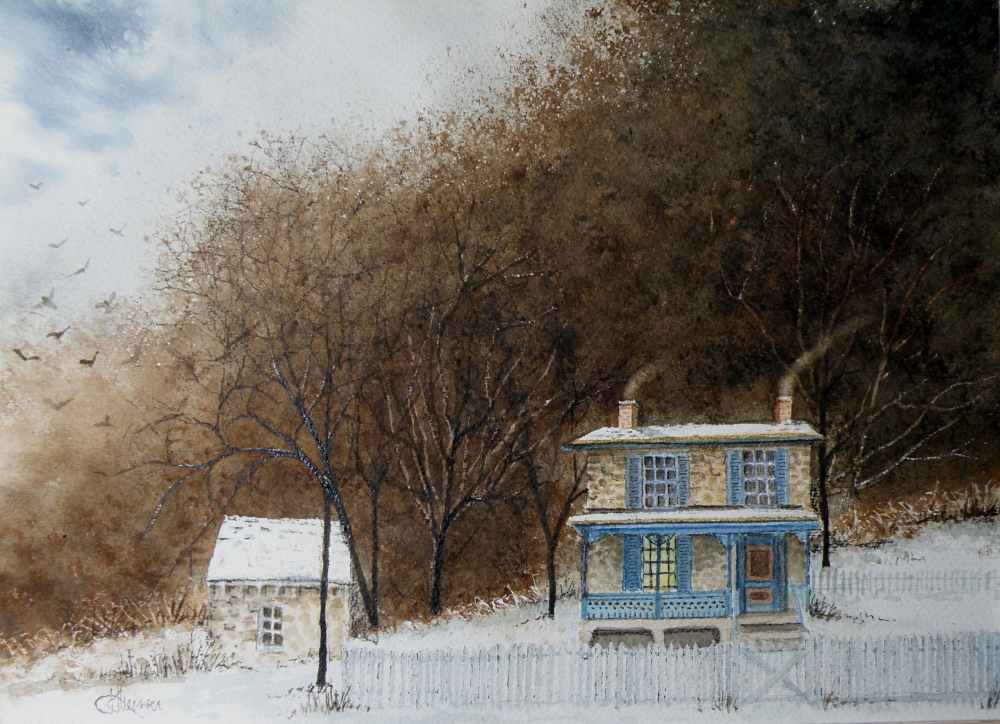
"Snug"
North American Robin (Turdus migratorius)
January 15, 2012
Pushing my cart into the supermarket yesterday I almost ran someone over. I’d jerked my head around to make sure I was seeing correctly–there in the middle of the aisle was a big fat display of this year’s new vegetable and flower seeds!
I mean to tell you, it is -10C, and snowing out there right now like it’s just going to keep on all night, and they want me to start planting seeds?
So okay–in the spirit of all that, raise your glass. Here’s to a touch of Spring . . .

"Juvenile North American Robin"
Miniature Watercolours
January 4, 2012
I usually spend my painting days alternating between very large watercolours and tiny, intimate pieces. The miniatures sell exceedingly well, for after all, even if collectors truly can’t fit yet another painting on their walls, there’s always room for a wee one on a table, desk or mantle.
It’s birds which often become my subject of choice because many species are small and lend themselves well to the petite oval frame, or tastefully-tiny square. It’s such a joy depicting the finches and juncos I glimpse just beyond our living room window, attacking the feeders, nudging each other aside in order to get at the goodies.

"a gathering of miniatures"
Here’s a close-up of a landscape based on our British Columbian, mountain-surrounded Interior:
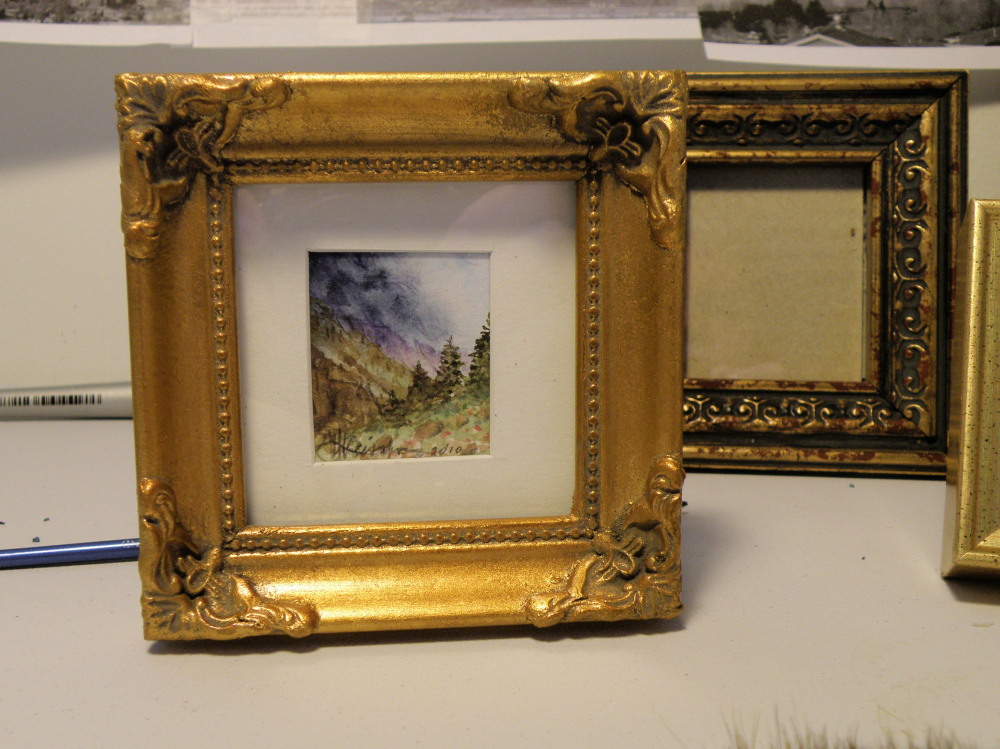
'A 1" x 2" Kamloops Alpine View'
 weisserwatercolours