Painting Progression 2
March 13, 2015
TREES are painted in very dark and the watercolour pigment tempered a bit in order to have it resist being completely taken away by an overlay of secondary wash.
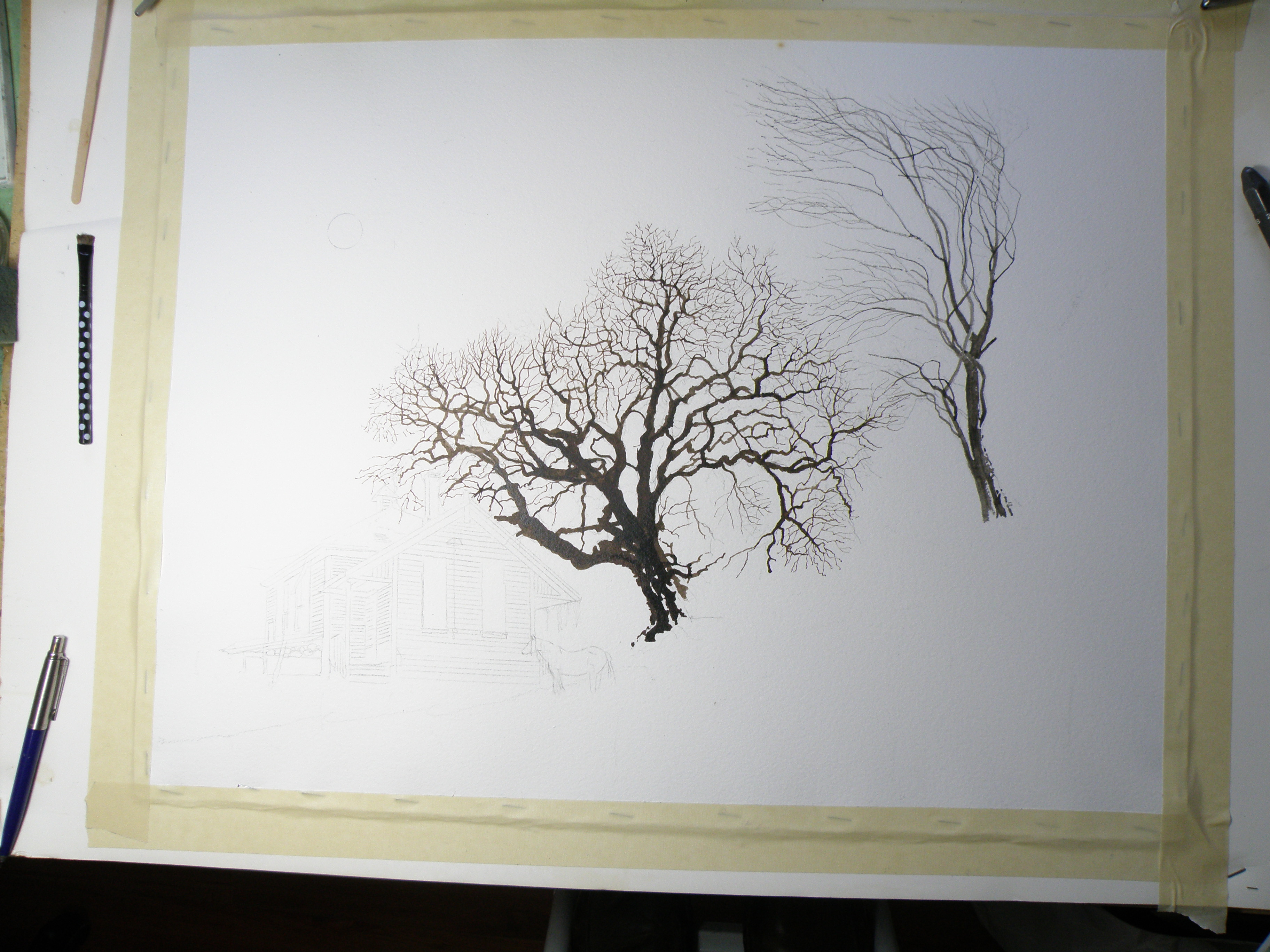
Painting Progression 1….
March 12, 2015
THERE WAS an old schoolhouse in the Township of Pritchard, British Columbia, just down the road from my friend Shiela. 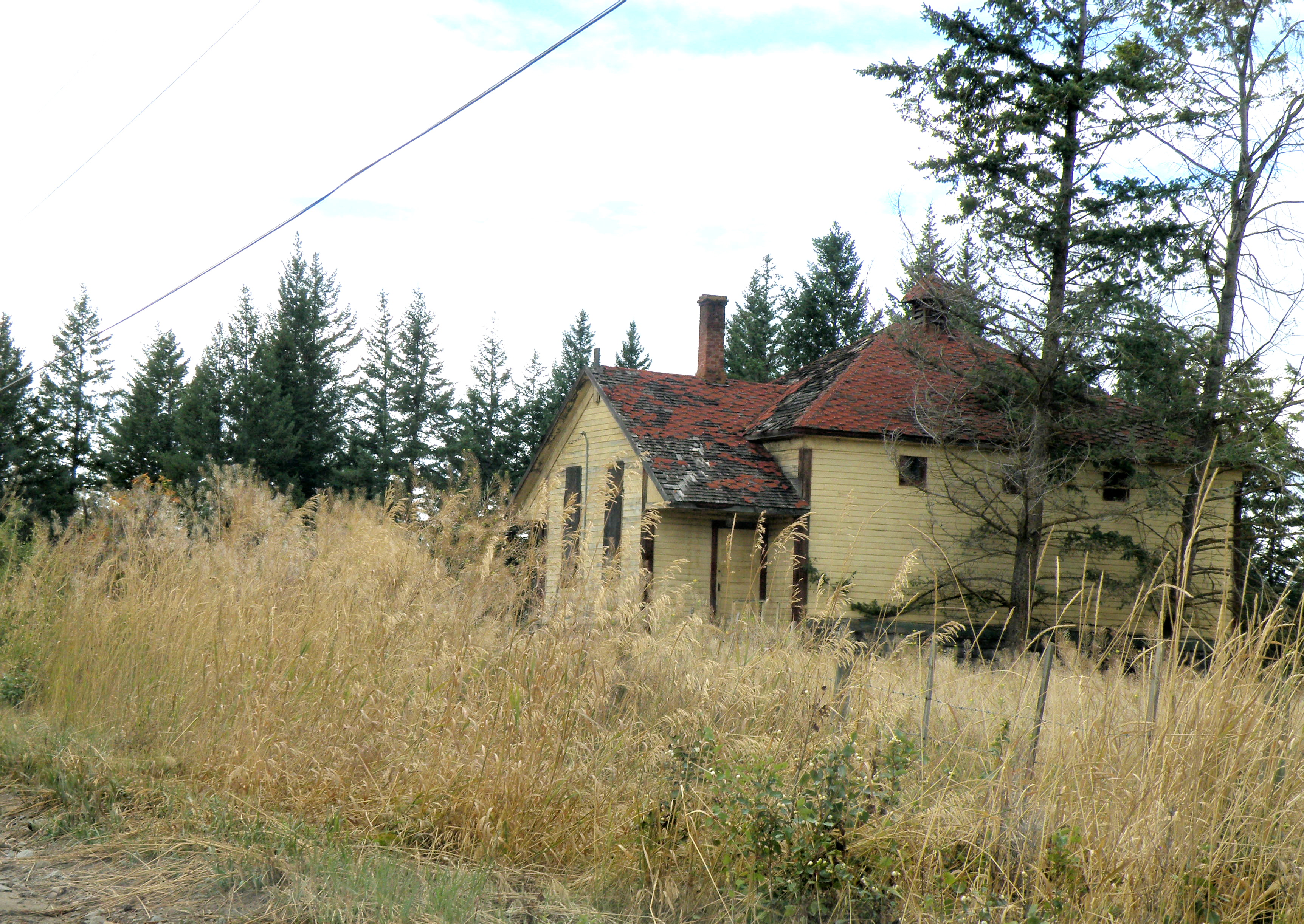 It was kept on a corner of field by a rancher who had attended it, hoping someday someone would see to its restoration. Eventually it was torn down, but not before I was able to photograph it. And I have painted it several times, choosing to situate it where I please….
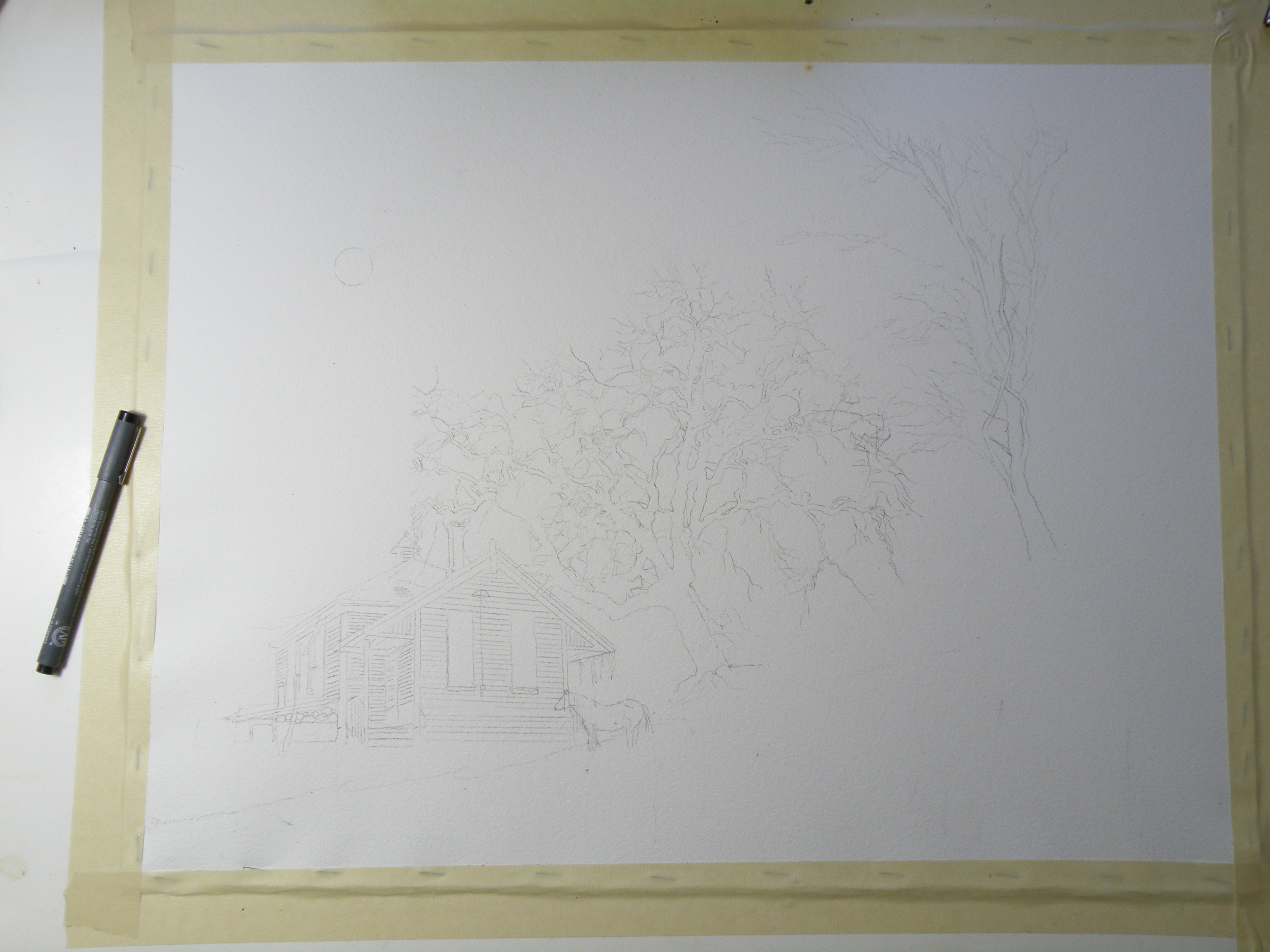
This is the initial drawing. Because the rancher kept horses, I decided to position one for sake of interest. The paper is Arches Cold Press 140 lb., stretched stapled and taped onto gater board, approx. 15 x 20 in.
New Painting
May 23, 2012
One more post before another Tylenol 3!
This painting is based on another photograph from the Irish Photographer Joseph Hogan (used for reference with permission). I have previously used his photography for the painting ‘Winter Barn’ (posted below). It is the second painting of it, as the first crashed and burned at the last minute when applying the wash of burnt umber for the shadow.
Like most watercolours, it had to be thoroughly thought out before beginning. It was deceptively difficult even though it looks rather a simple and straightforward subject.
Here is a preliminary look at it while in progress . . .
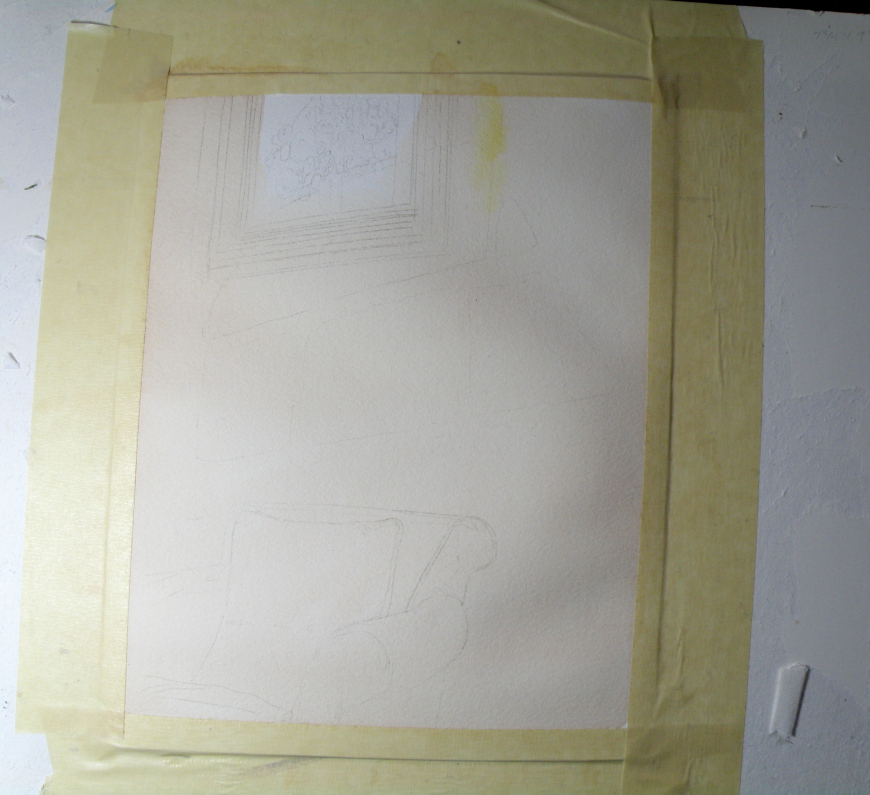
Initial wash of diluted Burnt Umber . . .

more detail added . . .
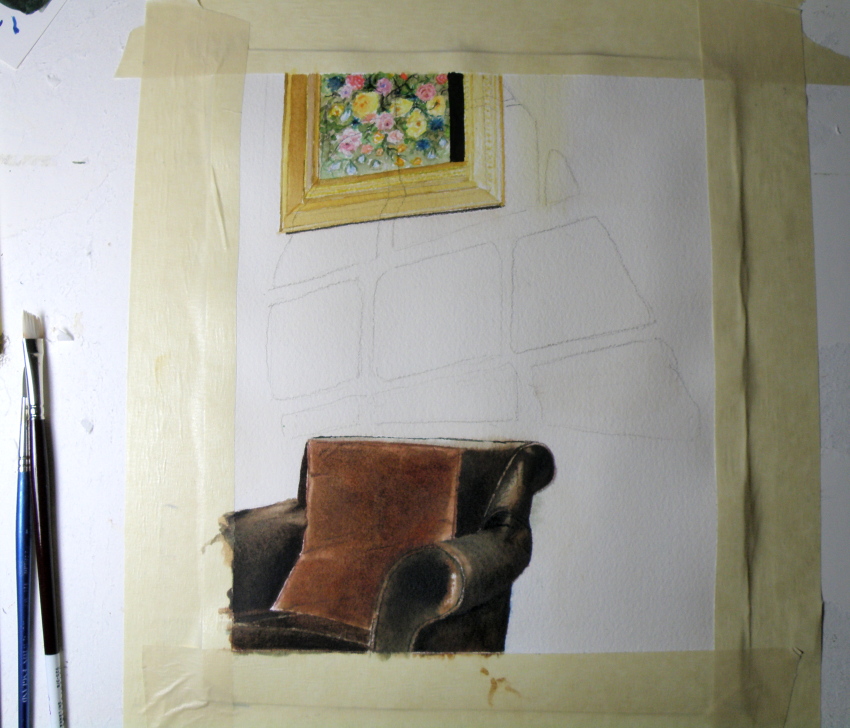
nearing completion . . .
The finished painting . . .

“Poppa’s Chair”
7.5″ x 10.5″ watercolour on 140 lb. Arches Cold Press Paper
It is a painting with a Father’s Day theme, now hanging in The Old Courthouse Gallery here in Kamloops, British Columbia.
Tylenol 3 here I come. . . .
Barn Owl Miniature
May 23, 2012
Whine Alert! I threw my back out and even my regular swimming routine isn’t helping restore things. It has been over a week and sitting at the computer only seems to aggravate it. Oddly, standing offers the most relief, so I’ve been painting.
My apologies for not leaving comments on my favourite sites. Even this just sitting here is causing shooting pains.
This pair of Barn Owls is from a photo on the BBC Website, without credits as to whom the photographer was/is. I’m in the process of offering compensation for my using the image as reference.
The Barn Owl (Tyto alba) is, oddly enough, common in a great many countries but not here in Canada. From Wikipedia: “. . . It is known by many other names, which may refer to the appearance, call, habitat or the eerie, silent flight: White Owl, Silver Owl, Demon Owl, Ghost Owl, Death Owl, Night Owl, Rat Owl, Church Owl, Cave Owl, Stone Owl, Monkey-faced Owl, Hissing Owl, Hobgoblin or Hobby Owl, Dobby Owl, White-breasted Owl, Golden Owl, Scritch Owl, Screech Owl, Straw Owl, Barnyard Owl and Delicate Owl. “Golden Owl” might also refer to the related Golden Masked Owl (T. aurantia). “Hissing Owl” and, particularly in the USA, “screech owl”, referring to the piercing calls of these birds. . . ”
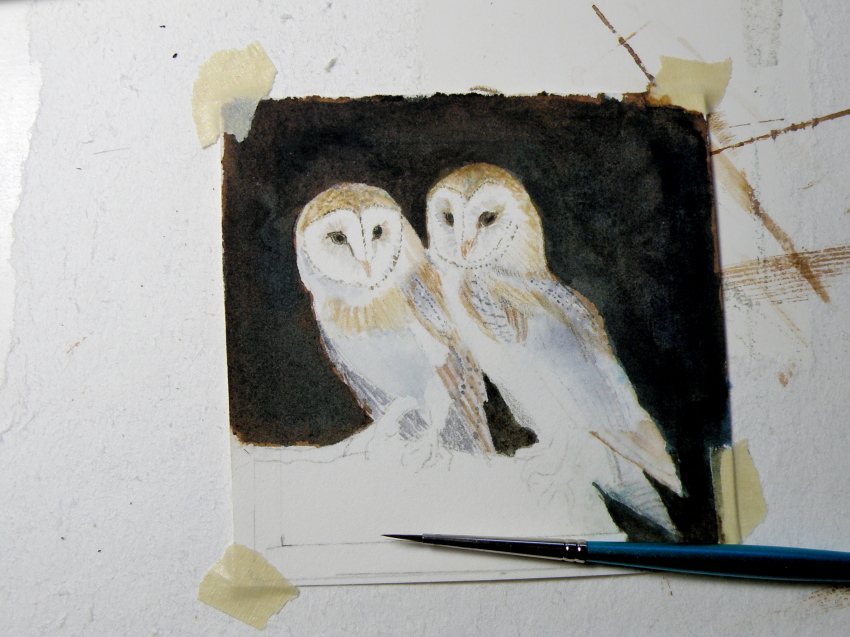
Work in progress . . .
The finished piece–a birthday gift for my friend Shiela

“Barn Owls”, watercolour on Hot Press Arches 140 lb. Paper
image: 2.5″ x 2.5″
framed size: 4″ x 4″
Thank you for your patience and support. I’ll be seeing my doctor soon, and hopefully we’ll get to the cause of the problem.
Jamieson Creek
May 6, 2012
This little painting (6″ x 7.5″) is of Jamieson Creek, which is not even ten minutes drive from our front door. This is a desert-like region, featuring its own local cacti (which I discovered by way of my hand), and is called The Sunshine Capital of Canada. Water, while not scarce, has usage restrictions and homes are now being installed with water meters.
So to have the Jamieson splashing over and around rocks and fallen timbers is a great joy. It is the epitome of the ‘laughing brook’ of literature, and compliments the broad, slow-moving Thompson Rivers which run through town. Were it not for our rivers, Kamloops would be uninhabitable. Right now the creek and rivers are swelling from the melt-off of mountain snows. Kamloops itself is some 4,000 ft in elevation, the mountain snows are up that much higher, and June is when the river level is at its peak.

“Up The Jamieson”, L & M Jones Collection
This painting was on the wall no longer than ten minutes before it was sold. My colleague in art, Lynda Jones, thought it complimented her pottery so well she went with her impulses. And that made my day.
Our Recent Show
May 5, 2012
It was an honour being asked by Lynda Jones to share her spotlight as Featured Artist at our Old Courthouse Gallery here in my city of Kamloops, British Columbia, Canada. Lynda is a potter whose studio is in Falkland, B. C.– a potter of ever-increasing recognition, most notably for her astonishingly beautiful smoke-fired pottery which can be seen in more detail here: http://www.okanaganpotters.ca/ljonesgallery.html.
Our Opening on May 1st came off well even though the wall socket we’d plugged the coffee and tea into was busted and we didn’t know until we were due to serve it. But once extension cords were found, a good time was had by all.
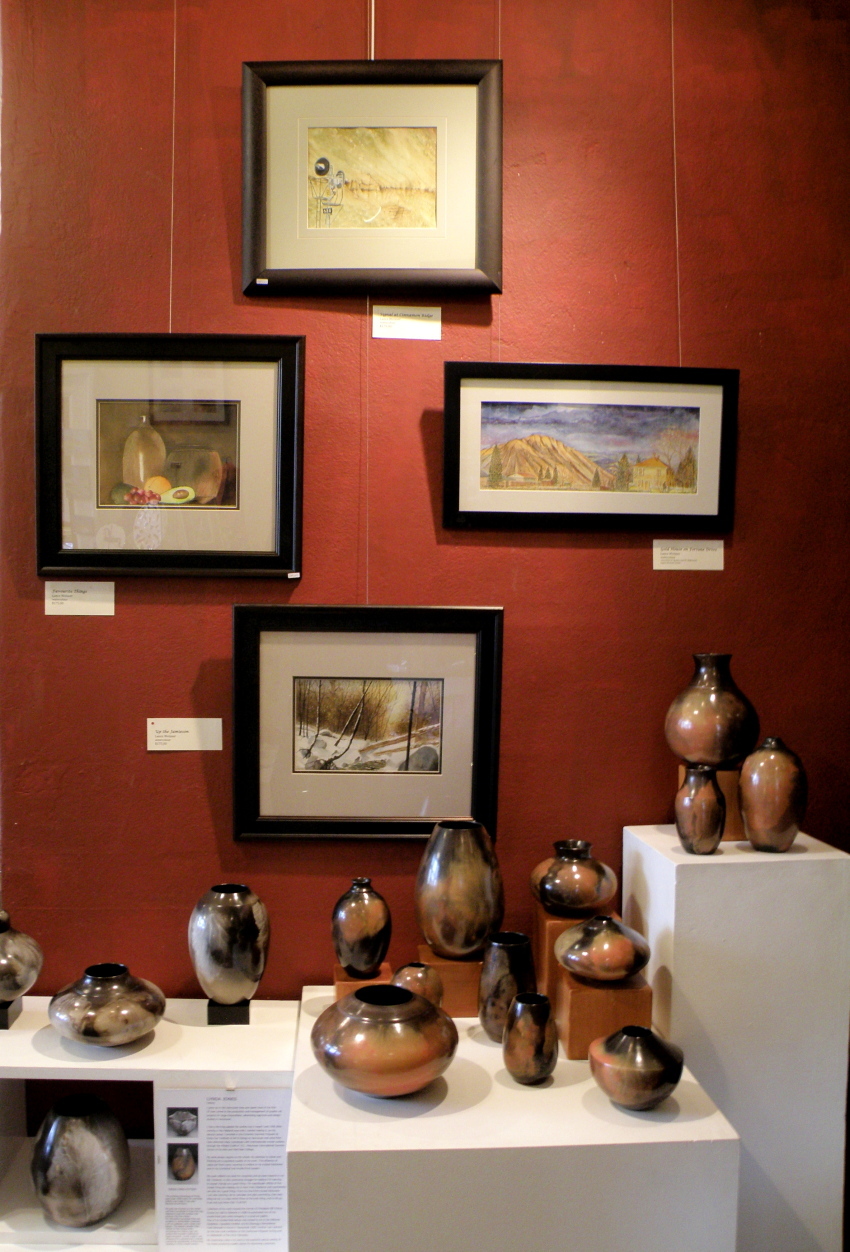
Lynda Jones and Lance Weisser, Featured Artists
Old Courthouse Gallery, Kamloops, B. C.
That same day, a quarterly magazine, ‘Currents’ published this very generous feature . . .
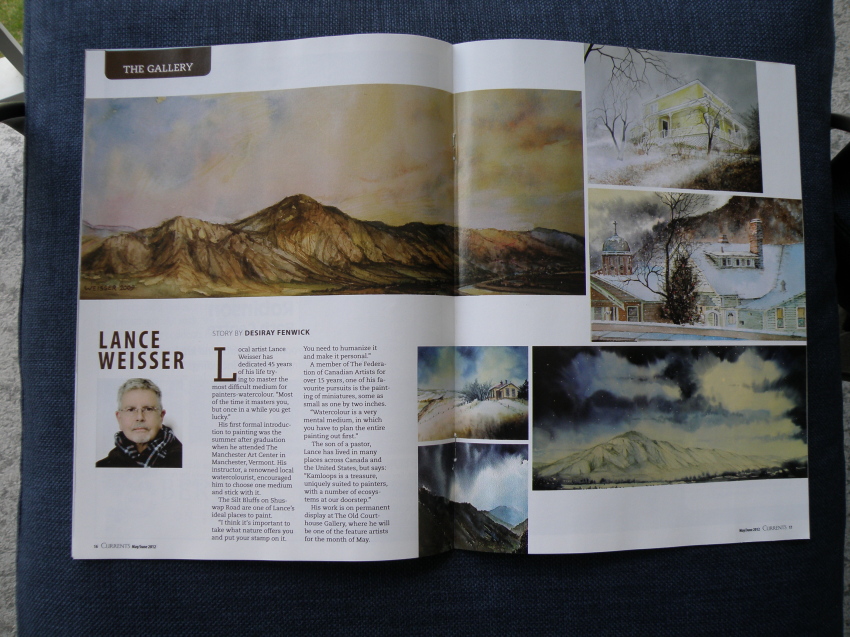
‘Currents Magazine’ May 1, 2012
Publicity like this is very helpful and makes it all the more necessary for me to remember that watercolour is my hobby, and a medium I struggle mightily with. All I can hope for is the chance to keep learning from my continual mistakes, while trying to improve in incremental steps.
Yesterday I was very happy to learn that the owner of the ‘Dr. M. S. Wade House’ (see ‘previous entries’ below) is very taken with my rendition of her home. She’s lived in it for more than 35 years and rues the day she’ll ever have to move out–but says if and when she does, she’ll now have my painting to bring back the memories. And as a painter, it just doesn’t get any better than that!
Local Cliffs, Finished Piece
April 25, 2012
D Day for me is May 1st. That is when Lynda Jones and I are teaming up to be The Featured Artists at The Old Courthouse Gallery here in Kamloops. Lynda is a rare and amazing potter who specializes in highly burnished smoke-fired pieces and counts among her collectors the former U. S. President Clinton.
Here is the fantastic poster she has designed:
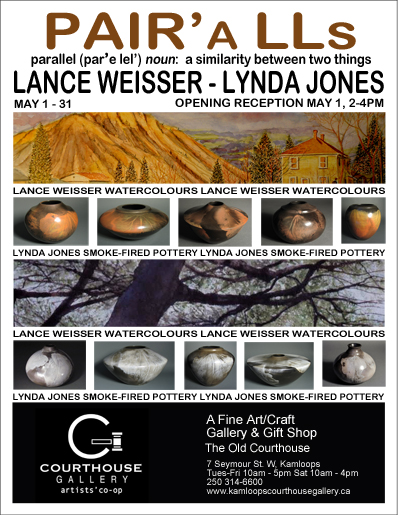
PAIR' A LLs E-POSTER MAY 2012 Courthouse Gallery
The Local Cliffs subject I’ve been doing studies of has finally been completed as a work I’m satisfied enough to allow to be matted and framed.

"Cinnamon Ridge Signal" 7.5" x 9", Arches 140 lb. Cold Press Paper
One thing I’ve learned through doing it, is that this small size of 7.5″ x 9″ is very pleasing for me. It is large enough to include a good amount of detailing, and small enough to get finished in a timely way.
And now it is on to getting painting #2 for the show done before our May 1st opening. Thank you for your previous comments which helped me in producing the final result!
Local Cliffs — Study I & II
April 15, 2012
About ten minutes from our house is ‘Cinnamon Ridge’. These are cliffs with very distinctive geologic caves and ‘hoodoos’ caused by wind erosion. Though not around at the time (I was but a gleam in my parents’ eye) 50 million years ago, the Kamloops region of British Columbia (from the Native word Tk’emlups–‘where rivers meet’) was the source of great volcanic activity, and formed the seafloor of the ancestral Pacific Ocean.
Not far from Cinnamon Ridge is a loose shale shelf where my friends go to collect fossils. These fossils indeed prove this area which is so very dry, was once water-covered.
I’ve now done two studies of Cinnamon Ridge (so named because of its rich colour). The first is a small watercolour sketch about 4″ x 8″
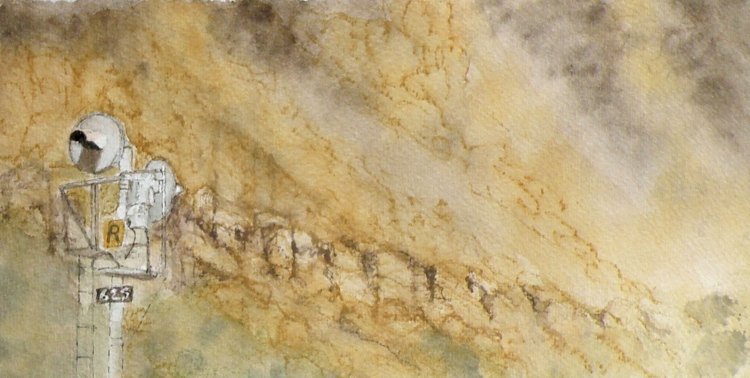
'Cinnamon Ridge' watercolour sketch
The second is a more detailed and focused piece around 8.5″ x 12″. It has some issues as far as values go (it’s a bit too light and lacking in contrast), as well as a composition issue having to do with the train signal being much too far to the left.
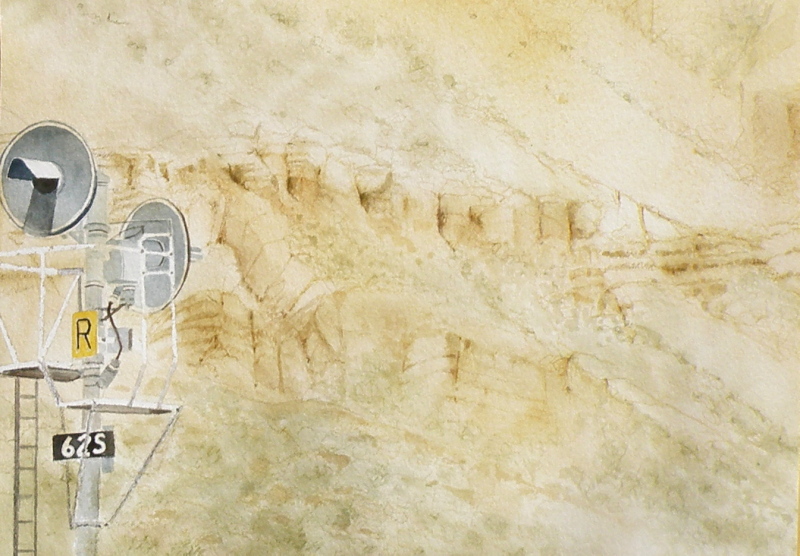
'Cinnamon Ridge' Study II
And here is the photo both studies are based on:
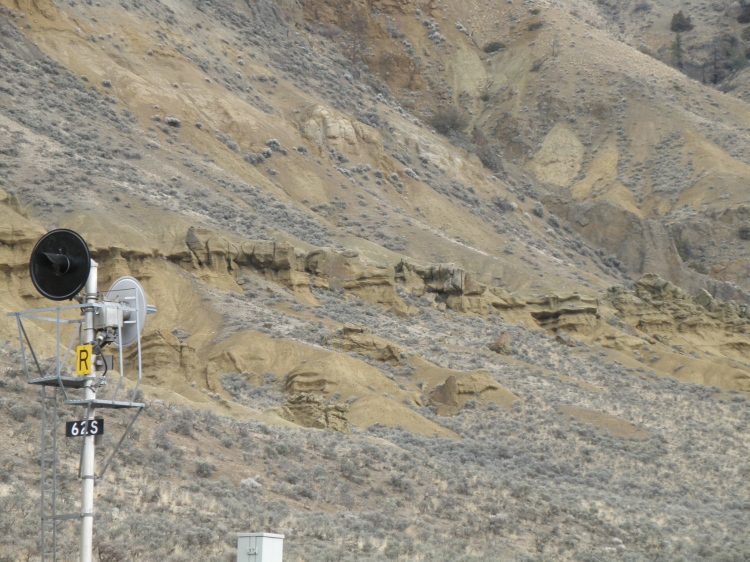
reference photo of Cinnamon Ridge
The final painting must be ready for hanging on May 1st. So I am now about to do Study III, which will hopefully end up graduating from being a study to being worthy of mat and frame.
Painting is much like cooking. Too little salt is as much a turn-off as too much. Getting things just right wasn’t just a problem for Goldilocks.
Horse Study Continued ….
March 28, 2012
[I apologize to my blogging friends for falling behind in viewing your many entries. There have been a number of deadlines I’ve been facing, and now I feel somewhat negligent in posting and commenting.]
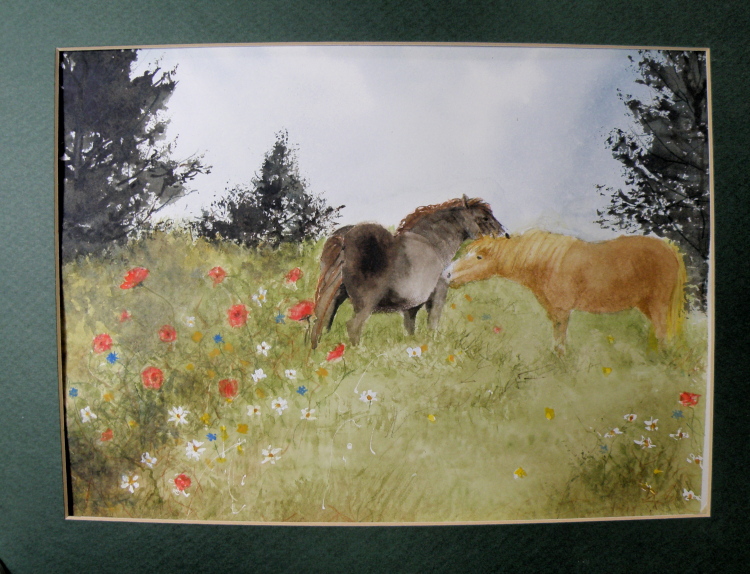
In continuing to try and improve on my initial study of a pair of horses, I have placed them in a more complex setting.
Icelandic Horses "Odur" and "Lettir"
I am somewhat more satisfied with this result, and have been learning a great deal in the process. This is Arches Hot Press Paper which is has a very smooth surface and is slightly creamy in tone. It has the qualities of illustration board. The demand on the painter with Hot Press is the need to lay the initial wash down with the hope of not going back into it, or back over it. Because there’s no ‘tooth’ to the paper, the paint floats on the surface before finally being absorbed.
Although the flaws of this scream out at me, the reason watercolour is considered the most demanding of painting mediums is simply because trying to correct the flaws will result in outright catastrophe.
All I can hope for is renewed confidence and another attempt. However, I remain pleased with the composition, if not some of the particulars.
My painting mentor taught me to adhere to the “20 to 1 principle”–‘for every painting you keep, throw out 19’.
Horse study . . .
March 18, 2012
I have been endeavouring to paint a fondly-loved pair of horses for a friend of mine. Were I to choose my own equine subject matter, I would likely have preferred more than two, or where they weren’t quite so front and centre. I have painted horses before, but lack confidence due to not being raised around them. I lack fundamental knowledge of what they are like, i.e. horse sense (groan).

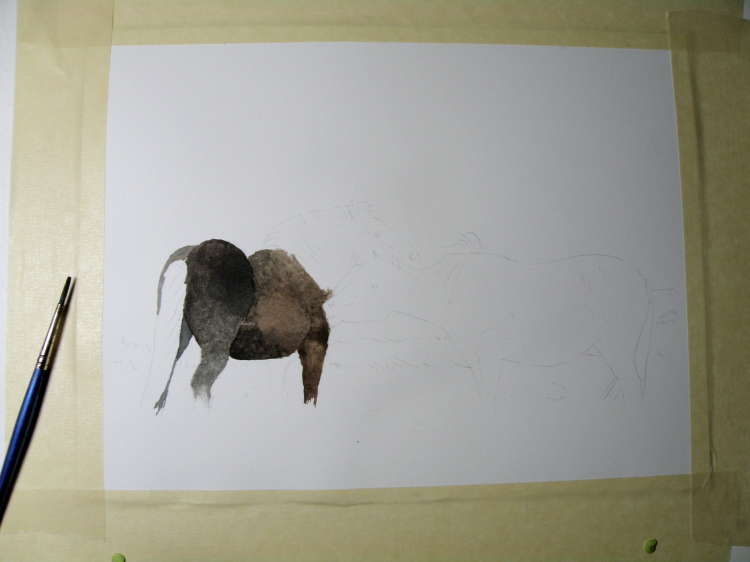
Starting from behind . . .

"Odur" nears completion . . .
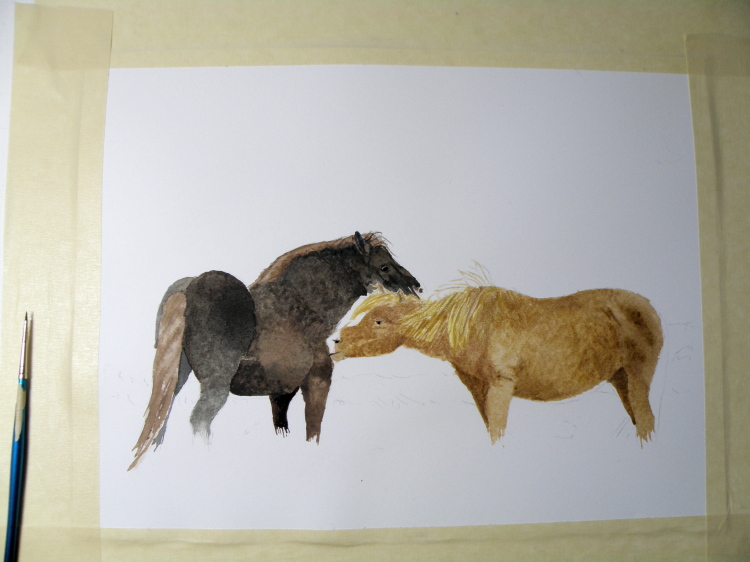
"Lettir" joins "Odur"

wash of sky is dropped in with a few strokes . . .
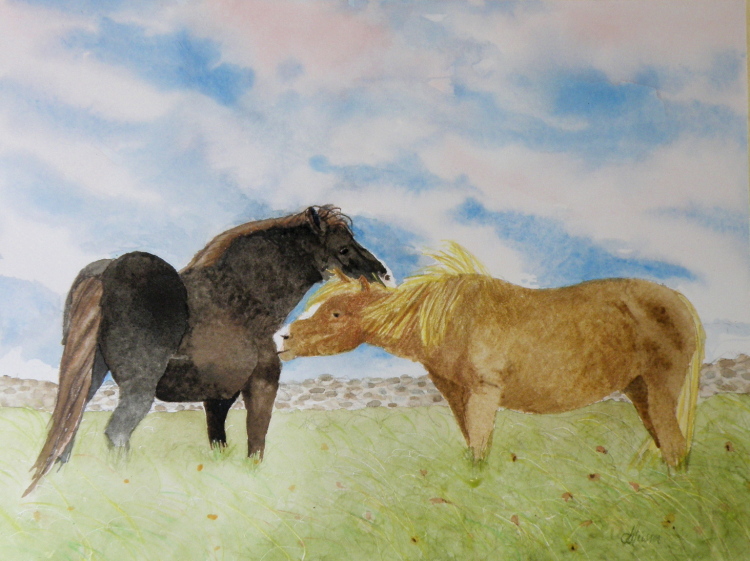
"Odur" and "Lettir"
The horses aren’t too bad, but the sky is too blue, and the field too green. I am also not thrilled I added the stone wall, as it cuts a swath right through the middle. So . . . back to the proverbial drawing board. I will keep you posted, and provide the next instalment.
Teeny Weeny
March 11, 2012
These two frames were recently given to me by my friend Shiela, and truly are the smallest I’ve ever come across. Measuring 1.5″ x 1.5″, or 3.5cm x 3.5cm, the paintings themselves had to be 1″ x 1″ or 2.5 cm x 2.5 cm in order to fit within the glass.

I used as subjects, birds based on the photographs of Cornel Apostol at http://apostolcornel.wordpress.com, who has introduced me to species we don’t have here, but ones he has at his feeders in Romania. I believe the first one is a Chaffinch or ‘fringilla coeleb’ and the one on the right is a Great Tit, or ‘parus major’.
‘The Silt Bluffs II’
February 26, 2012
The landscape of Kamloops, British Columbia, (native word meaning ‘dividing of waters’–the Thompson River divides mid-city to create the North and South Thompson), varies remarkably.
Think of a city at 1132 ft. elevation with homes built in terraced-layers down one mountainside and up another, all finding bottom along the broad Thompson River which attracted the attention of The Hudson Bay Company in 1811. Since then Kamloops has become a train hub, a location for gold prospectors seeking their fortunes, and more recently a centre for the forest industry.
It is arid here. Summers are hot and dry, and rain is an event. Winters are cold, windy, with average amounts of snow, and a major spot for skiers and snowboarders at the highest elevations. When I walk the dog at 5 a.m., I always hear owls and sometimes coyotes, and occasionally spot a few deer searching for something in the yards below the mountain ridge we hug up against. I’ve also come across black bear in the car port, and seen the evidence of moose.
This painting is of what’s locally referred to as The Silt Bluffs. They feature hoodoos, free-standing rock formations caused by wind erosion.

'The Silt Bluffs', 5" x 7" Original and signed Watercolour on Arches Hot Press 140 lb. Paper, $100.00 black-matted & framed in gold
The most prevalent raptors in our area are the Red-Tailed Hawk, Golden and Bald Eagles, Osprey, and Turkey Vultures.
Winter Horses
February 1, 2012
The Old Schoolhouse in Pritchard on Duck Range Road was torn down last summer. It was in a farmer’s field–a farmer who’d gone to it as a child–and though he wanted to see it restored and taken over by the community, no one stepped forward to do so.
For years his horses used the school yard as their private pasture. Rain or shine–snow or sleet–anyone driving by would see them, the pair of steeds only momentarily looking up before resuming their grazing.
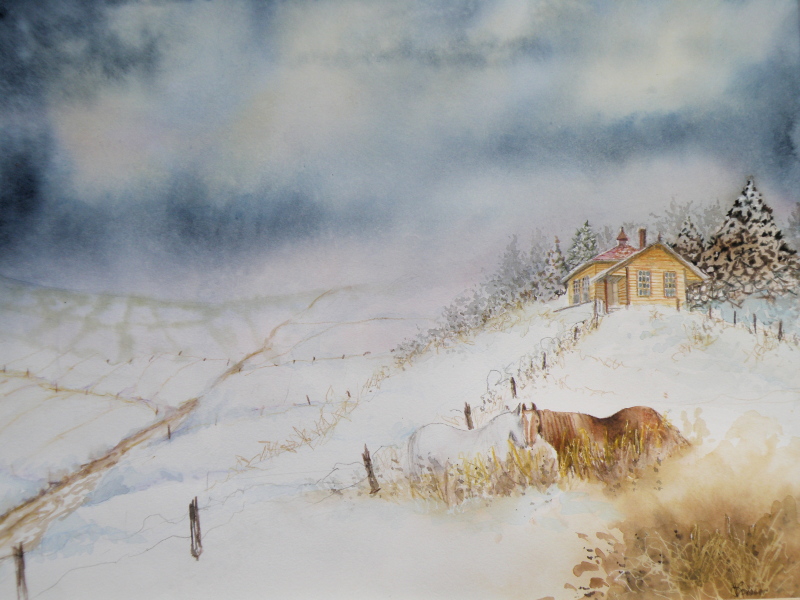
"School Yard Pasture"
Finally, after numerous appeals to various groups to assume responsibility for the Old School, the farmer reluctantly went about making sure it didn’t collapse and possibly cause an accident. Someone told me it only took a couple of hours for it to be reduced to a pile of boards and beams. If one drives by now, the only thing left standing are the horses.
Fort House
January 3, 2012
Kamloops (a native word meaning ‘the joining of two rivers’) has evolved from an c1812 outpost of The Hudson’s Bay Company and an early Railroad and Gold Rush centre into the largest city in the Thompson-Nicola Region of British Columbia’s Interior.
One of our most distinctive houses situated near the North Thompson River, was built in 1907 for a farmer, Archie Davis, who had purchased land originally belonging to Fort Kamloops. It sits at the corner of Fortune Drive and Fort Avenue, and is simply referred to as ‘Fort House’. No longer in the Davis family, its acreage has been reduced to a lot-sized yard, and its classic box design has been altered so that now it is a rooming house with various entries and stairs added.
Wanting to depict it as it once was, this painting imagines a moonlit night with one lone window indicating activity, perhaps Archie Davis preparing to get up–pre-dawn–to attend to his animals and daily chores. It was purchased almost as soon as it was displayed, by a young couple who have a fondness for this familiar Kamloops landmark.

"Up Late"
 weisserwatercolours