Summer’s Zenith
August 5, 2020
We’ve been sizzling here in British Columbia’s Southern Interior. For the past two weeks, it has been very hot and very dry. This is when all the dirt bikes get loaded on the back of country music-blaring pickups, heading for the hills, bypassing all the slower, fishing boat-toting pickups. And even those pickups bypass the even slower camper trailer-toting pickups, with everyone and their dog all heading out of Dodge.
What’s left behind are solitary scenes of empty pasture, sun-weathered farms, the occasional horse. And not a lick of shade.

We’re at the apex of Summer–the zenith–with a high today of 35C (95F). And tomorrow? Well, tomorrow marks the slow slide into September, with showers and a high of only 23C (73F).
So today we pretend we’re Texans, and tomorrow that old familiar tinge of an early Fall brings us all back to where we really are and love to be.
‘School’s Out’
April 9, 2018
Not far from our Kamloops, B. C., home is the village of Pritchard which used to have an original one room school occupying a corner of a farmer’s pasture–a school he himself reputedly attended as a boy–that no amount of seeking to have it lovingly restored bore any fruit with historical groups or municipalities.
Fearing its derelict floors and frame would be responsible for causing trespassing children accidental injury, he reluctantly tore it all down some five years or so ago. But fortunately I managed to capture its classic image with my camera while it was still part of this farmer’s horse paddock, and I’ve painted a series of watercolours using it as a focal point.
Since it no longer exists, I choose to place this old school in settings that depart rather dramatically from where it actually had been (on a rather non-descript flat field right beside Duck Range Rd).

‘School’s Out’, watercolour by Lance Weisser, 14″ x 16″
Arches Hot Press 140 lb. Paper, Sold
painting night
May 18, 2015
THERE IS A FASCINATION surrounding night, when all is cloaked in darkness and the earth dons a mysterious manteau.
WE SEE, and yet we don’t. Depicting night is a painting fascination because I personally do not have a firm visual anamnesis of what exactly night ‘looks like’.
FOR EXAMPLE, is the moon really white–or silvery? Or is it, rather, lemony–or perhaps, blue?
A NUMBER OF RENOWNED NORTH AMERICAN PAINTERS made the depiction of night their signature subject. Some, like the famous Western painter, Remington, chose to depict moonlight as a bit of each, including even at times, degrees of green….


IT IS SOMEWHAT OF A MYSTERY as to what our eyes truly see, in terms of chromaticity, when looking at night, and particularly, moonlight. Painting night offers an enjoyable challenge: convincing viewers that what has been painted corresponds to their personal, nightly experience.
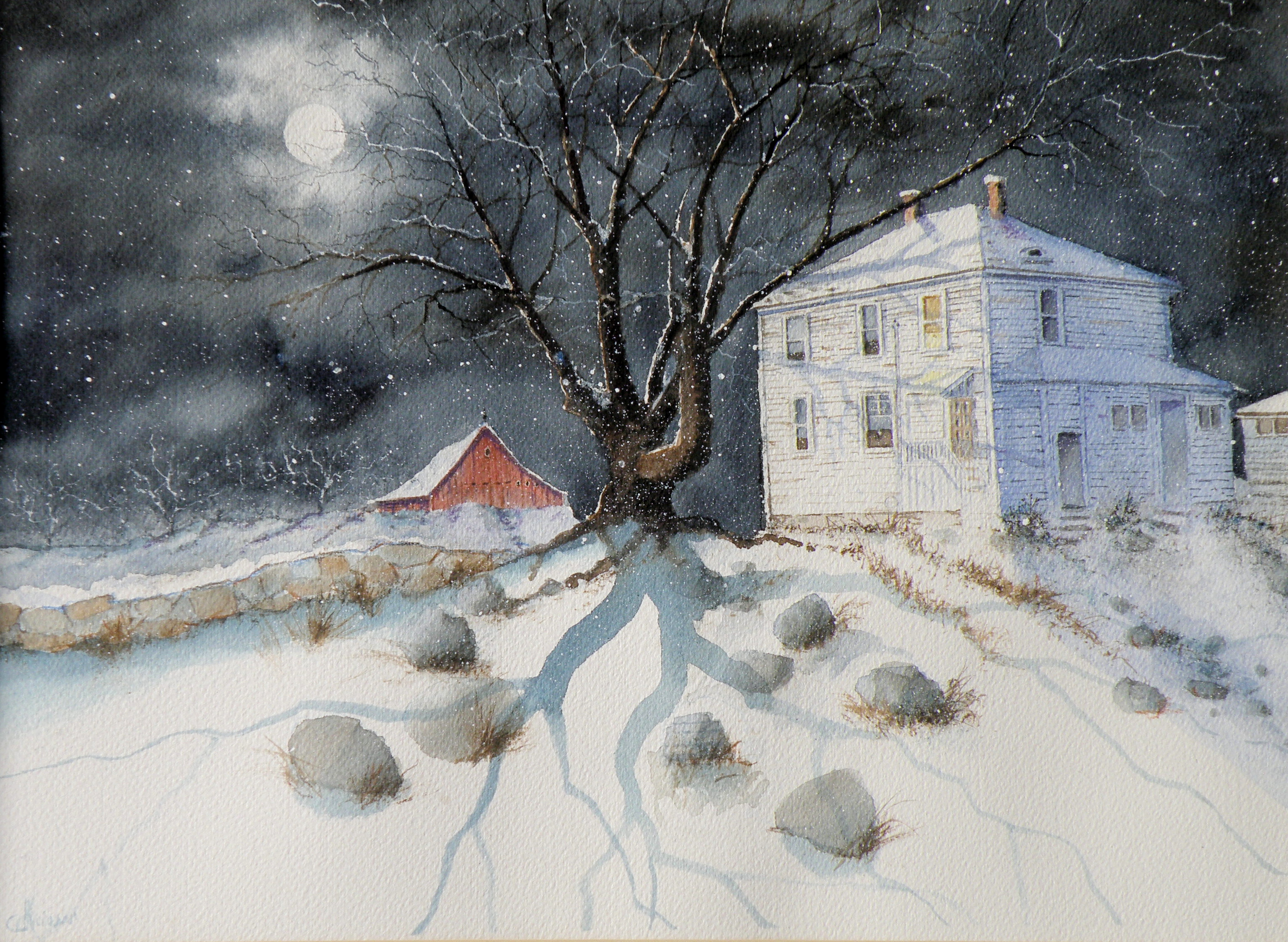
‘Up Late’, watercolour, Arches Hot Press Paper, “14×18”, (sold)
THIS IS ANOTHER heritage home in Kamloops, known locally as Fort House, because it was built on land originally used as a Fort by The Hudson Bay Company when Kamloops was established in 1812. At present, this early 20th century farmhouse is a rather rundown rooming house.
Same subject, different take…
March 17, 2015
THE OLD SCHOOLHOUSE is once again the subject……

THIS TIME around, a horse was to be included, which meant it could not be a nocturnal scene, as that would be an odd addition to a night painting. The choice was made to have only a single horse, even though horses are most often seen in pairs or groups, being a social animal…..
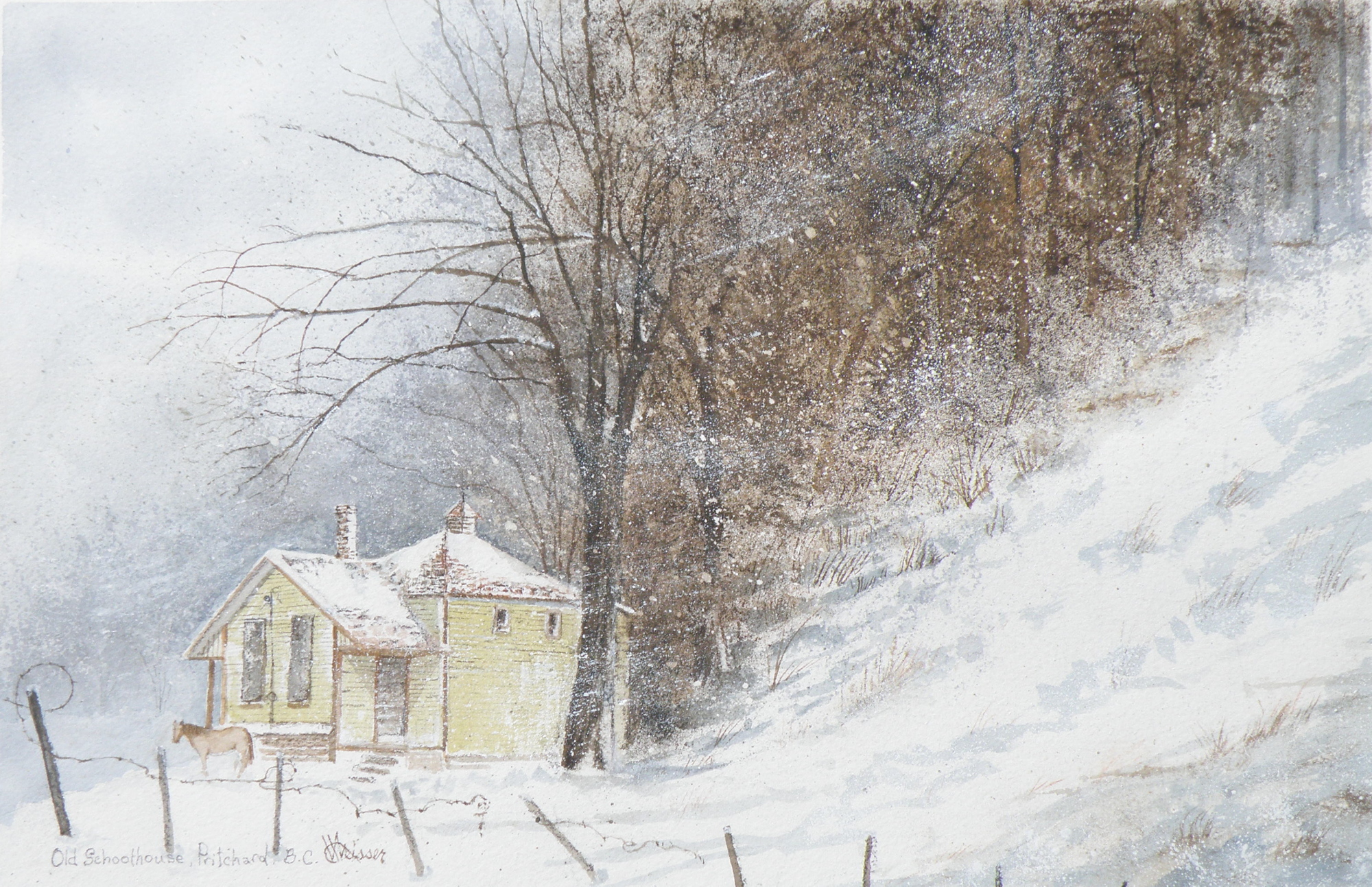
THE DECISION over depicting a single horse was selected as adding to the feeling of isolation: a lone horse beside an abandoned school in a lonely, forgotten field in the dead of winter……
“FROZEN IN TIME”
watercolour, 12″ x 15″, 140 lb. Arches Cold Press Paper, Kamloops Courthouse Gallery, Kamloops, British Columbia http://www.kamloopscourthousegallery.ca
Horse Study Continued ….
March 28, 2012
[I apologize to my blogging friends for falling behind in viewing your many entries. There have been a number of deadlines I’ve been facing, and now I feel somewhat negligent in posting and commenting.]
In continuing to try and improve on my initial study of a pair of horses, I have placed them in a more complex setting.
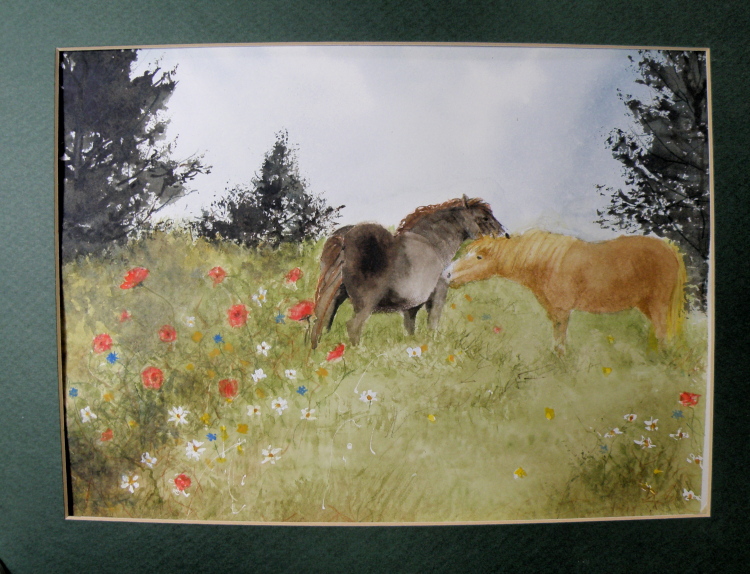
Icelandic Horses "Odur" and "Lettir"
I am somewhat more satisfied with this result, and have been learning a great deal in the process. This is Arches Hot Press Paper which is has a very smooth surface and is slightly creamy in tone. It has the qualities of illustration board. The demand on the painter with Hot Press is the need to lay the initial wash down with the hope of not going back into it, or back over it. Because there’s no ‘tooth’ to the paper, the paint floats on the surface before finally being absorbed.
Although the flaws of this scream out at me, the reason watercolour is considered the most demanding of painting mediums is simply because trying to correct the flaws will result in outright catastrophe.
All I can hope for is renewed confidence and another attempt. However, I remain pleased with the composition, if not some of the particulars.
My painting mentor taught me to adhere to the “20 to 1 principle”–‘for every painting you keep, throw out 19’.
Horse study . . .
March 18, 2012
I have been endeavouring to paint a fondly-loved pair of horses for a friend of mine. Were I to choose my own equine subject matter, I would likely have preferred more than two, or where they weren’t quite so front and centre. I have painted horses before, but lack confidence due to not being raised around them. I lack fundamental knowledge of what they are like, i.e. horse sense (groan).

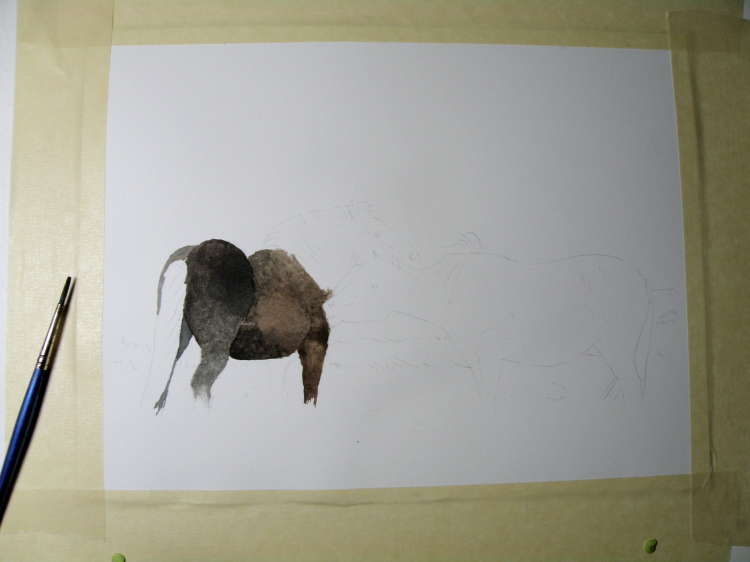
Starting from behind . . .

"Odur" nears completion . . .
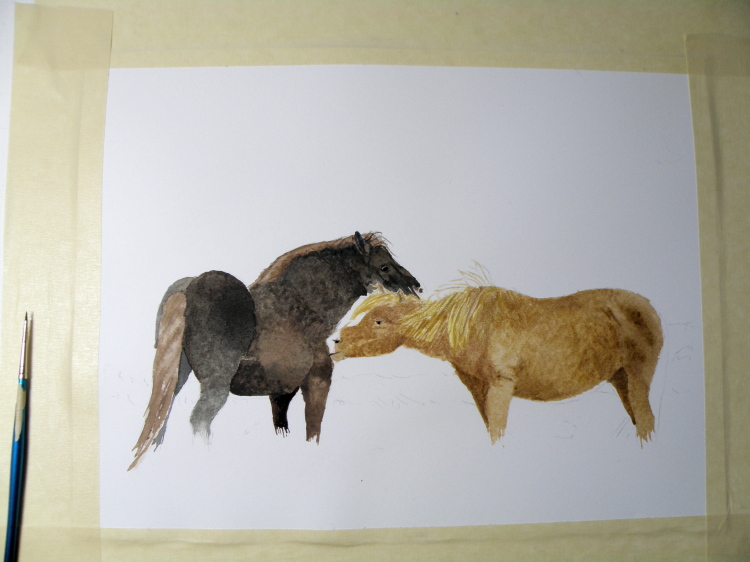
"Lettir" joins "Odur"

wash of sky is dropped in with a few strokes . . .
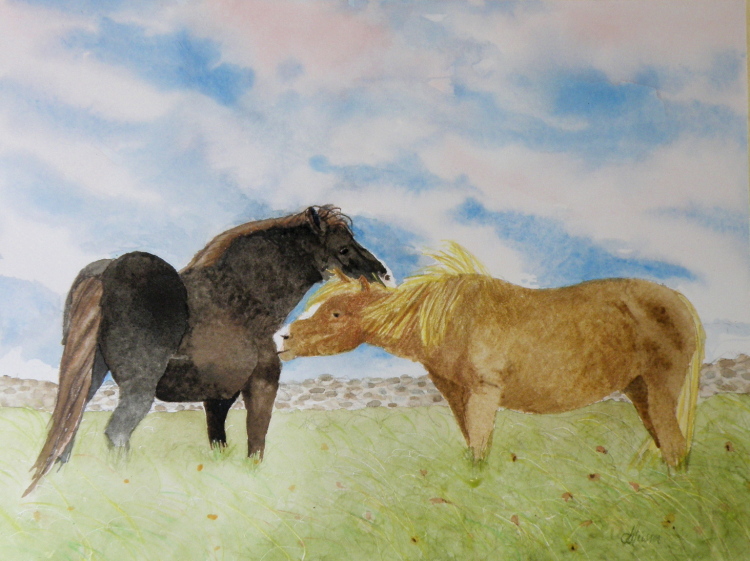
"Odur" and "Lettir"
The horses aren’t too bad, but the sky is too blue, and the field too green. I am also not thrilled I added the stone wall, as it cuts a swath right through the middle. So . . . back to the proverbial drawing board. I will keep you posted, and provide the next instalment.
Winter Horses
February 1, 2012
The Old Schoolhouse in Pritchard on Duck Range Road was torn down last summer. It was in a farmer’s field–a farmer who’d gone to it as a child–and though he wanted to see it restored and taken over by the community, no one stepped forward to do so.
For years his horses used the school yard as their private pasture. Rain or shine–snow or sleet–anyone driving by would see them, the pair of steeds only momentarily looking up before resuming their grazing.
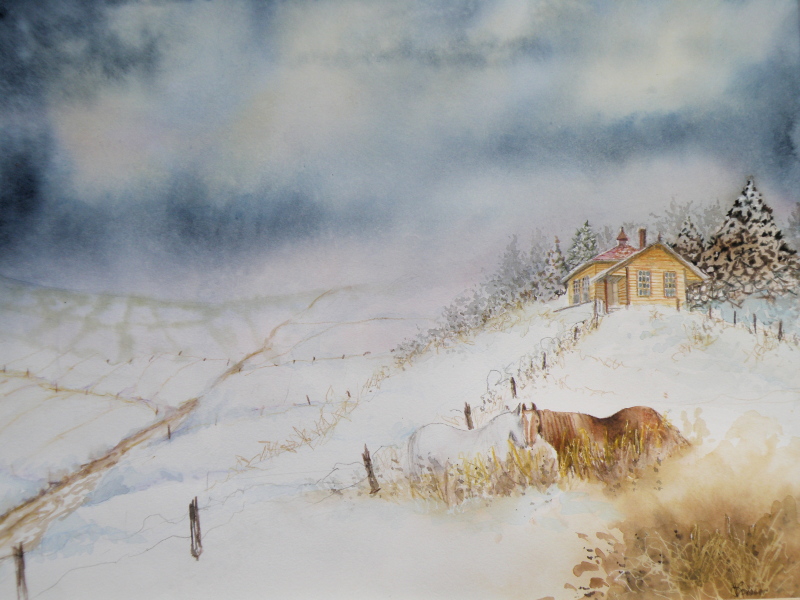
"School Yard Pasture"
Finally, after numerous appeals to various groups to assume responsibility for the Old School, the farmer reluctantly went about making sure it didn’t collapse and possibly cause an accident. Someone told me it only took a couple of hours for it to be reduced to a pile of boards and beams. If one drives by now, the only thing left standing are the horses.
High Country
January 9, 2012
Within the Kamloops city limits lies The Lac du Bois Grasslands Protected Area, dedicated to preserving native grasslands and the sweeping vistas of this special region. Old time ranching and a culture of horses and cattle survives.
This is a region of British Columbia with wide open spaces, with sagebrush and cactus and Ponderosa Pines. It’s a land of Eagles, Hawks, Owls and Ospreys. Through it winds the North and South Thompson Rivers and above their winding, watery ribbons is high country.

'High Country"
 weisserwatercolours